I started writing this blog, first entitled Londoner’s Musings, then Scribe Doll’s Musings, back in February 2011 because blogs were all the rage, it was Valentine’s Day and I was single with nothing to do, and in order to vent a series of frustrations related to modern English language usage (e.g. Words and Civilisation: Coffee) and a few examples of social double-standards in vogue at the time. Eventually, this blog developed into an eclectic collection of bits and bobs, from travel impressions to family stories, from eulogising over fountain pens to describing the huge, shapeshifting East Anglian skies.
For eleven years, this blog has been for me an oasis of self-expression and, more often that not, a rare, precious opportunity to spend a few hours scribbling during a week otherwise consumed by work. Moreover, it was unbridled scribbling, jotted down à la diable, trying to please only myself. Having real fun.
After eleven years, I have decided to wind up this odds-and-ends blog – and begin a new one that focuses on a specific theme. For the next few months, my Sunday blog will revolve around this one topic. Any posts on other subjects I may suddenly have the urge to write will appear on other days.
The new blog is intended as something joyful, bright, with a dusting of quirkiness. Something that may appeal to your senses. Something to make me smile as I write it and something which – I hope – you will find heartwarming. There is, more than ever, much need for warmth and smiles.
It will be a weekly or fortnightly helping of lightness and fluff. But then if birds’ feathers weren’t made of lightness and fluff, they wouldn’t be able to fly.
Thank you all for following me these eleven years. I hope you will keep Scribe Doll company on this new adventure.
Let go of the Old Year, gently, with respect – it has taught you much, and anything learnt is never wasted. Usher it out with thanks and an apology – for all you failed to learn, for all your mind could not grasp, your heart was too shy to accept, your pride too rigid to absorb.
Forgive the Old Year for all the scars it has left on you, and forgive yourself for the wounds you have not yet healed.
Let go of all the people who walk in greyness – there is enough darkness in the world already. Instead, stand where you can meet those who look to the sun, to the moon, to all that’s light and brilliance.
Let go of the friends who rush to hold you up when you’re falling but turn away when you’re rejoicing. Instead, cherish those who can cry with you, but also laugh with you, and who cheer at the top of their voices when you take a triumphant bow.
Above all, let go of the “yes – but” people. Cherish the “yes – yes – yes!” people: they are gems that catch the light and reflect it back at you.
Let go of “why?”s in favour of “why not?”s. If you cannot imagine you can do it, then at least forget that you can’t.
Let go of what weighs you down. Heaviness keeps you static. You can only fly with light wings.
Shake hands with the Old Year, and let it go. Then fling open all the windows and let the wind blow the New Year in.
***
Thank you to all those who have read my posts over the past year, and especially those who have taken the time to comment – reading your words in response to my own words makes my writing worthwhile.
I wish you all a happy, fruitful 2023 filled with possibilities and blessings.
The light is draining from the sky. The sun has withdrawn without pomp. This is not an evening for lavish displays. The night must cast its cloak over the horizon soon, so that the magic may take place.
There is haste in the beating of birds’ wings as they dart to take shelter on tree branches or huddle on roof tiles. Not a needle is stirring on the pine trees outside the house. Even the wind is holding its breath.
It is the moment after your eyes have stopped making out forms distinctly and before your ears are fully tuned. The moment when another, unnamed sense tells you that, in this stillness, everything is breathing, quivering, spinning, singing in a close harmony of colours and textures.
This sense halfway between sight and hearing tells me that the conkers I planted into a pot of compost a couple of months ago are starting to wriggle in the moist, dark earth, the embryonic horse chestnut trees inside them ready to crack open the hard skin and sprout roots. It assures me that the acorns in another pot are also growing impatient to push forth and surface to the light. And that the slender rowan tree saplings secured to bamboo sticks dream of yielding berries and inspiring poets.
I walk out onto the balcony and the chilly stillness wraps around me softly. What are you doing outdoors? its embrace seems to say. Go back inside.
I lean over the railing and let my eyes wander across the wide expanse of thickening greyness. In the distance, a spot of yellow light pierces through the mist. It’s a window under a gable.
In this stillness so rich in presences, there is a feeling of protection and the quiet certainty that the approaching darkness is filled with happenings. With a heightened activity of entities and creatures outside the field of our perception.
Down below, I see something slinking across the driveway, slowly, gracefully. It’s a black cat. It stops, sits. It is now too dark for me to distinguish the details of its muzzle, but I can make out its yellow eyes, inquisitive and judging, boring into mine. Eyes that can see what mine cannot. What are you doing outdoors? they seem to say.
A gust of wind ruffles the tops of the balcony plants and I feel its cold breath on the back of my neck. Time to go inside, it whispers.
I turn and tiptoe back into the flat. I don’t know why I tiptoe, only that I suddenly feel like an intruder on my own balcony. I close the French windows and keep staring at the horizon that is gradually melting into a sea of purple-grey.
I try to hold onto my sense between sight and hearing for a little longer. I know it’s the key to accessing a world I yearn to enter. A world the cat with yellow eyes can drift into and out of at will. A world we humans relegated to illustrated books and childish imagination centuries ago. But my precious sense is undeveloped, untrained, so my commands have no authority over it.
I leave my study, go to the living room and plug in the Christmas tree lights. The reflection of a hundred gold-yellow eyes appears in the window pane. I approach it to pull the blind down and catch sight of two pellets of similarly gold-yellow light three floors down, at the foot of the maple tree outside our apartment block. The black cat has slinked around the building and is looking up at me. Keep practising, it seems to say. It’s certainly a world worth seeing.
The elderly mother of a close friend sends me nameday good wishes every 25th November, and I thank her for her attentiveness.
My mother once told me which Saint Catherine I had been dedicated to at birth, but I have forgotten. I never gave it much thought until, relatively recently, I realised that something did not quite make sense in this vague recollection. We weren’t Catholics and I was not christened as a child. So this was either a made-up childhood memory, a misunderstanding on my part, or a rare moment of religious piety in my mother’s firmly pantheistic spirituality. I cannot therefore imagine any circumstance in which I would have been in any way dedicated to a Church saint.
I find the character of Saint Catherine of Siena, whose feast falls in April, more appealing: a Doctor of the Church, an educated woman whose opinion was sought and respected by high (male) prelates at a time when most women became wives, nuns or whores with little or no choice afforded them in the matter. The few paintings of her, however – and I think of Tiepolo’s in particular – I find somewhat dull, if not sad: an ill-looking Dominican nun with eyes turned upwards and a despairing, long-suffering expression.
Pintoricchio
Saint Catherine of Alexandria with a Donor
probably about 1480-1500
Oil on wood, 56.5 x 38.1 cm
Bequeathed by Lt.-General Sir William George Moore, 1862
NG693
https://www.nationalgallery.org.uk/paintings/NG693
Paintings of Saint Catherine of Alexandria, on the other hand, are more suggestive and inspiring. My absolute favourite among them is by Il Pinturicchio, currently in storage at London’s National Gallery. A beautiful woman with a fresh complexion, wearing a dress of a stunning blue, and although she is holding a sword above a wheel – symbols of her gruesome martyrdom – in her right hand, there is a large leatherbound book with two clasps in her left. She looks down at the Donor who no doubt paid handsomely to be painted beside her in the Renaissance precursor to photobombing. There is a polite half-smile on her lips and an expression of mild benevolence on her face, although I sense a hint, a faint shade of weariness verging on boredom.
Another one, she seems to think.
The Donor, whoever he might be, is kneeling, his back very straight, like a little boy who knows he has been good and is claiming his reward with self-assurance. His hands, joined in prayer, are held forward to make room for the well-fed belly we glimpse under his severe robe. Interestingly, he stares straight ahead and not up at the holy woman whose blessing and intercession he presumably seeks.
Another one who asks, but does not listen, who searches, but does not look.
Catherine’s body is facing us, but not fully. Her right shoulder and hip are slightly further back, as though she is in the process of turning away, while her face is still oriented to her left, her eyes on the Donor standing on his knees, staring straight ahead, in perfect, quasi cardboard cut-out profile.
Another one who will continue heading in the same direction, without looking right or left, no matter what I say.
The folds in the fabric of her blue dress suggest that Catherine’s left knee is raised slightly. Is she lifting her foot to take her first step away from the Donor?
She holds the large, green leatherbound tome in her left hand, its front cover against her, so the man is unable to read the title. The spine, where the title may also be embossed, is concealed under her fiery-red shawl. The top of the book is under her left breast, near her heart.
Another one who would not understand, anyway. Another one in whose hands knowledge may become dangerous.
During some elementary theology meetings I attended, a few years ago, the participants were asked to choose a symbol to represent their faith. I picked the image of a book. Faith goes hand-in-hand with knowledge, I said. Knowledge nourishes faith.
We Christians are not people of the Book, the priest told me, and not just on one occasion. We are people of Faith, he said in a tone that brooked no contradiction.
“À la Sainte-Catherine, tout bois prend racine.” On the Feast of Saint Catherine, all wood takes root. I wish I could remember the name and face of the French teacher who told me this proverb at secondary school. The belief – based on experience, and so knowledge – is that this is the ideal time of year to take cuttings from trees and plant them. The autumn’s weather and temperature fluctuations have settled into a steadier rhythm, the frosts have not taken a hold yet, and, since the tree does not need the energy to produce new leaves or fruits yet, it can nurture and expand its roots. I am sorry I cannot remember which teacher said this to me, because it is one of the lessons that made the deepest and longest-lasting impression on me. The realisation that, in Northern European climates, while the land looks outwardly desolate and bare, deep down, in the darkness, it is busy creating, it is secretly pregnant with all the colours we will see in the spring. A piece of information that fascinates me to this day. The thought of all the miracles and magic that may thrive in a dimension most of us cannot perceive with our five senses. This knowledge gives me faith in many things.
And so as I am disappointed to discover from the National Gallery website that Pinturicchio’s painting is currently not on display, I consider ordering a print for my wall. If I continue to study this Saint Catherine, perhaps she will whisper more stories to me. Perhaps she will tell me what is really in the green leatherbound book she is holding against her heart.
By the time H. and I managed to tear ourselves away from work long enough to organise a much-needed holiday, all the hotels were booked up or too expensive. The fares had also gone up. So our plans to go to either France or Italy had to be reconsidered. We were determined to go abroad. We hadn’t been out of England since before the pandemic. Our ears were starved of other languages.
We were both exhausted, overworked and stale. We needed a different country, but, given the sweltering heat, didn’t want to spend yet another holiday sightseeing and socialising. “Where can we go that we already know?” I said. “Somewhere we like, that’s walkable, beautiful, where we can just be and recharge?”
“How about Bruges?” H. said.
We’d both been there a couple of times, together and separately, were familiar with the city layout, liked the atmosphere. And you don’t need to ask me twice if I want to go to Belgium, Flanders especially. I don’t care for the climate or the pale, half-hearted sky, but the architecture and the people more than make up for that.
“Shall we stay at that little hotel I told you about?” I said. “The one where I stayed in 2009?”
There was a double room available, reasonably priced, and the website suggested the hotel had changed ownership and decor. Its famous restaurant, however, remained untouched.
***
“You’re staying ten days…” the young man at reception says. Not quite a question but not a statement either.
“Yes.”
We’re handed keys and remote control for the air conditioning, and we drag our suitcases up the stairs. I am suddenly worried that I may have oversold the hotel to H. What if the room is dirty or smelly? Unlikely in Flanders, but you never know… And if so, it’ll be on my head for a whole ten days. Whatever happened to the time when you could check into a hotel without booking weeks ahead or committing yourself to a set number of nights, stay as long as you liked, then, once you decided to leave, go down to the reception desk the night before and just inform the receptionist that you’d be checking out the following morning?
Fortunately for us, the room is lovely, spotlessly clean, with the widest bed I’ve ever seen. Moreover, it’s on the same side of the building as my room in 2009, so has more or less the same view, with a lot of hazy, pastel sky.
Since H. and I both know the city quite well, our relationship with it is relaxed. Neither of us sees it through the eyes of the other, the way you do when one of you is the guide.
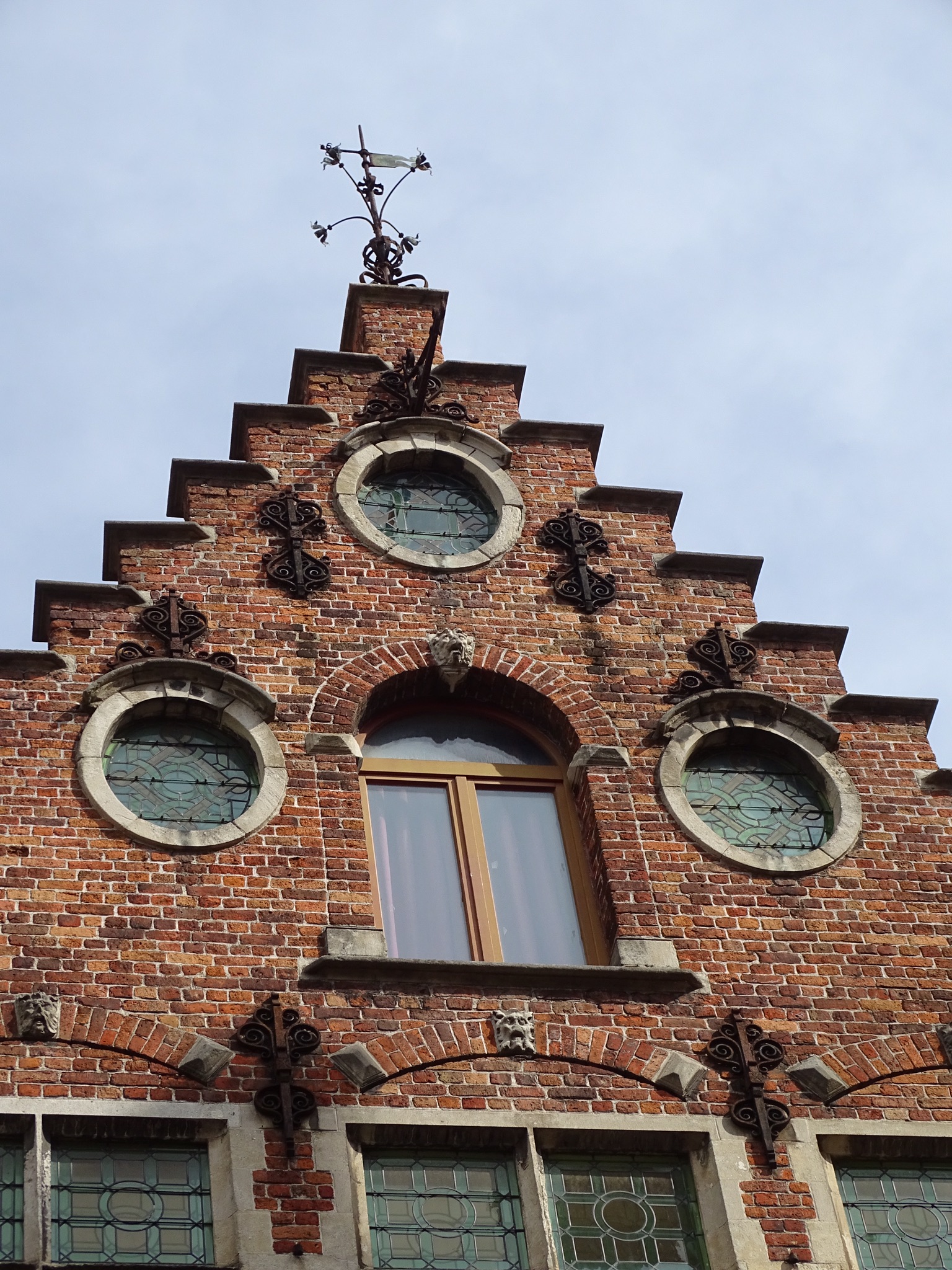
There is something special about becoming intimate with a city you love: as it learns to trust you, it reveals details you failed to notice during your first or second visit. And so one architectural detail leads to another, and you are guided down unfamiliar streets where you discover treasures that don’t feature in glossy tourist books: the mascaron with a grumpy woman that could be me on a Tuesday morning, once I’ve realised that, this week, too, I will fail to achieve everything on my to-do list. Above a brasserie, a terracotta man holding a something we can’t make out. A lantern? A bell? I focus the zoom lens of my camera on him. It’s a tankard of beer. Of course, what else? On top of a gable in Jan Van Eyckplein, a stone cat holds a fish in its mouth. And, on our way to Dammerport, I come across my own favourite discovery: in the distance, a weather vane, as beautiful as many other weather vanes in Brugge, but with a difference – I can’t tell what it represents, even through my zoom lens. Human figures, one holding a child, perhaps – the other one kneeling? – a cross, a spear. The next day, I go in search of the building on top of which it stands. It’s a church on the grounds of the College of Europe. Private property. I appeal to a resident walking her dog. “Please,” I say, “may I come in just for a few seconds to take a picture?” She lets me through the barrier. “What does it represent?” I ask, but she doesn’t know.
We dine in the hotel restaurant most evenings. The special is mussels cooked in white wine with celery, served with fries. I don’t like seafood, but these mussels are fresh and skillfully prepared. The fries are in a different league to the chips we’re accustomed to in the UK. They’re crisp, fried twice, and soft inside. We compliment the chef, who is the father of the Flemish family who now own the hotel. “You’re the guests who are staying with us ten days, right?” he says with a broad grin. “Thank you! I’m glad you enjoy our food.”
His wife and children are also very friendly and efficient. They all speak fluent English and French beside their native Flemish. I hear the mother converse in German with some guests. “How many languages do you speak?” I finally ask.
“I also speak Spanish. My Italian is only basic, but I can get by.”
I stare in admiration. In London, you’d be hard pressed to find hospitality staff who speak more than two foreign languages, unless it’s in a four or five-star hotel.
Once again, I find myself admiring Flemish resourcefulness and hard work. Before I ever came to Belgium, a British man who had spent several years here once told me, “These are people who have fought the sea for their land for centuries. The sea. That tells you how strong and determined they are.”
On our second day, when we return after a day out, we find our bed still unmade and the towels unchanged. We go downstairs and ask the elder son of the family when the rooms are cleaned. “This is a two-star hotel,” he explains, “so technically speaking, we don’t have to clean the rooms every day. Most people only stay one or two nights anyway, so it’s not a problem. But you’re staying with us for ten days. No one has ever stayed ten days, so we’re not sure how to operate.”
“Fine,” we say. “We’re sure we can work out a modus operandi among us all. Just let us know when you’ve decided what’s best for you.”
The towels are changed most days, we make the bed some days, they do it on others. One morning, a mosquito bite leaves a smear of blood on the pillow case. It’s unsightly, so I turn it over before we go out. By the time we come back, although the bedding hasn’t been changed, the pillow case with the blood stain has been replaced with a fresh one. Nice touch.
A trip to Brugge requires at least one meal at Cambrinus, on Philipstockstraat, the restaurant-brasserie named after the folklore character personifying beer. There, the beer list, which features a couple of hundred varieties, is listed in a heavy, leather-bound volume. White beers, blondes, dark, amber, and Trappist concoctions. We discovered Cambrinus on our first trip to Brugge together, in 2014. It’s where we first sampled the exclusive, astronomically expensive Vestvleteren, another nectar manufactured by Trappist monks (whatever one might feel towards the Church, we owe them much good art and good drink). Given the price, we shared a glass between us and sipped it slowly, savouring every mouthful. As far as I’m concerned, Vestvleteren is certainly overpriced, but not overrated. It’s delectable, cold beer in your mouth one moment, warm cognac caressing your oesophagus and stomach the next.
One morning a week, the hotel family take time off, so breakfast is served in a nearby café instead of the hotel restaurant. H. and I look at the menu and ask the waitress what we’re allowed to have. She smiles. “You’re the English people who are staying ten days, aren’t you? The owners of the hotels told us to serve you anything you like and as much as you like.”
“Do you suppose there’s a picture of us in the local paper?” I say to H.
When you become intimate with a city, its residents seem to sense it. They, too, start disclosing details normally unavailable to tourists. Seeing us take photos of the bas-reliefs on the Stadhuis in Burg, a young woman tells us that the figures of Adam and Eve have the faces of the sculptor who worked on the restoration of the sculptures after the bomb damage during the Second World War, and of his wife: apparently a small act of rebellion after the city failed to pay him his due. There, now you have to see my discontented face whenever you pass the building.
I strike up a conversation with a lady in a tapestry shop. She describes to me the Flemish character in a nutshell. “It’s all work, work, work, money, money, money in Flanders. No lunch break, just a sandwich, because you have to make money. In Wallonia, it’s: On prend un apéritif, ouais? Long lunch with wine, then dessert… and it’s time to go home.”
I ask if she is Flemish. “Yes. No. Yes, I was born in Flanders, but we’re all mixed, all part Walloon, part Flemish. We’re Belgians. None of us is 100% one or the other.”
I think of Brussels and its street names in both languages, of its mainly Francophone population and bon vivant attitude, and as usual, have to remind myself that Brussels is actually geographically in Flanders. Wonderful, eclectic, quirky, dirty, charming, lovable Bruxelles/Brussel.
“You’re staying with us ten days,” the lady of the house mentions one morning in the restaurant. “You can’t eat the same thing for breakfast every morning for ten days. I’m going to make scrambled eggs with smoked salmon. Would you like that?”
I accept with thanks. She is as good a cook as her husband. The eggs are creamy, the smoked salmon sliced wafer thin, the way I like it. There’s just the right amount of black pepper, enough to bring out the other flavours, but without drawing attention to itself.
On the Saturday, we go to Brussels for the day, to see some of the old sights again, visit the Saint-Gilles district, where we used to live, and have lunch with a couple of fellow translators. As we get off the train on the way back I feel I’m back home again and wonder if I would be happy living in Brugge. “You’ll go stark mad within a month,” H. says. “You’re always complaining about Norwich being too small.”
Good point. Perhaps special places are special precisely because they feel like home, but aren’t.
We come into our room to find a large, colourful bunch of flowers in a vase on the windowsill. Reds, purples, white and even a glorious sunflower, bright against the pastel sky. The next morning, I thank the lady of the house. I assume it was she who placed the flowers in our room. It’s the kind of thing a woman thinks of. “It’s market day on Saturday,” she says. “The flower man always brings a couple of bouquets and I thought you’d like one.” She doesn’t add because you’re staying ten days.
We tell her about Norwich, about the connection between our city and hers, thanks to the Flemish weavers and the cloth trade. We, too, have a few crow-stepped gables, and there is a church near Cringleford, with the weatherbeaten statue of what looks like a bear. I wonder if it’s the bear seen all over Brugge, a symbol of the city. The white bear killed by one of the Counts of Flanders in the Middle Ages.
On the eleventh day, the family offer us a lift to the station, but we prefer to walk. We want another look at the cobbled streets and the crow-stepped gables. I tell H. I want to come back. “Let’s make this our go-to place when we need a break and can’t travel far,” I suggest.
“We’ll stay at this hotel again, if they have vacancies,” H. replies. “Let’s write a glowing review on Tripadvisor when we get back.”
“Sure,” I say. “But let’s also send them a card from Norwich. A card with a picture of Elm Hill, with its medieval cobbles and gables.”
He agrees. Ten days. That calls for a handwritten card.
I felt at home there even as I wheeled my suitcase from the train station. The mid-August sun was setting behind the rooftops on Züdzandstraat, the crow-stepped gables that looked like stairways to the sky.
“I think there’s an error in your booking,” the hotel owner said in crystal-clear English, her finger on the open register. “It says here 16th to 21st.”
“That’s right.”
“Six nights?”
“Yes. Is there a problem?
She looked up at me, puzzled. “No problem. It’s just that nobody stays six nights in Bruges.”
I sighed. “I work all the hours God sends. I’m exhausted. It’s my first holiday in six years. I just want to be somewhere for a few days, get to know it, and just rest.”
I thought I saw something soften in her pale eyes. “I understand you. I’ve been running this business for years, then I was diagnosed with two ulcers and my staff told me they would leave unless I took a holiday.”
A wave of deep solidarity swept over me like the warmth from a hearth. Yes, I will be comfortable here, I thought.
I climbed the creaky stairs of the old, tall, narrow building, a smell of old timber filling my nostrils. This is the kind of place that could be a character in a story. My room was all white and blue, with a nautically-themed decor, a welcoming bed with crisp, white sheets that smelt of cleanliness, and a large window that took in a lot of sky. I could already see myself sitting by it, scribbling, gazing at the stars before going to sleep,
A reputable restaurant was attached to the hotel. Dark red walls covered in sepia portraits, bottles with dripping red candles, dimmed lighting, small, dark, glossy wood tables and chairs, polished to perfection.
“Goedenavond, spreekt u Engels?” I had memorised a few phrases in Dutch. I don’t like to be the Anglophone tourist who assumes everyone must speak English.
“Good evening,” the tall Flemish waiter replied with an inscrutable expression (I later realised that just about everyone in Flanders speaks English). “Just one?”
“Yes.”
“Where would you like to sit?” he said, indicating the half-filled restaurant with a sweep of the arm.
I was taken aback by his question. In Italy and France I had automatically been relegated to tables by the toilets, next to the kitchens, or behind doors, waiters keen on hiding from other diners the awkward sight of a woman eating alone.
The Flemish waiter didn’t wait for my answer. “How about that table by the window?”
I followed him, barely believing my luck. It was a table for four, in full view. This really is I country I could easily get used to.
I ordered a baked potato with salad and that was to be my third surprise of the evening. It was far removed from the dry, waxy jacket potatoes you get served in England, where the skin could be used for re-soling your shoes, and which I usually leave in my plate after scooping out as much unevenly cooked flesh as I can. This potato was creamy, runny with tasty butter, generously filled with rich dressing peppered with mustard seeds. The bed of salad – everything crisp, fresh, chopped small and full of flavour, included a vegetable I immediately liked and have been buying ever since: Brussels lof, or endives. It was drizzled with just enough vinegar to make it suggestive, dusted with just enough black pepper to bring out the various textures. This was the jacket potato and salad to shame all English jacket potatoes and salads.
After dinner, I ventured to the city’s main square, Markt. It was flooded in white and amber lights and dominated by a mediaeval belfry, the bells chiming like a carillon. I stood in the centre of the cobbled square and began turning on the spot, awe-struck by the architecture. I had never seen anything like it. It looked like something from a book of fairy tales. Tall, narrow, buildings with steep gables and picturesque weather vanes and roof decorations – a siren, a snail, a cat arching its back – trimmed with details that looked not like the modest brass we see in England, but gold leaf. There was a comforting sense of industry, opulence and pleasure. I’ve always liked that in a city. This is a place where you can dream.
The first thing that struck me when I strolled down the empty streets early the following morning was the overpowering smell of chocolate. It seemed to permeate every brick and cobble. Brugge, the city of chocolate and lace, of pleasure and precision. I’ve always liked precision. This precision mainfested itself in everything I saw: in the exquisite bas-reliefs on the façades of the buildings, in the young, delicate Madonna I passed every day on the corner of Kemelstraat; in the quirky mascarons and consoles; in the breathtakingly beautiful, complex bobbin lace patterns; and even in the impeccable presentation of the food served in cafés and restaurants. After spending much of my adult life in a country where, unless you frequent expensive, exclusive establishments, tea comes in pots with stained spouts, spoons carry watermarks, glasses have smears and sandwiches are unexplainably served on top of the napkin on your plate, I couldn’t get enough of holding glasses up to the light, not a single speck on them, and enjoying my daily kaffee verkehrt in a gleaming receptacle on an immaculate saucer, and stirring it with a spoon so brilliant it practically glowed in the dark.
Every morning, as I came downstairs, the hotel owner would suggest places to visit. At dinner time, she’d ask about my day. I discovered that the tall waiter had a deadpan, sharp sense of humour. It didn’t feel like a hotel but a second home. On my last evening, the landlady offered me a glass of beer on the house. “After all, you stayed with us for six days,” she said.
The tall waiter asked me to choose one. “You choose for me,” I said. “I like dark beer, so bring me whatever you recommend.”
I was served a rich, smooth, comforting trappist beer with an amber glow and a hint of caramel and spices, in its own special glass, as is customary in Belgium. Each beer is honoured with its own distinctive receptacle. Belgians treat beer with respect.
One sip and I was converted to trappist beers, and have been unable to touch English beers ever since.
A wedding party is spilling out of the sternly robust 19th-century church that stands on the edge of the Parvis. The eye is immediately drawn to the splendid bride, skin like molten chocolate against the white lace dazzling in the early afternoon July sun. A fair-skinned, slender groom, beaming. Families and friends with forebears from two different continents, righting history’s wrongs. United in celebration and humanity. Hugs, kisses, photographs, introductions. Passers-by stop and stare, admire, wish the couple happiness, if not out louds than in their hearts. Like many other strangers, H. and I pause to admire and bathe in the joy. Further up towards Chaussée Waterloo, people sipping a wide variety of beers crane their necks to catch a glimpse of the scene, exchange happy remarks in French, Flemish, Portuguese, English, Spanish. This is Saint-Gilles, where I’ve heard that a hundred and thirty-six languages are spoken, where over 40% of the residents are ethnically non-Belgian. Where borders and passports and colour differences have no place.
The bride walks to the middle of the area outside the church. Left foot forward, tap, tap, tap, then tap, tap, tap with her right. A three-quarter turn and tap, tap, tap again. A guest joins her, and another, and they mirror her moves. The dance formation grows by the second.
A gleaming black car is parked a few metres away, and the driver turns on the stereo. The doors open upwards, like expanding wings. A song with a strong beat spreads over the whole Parvis, where the last market sellers are packing up their stalls. When H. and I lived in Brussels, I used to shop here. You can find every kind of fruit and vegetable, from any corner of the globe. Any kind of cheese. Your nostrils are caressed by the aroma of Italian, French, Belgian, Moroccan, Greek breads.
The crowd of onlookers on the fringes of this line dance also grows. One, two, one-two. One, two, one-two. Dip, three-quarter turn, clap. Some of us start tapping our toes, letting the rhythm travel up our bodies, teasing every nerve. Others nod in time with the beat, or sway, as the female singer, a voice that rises from the gut, from the depths of the earth itself, weaves and embroiders a tune. A voice with pride in its very fibres. I don’t recognise the language she sings in, but what it communicates transcends dictionaries. My chin is wet, dripping on the front of my dress, my nose is full. I can’t find a tissue in my pocket and don’t feel like rummaging through my rucksack. Next to me, H. is also entranced, his eyes glistening. A Belgian man in front of us turns round. His eyes and nose are streaming. “I’ve never seen anything so beautiful in my life,” he says in French.
I turn to a lady next to me. Her glamorous, colourful dress suggests she must be a close relative of the bride. She studies my face for a couple of seconds and gives me a broad smile.
“What’s this dance?” I ask.
“It’s a South African song,” she says. “It’s called ‘Jerusalema’. It’s played a lot everywhere.”
I indicate the line dance with a hand gesture. “It’s so wonderful. It brings faith in human nature back.”
She gives me a look of understanding.
I instinctively place a hand over my heart. “Please will you tell the bride and groom that we wish them every happiness?”
“Of course! Thank you.”
There’s a halo of joy over the whole Parvis de Saint-Gilles as the dancers begin to drift away to chat to the remaining guests and the driver turns down the volume of the car stereo. Joy. And an underlying sense of hope.
Brugge. That’s what I want to call it from now on.
It’s in Flanders, not Wallonia.
How typical of the Anglophones – the British in particular – to use its French name by default. We haven’t grown out of automatic Gallicisms when referring to things European. If you order a board of “Continental” cheeses in a restaurant, you’re usually served Camembert, Brie, Roquefort; not Manchego, Fontina or Feta. And so, on Anglophone lips, Brugge becomes Bruges.
Brugge. With a softly rolled r and a very light kh, like a sigh, between two delicate vowels, not as limp as a schwa, not as long as a French eu. The double g is almost like an h, a breath, the lady in the gift shop told me this morning. “Not with a hard guttural sound the way the Dutch say it. Flemish is much softer.”
The second dig at the Dutch I’ve heard in two days.
We don’t say Kiev or Peking anymore. Flanders is no longer under Francophone dominion. Let’s say Brugge. Brugge. A sound as fine as the bobbin lace made here for centuries. As light as gossamer.
The emotional memory of that day is much stronger than the memory of the event’s details.
It was 1981 and I was coming home from school on the bus. I was sixteen. Without a word, she presented a card with frayed edges with a handwritten address on it. Someone’s name, UNHCR and a street in the neighbourhood. I couldn’t imagine any office of the United Nations High Commission for Refugees being located in that Rome suburb. There was a branch of the Italian Communist Party, a few shops, and the square where my mother wouldn’t let me take the dog out after dark. There was the corner near our home, where youths would gather and sometimes form a tight rank when they saw a girl or a woman coming. Keep your nerve. Keep walking at them. Push if need be. Don’t show them you’re scared. There. Now don’t turn to look at them. Keep walking. You’re almost home. It was also near the beach where, a few years earlier, Pier Paolo Pasolini had been murdered.
My stop was next – near the address the woman wanted – so I motioned her to get off the bus with me. She didn’t speak any Italian. “Do you speak English? Français?” There was no response in her pale blue, almost white, bespectacled eyes.
“Polski,” she finally volunteered.
“So you speak Russian! Togda vi govorite po ruski!” I said. My Russian-born, Armenian grandmother had taught me Russian.
She shook her head. “Nie.“
I found that odd. I knew all Poles spoke Russian. Everybody in the Eastern Bloc learnt it at school in those days.
I walked her to the address on her card and, as I’d suspected, there was no UNHCR office there. I asked a few passers-by, but no one knew anything. I tried to explain to the woman that such offices normally closed early in the afternoon, and it was already three o’clock. Again, the calm, blank, hard stare. I tapped on my watch. “Tomorrow,” I said. “Domani. Demain. Zavtra.”
She shook her head earnestly and launched into what sounded like a protest, incomprehensible to me. She then also tapped on her watch and I gathered from the few Polish words I was able to understand thanks to my Russian that she had to be back in central Rome by six to return to Poland. Why? Did she have a train or a coach to catch? Was she with a group of fellow nationals? I tried to ask, but her face had resumed its impenetrable expression.
I found a phone box and rang home to tell my grandmother I wouldn’t be back for my customary, late, after-school meal. Then I called my mother at her office. “But the UNHCR is in the centre!” she immediately said. “How did she get that address? Besides, they’re probably closed by now.”
She quickly looked up their address and number and I called them. There was no reply.
While waiting for me to finish talking to my mother, the woman took a sandwich out of her bag and started eating it. I remembered I hadn’t had lunch. School finished at 1.15 p.m. and we lived a train and two bus rides away, so I wouldn’t get home until nearly three. The only thing left was to try our luck at the UNHCR in central Rome anyway. “Come, I’ll take you there,” I said, waving at her to follow me.
We got on the bus to the station, then took the local train to Rome, to the Pyramid stop. There were delays on the way. All my attempts at communicating with the woman hit a wall. I couldn’t understand what she was telling me. She kept repeating one word in particular. I was tired and hungry. I had homework to do. Above all, I was frustrated. “Look, I’m trying to help you,” I snapped in Russian. “I really want to help you – can’t you see I’m trying hard? – but I don’t speak Polish and you’re refusing to speak Russian. Please help me, meet me halfway, so that I can help you!”
The woman’s face softened slightly, and she suddenly put her hand on my cheek and gave it a gentle pat. She repeated the word in Polish, then said it in Russian. I wanted to hug her. I wanted to cry. I thanked her in Russian. I wish I could now remember what that word was.
By the time we reached the city, it was too late to go to the UNHCR. She gestured to me to get back on the train and go home. I realised that she would be leaving for Poland in the next hour, that she’d perhaps missed her one chance to stay in Italy and not return to the Eastern Bloc. We said goodbye. On the train home, I wondered who the woman was. Did she have a family? Or nobody to go back to, which is why she wanted to stay in Rome? Who had given her the wrong address for the UNHCR? Why did she want to defect? What had happened to her in Poland? And what had the Soviets done to her or her loved ones that she should have apparently vowed never to speak Russian again?
It was dinner time when I finally reached home. My mother was back, and there was sadness in the air as the three of us sat around the kitchen table. My own grandmother had left the USSR in 1933. She had told us on countless occasions about the fear, the oppression. When, in the mid-1950s, letters from her mother and sister had suddenly stopped coming, there was no way of discovering what had happened to them. No amount of begging at the Soviet Consulate helped her obtain information, and, of course, she wasn’t allow to travel to the USSR. The Soviet Union had left scars on my family, too. And for all my grandmother’s passionate attempts to distinguish Soviet from Russian, the language was still the same.
When, in the early 2000s, I began teaching English as a Foreign Language, I had many Polish students. I always wondered if, by the magical turn of coincidence, any of them knew the Polish woman on the bus in Rome, or perhaps were even related to her. I wondered if, after Lech Wałęsa had set in motion the crumbling of the Eastern Bloc, she had managed to leave Poland, or if she had still wanted to.