Feasts & Fancies: Chocolate Notes

One of my favourite haunts is Chocolate Notes.  

Norwich, where we live, could possibly be described as the city that always sleeps, in that – unless you resort to a chain (and I prefer independent cafés) – it’s near impossible to have breakfast before about 8 a.m. because everywhere is still closed, and quite a challenge to have afternoon tea after 4 p.m., because most places close around about then.  The beauty of Chocolate Notes is that you can enjoy a steaming bol of chocolate with a freshly baked, buttered baguette as early as 7 a.m., while being gently woken up by a cello suite by J. S. Bach, and pop in for a late night malted cocoa just before midnight, lulled by soft madrigals by Byrd or Gibbons, before a slow stroll home across a ghost town where you can hear your footsteps tip-tap on the flint cobblestones and meet only the odd prowling cat.  During the day, I often pop in for a “choc-express”: a large thimble-size shot of black, 100% raw cacao, knocked back while standing at the counter, the way Italians get their fix of coffee in bars in Rome.  It is also the only place in town where you can sit and read all the main international broadsheets. They even have the literary supplements.  Consequently, the café area is like a miniature version of London, where you can hear several languages being spoken at any one time. 

Chocolate Notes is a hot chocolate and classical CD shop in one.  The owner, Fiamma, a viol player, lived in about twenty different countries and on at least three continents before moving to Norwich.  “I fell in love with the dramatic, shapeshifting skies,” she says, brushing her mane of wavy, pre-Raphaelite red hair over one shoulder. “I like having 180º of sky when I step out of the house.” 

Whether you’re a fan of concertos, symphonies, opera, lieder or Early Music, Fiamma either stocks it or can order it for the following week.

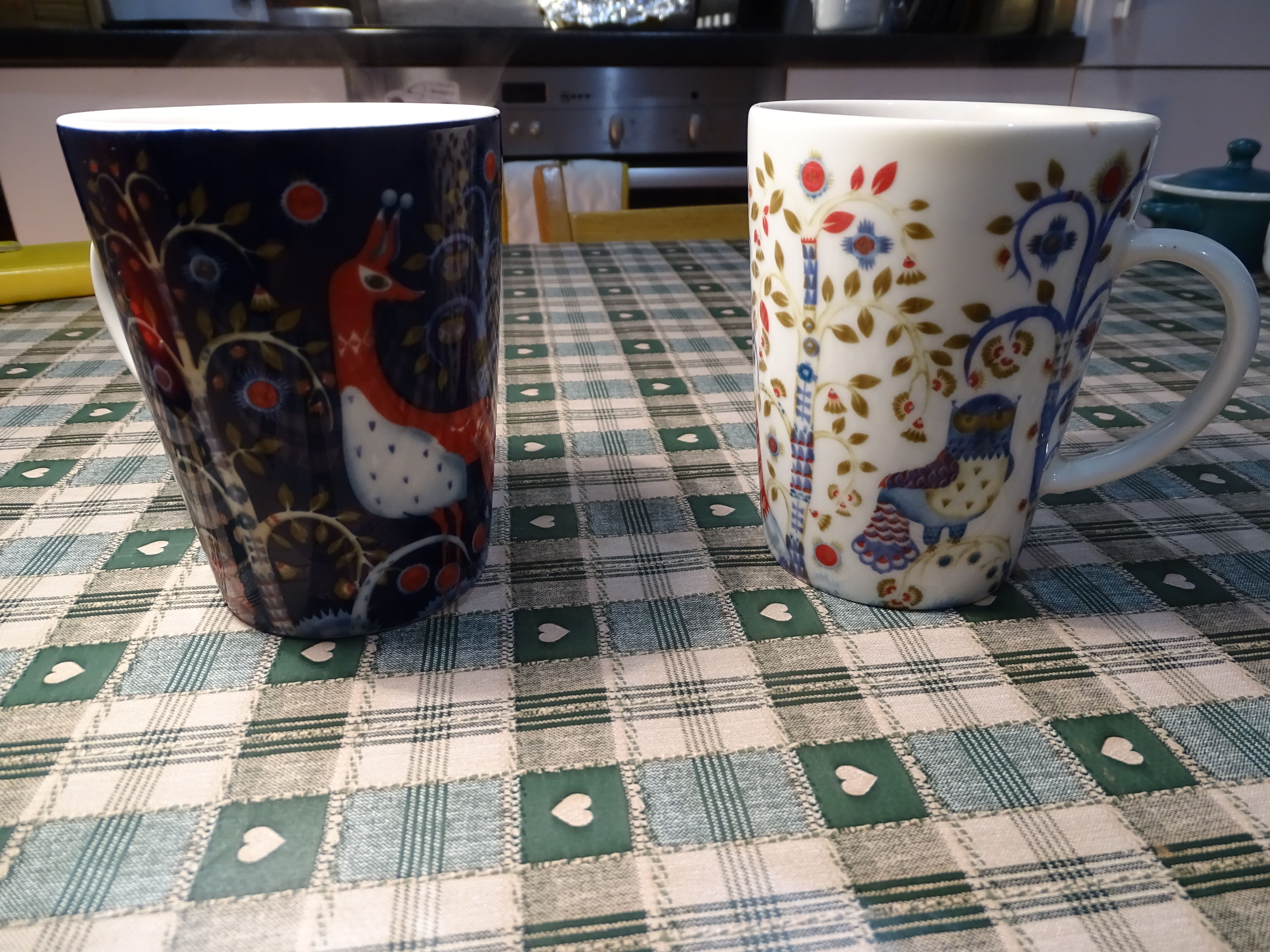
As well as being one the very, very few shops in the UK where you can not only purchase real, physical CDs, but also listen to a couple of tracks on state-of-the-art heaphones before buying them, Chocolate Notes is probably the world’s only hot chocolate café – and what a café.  The board behind the bar lists about twenty different options, all made from 100% organic cacao beans.  White chocolate with ginger or nutmeg; thick dark chocolate with a soupçon of cayenne and a dollop of crème fraîche; dark, bitter chocolate with a twist of mint; rich, medium brown chocolate perfumed with orange peel;  the “choc-express” mentioned earlier: 100% raw cacao and water, served in small espresso cups.  These are just a few and let’s not forget the “Guest Hot Chocolate of the Month”, which has included “HazelChoc”, “Morello Cherry Velvet” and “Coconut Fancy”.  Of course, there also the liqueur versions.    Like Belgian beers, every hot chocolate comes in its own special signature mug, cup or glass.

Most drinks are unsugared, unsweetened.  “You’d never dream of serving pre-sweetened coffee,” Fiamma says, raising an eyebrow, “so why not equally leave people the freedom to add sweetness to their hot chocolate if they wish to – or let them have it black if they choose?” 

On this front, there is a wide range of options available: golden sugar, dark moscovado sugar, date syrup, honey and maple syrup.  

I am a chocolate lover who never used to order hot chocolate because I always found it too sweet, so for me Chocolate Notes is a dream come true*.  I often go there in the evening, after dinner, and sit at a corner table and write.  “Just pick a drink for me,” I tell Fiamma.  She’ll ask me what I’m writing, and usually bring me my favourite:

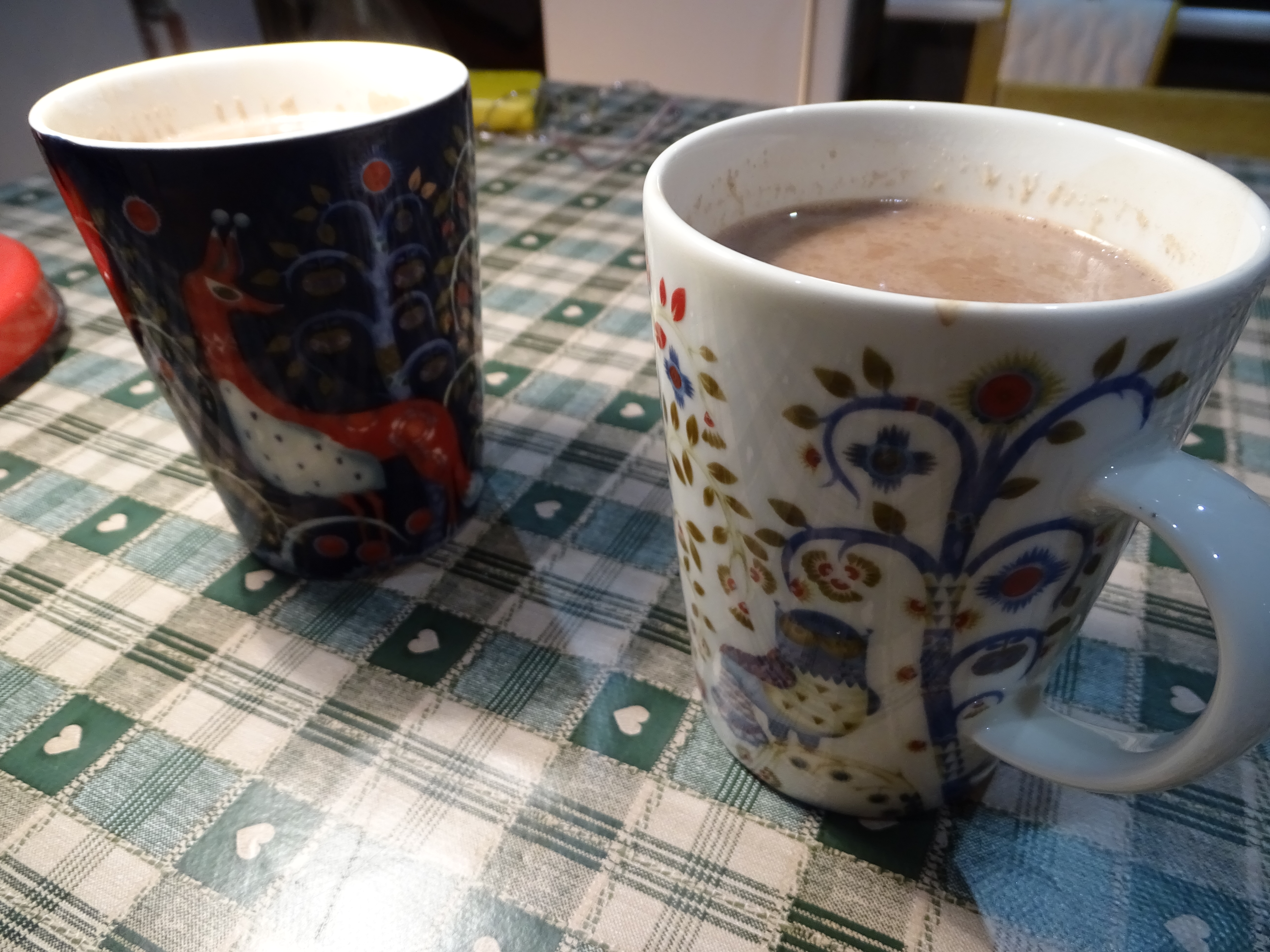
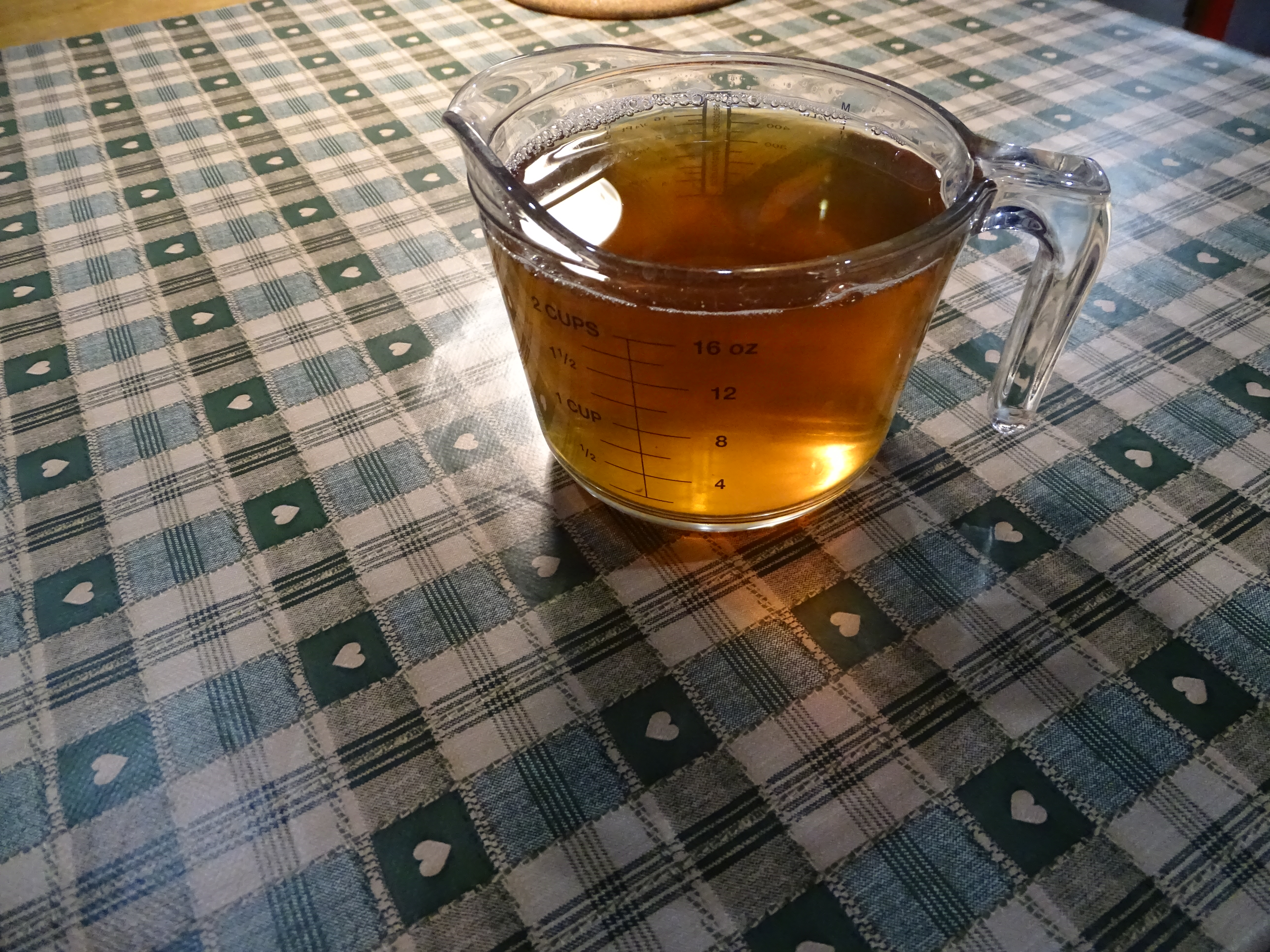
Hot Chocolate with Cardamom   

(this one is for my dear friends Lee and Jane, who love hot chocolate)

Your essentials for one mug of hot chocolate:

(all measurements are approximate, see https://scribedoll.com/2023/01/15/new-blog-feasts-fancies/)

❧ Either goat’s or full-fat milk 

❧ 1 heaped teaspoon of raw, preferably organic cacao

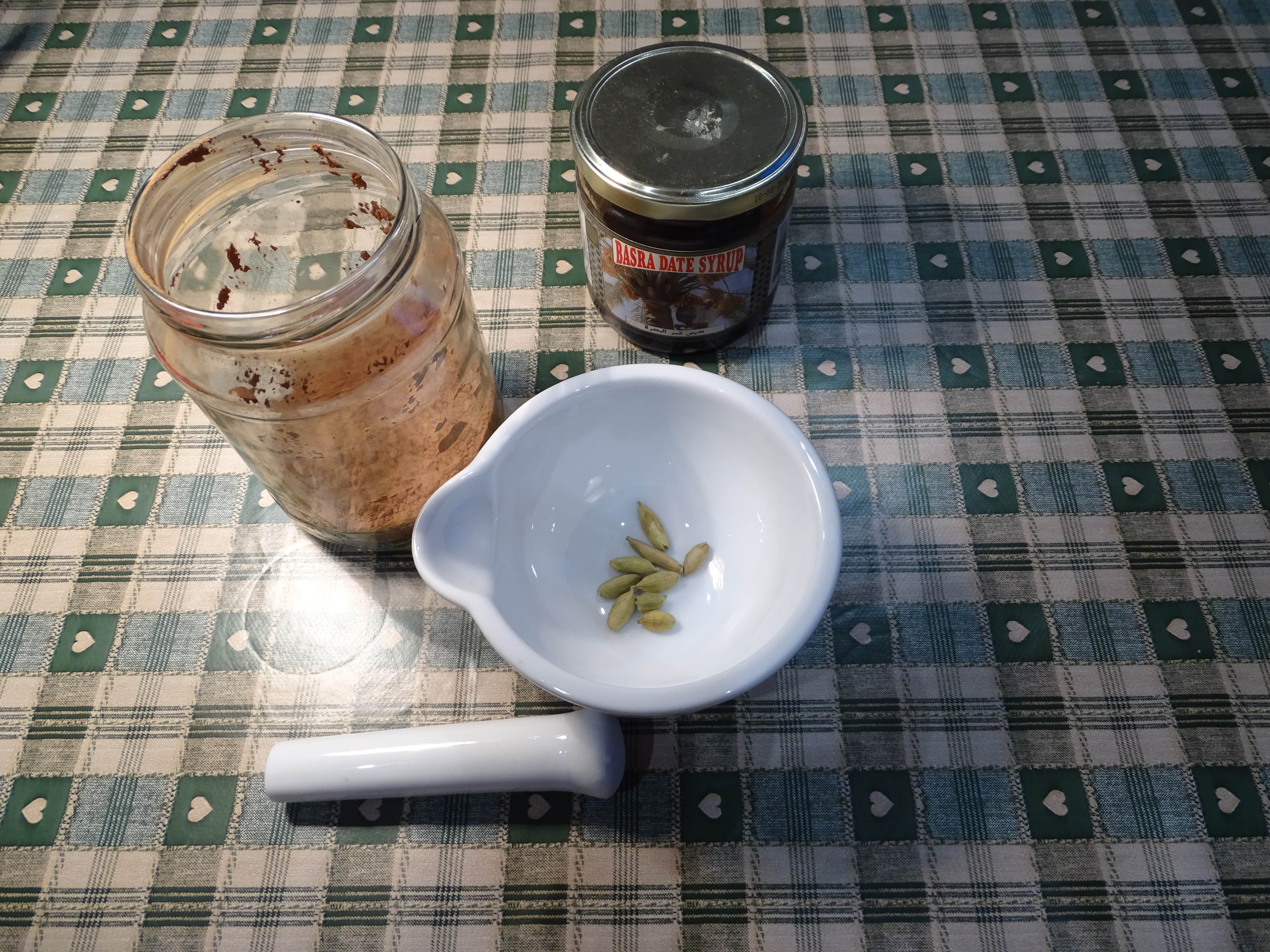
❧ 1 teaspoon of date syrup

❧ 3 or 4 cardamom pods

❧ a non-stick milk pan

❧ a non-scratch whisk

❧ a little patience

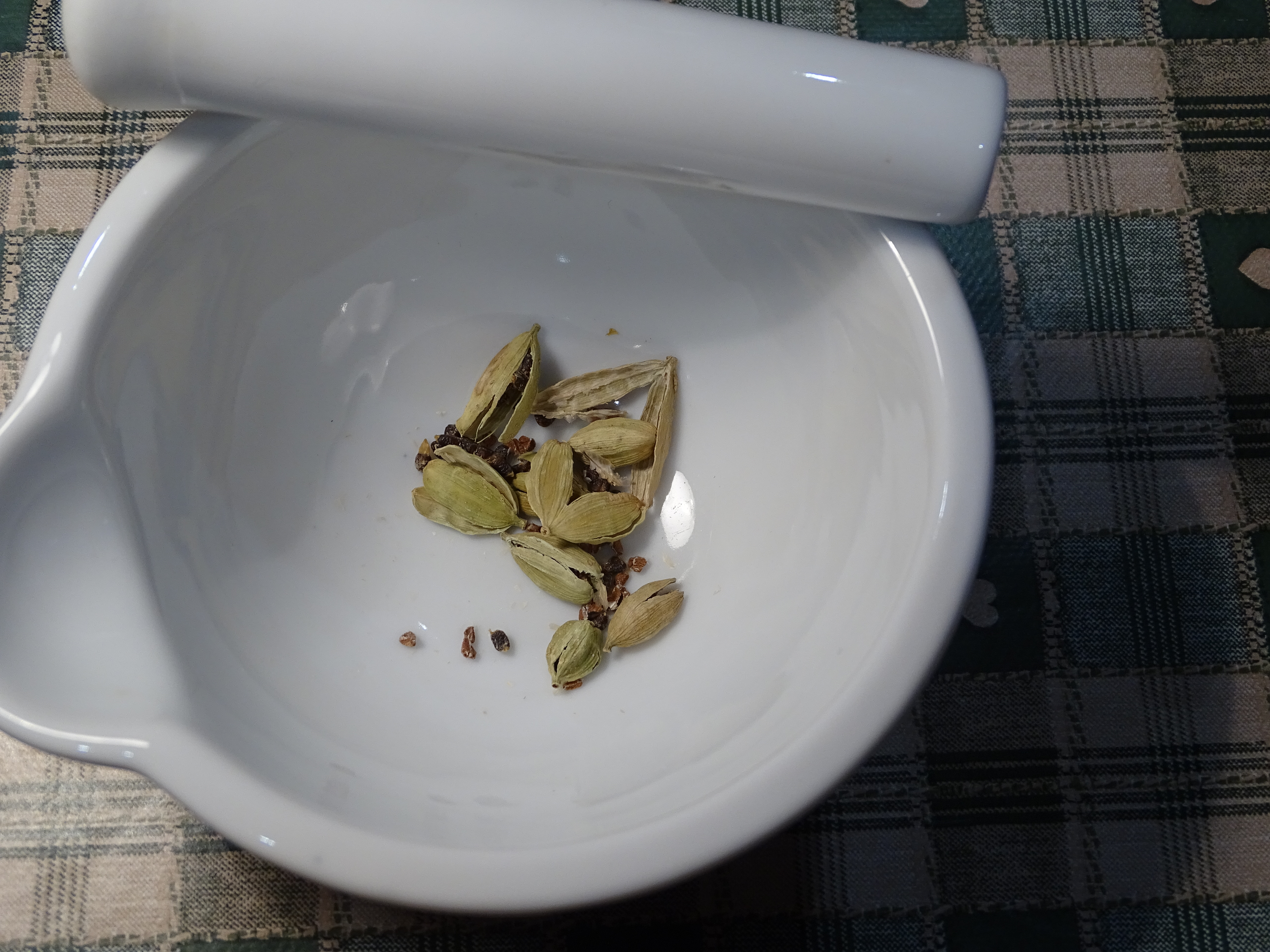
Crush the cardamom pods with a pestle in a mortar.  I tend to remove the shells before putting the seeds into the pan because I like chewing them, but if you’re planning on straining the drink before serving it, then you can throw everything into the pan, although I recommend crushing the cardamom first to release the fragrance.

Once the cardamom is in the pan, add the cacao and the date syrup.  Cover with milk and let it stand for five or ten minutes.  Give the ingredients time to get acquainted.

Put the pan on a medium-low heat and start stirring slowly with the whisk.  Don’t rush, let the milk warm in its own time, the cardamom release its flavour, the cacao blend in, the date syrup give the brownness a hint of red.  Heat it for about ten minutes, stirring slowly, rhythmically, respectfully.  Watch for the first bubble (don’t let the milk boil – it will impair the flavour) and remove from the hob.  Strain if you don’t want the cardamom in your cup.  

Serve this hot chocolate in the kind of mug or cup you want to curl your fingers around, your palms to hug.

* Err…. not yet.

Posted in Feasts & Fancies | Tagged , , , , , , , | 22 Comments

Feasts & Fancies: Polenta Cobbler

When I first came to England as a late teenager, in 1984, the biggest culture shock I experienced was undoubtedly the natives’ frugal attitude towards food.  It seemed to be perceived as an undeserved luxury rather than a basic right.  Moreover, there was a code to follow, which I needed to learn.

For instance, when my first English landlady remarked, “If my children had half your appetite, I’d never worry about their health,” something told me she didn’t mean it as a compliment.  When a host handed you a plate on which the food occupied about 25% of the surface area, with a benevolent, “Is that all right, my dear, or is that too much?” you did not reply, “Does it come with a magnifying glass?”  And when you were offered a second helping of the main course, “Yes, please!” was not always the best response.  You might just embarrass the host with too much directness.   It was preferable to resort to:

“Oh, all right, you’ve twisted my arm”

or “Are you sure? I feel I’m being greedy”

or “Well, perhaps a very, very tiny bit more”

and if you really wanted to make your host beam at you, then, “Oh, that’s so kind, that was truly delicious… but I couldn’t possibly… I’m so sorry.”

As a nineteen-year-old used to fighting off insistent offers of food in Italy, France, Greece and in her own family, I learnt, after the first few invitations in England, to wolf down a bowl of pasta at my home before going for a meal at someone else’s.  That way, not only could I assure the host that 25% of my plate area was such a huge amount of food and I didn’t know how I would manage to eat it all, but I could gracefully decline any subsequent offers with the sincerity of a full stomach.    

Of course, this is something of a generalisation.  My experience of English hospitality is limited to East Anglia, London, the Home Counties and the West Country.  I am not very familiar with Northern customs. Moreover, eating mores have changed in recent decades.  However, there is even now an assumption that women eat less than men.  More often than not, at a dinner party, my husband is offered a second helping before I am.  There is a persistent tendency for the hostess to coax a young man to finish the rest of, say, the salad left in a bowl, and ignore the young woman next to him, who might actually quite like the rest of the salad for herself because she is still hungry.

I no longer devour the vast amounts of food I used to as a young woman, but I still like to play it safe and whenever I am invited to someone else’s home for a meal for the first time, I generally have a small snack beforehand, and if I stay with friends overnight, I slip a packet of oatcakes into my bag.  Just in case.

In England, when you’re given a cup of tea, you’re often asked if you would like a biscuit.     Perhaps this is out of genuine concern for your figure or your blood sugar levels, although, oddly enough, whenever I place a heaped plate of biscuits before my own guests, I see them munch their way through several.  I guess they are so eager to be polite, they don’t mind sacrificing their own health and waistline in the process. 

There is a scene in the film My Fair Lady that always makes me cringe.  When Freddie Eynsford Hill rings the doorbell at Professor Higgins’s house, looking for Eliza Doolittle,  the housekeeper, Mrs Pearce, says, “Wouldn’t you like to come in, sir? They’re having dinner but you may wait in the hall.”

Yes, Higgins is a self-centred eccentric, but whenever I watch this film, I am horrified by the fact that Mrs Pearce doesn’t convey an invitation to join the household for dinner – or at least coffee and dessert.    Yes, it’s a Hollywood movie, and that makes it even more embarrassing: even often innacurate 1960’s Hollywood was aware of our hospitality traditions.

We were recently invited for dinner in a large Elizabethan house by a well-to-do couple.  It was a jolly party all round, and we all duly complimented the hostess on the main course.  She smiled.  “Who would like some more?” and just as we all looked at her expectantly, she added, her smile losing some of its brightness, “There are only a few potatoes left.”

I don’t know if it’s Protestant austerity or the fact that the climatic conditions of the island don’t favour a plentiful, varied crop, or if – as older English people have often told me – it’s a leftover of World War II privations (rationing for certain foodstuffs went on as late as 1954).  The fact remains that a degree of thriftiness is considered virtuous and sensible where food is concerned. 

Perhaps because of my upbringing, or my personality, I like meals to be hearty and abundant.  Here’s one that lends itself to merry conviviality and, given the time it takes to prepare, good to share – in several helpings – with as many friends as can fit at your table.

POLENTA COBBLER

Your allies: 

(all measurements are approximate, see https://scribedoll.com/2023/01/15/new-blog-feasts-fancies/)

❧ Polenta

❧ Pinto beans

❧ One or two bay leaves

❧ Mushrooms

❧ Butter

❧ Sprout tops (or other cabbage greens)

❧ Grated parmesan

❧ Olive oil, salt, pepper

Soak the beans for at least 10 hours in plenty of cold water, then strain and rinse with fresh water. Put the beans into a large pan, cover generously with water, add salt and the bay leaves, and bring to boil.  Let boil briskly for twenty minutes or so, then turn down the heat slightly and let cook until ready.  At some point, add a little olive oil, to bring out the flavour of the beans.

Wash the mushrooms and slice off the bottom of the stalks. Fry in butter.  Once cooked, set aside.

Soak and wash the sprout tops, then steam them.  Sprout tops are tasty greens you can generally find only at small greengrocers rather than supermarkets – at least where we live.  In the absence of sprout tops, you can use shredded Savoy cabbage or chopped Brussels sprouts, or pretty much any other cruciferous vegetables, although personally I would advise against broccoli because they get mushy too easily. 

Oil a casserole or a deep baking dish.  Spoon in the beans, mushrooms and steamed sprout tops, either in layers, or all mixed together.  Add a little water from the boiled beans, just enough for a little sauce at the bottom of the dish.

Grate the parmesan.

Boil the water for the polenta, add a little salt.  Spoon the polenta in slowly, whisking gently as you go along to avoid lumps forming.  Keep stirring until it reaches the consistency of thick porridge.  Add a smidgeon of olive oil and a spare dusting of black pepper.

Making polenta is a hazardous activity and should come with a warning.  I guess there is a reason why in Northern Italy it is traditionally cooked in a cauldron, outdoors.  Apart from the smoke enhancing its flavour, you can stir the boiling maize with a long stick and stand far enough away so that while bubbling, the squirts of boiling polenta can’t reach you.  As I have a tiny kitchen, I watch the polenta very attentively, and as soon as I see a bubble forming on the surface, I quickly remove the pan from the heat and wait for it to calm down before I put it back on.  

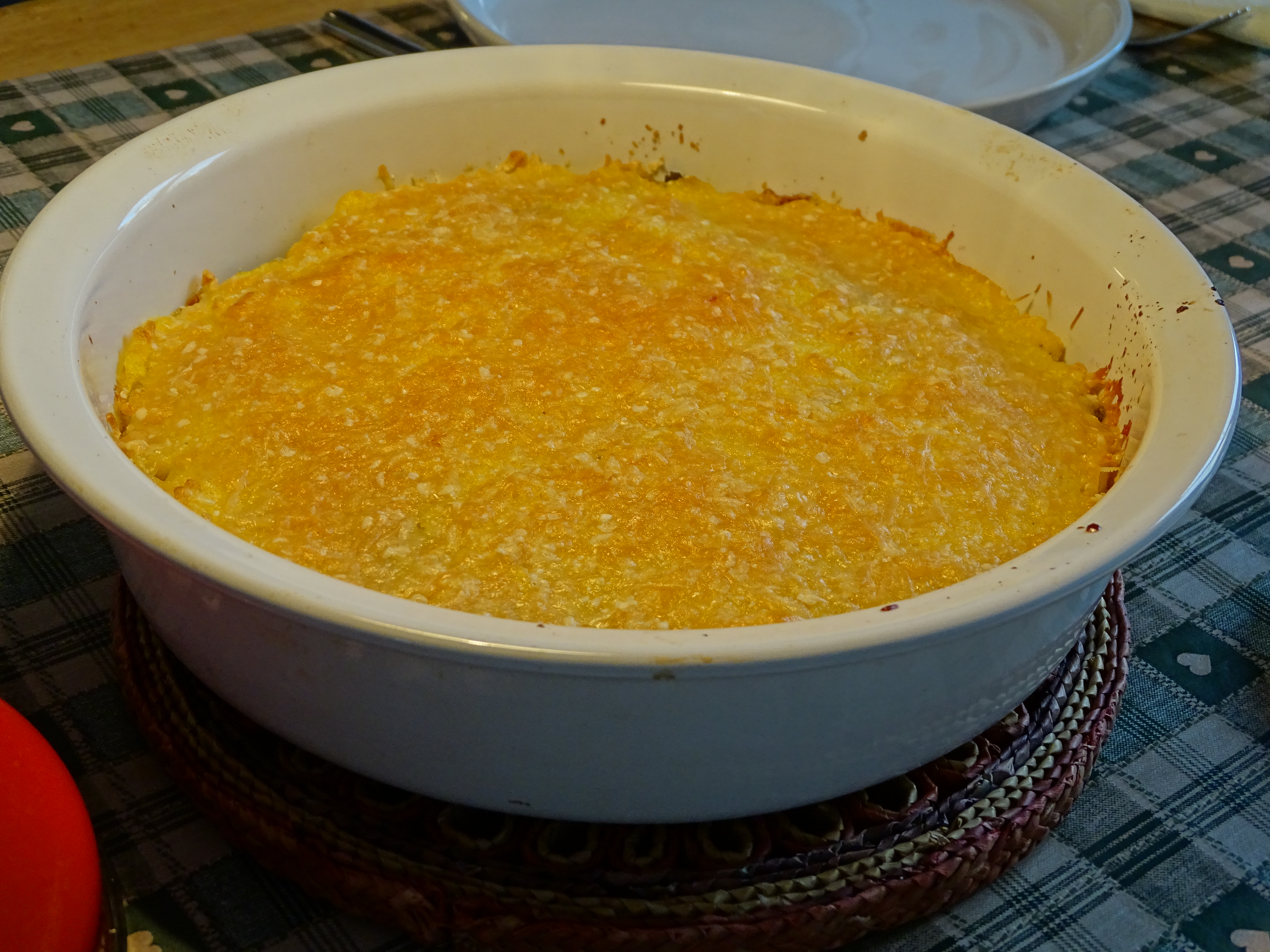
When the desired consistency is achieved, mix the grated parmesan in with the polenta and spoon it in dollops on the vegetables in the casserole dish.  The mounds of polenta and parmesan don’t have to be identical.  Let them land the way they land, looking as if they don’t care.

Put in the oven and bake long enough for the top of the polenta to be a darker gold.

Serve.

Enjoy.

Posted in Feasts & Fancies | Tagged , , , , , , , , , | 19 Comments

Feasts & Fancies: Miscellaneous Potato Rösti

Back in the days when my metabolism could happily burn six meals a day and I indulged in a full English breakfast every Saturday at our local greasy spoon, I would always ask for an extra helping of hash browns.  In fact, hash browns were the main reason I ordered English breakfast, although I’ve recently discovered that they are a North American invention.  Had I been able to order a plateful of hash browns without the eggs, mushrooms, fried bread, etc. I would have done it.  

During a trip to Hamburg, I discovered something better: kartoffelpuffer.  I was strolling across a Christmas market by the Elbe river, hungry, cross at how difficult it is to be a vegetarian in Germany (at least Hamburg, in December 2008), when I came across a stall serving these fragrant, golden potato pancakes with a dollop of apple sauce.  I took my paper plate heaped with kartofelpuffer and a plastic fork to one of the metal bar tables overlooking the river, and dug in.  They were scrumptuous and, as far as I was concerned, vastly superior to hash browns.  Just as I was starting on the last pancake, a large, majestic seagull landed on the edge of my table, an eloquent look in its ice-coloured eyes.  Are you a German seagull or have you flown over from the Netherlands?  I wondered.  It stood there, not begging, just making its regal presence felt, the curved, red tip of its bill held high.  “Are you hungry?” I asked.  “Would you like half my kartoffelpuffer?” and proceeded to cut the pancake in two.  Then a thought whizzed through my mind and I stopped.  “Look, I’d gladly share my lunch with you,” I said.  “Only you’ll then go and tell all your family and friends, won’t you? Before I know it, it’s going to be a scene from Hitchcock’s The Birds.  You can just fly away at the first hint of trouble, but I’ll be stuck here, having to explain myself to the locals – and I don’t even speak German!”

The seagull cast me a cold glance.  

“I’m sorry, I hope you understand.  If it were just you and me here…” I said, hastily  wolfing down my remaining kartoffelpuffer with a side of remorse.

The seagull stood looking into the distance for a couple of minutes, as though my decision was of perfect indifference to it, then spread its huge wings and took off.  Fifteen years later, I am still impressed with this Hamburg seagull’s dignity and good manners.  It could easily have swiped the food off my plate, but it didn’t.  It just landed on the edge of my table, hinted, and took no for an answer.  No squawking, no attacking, no fishwife behaviour.  When I think of our Norfolk seagulls, diving to snatch fries from your fingers, sometimes flying off with your sandwich!

One of the first dishes I cooked Howard after we moved in together, was kartoffelpuffer, following a recipe I’d found online and had been enjoying for a number of years.  He looked at the dish I’d put on the table and his eyes moistened.  “They’re latkes,” he said, devouring them with glee.  “My mother used to make them! Oh, I haven’t had them for decades!”  

A man telling you that something you cook reminds him of his very happy childhood.  Irrestistible, right? I had no reason not to believe him, until I sampled the sublime latkes at Sacha Finkelsztajn’s delicatessen shop in Rue des Rosiers, in Paris.  Delicious and very more-ish – and very different from my own efforts.

The following is an evolved version of my understanding of kartoffelpuffer, my experience of latkes, with the addition of my own Mediterranean unbringing.  They’re not kartoffelpuffer, they’re not latkes.  So let’s call them

Miscellaneous Rösti

Your Allies:

Potatoes (about 1 kg)

Maize flour

2 eggs

1 small onion

Fresh flat parsley

Salt, pepper

Olive oil

❧ Wash and peel the potatoes, then grate them using the side with the large slots and put them in a large bowl where you have already beaten two eggs.

❧ Either grate (if your eyes can stand it) or chop the onion very finely and stir it into the mixture.

❧  Add salt, pepper and some finely (or not so finely) chopped or torn up parsley (previously washed, naturally), as well as a dash of olive oil.

❧ Stir everything.  You will notice the moisture from the raw potatoes form a pinkish liquid at the bottom of the bowl.  This is when you need to start adding a few tablespoons of maize flour.  Add as little or as much as you need for some of that liquid to be absorbed.  Many people suggest pouring it out, but I like keeping as much of it as I can.

❧  Pre-heat the oven to about 200 – 220ºC, and spread a generous amount of olive oil on the bottom of a baking sheet/ oven tray (or two, depending on how much potato mixture you have).

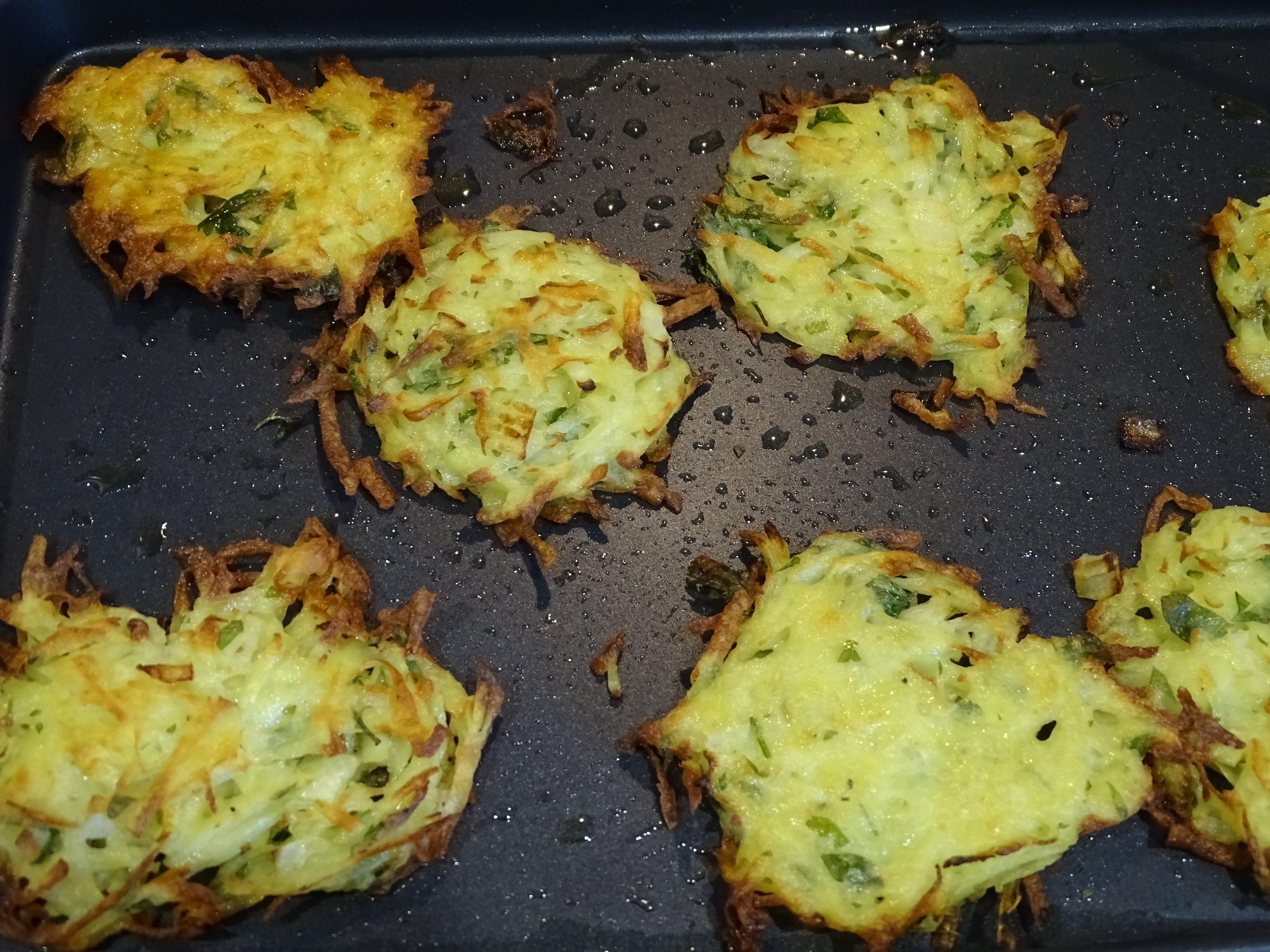
❧ Spoon dollops of potato mixture onto the tray and flatten them with the back of the spoon to form a kind of patty, leaving a little space between them.

❧ Put the tray(s) into the oven and bake until golden on one side, then turn over each patty.  The time your rösti take to brown depends on your oven, on how many patties you’re baking at once, and on how thick they are.

I tend to serve our rösti with a side of greens.  Last week, we had steamed curly kale with a knob of butter.

Kartoffelpuffer, latke and rösti are traditionally fried.  I choose to bake them for the simple reason that I am a keen but lazy cook with a full-time job as a translator.  Frying on the hob involves my standing over the cooker for over half an hour, with splatterings of  hot oil aiming at me, and I still need to keep the ready rösti warm in the oven until I’ve finished frying the last one.  Baking them in the oven all at once allows me to put my laptop on the kitchen table and do a little more work while the rösti are browning. 

Plain flour can be used instead of maize, and you can replace fresh parsley with oregano or basil or herbes de Provence.  I frequently do.

Posted in Feasts & Fancies | Tagged , , , , , , | 4 Comments

Link missing from previous post

My apologies to e-mail subscribers: there is a link missing in the previous post, FEASTS & FANCIES: THE MAGIC OF BREAD.

In the section:

Three-Seed Brown Bread

Your allies:

(all measurements are approximate, see here )

Here is the link:

 https://scribedoll.com/2023/01/15/new-blog-feasts-fancies/)

Posted in Uncategorized | Comments Off on Link missing from previous post

Feasts & Fancies: The Magic of Bread

If anything makes me believe in magic in the kitchen it is making bread.  The verb make is, of course, somewhat inappropriate in the context of magic, since you are not, alone, in control of the process.  As in any magic spell intended to come to fruition, you pick the right ingredients, set up the right circumstances, focus (focus softly: hard focus is too dense, impenetrable to imagination and, consequently, a magic-repellent) and let… the rest ensure it all turns out right. 

In the Chinese practice of QiGong, you achieve your greatest result by using 70% of your energy.  Push yourself to 100% and you have no reserves left for your next endeavour.  70% leaves room for elegance, which is a sibling of effortlessness and of grace, in every sense of the word.  70% allows you to focus softly, allowing inspiration to flow in.

Magic.  Mixing just some yeast, water and flour with a pinch of sugar, letting it rest for a couple of hours and returning to find the mixture swollen two- or threefold.  If that doesn’t give you a sense of magic, I don’t know what will.

Like so many other people, I learnt to bake bread during the first Lockdown.  I joined the scores of amateur bakers with enough time on their hands to post photos of their loaves on Facebook, then count the number of Likes.

Sourdough is still a spell beyond this apprentice’s skills.  My numerous starters have yet to start.  Perhaps, by the time this blog, Feasts & Fancies, is completed, a year from now, I will have graduated with a Pass grade in the art of sourdough baking.  In the meantime, I love working with fresh yeast (dried or fast-action never responds to me).

I bake our bread in what the British call, in deference to our French neighbours, a casserole, and North Americans a Dutch oven– a name I prefer.  A Dutch oven brings to mind tall, narrow houses mirrored in straight, narrow canals, and the crow-stepped gables of my beloved West Flanders.  I imagine a hearty stew made up of glossy, colourful vegetables being spooned out of a casserole, and the lid of a Dutch oven being lifted to release the bear-hug-like aroma of freshly baked bread.

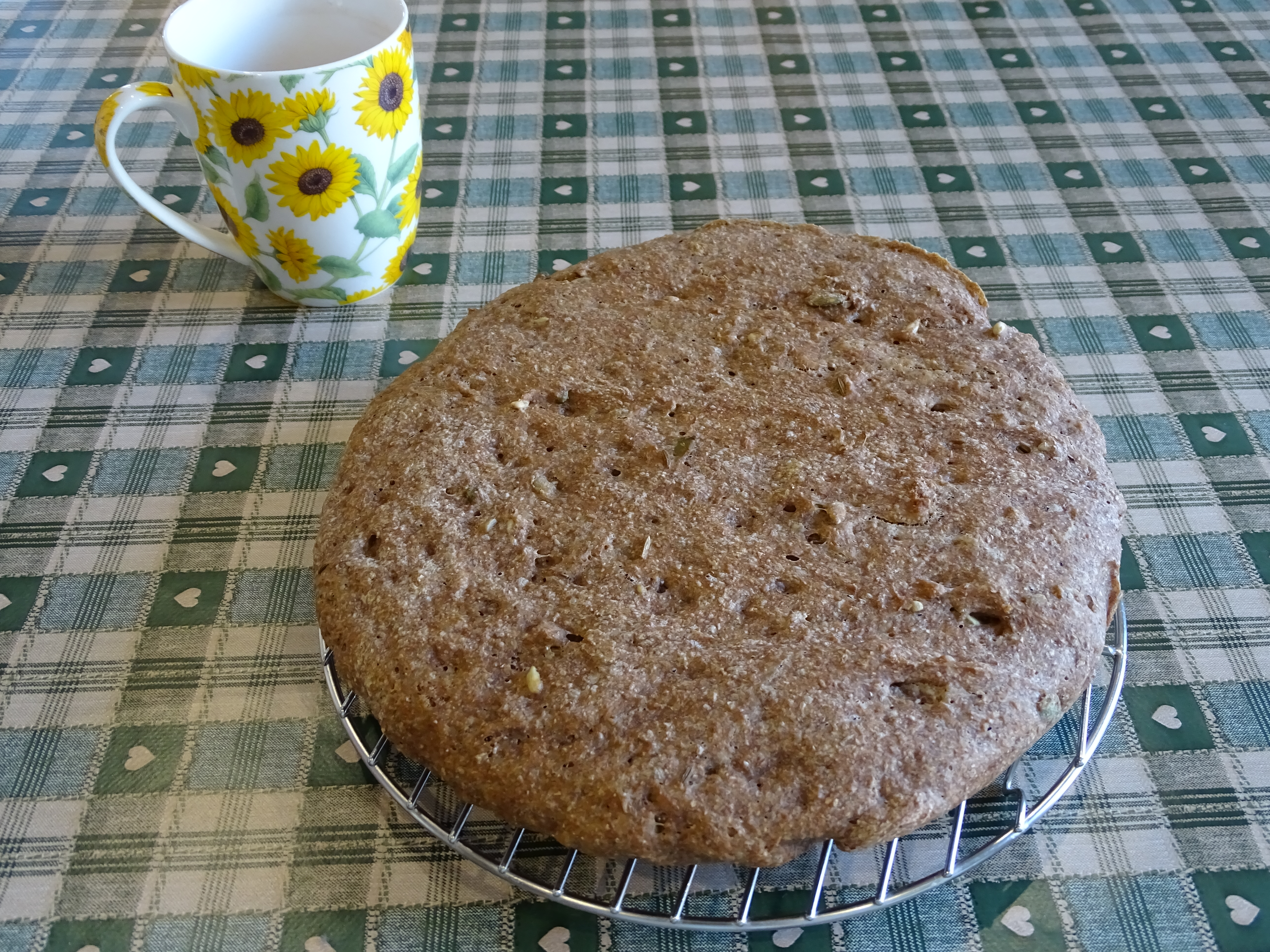
Possibly because I always bake very small loaves, enough for one or two meals, in our large Dutch oven, or maybe because of a fault in my modus operandi, my bread tends to sprawl during baking, and often looks more like a focaccia than a loaf.  Still, Howard, my husband, says it tastes good.  And I like it, too.

Three-Seed Brown Bread

Your allies:

(all measurements are approximate, see https://scribedoll.com/2023/01/15/new-blog-feasts-fancies/)

● 300g wholemeal flour

● 250-300 ml tepid/lukewarm water

● a piece of brewer’s yeast

● one tablespoon date syrup

● a small handful of sunflower seeds

● a small handful of pumpkin seeds

● a third of a handful of caraway seeds

● salt

● extra-virgin olive oil 

In a large bowl, dissolve the yeast in the lukewarm water, with the date syrup.

Add the flour, a couple of tablespoonfuls at a time, whisking gently with a fork until you have a dough of the right consistency.  You’ll know when that is, and if you need to tweak the amount of flour or water.

Using a spatula, lift the dough from the sides of the bowl and flip it over a few times, creating a homogeous mass.  Leave it for 10-15 minutes, then do it again. Scrape it off the sides of the bowl, turn it, flip it, toy with it, tease it.  And once more.

Once the third game is over, it’s time for your dough to enjoy a good night’s rest: it has a feat to accomplish the next day.  I cover the bowl with a silicone lid and, if it’s winter, place it in the bedroom, where the heating is on and it’s nice and warm, overnight.  If it’s a very hot summer, the dough sleeps in the fridge.

With a little luck, by morning, the dough will be awake before you are, grown threefold, pushing against the lid, bubbling to burst out of the bowl, demanding your attention.

Prepare your work surface (I use a large wooden board), a small amount of flour so the dough doesn’t cling to your fingers too much, and the remaining ingredients.

Scoop the bread dough onto your work surface and start kneading it gently, incorporating the salt, seeds and olive oil, making sure these are distributed throughout the mixture as evenly as possible.  Stretch, fold, turn, massage, then form a ball and place it in the Dutch oven, lined with baking parchment.

Just like the human body after exercise, the dough must now be kept warm and not catch a chill.  I usually put the Dutch oven on the bed, wrapped in a woollen jumper or blanket, on top of a not-very-hot hot water bottle.  I live in England.  In warmer climes, this is not necessary.  In the summer, I stand the Dutch oven in a sunny part of the room.

After a couple of hours, the dough will usually have risen enough (twice its original bulk) for you to put it into a preheated oven at about 200ºC (180ºC if, like me, you have a fan oven) for about 20-30 minutes.  After that, remove the Dutch oven lid, turn up the heat by 20 or so degrees and let the bread become brown and crusty.  If, like me, you have used date syrup, don’t be surprised if the brown of your bread has a reddish glow about it.

Take the Dutch oven out of the oven, scoop the bread out with a long-handled spatula or wooden spoon and let it cool on a wire rack before you cut the first slice and perform the how-does-it-taste-with-butter test.  Inhale the reassuring aroma of your freshly baked bread.  Fill your lungs with its goodness. 

I like to give thanks after the first bite, reminding myself that this alchemical process was a team effort between me and all the ingredients.  I just find that it makes the bread taste even better.

Enjoy!  

Posted in Feasts & Fancies | Tagged , , , , , | 10 Comments

New Blog: Feasts & Fancies

No Scales or Measuring Jugs – Just Imagination and Senses

Welcome to my new blog, Feasts & Fancies and the first recipe. 

When I moved away from my family, to another country, I asked my grandmother to write down the recipes of my favourite dishes and cakes.  She bought an exercise book — grey with a cluster of multicoloured stripes running across it – for that very purpose, only I waited and waited, but the recipes weren’t coming.  “Wait, it’s not ready yet,” she kept saying.  On one of my visits, I saw her writing in the exercise book, then tearing out the page almost immediately.  “No, that’s not quite right,” she muttered to herself.  The loose cover led me to suspect this wasn’t the first page she had torn out.  

“If you carry on like that, I’ll never get my recipe book,” I said.  She gave me a look of barely perceptible frustration.

When, at long last, my grandmother gave me the exercise book, the cover was a little frayed and only half the remaining pages had been filled with her neat handwriting.  I thanked her, took a look, and didn’t open the exercise book again for three decades.  Her recipes were no use to me: they contained hardly any measures of weight or volume.

Cooking had always been a bone of contention between us.  Her voice would call from the kitchen. “Katia, I’m making borscht [or kalach or Salade Olivier].  Come and watch, so you can learn.”

“I can’t.  I’m doing my homework.” 

Sometimes, when unable to provide the unarguable excuse of homework, I would drag myself to the kitchen and stand fidgeting, forcing myself to watch my grandmother slicing, chopping or stirring and listen to her explanations.  But then some beautiful piece of music would catch my attention and I would turn up the radio dial, or our dog would stroll in for some company and I would start playing with him, or else I’d be rescued by a ringing phone.

Yekaterina Gregorián (1911-2012)

My maternal grandmother, a Russian-bred Armenian from Rostov-on-the-Don, was a superlative cook, and any friend who came for a meal would eagerly accept a second and third helping of her food.  My mother, on the other hand, was an enemy of all household chores, cooking first and foremost.  When I was growing up, she could produce all of four dishes: lettuce salad, tomato salad (she did not believe in mixing the two), artichokes a la romana and steak, my absolute bête noire

I will never forget my mother’s daily steak during the fortnight my grandmother spent in hospital because of a ruptured hernia, when I was about six years old. 

“Katia, eat your steak.  It’s getting cold.”

“I can’t swallow it – it comes back up.”

“Nonsense.  You’re not leaving the table until you’ve eaten everything on your plate.  You’ll sit here all day, if need be.”

After a couple of days, Snoopy, our gentle English Setter cross, came to my aid.  He learnt to sit very still under the table and quietly wolf down the chunks of meat I would spit, unchewed, into my napkin before placing the said napkin back on my lap.

In her later years, my mother became a vegetarian, and so added pasta sauce, roast potatoes and two or three other dishes to her repertoire, although raw salad (which included uncooked grated potato) was always one of her favourites.  

I prided myself on being my mother’s daughter.  In my first week away from home as a self-catering student, I dined on grilled apple halves filled with Cheddar cheese.  In my late twenties and married to my future ex-husband, I produced some very respectable dishes from recipes copied to the letter without the slightest deviation.  

In my forties, I learnt to cook.  Using imagination and instinct in preference to scales and measuring jugs.  Trusting my senses.  Trusting the vegetables, the fruits, the grains, the herbs.

A few months ago, when I opened my grandmother’s grey exercise book with the cluster of multicoloured stripes running across the cover, I suddenly understood her frustration at having to squeeze her intuitive cooking into exact grammes and centilitres, her inability to explain her creativity in cups and centigrades.  She tore out the pages because the recipes she recorded were not true to the reality of her cuisine.

With age, I have become more and more my grandmother’s granddaughter in the kitchen.  When friends ask me for the recipe of something they’ve enjoyed eating at my table, I, too, hum and haw, struggling to provide exact instructions.  “It’s a handful of this,” I say apologetically, “and a small fistful of that – but if you prefer you could use that as a substitute for this and add another thing instead.”

All that is a roundabout way of saying that most measurements in Feasts & Fancies will be approximate.  These posts and the recipes included in them are intended for spontaneous, intuitive, fun-loving cooks.  If you cannot trust your intuition in the kitchen, where can you trust it? I will provide no oven temperature settings because I wouldn’t dream of assuming that your oven and my oven have the same personality.  Only you know your oven and its quirks.  I will not tell you how many apples to use in a cake or how many spoonfuls of cinnamon powder to add to the mixture.  No two apples are exactly the same size, or have exactly the same degree of sweetness.  It is up to you to consult your palate and decide how much sugar it craves on that particular day.  Or how much salt it fancies.  No two snowflakes are the same, and neither are two vegetables, two pieces of fruit, or two eggs.  No two dishes will turn out identical, even if you use the same recipe twice.  And that’s part of the fun.

I hope you enjoy Feasts & Fancies, and that it inspires you to take joy in cooking if you don’t already.

I dedicate this blog to the memory of my grandmother, Yekaterina Gregorián.  Wherever she is, I hope she watches me cook – and smiles.

Unpasteurised Brie* Tartiflette

Your assistants:

Potatoes

Unpasteurised Brie*

A bunch of fresh basil (washed in cold water)

Extra-virgin olive oil

Salt & pepper

When my potatoes are organic, from a trusted greengrocer, and the skins are smooth and glossy, I scrub them thoroughly under the tap, but don’t peel them.  

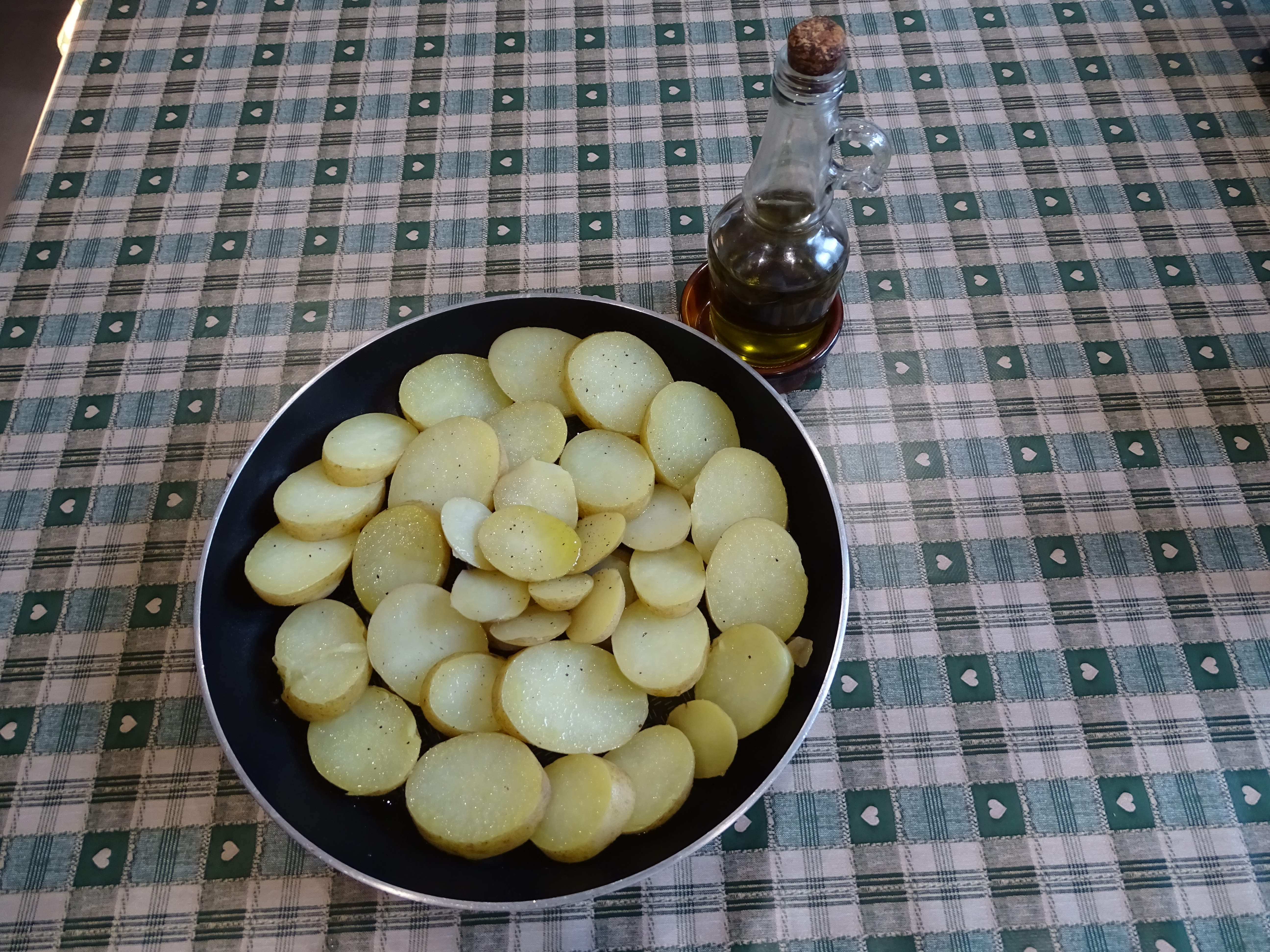
Place a large pan of salted water to boil, while you cut the potatoes into slightly thick, even slices.  Once the water starts bubbling, remove it from the heat and carefully ease the sliced potatoes into the hot water with a long-handled spoon.  Once they’re all in, place the pan back on the ring and turn down the heat.  The bubbling must be gentle, playful, like a giggle, not a volcanic eruption.  How long should the potatoes cook for? Well, as long as it takes for you to stick a fork in easily but without the flesh crumbling.  Once that’s achieved, drain the potatoes, taking care not to break them – so don’t go shaking the pan.  This may be a good time to preheat your oven and set it to a moderately high heat.

With a perforated spoon (to make sure the excess water drains), place each potato slice in an oven-proof dish previously drizzled with olive oil.  How you arrange the potatoes is entirely a matter of personal preference.  You can line them in rows, wind them in a spiral, form them into a flower, or however you please, depending on the size and shape of your oven-proof dish.  A generous drizzle of olive oil on top, then slide the potatoes into the oven and wait for the edges to brown.

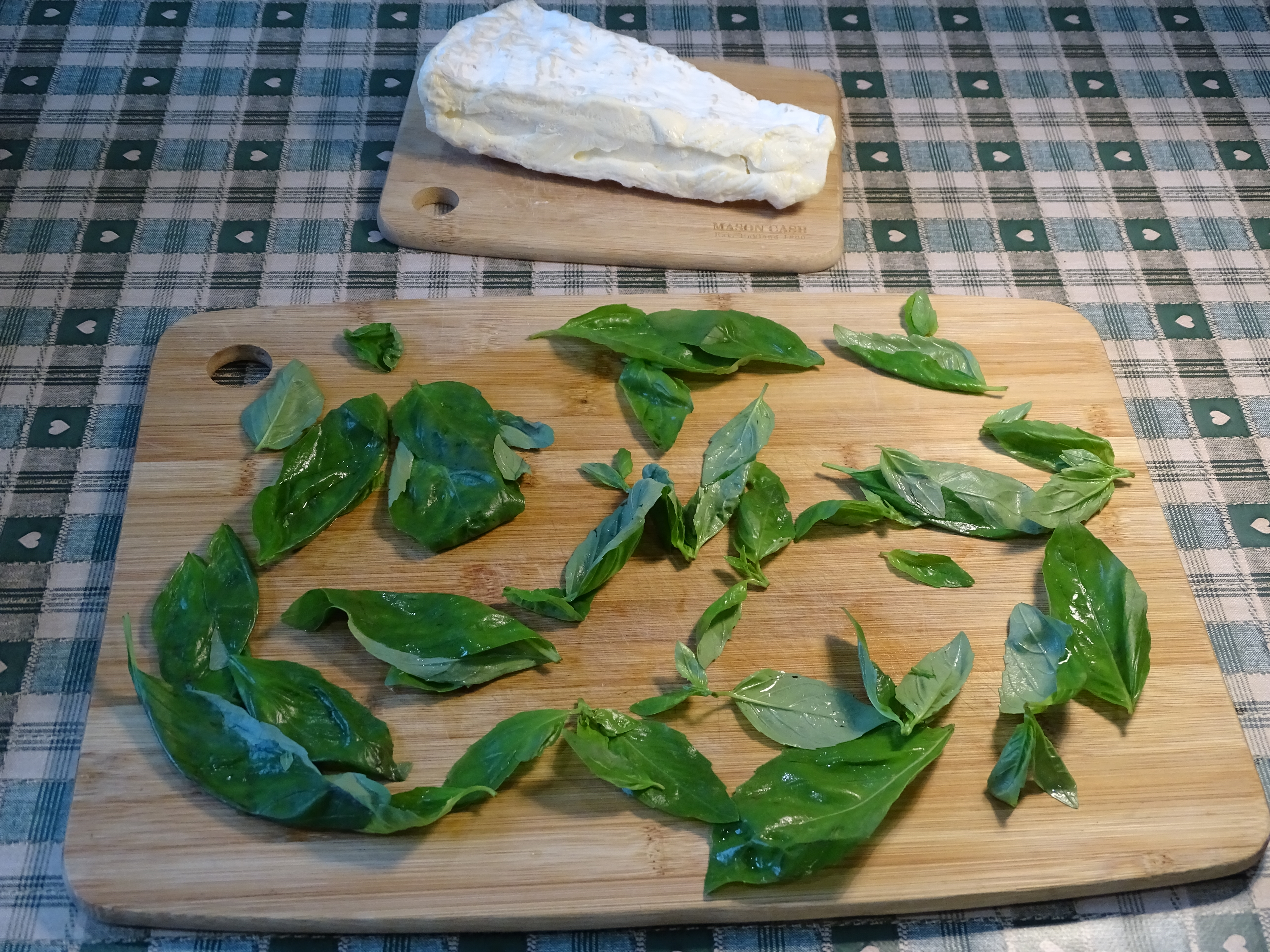
Meanwhile, cut the Brie into thick slices, not forgetting to put one piece into your mouth – a cook’s efforts deserve a downpayment.

 Then, tear up the basil leaves into large strips.  Some people cut herbs with a knife.  I find metal too hard and cold against the delicate leaves, so I use my hands, and the bright, joyous aroma of basil rubs off on my fingers.  

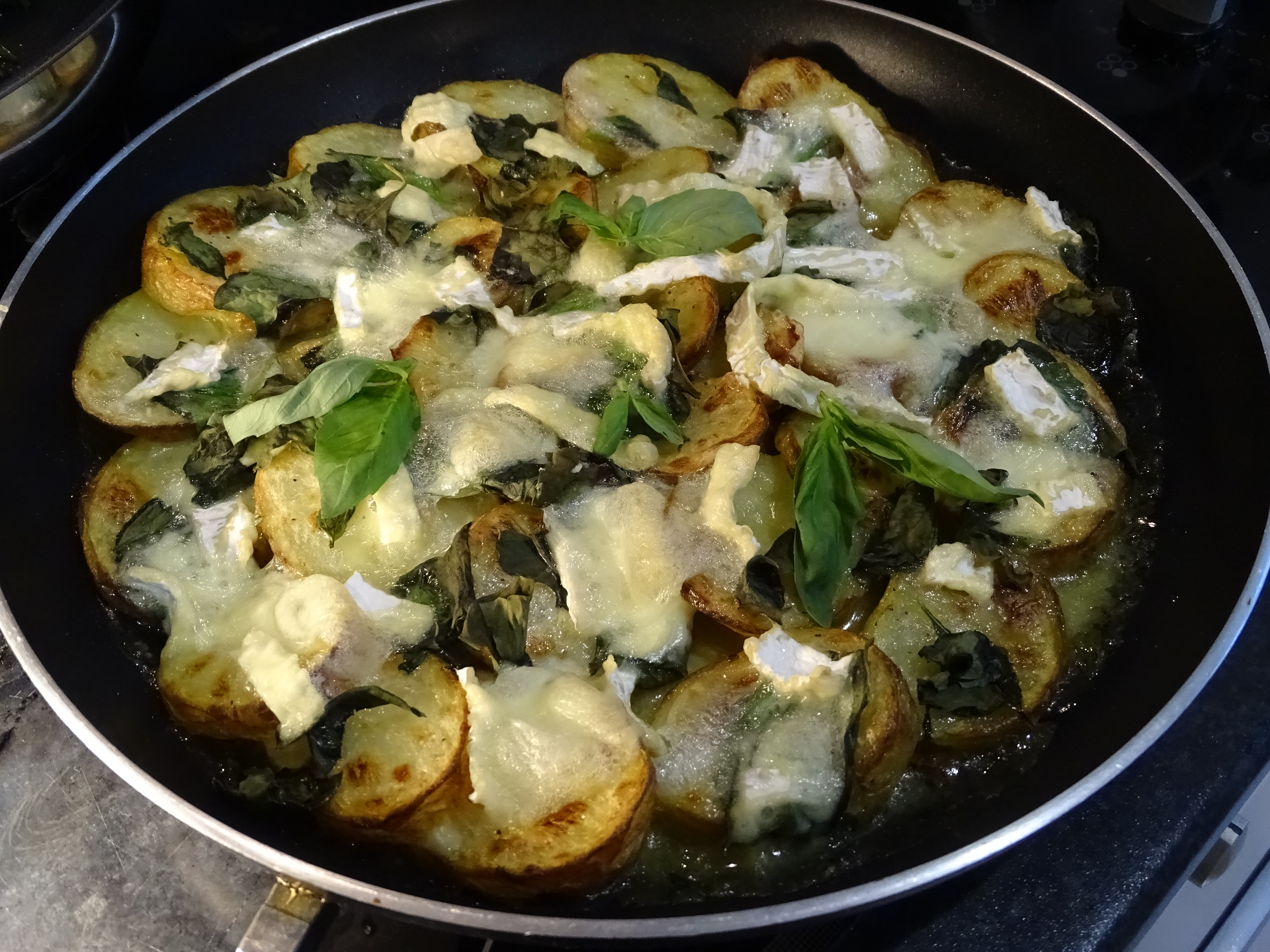
Once the potatoes have got a golden crust on them, take them out of the oven and scatter the shredded basil over them, then distribute the slices of Brie, making sure most of the potato and basil surface is covered.  Uncovered basil is likely to turn black in the heat.    On some days, I add a very, very light dusting of freshly-ground black pepper.   

And now everything goes into the oven… for as long as it takes for the Brie to melt and perhaps turn golden.

This is the stage when H., my husband, starts loitering in the kitchen, asking when the food will be ready.  And it soon is.

I usually serve my tartiflettes with a side of stewed spinach, or some steamed green kale, or cooked red cabbage.

* I prefer unpasteurised Brie, but please check if you can tolerate unpasteurised dairy produce and note that it is generally not advised during pregnancy.

Posted in Feasts & Fancies | Tagged , , , , , | 25 Comments

The End of a Blog – and the Beginning of a New One

I started writing this blog, first entitled Londoner’s Musings, then Scribe Doll’s Musings, back in February 2011 because blogs were all the rage, it was Valentine’s Day and I was single with nothing to do, and in order to vent a series of frustrations related to modern English language usage (e.g. Words and Civilisation: Coffee) and a few examples of social double-standards in vogue at the time.  Eventually, this blog developed into an eclectic collection of bits and bobs, from travel impressions to family stories, from eulogising over fountain pens to describing the huge, shapeshifting East Anglian skies.

For eleven years, this blog has been for me an oasis of self-expression and, more often that not, a rare, precious opportunity to spend a few hours scribbling during a week otherwise consumed by work.  Moreover, it was unbridled scribbling, jotted down à la diable, trying to please only myself.  Having real fun.

After eleven years, I have decided to wind up this odds-and-ends blog – and begin a new one that focuses on a specific theme.  For the next few months, my Sunday blog will revolve around this one topic.  Any posts on other subjects I may suddenly have the urge to write will appear on other days.

The new blog is intended as something joyful, bright, with a dusting of quirkiness.    Something that may appeal to your senses.  Something to make me smile as I write it and something which – I hope – you will find heartwarming.  There is, more than ever, much need for warmth and smiles.

It will be a weekly or fortnightly helping of lightness and fluff.  But then if birds’ feathers weren’t made of lightness and fluff, they wouldn’t be able to fly.

Thank you all for following me these eleven years.  I hope you will keep Scribe Doll company on this new adventure.

Watch this space (here’s a little clue…)

Scribe Doll 

Posted in Odds & Ends, Uncategorized | Tagged , , , , | 11 Comments

Let Go of the Old Year…

Let go of the Old Year, gently, with respect – it has taught you much, and anything learnt is never wasted.  Usher it out with thanks and an apology – for all you failed to learn, for all your mind could not grasp, your heart was too shy to accept, your pride too rigid to absorb.

Forgive the Old Year for all the scars it has left on you, and forgive yourself for the wounds you have not yet healed.

Let go of all the people who walk in greyness – there is enough darkness in the world already.  Instead, stand where you can meet those who look to the sun, to the moon, to all that’s light and brilliance.  

Let go of the friends who rush to hold you up when you’re falling but turn away when you’re rejoicing.  Instead, cherish those who can cry with you, but also laugh with you, and who cheer at the top of their voices when you take a triumphant bow.

Above all, let go of the “yes – but” people.  Cherish the “yes – yes – yes!” people: they are gems that catch the light and reflect it back at you.  

Let go of “why?”s in favour of “why not?”s.  If you cannot imagine you can do it, then at least forget that you can’t.

Let go of what weighs you down.  Heaviness keeps you static.  You can only fly with light wings. 

Shake hands with the Old Year, and let it go.  Then fling open all the windows and let the wind blow the New Year in.

***

Thank you to all those who have read my posts over the past year, and especially those who have taken the time to comment – reading your words in response to my own words makes my writing worthwhile.  

I wish you all a happy, fruitful 2023 filled with possibilities and blessings.

Scribe Doll 

Posted in Uncategorized | 4 Comments

Christmas Eve

The treble has sung.  Christmas has begun.  

Once in Royal David’s city…

A voice like gold shimmering in the firelight. 

The light is draining from the sky.  The sun has withdrawn without pomp.  This is not an evening for lavish displays.  The night must cast its cloak over the horizon soon, so that the magic may take place.

There is haste in the beating of birds’ wings as they dart to take shelter on tree branches or huddle on roof tiles.  Not a needle is stirring on the pine trees outside the house.  Even the wind is holding its breath.

It is the moment after your eyes have stopped making out forms distinctly and before your ears are fully tuned.  The moment when another, unnamed sense tells you that, in this stillness, everything is breathing, quivering, spinning, singing in a close harmony of colours and textures.

This sense halfway between sight and hearing tells me that the conkers I planted into a pot of compost a couple of months ago are starting to wriggle in the moist, dark earth, the embryonic horse chestnut trees inside them ready to crack open the hard skin and sprout roots.  It assures me that the acorns in another pot are also growing impatient to push forth and surface to the light.  And that the slender rowan tree saplings secured to bamboo sticks dream of yielding berries and inspiring poets. 

I walk out onto the balcony and the chilly stillness wraps around me softly.  What are you doing outdoors? its embrace seems to say.  Go back inside.

I lean over the railing and let my eyes wander across the wide expanse of thickening greyness.  In the distance, a spot of yellow light pierces through the mist.  It’s a window under a gable.

In this stillness so rich in presences, there is a feeling of protection and the quiet certainty that the approaching darkness is filled with happenings.  With a heightened activity of entities and creatures outside the field of our perception.

Down below, I see something slinking across the driveway, slowly, gracefully.  It’s a black cat.  It stops, sits.  It is now too dark for me to distinguish the details of its muzzle, but I can make out its yellow eyes, inquisitive and judging,  boring into mine.  Eyes that can see what mine cannot.  What are you doing outdoors? they seem to say.

A gust of wind ruffles the tops of the balcony plants and I feel its cold breath on the back of my neck.  Time to go inside, it whispers.

I turn and tiptoe back into the flat.  I don’t know why I tiptoe, only that I suddenly feel like an intruder on my own balcony.  I close the French windows and keep staring at the horizon that is gradually melting into a sea of purple-grey.

I try to hold onto my sense between sight and hearing for a little longer.  I know it’s the key to accessing a world I yearn to enter.  A world the cat with yellow eyes can drift into and out of at will.  A world we humans relegated to illustrated books and childish imagination centuries ago.  But my precious sense is undeveloped, untrained, so my commands have no authority over it.

I leave my study, go to the living room and plug in the Christmas tree lights.  The reflection of a hundred gold-yellow eyes appears in the window pane.  I approach it to pull the blind down and catch sight of two pellets of similarly gold-yellow light three floors down, at the foot of the maple tree outside our apartment block.  The black cat has slinked around the building and is looking up at me.  Keep practising, it seems to say.  It’s certainly a world worth seeing.

A happy, magical Christmas to all.

Scribe Doll 

Posted in Odds & Ends | Tagged , , , , , | 6 Comments

The Feast of Saint Catherine

The elderly mother of a close friend sends me nameday good wishes every 25th November, and I thank her for her attentiveness.

My mother once told me which Saint Catherine I had been dedicated to at birth, but I have forgotten.  I never gave it much thought until, relatively recently, I realised that something did not quite make sense in this vague recollection.  We weren’t Catholics and I was not christened as a child. So this was either a made-up childhood memory, a misunderstanding on my part, or a rare moment of religious piety in my mother’s firmly pantheistic spirituality.  I cannot therefore imagine any circumstance in which I would have been in any way dedicated to a Church saint.  

I find the character of Saint Catherine of Siena, whose feast falls in April, more appealing: a Doctor of the Church, an educated woman whose opinion was sought and respected by high (male) prelates at a time when most women became wives, nuns or whores with little or no choice afforded them in the matter.  The few paintings of her, however – and I think of Tiepolo’s in particular – I find somewhat dull, if not sad: an ill-looking Dominican nun with eyes turned upwards and a despairing, long-suffering expression. 

Pintoricchio Saint Catherine of Alexandria with a Donor probably about 1480-1500 Oil on wood, 56.5 x 38.1 cm Bequeathed by Lt.-General Sir William George Moore, 1862 NG693 https://www.nationalgallery.org.uk/paintings/NG693

Paintings of Saint Catherine of Alexandria, on the other hand, are more suggestive and inspiring.  My absolute favourite among them is by Il Pinturicchio, currently in storage at London’s National Gallery.  A beautiful woman with a fresh complexion, wearing a dress of a stunning blue, and although she is holding a sword above a wheel – symbols of her gruesome martyrdom – in her right hand, there is a large leatherbound book with two clasps in her left. She looks down at the Donor who no doubt paid handsomely to be painted beside her in the Renaissance precursor to photobombing.  There is a polite half-smile on her lips and an expression of mild benevolence on her face, although I sense a hint, a faint shade of weariness verging on boredom.

Another one, she seems to think.

The Donor, whoever he might be, is kneeling, his back very straight, like a little boy who knows he has been good and is claiming his reward with self-assurance. His hands, joined in prayer, are held forward to make room for the well-fed belly we glimpse under his severe robe.  Interestingly, he stares straight ahead and not up at the holy woman whose blessing and intercession he presumably seeks.

Another one who asks, but does not listen, who searches, but does not look.

Catherine’s body is facing us, but not fully. Her right shoulder and hip are slightly further back, as though she is in the process of turning away, while her face is still oriented to her left, her eyes on the Donor standing on his knees, staring straight ahead, in perfect, quasi cardboard cut-out profile.

Another one who will continue heading in the same direction, without looking right or left, no matter what I say.

The folds in the fabric of her blue dress suggest that Catherine’s left knee is raised slightly.  Is she lifting her foot to take her first step away from the Donor?

She holds the large, green leatherbound tome in her left hand, its front cover against her, so the man is unable to read the title.  The spine, where the title may also be embossed, is concealed under her fiery-red shawl.  The top of the book is under her left breast, near her heart.

Another one who would not understand, anyway. Another one in whose hands knowledge may become dangerous.

During some elementary theology meetings I attended, a few years ago, the participants were asked to choose a symbol to represent their faith.  I picked the image of a book.  Faith goes hand-in-hand with knowledge, I said.  Knowledge nourishes faith

We Christians are not people of the Book, the priest told me, and not just on one occasion.  We are people of Faith, he said in a tone that brooked no contradiction.

À la Sainte-Catherine, tout bois prend racine.”  On the Feast of Saint Catherine, all wood takes root.  I wish I could remember the name and face of the French teacher who told me this proverb at secondary school. The belief – based on experience, and so knowledge – is that this is the ideal time of year to take cuttings from trees and plant them.  The autumn’s weather and temperature fluctuations have settled into a steadier rhythm, the frosts have not taken a hold yet, and, since the tree does not need the energy to produce new leaves or fruits yet, it can nurture and expand its roots.  I am sorry I cannot remember which teacher said this to me, because it is one of the lessons that made the deepest and longest-lasting impression on me.  The realisation that, in Northern European climates, while the land looks outwardly desolate and bare, deep down, in the darkness, it is busy creating, it is secretly pregnant with all the colours we will see in the spring.  A piece of information that fascinates me to this day.  The thought of all the miracles and magic that may thrive in a dimension most of us cannot perceive with our five senses.  This knowledge gives me faith in many things.  

And so as I am disappointed to discover from the National Gallery website that Pinturicchio’s painting is currently not on display, I consider ordering a print for my wall.  If I continue to study this Saint Catherine, perhaps she will whisper more stories to me.  Perhaps she will tell me what is really in the green leatherbound book she is holding against her heart. 

Scribe Doll 

Posted in Odds & Ends | Tagged , , , , | 4 Comments