A Broom to Sweep Out the Old*

In Rome, at this time of year, among the blocks of torrone and wedges of panforte piled up on the market stalls, you can also buy a scacciaguai.  It is a miniature broomstick.  People hang it just inside their front doors, to keep their homes clear of trouble for the coming year.

When I was a teenager, and we were living in a less than classy area just outside Rome, the approach of the New Year was greeted not only with fireworks and the loud crack of botti, but with the crash of glass bottles and unwanted furniture thrown off the balconies, into the street below.  The fracas was exhilarating.  Cathartic.  Getting rid of the old to make way for the new.

Getting rid of things, yes – but also, shedding relationships you no longer need.  Toxic relationships, draining, one-sided, or simply unnecessary ones.  Why clutter your life with what you do not need or want? Unclasp your arms from around people you have been fiercely clinging to for years, and stand back to see if their arms are also around you, or if they hang limp.  Unclasp your arms and see if these people suddenly jerk forward, and grab hold of you, or if they drift away without looking back, as though you had never been there.

In this strange and wondrous whirlwind that was the past year, I lost three relationships.  Three friendships I thought were for life.  Friends I had held onto for many years.  Then one day, I noticed that it was my arms alone that were holding the friendship together.  So I closed my eyes, took a deep breath, and opened my arms.  When I looked again, they were gone, without a sound.  No one cried out for me not to let go, nor grabbed at my sleeve.  They simply drifted away.  That was months ago.  There has not been even a Christmas greeting from them.  I now know they are gone for good.

Much is made of the virtues of giving without expecting to receive, but not enough is made of receiving – of accepting – passively, without engaging in return.  After all, is that not like receiving without giving thanks?

When you invite friends for a meal, you cook for them wholeheartedly.  When you help them in their careers, you do so enthusiastically.  When you involve them as part of important moments in your life, you do so spontaneously.  You do not draw up a profit forecast.  So when, at first, they do not reciprocate, you do not notice.  After all, who’s counting? Then, the years go by, and you hit the proverbial hard patch.  You are suddenly unable to give.  That is when you notice that your ‘phone does not ring.  That your e-mail inbox is empty.  That you have stopped spinning the wheel and the whole machine has stopped turning, as a result.  You notice that people clamour to see you the week before Christmas, and the week immediately after New Year’s.  But not on Christmas Day, or on New Year’s Eve.  Not on the special days.  And, in a Eureka! moment, you suddenly realise that, while you have been giving these friends starring roles on your life’s stage, you have been a spear carrier in theirs.  And who notices if the spear carrier slips off the stage? It is not their fault.  Sometime, long ago, they offered you that part, and you accepted it.

Ring ye bells! Sound ye trumpets! And bring me the broom.  I no longer want to be a spear carrier.  Bring me the broom, that I might sweep my decks clean.  It is no big deal.  After all, I am only sweeping out what was not really there in the first place.  And if, by any chance, I try sweeping out something real, then I am sure that he or she will voice a protest.  In that case, I will apologise, and keep sweeping around him or her.

Bring me the broom, that I may clear the space for the new.  This time, I know it will be real.

Happy New Year to you all!

*I wish to dedicate this piece to those precious, much-loved friends, who have constantly held onto me.  Keep holding on.

Scribe Doll

Posted in Odds & Ends | Tagged , , , | 19 Comments

Short Story: ‘Christmas Eve’

Instead of the usual blog, a short story, for a change.  A gift.  The season demands it.  I hope you enjoy it.

Christmas Eve*

She scratched the paint off the woodwork with her fingernails.  There was a hollow, there, on the side of the bannister.  Wedged inside was a piece of paper, yellowed by time.  A youthful poem in faded ink and, at the bottom, the familiar signature of an old friend.  A friend who had believed in him.  Believed in her.

*   *   *

“You’re not a poet,” Jonathan said.  “No one will publish these.  Trust me, I’ve been in the business long enough.”

Heather felt something cold in her belly.  She reached for the green hardback notebook on her husband’s desk.  She felt suddenly resentful, not because Jonathan had, once again, put a wet blanket on her poetry, but because he just sat there, already fully absorbed by his new novel, typing mechanically.  He could at least hand her the notebook back – show some kindness – instead of leaving it on the corner of his desk.  She wondered if he actually saw her standing there.  Jonathan had an extraordinary ability to switch off his surroundings, even when these included Heather, and concentrate on whatever he had to do at the time.

“I am going to make Christmas pudding,” she said deliberately loud.  Jonathan continued typing.  She wanted to grab him by the shoulders and shake him.  Say somethingTell me I should have made Christmas pudding months ago.  Look at me!

Heather kept glancing at her notebook on the kitchen table, whilst mixing the dried fruit and spices.  She needed its company.  She walked over to the counter to turn up the radio.

Once in Royal David’s city…

The treble’s voice rose up to the fan vaulting in King’s College Chapel like a moonbeam.  Heather wished she had gone to the carol service there.  As an undergraduate, she had gone every year.  Thinking back, she realised she had not been to carols at King’s since her marriage.  Jonathan was a fellow at Corpus Christi and for the past ten years, she had attended services there.  The college which boasted alumni like John Fletcher, Christopher Isherwood and Christopher Marlowe.  The college of great poets and playwrights.  She did not like the Corpus choir.  She always found women’s voices in a choir too strident.  Of course, dining at High Table, Heather could not say that she preferred trebles.  It would have been undiplomatic.

Of course, no one actually forbade her from going to King’s.  It was just another unspoken rule Heather had imposed upon herself in recent years.  In order not to embarrass Jonathan.  One of the youngest and most respected Corpus Christi Fellows.  A brilliant historian and a successful novelist.  The BBC were about to dramatise one of his historical novels.   That was all the Master and Fellows had talked about at High Table for the last few weeks.  Naturally, they were proud of their celebrated Corpustle.  Why should they not be?

A light dusting of sifted flour settled on the glossy green notebook.  Jonathan’s words echoed in her head – “You’re not a poet.  No one will publish  these.”  Heather was angry for allowing herself to be so demoralised.  After all, as an undergraduate at Pembroke, she had won poetry competitions.  She had been invincible.  She tried to remember the precise moment when she had lost all that; when she had first felt afraid.  After she had married Jonathan, she had continued writing for a while, even submitting a few of her poems to agents and publishers.   Rejections did not deter her at first.  She knew it was the normal course of things in the beginning.  Jonathan had been very supportive.  In fact, he had offered his advice as an already established writer.  First, on how to approach people with a view to publish; then, on how to present yourself as a poet.  And finally, on how to write a publishable poem.  Heather had been grateful for the interest her husband showed in her work.  He seemed to know that it was not enough to write from the heart.  One had always to bear in mind the public taste of the moment.  So Heather altered her writing style.  She wrote every new poem according to the new trend then presented it to Jonathan for constructive criticism, after which she would go back and rewrite it.  She needed her husband to guide her, help her, correct her lack of business sense.

That was all in the first three years of their marriage.  Since then, she had got into the habit of showing Jonathan everything she wrote.  And she resented this habit.  He never liked what she wrote.  Her long, slanted, Parker fountain pen handwriting would come back littered with tiny biro annotations between the lines.  Like spiders, crawling all over her writing.  In spite of that, Heather did not manage to have her poems published.  In fact, she had not submitted any for years.  Jonathan – and she – did not think they were good enough.

Adam lay ybounden

Bounden in a bond;

Four thousand winter

Thought he not too long.

Heather had liked that carol for as long as she could remember.  She found its simplicity appealing and unexplainably familiar.  She remembered that she had a shiny penny in her purse.  She took it out and washed it in the sink.

And all was for an apple,

An apple that he took

As clerkès finden written in their book.

She held the penny in her hand and tried to make a wish but could not think of one.  She dropped the penny into the pudding mixture and gave an anti-clockwise stir with the wooden spoon, without making a wish.  She then poured the mixture into a ceramic basin and proceeded to tie the greaseproof paper over it.

Ne had the apple taken been

The apple taken been,

Ne had never our Lady

Abeen heavenè queen.

“That smells nice.”  Jonathan was standing in the doorway.  “Need any help?”

“I’m nearly done,” said Heather.  “I just have to steam it.”

She took a tea towel, smoothed it over the basin and wrapped the string around the lip.

“Let me tie that for you,” said Jonathan.   He lifted the corners of the tea towel and started tying them together.

“I said, I don’t need your help!” Heather nearly shouted, grabbing the basin away from him.

She saw her notebook fly towards the counter with a crash.  Too loud a crash for a cardboard cover.  The raw Christmas pudding lay splattered over the ceramic pieces of the broken basin.  At first, Heather could not move.  Then she stepped over the magma of dried fruit and egg, and picked up the green notebook which lay on the floor, its cover spread open and pages creased underneath.

Blessèd be the time

That apple taken was,

Therefore we moun singen

Deo gracias!

“Why are you so jumpy? What’s the matter?” Jonathan’s voice was impatient.

Heather crouched down and started clearing the mess on the floor.  “Oh, God,”  she said.  “I can’t face doing this again.  I’ll pop out and buy one before the shops close.”

“Are you all right?” asked Jonathan.

“Yes – just tired.  I’ll feel better once I’ve had some air.”

Jonathan left the kitchen, with Heather scrubbing the floor.  As she put on her duffel coat, she heard the quick tip-tap sound of his typing.

The chill of dusk was a welcome sensation on Heather’s face as she cycled down Silver Street and along King’s Parade.  It was unusually cold and crisp, and Heather felt grateful for being spared the usual mild and wet Cambridge Christmas.  She locked her bicycle at the back of Corpus Christi , and rushed to the Marks & Spencer on the Market Place.

Heather picked off the shelf the first Christmas pudding she saw.  She did not want to have to choose from the half an dozen or so different types.  She wanted to have enough time for a stroll before going home.

On the Market Place, vendors were packing up their stalls.  A man strode past her, carrying a small fir tree.  She followed him with her gaze, as he rushed past Great St Mary’s.  She was sure he had a family waiting for him at home, with mince pies, tea and the scent of cinnamon and nutmeg.  He had children waiting for him at home.  Children who would have to be cheated into going to bed early, to give Father Christmas the time to leave brightly wrapped parcels at the foot of their beds.  For years, Heather had fantasised about how she would instruct her own children to leave a glass of sherry and a mince pie on the mantelpiece for the night.  Children she still did not have.  Jonathan kept saying they had plenty of time.

Waves of treble voices filtered through the stained glass window of King’s Chapel.  Heather sat on the low wall on King’s Parade, trying to catch the errant sounds.  She shuddered.  The temperature was dropping and she stood up again, and walked slowly along King’s Parade, towards Corpus Christi.

“May I have the key to the chapel?” Heather asked at Corpus Christi Porter’s Lodge.

“Of course, Mrs Fleming,” said the Welsh porter.  “And how is Dr Fleming? At home, is he?”

“Yes, he is doing some work.  I thought I’d take a walk and sit in the college chapel for a few minutes.  I’ll bring the key back.”

“You stay as long as you like.  I’m off shortly, so just leave the key on the desk here.  Happy Christmas.  Give my best to Dr Fleming.”

“Thanks, I will.  You have a good Christmas, too,” said Heather.

The college chapel was dark, except for the moonlight streaming in through the large, stained glass window.  Heather refrained from turning on the lights.  She did not want any passing Fellows noticing the lights from the Court and walking into the Chapel out of curiosity.  Instead, she fumbled around the vestry for a couple of candles and a box of matches. She lit the candles and placed them into holders in the choir stalls.  They gave sufficient light for her to see her own handwriting in the green notebook she took out of her bag.  Heather could not explain even to herself why she chose to sit on the hard bench of the choir stalls.  The Fellows’ seats were wider and made more comfortable by padded velvet.  The candlelight threw dancing shadows over Heather’s handwritten poems.  Jonathan would be wondering where she was.  She would have to go home soon.  Her mind wandered as she drifted into sleep…

*   *   *

Roderick knows he must make haste.  He whisks a stack of sheet music off the oak table.  His surplice is on the bed.  He needs that, too.  Run, run downstairs into the Court.  He wonders if Kit is still sleeping.   They drank much ale, last night, at the Eagle.  The icy wind takes his breath away as he runs through the thick snow.  A lady and a squire are standing outside the Porter’s Lodge at King’s.  Roderick runs across the street and is narrowly missed by a coach.  The coachman swears at him.  He takes a leap to avoid the horse, slips and falls flat in the snow, his sheet music scattered around.  His gown is soaked and his elbow is grazed.  He gathers the sheets of thick paper from the ground.  The paper is wet and the ink traced notes are leaking down the staves.  The choir master will be angry.  Thank Heavens, the damage is small.  He can still read the alto part.  He runs into the chapel and takes his place in the choir stalls, amidst laughter from the other King’s choral scholars because there is a tear in the sleeve of his gown, where he fell and grazed his elbow.  He must stand so the choir master does not see it.  After the carol service, he will go back to College and ask one of the buttery girls to sew it up before tomorrow.  He cannot have a torn gown on Christmas morning or his father is certain to hear of it.

Adam lay ybounden

Bounden in a bond;

Four thousand winter

Thought he not too long.

The flame from the candle flickers on his music, making it difficult to read.  It flickers on the faces of the Provost and Fellows sitting in the wood-panelled seats.  It throws dancing shadows on the face of the Dean, as he reads the first lesson.  He has a kindly face.  No sign of Kit anywhere in the stalls.  Maybe he is late.  No.  Roderick knows he will not come.  Kit does not like attending church.  Nevertheless, he could make an exception for Roderick – his friend.

The choir master glares at him, a finger on his lips.  His counter tenor voice soars too high above those of the others.  He drops his voice but the verse he has just sung too loud lives on.   It rises to the fan vaulting where it quivers awhile before dispelling in the cold air.

Here they are, twelve men and fourteen boys, singing carols for their supper.  It is his singing at King’s that pays for Roderick’s degree in Law at Corpus Christi.  The tenor next to him elbows him in the ribs and whispers in his ear.  There is a smudge of blood on the sleeve of his surplice.   He must have injured his elbow worse than he thought.

And all was for an apple,

An apple that he took

As clerkès finden written in their book.

It is dark in the street when he leaves King’s, and very cold.  He runs back to his college, taking care not to fall again.  He throws his scores on his bed, then goes to Kit’s rooms.  Kit has lit a fire and is roasting an apple on a skewer with one hand, a scribbling quill in the other.  As usual, he wears a doublet of the latest London fashion and not the sober academic dress expected of students.  A black doublet with fiery red lining.  “Writing a poem, Kit? May I read it?”

Kit continues writing without looking up but Roderick can see the beginning of a smirk.  “Later, dear boy.  Later.  Here, roast this apple, will you? You can eat it when it is done.”

Roderick is peeved but has learned, over the past few months, not to interrupt Kit whilst he is prey to the writing Muse.   Taking the skewer from Kit’s hand, he sits by the fireplace.  The sudden warmth through his soaked, cold clothes makes him shudder.   Kit looks up.  “My dear boy, you are drenched!”

As though to second his statement, Roderick sneezes violently.  Kit bounces up from his chair and proceeds to strip him of his gown and clothes down to his undergarments and hangs the wet gown and doublet over the fireplace.   He washes the dried blood from his elbow.  Kit is but three years his senior, yet he always treats Roderick as though he were much younger.  Kit reads him his poem.  Once again, he has forged music out of words.  They roast more apples over the fire.

Kit asks, “And what about your poem?”

Roderick takes another bite from the apple.  He wishes he could write poetry.  His feeble attempts at verse are always disappointing, and he tears up the paper almost as soon as he has scribbled on it.  His most recent composition is in the pocket of his doublet.  He reaches for it and sees that it has been spared from water damage.  Kit reads his mind and his usual impish expression gives way to a warm smile.  “Go on, my friend,” he says, “read it out loud.”

Roderick feels shame for his sad lack of talent.  He reads fast, for it to be over soon.  Then he throws it into the fire.

“No! For God’s sake boy – you are such a fool!”

Kit leaps out of his chair and grabs the burning paper.  He blows on the smoking flames that are devouring it fast.  “Do not ever, ever do this again!” he shouts.  “It is like burning a part of your immortal soul!”

Roderick tries to take the piece of paper from him but he keeps it away from him.  “My boy,” he says, “you have the gift of poetry and it pains me to see that you do not believe me.  How can I make you believe?”

Roderick’s eyes well up.  He does not know if he should believe him.  Kit sits by him and starts reading his poem aloud.  Roderick’s words sound better when uttered by Kit’s voice.  Then Kit picks up his quill and writes something at the bottom of Roderick’s poem.  “Come,” he says, and leaves the room, still holding the poem.  Roderick follows him into the chilly staircase.   “Look,” Kit holds up the partially burnt parchment.  Under the last verse, he has written Roderick’s name, then added, “These verses were saved from the fire by his friend and fellow poet” and inscribed his own signature.

Roderick wonders what folly he is about to commit.  Kit proceeds to fold the paper several times until it is the size of a twig.  He points at a tiny crack in the wood of the staircase bannister, right next to the wall.  Carefully, he slides the poem into a cranny in the timber.  Roderick asks why he is doing this, and whether he has gone mad.  Kit smiles, a twinkle in his eye, and says, “One day, when you and I have been driven apart by life, you will need reminding that you have a great gift.  This sheet of paper will then serve as witness.  Only remember to look for it here.”

Roderick is about to jest but Kit’s face is suddenly sad.  “I beg of you.  If you remember nothing else, remember this.”

Roderick says nothing.  He follows Kit back to his room.  It is soon time for supper.  They do not speak of poetry anymore.  Roderick sits and stares into the fire, laughing at Kit’s jests.  He laughs but his heart is heavy with a sense of foreboding.  He knows – as certainly as he has a soul – that he will not write any more verses.  Suddenly, he sees himself again, years later, as an old man with social responsibilities, a family he does not love and many dreams he let go of after he left Cambridge.  He thinks back to his youth, to his friend Kit – the poet, the Muses’ darling.  Kit was murdered, they said, in a fight over a tavern bill.  He remembers that he has hidden something in the staircase outside his college room.  Some joke.  He cannot remember what exactly.  Roderick just knows that, were Kit still alive, he would be disappointed to see what he has become.  Or not become.  He wishes.  He wishes.  But what use is it now? He is an old man.  A tired man.

*   *   *

Heather was woken up by the violence of her sob.  A dream so real.  Was it a dream? Or a memory? Of course, it was a dream.  A strange dream.  Yet she could stop sobbing, overwhelmed by a sense of longing.  Kit.  Kit.  How disappointed you would be if you could see me now, she found herself thinking.  Words that made no sense to her mind.  She was shuddering in the cold of the dark chapel.  What time was it? Nearly nine.  How strange that she had fallen asleep like this.  Jonathan would be worrying.  She blew out the candle stubs and walked out of the chapel, taking care to lock it again.  Heather’s hands were shaking as she turned the key.  She must stop crying.  She must go home.  Her husband is waiting.  She must hurry.

No.

She could not help herself.  Her legs carried her into Old Court.  It had started to snow and large flakes were settling on the lawn.  Heather ran up the staircase with a feeling of exhilaration.  There, the bannister from her dream.  She scratched the paint off the woodwork with her nails.  There was a hollow, there, on the side of the bannister.  Wedged inside was a piece of paper, yellowed by time.  A youthful poem in faded ink, and at the bottom, the familiar signature of an old friend.  Kit.

‘These verses were saved from the fire by his friend and fellow poet.’ 

A friend who had believed in him.  Believed in her.  Heather breathed in the smell of the old parchment and thought she could detect the scent of roasted apples.

*   *   *

When Heather left home the following morning, she had packed only a small rucksack.  Jonathan had offered her money to tie her over but she did not want to take anything from him.  She kissed him goodbye, unlocked her bicycle and wheeled it through the snow.  Every step of the way, Heather wanted to turn back, afraid of the future.  But she kept walking.  The sun glowed on the Cambridge snow like a promise.  She took it as a sign.

Heather had not thought of where she would go or even where she would sleep that night.  However, the one unwavering certainty was the poem scribbled on a piece of ancient paper, which lay folded in the pocket of her duffel coat.  The bell tolled at King’s, announcing the Christmas Morning service.  The choir would be singing carols.  Heather locked her bicycle outside the Porter’s Lodge.  She walked across the lawn, her boots crunching in the snow and stepped into King’s Chapel.  She wondered if Kit could see her now.

 ©Katherine Gregor 2012

A few notes:

* It is customary for English Christmas pudding to be made months beforehand, to allow for the brandy to seep into the dried fruit.

* The College of King’s College, Cambridge broadcasts a ceremony of nine lessons and carols, worldwide, every Christmas Eve.

* It is customary to throw a penny into the Christmas pudding mixture, then stirring it one, anti-clockwise, for luck, and making a wish.

* High Table is the table reserved for senior members of the college, in the dining hall.

Posted in Odds & Ends | Tagged , , , , , , | 11 Comments

The Blackbird* Outside My Window

Unable to sleep, I wept into my pillow, each note of the blackbird’s song breaking my heart.  A doomed blackbird, his life drained away by the exhaustion of singing all night, and by the damp and icy December temperature.  That is what a friend of mine, a keen birdwatcher, had told me.  That blackbirds sang through the night because they were confused by our glaring street lighting, and so thought it was still daytime.  That they sang they lungs out to mark out their territory without rest until their strength gave way and they died.  The thought of finding his lifeless little body under a bush, in the morning, filled me with unspeakable sadness.   A few times, I got out of bed to look out of the window, but could not see him in spite of the bright garden lights.  I wished I could somehow will all those lights to go out, to give the poor creature some respite.  Throwing another crumpled and soggy tissue on the carpet by my bed, I felt hatred towards my fellow humans for disrupting the natural order of things.  Disoriented whales beaching themselves, migrating birds confused by too many energy-generating windmills, and now this crazed blackbird.  Like the eponymous heroine in Donizetti’s opera Lucia di Lamermoor, he sang his demented lament, swooping through a colourful range of notes.  At times with a slow and rhythmic whistle, then flying into the crescendo of a glistening coloratura.  The blackbird’s death song.  Silence, little bird, I beg you.  Sleep.  I tried to block out his farewell recital by covering my head with my two pillows but the trill penetrated through the down, accusatory, reminding me that, as a human, I also bore the responsibility of his impending death.


The following day was a write-off.  After a sleepless night, I carried an ache in my head which made me dizzy and queasy.  In the garden, the blackbird sang still, probably with his last breath.  I could not concentrate on anything I took up.  Working on the computer made my eyes hurt, all food was unappealing, and I dragged my sore body from one place to another, unsure of where I was going, the blackbird’s song still carrying across the garden.  I cancelled an evening engagement because, come afternoon, I was a wreck of exhaustion and guilt.


Towards the evening, having given up on any kind of constructive activity, I rang my bird-loving friend.  She would understand and sympathise.  With a heavy heart, I proceeded to tell her the events of the previous night.


“Oh, he’s just courting,” she said, her voice bright and cheery.

“He’s… What?!

“Courting.  He’s obviously the top blackbird in the neighbourhood, so he’s just showing off.”

“I couldn’t sleep a wink last night.  I actually cried because I thought he was dying, and you’re telling me the [Anglo-Saxon adjective] little [archaic/derogatory noun referring to person born out of wedlock] is courting?!!

“Yes.”

“But it’s December! Can’t the stupid bird tell it’s the middle of winter?!”

“They start early.  Some baby blackbirds are born as early as early March.”

“But, a few years ago, you told me they sang themselves to exhaustion.”

“Oh, sorry.  Well, that’s what people thought then.  A lot more research has been done since.  Yes, it’s true they sing late into the night because they’re confused by the street lighting – but he’ll be OK.  Don’t worry.”

“Isn’t he freezing his [a vulgar synonym of ‘bottom’] off?!

“Oh, no, they’ve learnt to keep close to the street lights, near the heat.  So his little legs are nice and warm.” Her tone assumed a smiley, baby-talk tone.  “They’re such clever little things.”


More profanities relating to organic fecal matter, from me.


“Just think of it as a serenade,” said my friend.


I comforted myself with the thought that our communal garden is regularly patrolled by a pair of long-haired ginger felines with rippling muscles.  With any luck one of them would act as keeper of the peace that night, and intimidate the blackbird so it would keep its beak shut.


It was after midnight, and I had just drifted to sleep.  Chirp, chirp, whistle, whistle, trill.  I woke up, grumpy, resentful and totally devoid of my natural animal-loving instincts.  Where were the feline toughies when you needed them? Probably curled up on their owner’s duvet, somewhere on the next street.  That’s the problem with giving cats free food, instead of getting them to earn it, I thought.


And why didn’t that flying thing go and sing under someone else’s window, anyway? I fluffed up my pillow, and untangled my feet from the duvet.  Clearly, this was going to be another sleepless night.


Whistle.  Whistle.  Pause.  Chirp.  Trrrrrrriiiiilllllllll!


Even I had to admit it.  It was a trill worthy of anything at Covent Garden or the Met.  A coloratura like a waterfall glistening in the sunlight, permeated by a rainbow.  I wondered if any mousy female blackbirds were listening, and if any of them were charmed off their branches, or whether they thought Oh, that Casanova, again.  I listened to the blackbird’s aria.  A love song, promising sweet honeysuckle, rosy sunsets and chivalrous protection against the neighbourhood cats.  The blackbird was giving it his all.  Every musical skill was deployed just to prove he was the best lover on the block.


Oh, well, good luck to him, I thought, as I fell asleep with a smirk on my face.


* Despite several attempts, I failed to take a picture of the creature.


Scribe Doll


Posted in Animals | Tagged , , , , | 10 Comments

In the Bleakness, a Bright Green Shoot

Seedless oranges, seedless clementines, seedless grapes.  The words are displayed in large letters on the glossy supermarket shelf labels, or squares of brown cardboard on the stalls of street vendors.  Seedless.  As an incentive for buying.  I shrink in horror at this sinister word, with the sense of abomination one gets when seeing something twisted and unnatural.  “I want fruit with seeds,” I say.  People stare at me as though I am something unnatural and twisted.

Seedless fruit is barren.  Like Federico Garcìa Lorca’s Yerma, it carries no hope of bequeathing another life to this world.  Seedless fruit is unnatural.  Like the beautiful miniature roses in flower shops.  I wanted to buy a pot of magenta pink ones for a friend’s new office.  I wanted to wish for her business to grow and bloom, year after year, like the roses on her windowsill.  But the florist told me they are designed to last only a month.  I did not buy them.  I did not want to give my friend a symbol of a death sentence.

In the foreword to her collection of short stories, La Ragazza di Via Maqueda, Dacia Maraini writes about the time she bought herself some beautiful chrysanthemums in a pot, while staying at the University of Middlebury, Vermont.  She looked forward to watching new buds emerge to replace wilting flowers, then more buds after that.  Within a few days, the chrysanthemum plant began to wilt, as though breathing in poisonous air, as though weary of living.  She changed the pot from plastic to earthenware, and added fresh soil.  The plant continued its decline.  Dacia Maraini finally consulted an Agriculture student who explained that these plants were especially designed to last only one week.  So that, after one week, you would have to buy a new one.

Plants and fruits especially designed to die.  Designed. Monsters created to be controlled by humans to ensure steady financial gain.  Robots devised to be entirely dependent on  human programming, deprived of all freedom.  Products of Nature, perversely maimed to prevent them from the holiest of natural rights – the right to give life.

What do environmentalists have to say about this? Why does the Church keep silent?

Many years ago, I saw a photo of prehistoric cave paintings.  Man and Mother Nature, said the archeologists.  It showed Man hunting Mother Nature with a spear.  Then it showed man running in the opposite direction, pursued by Mother Nature armed with the spear.

*   *   *

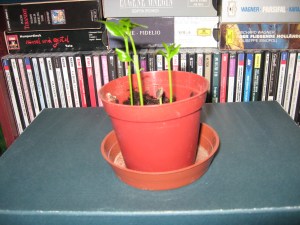
A couple of months ago, on a whim against a draining feeling of despair, I collected five pips from a lemon I had just squeezed into warm water.  Like drinking sunlight.  I pushed the pips into a small pot of soil, which I placed by my window.  Five pips.  Five hopes.  Four in a round, with one in the centre.  Like a star.  Perhaps one of the pips would give birth.  Every day, I collected a little water in the palm of my hand, and let my hope drip gently onto the soil.  Trying to give it rain.  Every evening, I moved it away from the window, before turning on the radiator.  I held the pot in my hands, and imagined the pips asleep, just beneath the soil surface.  Sleep.  Gather your strength.  You need to be strong for this world.  I fought the temptation to scratch the soil with my finger, to see if anything was happening.  Be patient.  Respect what your brain is too limited to comprehend.  Trust what you cannot see.  Five pips.  At least one of you must have enough life in it to burst through.  Just one.  Just so I know there is hope.

Several weeks went by.

IMG_0626

It was the morning of 28th November.  A bright green dot peering through the dark earth, in contrast to the grey sky outside, in defiance of my hopelessness.  There.  I’ll show you.  Look at the effort I’m putting in, pushing through the earth in this bleak winter time, just to pull you out of despair.  By evening, the glossy green head stood confidently above the soil.  I was happy.  So happy.  One of my five pips had made it.  My future lemon tree.  A few days later, just as it sprouted the indisputable shape of leaves, another little green head ventured out of the soil.  Two.  Oh, joy.  Then another…

IMG_0635

This morning, when I opened my curtains, another youngling was straightening its slender green body, shaking off the dust.  Bright green and glossy.

Number five.  The one in the centre of the star.

IMG_0632Scribe  Doll

Posted in Odds & Ends | Tagged , , , , , , , | 28 Comments

Be Yourself – At Your Peril

“Just be yourself.”  How many times have you heard that? It is the advice given by friends, psychologists, life coaches and even career advisors.  “Being yourself” is widely recognised as the best policy.

But what if that were not always the case? Of course, from other people’s point of view, if you are “yourself”, then they know exactly where they stand with you.  What I am questioning is, whether “being yourself” is always to your best advantage.

What if this “yourself” either offends, irritates, discomforts people – or simply does not fit into the socially recognised grid?

In the 21st Century, we pride ourselves with having demolished social conventions.  We have merely changed the material that constitutes our clearly defined social grid.  It is no longer made of heavy, palpable iron bars, but of invisible, though no less present, laser beams.  You get a needle-like burn through your skin if you cross certain demarcations.  As you try circulating from one box to another, you can end up covered in burns.  Scalded, frightened, unsightly, lost and so no longer presentable to Society.  At that point, you can slip off the grid all together, and try to find your way back in but the entrance is now camouflaged, like the door in The Secret Garden.

“I never fit in anywhere”.  You often hear that declared in almost boastful tones by many people in artistic professions.  This reminds me of some of the twenty year-old girls at my university who were so enamoured of Sylvia Plath’s poetry, claiming to relate to her feelings of depression.  I think if you truly related to the profound despair expressed in Sylvia Plath’s poetry, you would be so deeply horrified by it, you would find it too painful to read, let alone go around telling the whole college that you relate to it.  If you are sinking in black, sticky, scorching tar, you want to get out of it, not bathe in it and invite friends to take pictures.  I think if people truly feel that they do not fit in anywhere, they do not shout it from the rooftops.  They would be too afraid of being discovered.  If you had something you knew would make the world dislike you or feel uncomfortable around you, would you really tell the world about it? I find it noteworthy that it is so often artists who win prizes and accolades who say they do not fit in.  The very fact that they have won recognition contradicts that, surely.  Van Gogh did not fit in.  He never sold a painting in his lifetime.

Much gushing is done, nowadays, about the concept of “vulnerability”.  People all over the place encourage you to show your vulnerability.  Being vulnerable somehow equals being endearing. Why?   Every domestic cat knows not to sleep with his/her throat exposed.  It is basic self-preservation.

Yes, I am generalising, and the usual caveat applies.  I am merely exaggerating to illustrate a point.  We all know life is not all in black and white.  However, I cannot illustrate a point in grey.  It has to be in stark black and white contrast to be visible.

“Be yourself”.  What does that mean, exactly? I still do not understand.  I assume it means be honest with yourself and, by extension, with other people.

Can you always be honest?

At a job interview, do you tell your would-be employer that you really, desperately need the money? Or do you tell him/her that this is a challenging opportunity that you have been looking for all your life, and that working for this company is the sole object of your existence? When asked if you thrive under stress, do you laugh and reply, “It is medically impossible to thrive under stress” or do you say that you come alive under pressure?

Society has a list of recognised reasons for distress and, if yours falls into one of those categories, then people flock to your help.  Among them are, bereavement, divorce, loss of job and illness.  Mind, you have a time limit on those, too.  But what if your distress is outside this approved list? How many people would sympathise if (for argument’s sake) after two years, you still grieved your dead cat? Or if (again, just as an example), you hated a situation others considered as “not so bad”? It is so much easier to blame your sadness on something that makes you appear less “weird”.

When people ask, “How are you?” how many are really prepared to hear woes? It is not that people do not care.  Mostly, they do.  What most people hate, is to feel powerless.  If you tell them you are unhappy, they will try and fix it.  But if they cannot fix it, they often resent you for being “un-fixable”.  They cannot bear to have before them what they perceive as their failure to help.  So they avert their eyes – and move on.  One cannot, in truth, blame them.  Would you want to feel bad about yourself?

Our understanding is determined by familiar codes.  Like languages.  People will, I believe, almost always try and help if they understand what you are conveying to them.  But if you speak a language they do not know, how can you possibly expect them to respond? It is not that they do not want to help, it is that there is simply a communication problem.

Of course, it is perfectly possible to live off the social structure.  It helps, if you have financial security and a strong support system.  You must also perfect the art of living without regrets or expectations.

In the animal world, the odd one out is frequently either shunned, or bullied.  It appears to be a natural instinct.  Ethics and religion have spent centuries trying to root that instinct out of human beings.  The result, in this adolescence phase of the human race, is a conflict between reason and nature.

There may – I believe will – come a time when Society is truly inclusive, non-judgmental and enlightened.  I believe, with all my heart, that humans have a great capacity for kindness – even more so than they know.  They just do not always know that.  There’s the rub.

In the meantime, unless you have precious friends who happen to “get” you, appeal to your natural instinct of self-preservation.  Perhaps keep the “being yourself” to “yourself”.

Scribe Doll

Posted in Odds & Ends | Tagged , , , , , , | 18 Comments

Words and Civilisation: “Busy”

As I understand it, it is a medical fact that an allergy is often an intolerance to a substance with which your body is already saturated.  A kind of overflow.  In other words, an allergy is your body’s way of screaming it has had enough.

I have developed an allergy to the word “busy”.

It has increasingly become the one-size-fits-all shield for disorganisation, incompetence, lack of professional courtesy, disregard, carelessness and blatant rudeness.

You attend a social celebration, such as a wedding, anniversary, birthday, christening, etc.  You take the socially de rigueur present.  That is your end of the bargain.  The recipient’s end, is to send the equally socially stipulated thank you note, within a reasonable amount of time.  The prompter the thank you, the stronger the signal that your gift – and you – are appreciated.  Three months go by, and you finally receive the thank you note.  On it, is scribbled, “Sorry for the delay.  I/we’ve been so busy.”

You are left assuming that your friend’s implication is that his/her life is too full of interesting things to prioritise thanking you.


A while ago, I worked for an establishment for over two weeks before I was able to find out exactly how much I would be paid.  Each time I tried to broach the subject, my boss  would wave me away with ,”Sorry, yes, we simply must sort out your pay.  It’s just we’re very busy at the moment.”


I also once had a job interview, at the end of which – since the subject had not been raised by my prospective boss – I asked what the rates of pay were.  “Oh, yes, I knew there was something I had to find out,” he said.  “Sorry, it’s just been so busy  here.”


It took three e-mails on my part, finally to be given a daily rate.


Of course, in the current economic climate in the UK, you are afraid to make a fuss and insist on what some might actually define as your rights.  The unspoken fact that there are plenty of other people out there, who could step into your post at a second’s notice, dictates the power dynamic between you and employers.  The latter are too busy to deal with the tiny detail of your pay.  Apparently, they are too busy to establish a mutually respectful relationship with their staff.


Is the generally recognised definition of work not a financially remunerated activity, or am I being old fashioned?


Another breeding ground where the word busy thrives, is within the context of business e-mails and telephone calls.  Use this code word to justify why you have not returned a message and it places you above the need to provide further explanation.


Those of us who have worked in showbiz, know that this word is a particular favourite among theatrical agents and casting directors (usual exceptions apply).  You leave a message for an agent, enquiring about the availability of a particular actor for one of your projects; or inviting a casting director to a show.  You wait a couple of days, then leave another message.  Until you hear back, you cannot move forward.  You cannot register interest in another actor, lest the first one turns out to be available and keen.  You cannot go ahead and invite another casting director to the show because you might not be able to afford to buy more than one top price West End ticket.


So you ring again, a third time, in a state of anxiety – fearful of being considered a pest – mixed with simmering anger – you resent their blatant implication that they are the ones with the power over you.  They pick up the ‘phone and you mime along as they say, “Oh, sorry I didn’t call you back.  I was really busy.


The tone is invariably cavalier or flippant.  The kind of tone appropriate if the person has mistakenly poured milk into you tea when you prefer it black.  So you refrain from shouting, “And you think I’m not too busy to keep having to call you?!”, breathe a smile into your voice, and reply, “Of course, I understand…” while scribbling profanities on your notepad.


Then, there are those individuals who use the word busy as a conversation stopper. Among those are (again, usual exceptions apply):


– High-profile theatre directors at parties, when approached by anyone considered short-term inconsequential.


– Clergymen after Sunday services, when asked “How are you?” by single females under sixty, just before scooting away.


Other variants on busy are:


Hectic:  Interestingly the term originally referred to the recurrent fever that accompanied tuberculosis.  Perhaps someone should tell them that.  Someone securely established in his/her profession, naturally.


Mad: Do they mean “insane”?


Snowed under: Offer them a shovel.


Some use an original alternative, such as “I am totally disorganised”.  Is that supposed to be a good quality?


Busy.  Perhaps they should patent it as a one-size-fits-all immunity from responsibility  and basic good manners device.


Scribe Doll


Posted in Words and Civilisation | Tagged , , , , , , | 12 Comments

When the Day is Perfectly Still

I like still days, like yesterday in London.

They creep up on you softly and, suddenly, you walk out of the house and find yourself in the midst of one.  Early winter days, when the sky is a grey so pale, it is almost white.  Not a breath of wind to stir the few fiery leaves left on the tree branches.  Not a bird to be seen on the almost naked trees.  Not a sound to be heard.  No squirrel scurries across the lawn.  The garden is cloaked in a fine veil of grey, like a dust sheet.  Everything is so quiet and still, you wonder if the day is there at all, or if you are drifting through a dream.  Then, an insidious, icy dampness unexpectedly permeates your coat, slides its fingertips over the back of your neck under your scarf, and presses its cold lips on your cheek.  And you know, the day is definitely there, around you.  It has been waiting for you, like an invisible stalker.  It is a day that whispers into your ear, “Go back home.  This is no time to be out.  If you do need to be out, then tread softly in the streets – slowly, and make no noise.  Do not be noticed.  I will put my arm around you, and escort you to make sure you are safe.”

And so, after accompanying me to the shop for a pint of milk, the still day then walks me back home, its protective arm around me.  I know it by its cold breath on my neck, in that bare gap between my scarf and my short hair.  It sends a shudder through me.  A warning of sinister abilities, although I know I am not on its hit list.  Whatever its intentions, they are not against me.

It sees me home safely and counsels me to lock the door behind me.  I have no place outside today.  It is a day for staying in and looking out of the window, as the grey veil thickens.  I put nightlights in glass holders, and watch them glow in the dusk.  I make some tea.  It has slivers of almond mixed in with the leaves, and the sweet aroma wafts out of the warm yellow teapot.  Waiting for the tea to draw, I pour milk into the bottom of a bone china mug and take the tin of porridge oatcakes out of the cupboard.   Outside, the street lights come on shyly, glowing faintly in the mist, as though afraid to intrude on the growing darkness.

Everything is still, in a state of anticipation.  As though preparing for something.  As though something is about to happen.

Scribe  Doll

Posted in Odds & Ends | Tagged , , , , , , , | 16 Comments

‘A Many-Splendoured Thing’ by Han Suyin – An Undervalued Treasure

I was very sad to hear, through fellow-Red Roomer Kim Packard, of the death of writer Han Suyin, last 2 November.  Only last Sunday, I mentioned her novel, A Many-Splendoured Thing, in my piece about the moon.  I was very sad, that she did not know just what a powerful impression her best-known book has made on me.  Best-known, because Hollywood made it into a film – with Oscar-winning song – starring Jennifer Jones and William Holden.  Although the film is pure Technicolor, Stereophonic Sound, Swelling Strings and bucketfuls of Sentiment, as only Hollywood used to be able to serve up, it does not do the novel justice, and I am sorry that it is that – rather than the book itself – which sticks in the memory of my mother’s generation.  As for my own generation, I have met few readers who have heard of either the film or the book.  Since the book seems to be  currently out of print, I managed to locate, through Amazon, a copy for myself, then a couple more for friends, neither of whom has read it, yet.  I suspect it lies somewhere, buried under other books or papers, forgotten.  Not contemporary enough, and not a classic.  I guess the enthusiasm I tried to convey was not persuasive enough.

I am genuinely surprised that more people have not read A Many-Splendoured Thing,  since it is a gem.  It is like a small piece of Ethiopian Opal I have.  From a distance it is just a brick brown stone, but pick it up and turn it in the light, and you see flames of gold, vermillion and emerald flashing inside it.

Every obituary of Han Suyin I have read so far*, states that A Many-Splendoured Thing is a love story based on the author’s own true life affair with  journalist Ian Morrison, who was killed whilst covering the Korean war.  A love story, it is.  So much more than a love story, though.  It is a chronicle of Hong Kong life in 1949-50.  A place as colourful as the people who inhabit it, most of whom are just passing.  Western missionaries and businessmen escaped from the troubles in China, waiting in the hope that they can return to evangelising or making money.  Starving refugees who flood in every day.  Wealthy Chinese on the run from Communists.  There is the sexually abused Chinese servant girl  who risks everything to stand up for herself.  There is the narrator’s own sister who defies the rules and traditions of her family with her dream of escaping China.  The British expats who look down on the locals.  Han Suyin describes Hong Kong as a place

“where people come and go and know themselves more impermanent than anywhere else on earth.  Beautiful island of many worlds in the arms of the sea.  Hongkong.

And China just beyond the hills.”

As narrator and character in her own novel, Han Suyin is a Eurasian (her mother was Belgian and her father, Chinese) in a milieu where this is viewed by the polite society of cocktail parties and gossip, as a result of a kind of promiscuity, of breaking social codes.  Yet it is that very mix of East and West that gives her that invaluable insight into both cultures.  She is able to describe each with first-hand experience.

In the book, the narrator – a widow with a young daughter – makes a conscious choice to be Chinese.  Having completed her medical training in England, she waits in Hong Kong for the right time to go and practise in China, confident that the Communists will not harm a doctor.  Loyal to her Chinese upbringing, she does not intend to marry again, saying that her heart is safely dead.  When she meets journalist Mark Elliott at a dinner party, events are triggered that are beyond her careful emotional control.   She describes the meeting in a precise manner which stirs the reader and yet is strangely unsentimental.  A man comes to sit in the chair next to her.  She looks up at him.  Suddenly, she is acutely aware of the texture of the carpet under his shoes, as though it were against her skin.    “It was as if something had suddenly turned in its sleep within me, and sighed,” she writes.

Mark Elliott, however, is a married man.  Moreover, the couple have to contend with the prejudice and offended sensibilities of both Westerners and Chinese.  Han Suyin goes on to relate the affair not merely as a passionate love which capsizes their lives but as a thing of rare and refined beauty.  She describes feelings with the eye of an aesthete admiring the cornflour blue patterns of a rare porcelain vase, or a poet describing the hues of a peacock’s tail.  Both she and her lover are extremely sensitive to Beauty, whether that manifests itself in the perfect roundness of the moon rising up in the sky during the Moon Festival, or the grace of colourful Chinese goldfish, or poetry.  One gets the feeling it is Beauty that nourishes their relationship.  A relationship that lives and breathes every ounce of the world’s splendour.

Like so many Easterners writing in English, Han Suyin’s prose is poetical without too much lyricism.  It is as careful as a quill drawing an abundance of flowery and ornate  – but nonetheless rigorously precise – patterns on a parchment.  Patterns so intricate, you may often interpret them in more than one way.  Here you see the swirly tail of a dragon – and yet it also looks like a bird of paradise.  The double-meanings of Eastern philosophical poems.  The understatements which make the message all the more powerful.

A poem, by Francis Thompson, is also what gives the novel its title.  It is this extract, from O World Intangible, that Mark Elliot sends Han Suyin in a letter from Korea:

“The angels keep their ancient places:–

Turn but a stone and start a wing!

‘Tis ye, ‘tis your estrangèd faces,

That miss the many-splendoured thing.”

Love story, political history, social portrait and pure, unadulterated beauty, A Many-Splendoured Thing is a book that belongs in the Mount Parnassus of 20th Century Literature.

 Scribe Doll

* Han Suyin Guardian obituary

* Han Suyin The Independent article

* Han Suyin New York Times obituary

* BBC Radio 4 Last Word (18 minutes 44 seconds in)

* Television interview with Han Suyin

Posted in Odds & Ends | Tagged , , , , , , | 13 Comments

Theatre: ‘The Upstairs Room’ – We are who we are not in spite but because of others.

Playwright David K. O’Hara

It all began in Oxford, last year, with director James Savin planning to direct Sartre’s play Huis Clos.  Playwright David K. O’Hara read it and something did not sit well with him.  In Huis Clos, we are in hell – represented by a Regency-styled room in which the lights never go off – where a womanising coward, a murderous floozy and a manipulative lesbian are stuck with one another for eternity.  An eternity they spend driving one another crazy but are unable to go against their natures.  Sartre said, “L’enfers, c’est les autres.”  In other terms, it is other people who are hell, and you can only be who you are in spite of other people.    David K. O’Hara did not share that viewpoint.  In fact, he felt strongly against it.  So he went to see James Savin, and volunteered to write – in a month flat – another play to be staged instead of Huis Clos.  A kind of retort to it, which supports the theory that you are who you are because of other people.  This play is The Upstairs Room.

Anthony Cozens (Gordon) and Liza Callinicos (Stella)

David K. O’Hara’s play is set in a London struck by an ecological disaster.  Trying to escape the rising waters, and whilst awaiting forged documents he needs in order to return to  the US, Gordon – a writer – finds himself taking refuge in the attic room of a halfway house.  There, he meets sexy, enigmatic Stella and impish teenager Iris.  Trapped together, the women take Gordon on an emotional roller-coaster which forces him to face the painful truth of who he really is, and why he is there.  When he finally looks at himself, Gordon sees a man he did not know.

Bret Jones (the Manager)

Unlike Huis Clos, what we have in The Upstairs Room is not the eternal damnation of hell, but a cathartic journey through purgatory towards redemption.  Unlike Jean-Paul Sartre, David K. O’Hara gives us a glimpse through all the layers of evil and anger, into what is the fundamental purity of humankind.  He also gives us a glimmer of hope.  Self-destructive patterns can, in fact, be broken, and allow love to flow freely.


The Upstairs Room is a play relevant to our times, when man-made ecological disasters

Lucy Wray (Iris)

are a backdrop to growing poverty, despair and anger.  Confronted by a planet rebelling against human abuse, we are forced to re-examine our values and our long-standing patterns of behaviour both towards nature, and our fellow-humans.

Creating happy, new patterns is also the philosophy of Anthony Cozens, Steven Mills and James Savin, the three men who set up Giddy Notion, the production company staging The Upstairs Room.  “I graduated from drama school ten years ago,” says Anthony Cozens, who also plays the role of Gordon.  “After ten years, you tell yourself that you’ve served a long enough apprenticeship, and it’s time to take your career into your hands, and create an environment where you grow professionally, doing projects you believe in.  So I got together with Steven [Mills] and James [Savin] and we are working on creating a space where not only we three but also other actors and creatives can thrive.  A space where we can all help one another get to where it is we want to get to.”

Director James Savin

In these hard times where Arts funding is cut, and Film, TV, Theatre and Radio sometimes seem to revolve around a small group of box office proven names, Giddy Notion’s mission statement is truly inspiring, and one cannot but applaud it and wish it success.  After all, in these dark times, it is an act of great courage to see light.

Scribe Doll

The Upstairs Room is playing at the King’s Head Theatre                                                    (115 Upper Street, Islington, London N1 1QN) from 13 November to 8 December 2012.   Box Office Tel. +44 (0)20 7478 0160

For further information, please click here.

Posted in Reviews | Tagged , , , , , , , , , , , | 6 Comments

And What of the Moon?

Sun-kissed, sunbathe, suntan, a sunny disposition. Good morning, Sunshine.

And what of the Moon?

In his magical book, Portrait of the Gulf Stream, Erik Orsenna tells us that the Moon is getting further away from the Earth.  No wonder.  There is only so much snubbing a lady can take.  It must be discouraging to play second fiddle to the Sun, millennium after millennium.

In England, the national mood lifts beyond recognition on a sunny day.  Scowling Londoners actually smile at perfect strangers, in the street.  Some will even say, “Isn’t it a glorious day?”

Now the Moon can flood the streets of Mayfair with quicksilver, and let the Thames ripple over her image in its waters.  Nobody will stop and say, “What a splendid night!”

Time and again, I will be walking back from dinner or a show, with a man.  I will suddenly stop in my tracks.  The sight of the moon has taken my breath away.  He inevitably asks what has captured my attention.  I point at the sky.  I seldom get an awe-struck response.  Actually, no, not seldom – never.  They react as though it is just up there, a part of the furniture.  Nothing special.  If a man is not sensitive to the charms of the Moon, then how can I possibly trust him to appreciate me – a daughter of the Earth?

In Han Suyin’s A Many-Splendoured Thing – in my opinion, one of the most romantic novels ever written – the Eurasian narrator and her British lover sit in a restaurant in Hong Kong, waiting for the Moon to rise in the evening sky.  It is the Moon Festival, and the people set off firecrackers to frighten the clouds away from the face of the Moon.  The sense of trepidation, of awe, and of love for all that is beautiful,  makes it one of the most powerful moments in the book, for when the moon finally appears in all her glory, you feel that our protagonists are drawn even closer together by their admiration of her.

I have always loved the moon.  If moonlight ever streams into my bedroom, I open the curtains wide, and go back to bed, basking in its silver glow, feeling protected.  I can sit by the window, and watch the moon for hours, breathing in her inspiration.  I love all phases of the Moon.  I have seen a delicate New Moon crescent suspended from a black sky, over a minaret, in the Alhambra.  I have seen a huge, amber Full Moon reflected in the Canal Grande in Venice.  I have seen a platinum Gibbous Moon look down on the Palace of Westminster, part of her face hidden, as though under the wide brim of a hat.

Since I was a child, I have dreamed of living in a house with a top room with a glass ceiling.  I could then lie in bed, and watch the Moon and Stars slowly travel across the sky above me, as I drifted into sleep.

I do not like scientific programmes or articles about the Moon.  I am too much of a romantic for that.  I like to see the Moon from the distance nature intended.  A distance wide enough to allow room for all my fantasies.

As a child, I wrote fairy tales.  In one of them, I imagined an entire realm of castles and music on the Moon.  Humans could not see it, of course.  Over the course of my life, I have confided in the Moon many a secret, uttered many a wish, and shared many a joke.

There is magic, ispiration, romance and mystery in moonglow.

Oh, and contrary to the lyrics of A Nightingale Sang In Berkeley Square, the Moon is a she.  Most definitely.  Just look at her.

Scribe Doll

Posted in Odds & Ends | Tagged , , , , | 18 Comments