Time for a Change?

“Change your city, change your luck.”  It is a Jewish saying, my osteopath told me.

In a Russian fairy tale, the Tzar bids his sons go into an open field with their bows and arrows, and aim into the air.  Where their arrows land, there lie their fortunes.

In my case, I wrote the names of seven cities on small pieces of paper, folded them into tiny squares, put them in a mug and shook.  I closed my eyes and pulled one out.  So be it.  I unfolded the paper and read the name of an old city, built on a land so flat, the horizon goes on for ever, and where the skies are colourful and moody; where there is no mountain or hill to tame the wind.  A city of linguists and scribes.

I have lived in London for nineteen intense years.   Intense, because it cannot be otherwise, in London.  It is a city that flings open its doors and offers you the best of everything money can buy.  Theatre, concerts, art, restaurants, libraries, etc.  Whether you like the sophisticated boutiques of the Burlington Arcade, the self-styled scruffiness of Camden Town, or the quirkiness of Notting Hill, all you have to do, is ask – as long as you can pay.  If you cannot pay, though, the doors of all those rooms of glitter and possibilities slam shut in your face.  If you have no money, your London is a draughty, lonely corridor of unforgiving grey.

I am weary of looking through other people’s windows.  Of spending Christmas alone because one of London’s aberrations is no public transport whatsoever for thirty-six hours.  Of rents soaring while my income slumps.  I am weighed down by my sackful of errors and failures, which London does not forgive.

I am black and blue with London’s knocks and am tired of focusing my energy on fighting back.  My back is stiff and hunched.  It is time to stop fighting and start building.  I do not want to hear “What doesn’t kill you makes you stronger.”  Instead, I will heed the warning of one of Literature’s most perceptive observers of human nature, Somerset Maugham, that  “It is not true that suffering enobles the character; happiness does that sometimes, but suffering, for the most part, makes men petty and vindictive.”

Dickens shows us that it is misery and loss that gradually harden Ebenezer Scrooge’s heart.  He is not born cruel.

If I leave London, I shall miss it.  I think of hearing so many different languages on the bus, of warm crusty bread from the Turkish Bakery, of poppy seed cake from the Polish shop and of soft leather shoes from the Italian store.  I think of the thrill filling up my heart when the orchestra tunes up at the Royal Opera House, and of the excitement at hearing the opening chords of a West End musical.  I think of the high-gloss polish of a stage actor’s velvet voice, uttering powerful, soul-stirring words.  I think of French breakfast on a summer’s morning, on the Old Compton Street pavement, before Soho is fully awake.  I think of the luxury of a West End Opening Night party, where it is so easy to forget there is an economic crisis just outside the shiny revolving doors.  I must remember that I can no longer afford any of that.  Theatre tickets are now out of my reach, and Soho breakfasts seem like too much of an extravagance.

I think for as long as you are able to imagine good things happening, there is always the possibility they might happen.  It is imagination that keeps you alive.  But if you lose the ability to imagine, then it is time to move on, and look for something new to capture and revive your imagination.  Time – at least  to consider the possibility of change.  Time to straighten up and look beyond the horizon.

And so, time to pack my suitcase.

Scribe Doll

Posted in Odds & Ends | Tagged , , , | 37 Comments

Britain Sees Snow for the First Time – Again

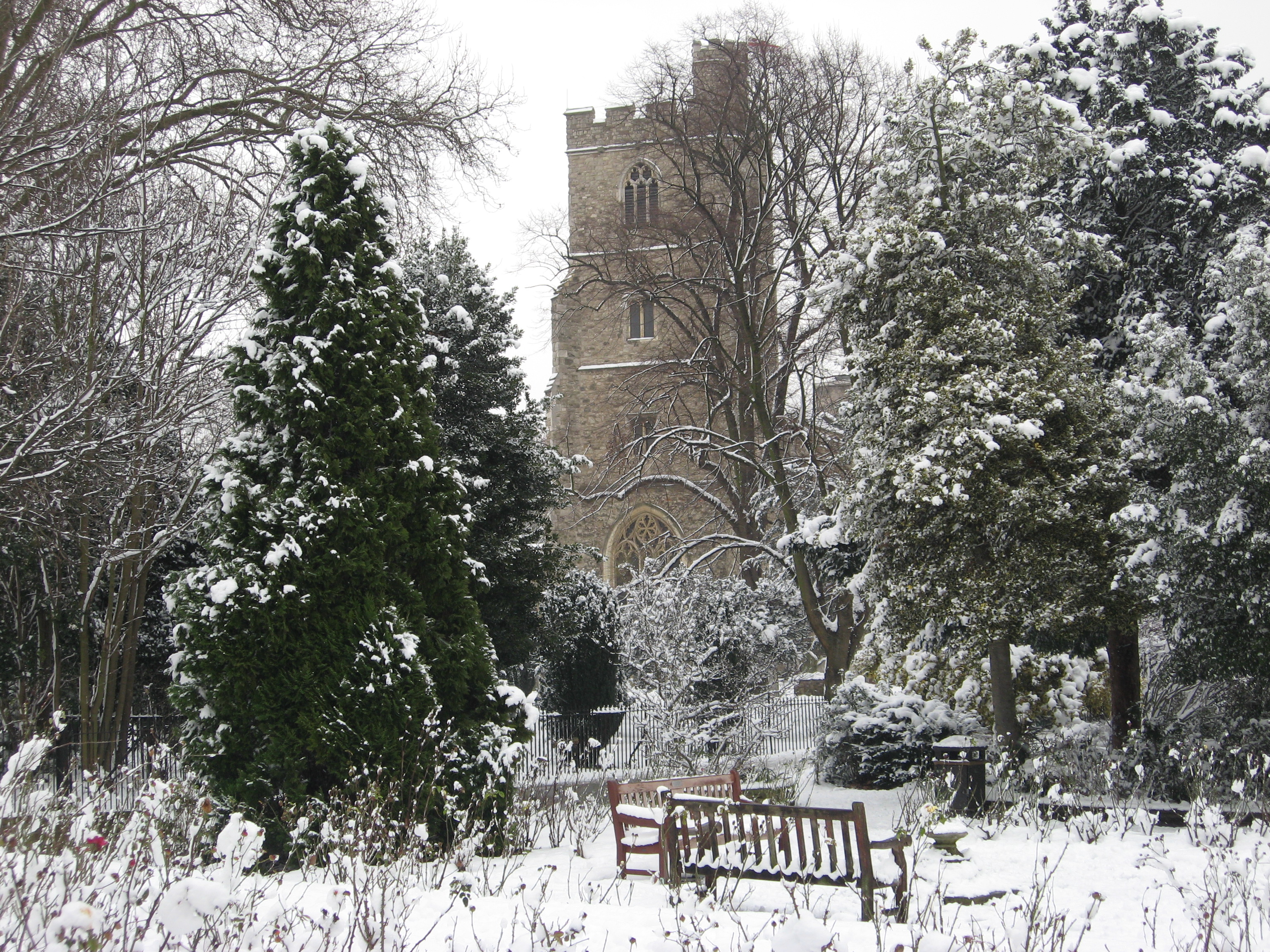
IMG_0058We had some snow, a couple of weeks ago.  Soft, white powder sifted out of a dark grey sky all day, without stopping.  Eventually, the dusting on the ground and roofs thickened to a cloak, and muffled the city sounds.  I love snow.  The crunching under my boots, the sensation of cleanliness, the crisp air.  I start listening to Grieg’s Peer Gynt, Tchaikovsky’s Pathétique and other “snow soundtracks.”  I wear a thick pair of Irish wool socks inside my only footwear that is really snow proof – a pair of black Wellington boots.  No – not the trendy ones, that bear a label with another word for “pursuer” right below the knee, and that all the London bright young things are now wearing at the first few drops of rain.   These ones, I bought from a Cambridge camping/army shop, and cut down to calf-length with a pair of kitchen scissors, in preparation for a winter trip to Wisconsin, about twelve years ago.  Wisconsin, in a place where the snow was high and the squirrels gargantuan, where I caused much vocal excitement among the neighbourhood dogs for being the only pedestrian, and where I could not find anywhere to serve me dinner after 7 p.m.  In a place where the landlady of the guest house could not fathom why I considered sweetened pancakes and maple syrup a little sickening (I finally asked her for scrambled egg on toast and she put sugar on the toast!)

IMG_0063

Back to the snow.  I find snow magical and there are few places in the world where snow possesses special, mind-altering powers, as it does in England.  For, indeed, here, it has the power to produce amnesia.  In England, it now snows most winters and yet, every year, the nation reacts as though it has never seen it before.  A few flakes suffice to trigger overwhelming incompetence and disorganisation in the land.  In London, except for the Centre and privileged areas like Chelsea, Kensington and Holland Park, the authorities mysteriously never seem to have enough grit to scatter on the streets.  Where I live, for instance, snow is 5% joy, snowmen and walks in the park (the first day) and 95% contending with icy pavements, trying not to slip and break a limb (the following week).

If you are lucky enough to live in area where grit is abundant, you see the ratherIMG_0065 unaesthetical transformation of fluffy white into brown slush.  When I was in New York, I noticed people spraying something on the snow which made it manageable for pedestrians whilst keeping it white.  Here, we lack the Manhattan sense of style.  In the spirit of no-nonsense practicality, we use unattractive brown grit.

When I lived in Rome, where snow falls ogni morte de papa (literally, “about as often as a pope dies”), when the white stuff did fall from the skies, I saw anti-slip chains on the tyres of many cars.  I have never seen them here.  Here, snow sends public transport into a panic.  Buses are delayed or cancelled and even the Tube can be affected.  I am still trying to figure out how snow can stop underground trains from running…

IMG_0071It is Candlemas.  The snow has disappeared.  Vanished, as though it never happened.

By Shrove Tuesday, our memories will have been wiped cleaned.

Then, next January, when it snows again – snow? What’s snow? How do we cope with it? Oh, dear!

Scribe Doll

Posted in Odds & Ends | Tagged , , , | 19 Comments

The British Obsession With Accent

In a café, after a West End matinée.  My friend has just introduced me to an acquaintance of hers, then left us alone to go and order tea.  “So what did you think of the show?” he asks.

I reply, “Well, I enjoyed the number with –”

“Where are you from?”

I am interrupted mid-sentence.  I say nothing, and glare.

“Where are you from?” Almost an order.

“It’s a long story,” I say, coldly.

You would think he would take the hint and back off.

“What do you do?” His tone becomes insistent, almost frantic.  Like a man lost at sea, desperate to clutch at something, or he will drown.

I can see he will not even pretend to be interested in what I have to say about the show.  “I’m a translator,” I say.

A glimmer of hope flashes across his face.  “Which languages?”

I sigh with as loud a pectoral rasp as I can produce.  “Italian, French and Russian – into English.”

His face relaxes.   His index finger taps on a list in the air.  “Ah, so you’re… (sotto voce) Italian… French… Russian.”

Thanks be!  He is now safely clinging to a bouy.  Because here, until you are able to pigeon-hole someone, you are drifting in dangerous waters.

Like so many others, this man has made the easy assumption that, just because I speak these languages, then I must automatically come from those countries.  Actually, by blood, I am not Italian, French or Russian.  But I did not want to play on the man’s vulnerability, and confuse him further.  What I wanted to tell him, was that I am mostly English, with an authentic English temper spiked with inborn sarcasm and – since I was not brought up in England and trained to keep it in check – if provoked, it flies out, unrestrained, in its purest, most unadulterated, caustic form.  The kind that would make John Donne, Sir Francis Bacon and many characters played by Maggie Smith cheer.

However, one thing I was taught, is that sarcasm is like fencing.  You do not engage with someone who cannot keep up with you…

We know from George Bernard Shaw’s Pygmalion that, in England, what places you, gives you your social position, and puts you into the correct trial dock, is your accent.  Even now, your accent is what influences people’s behaviour towards you.  Is it regional? Is it cut glass? Or – worst of all – is it slightly foreign?

It seems the British are incapable of having a conversation until they have placed your accent.  Until they can do so, panic – or disapproval – reigns supreme.  It is as though what you are saying cannot be heard or mentally processed until the exact origin of the speaker is determined.  As though they cannot decide whether to believe you or not until they know where you come from.  You can parry as much as you like; they will not stop until they have gained access to your very D.N.A…

Many years ago, I was at a luncheon in a Cambridge College.  I was having a seemingly anodyne conversation with one of the Fellows about the acoustics in an opera house.  I remarked that the sound naturally rose, so the best way to judge a singer’s voice, was to sit in the gods.

“Do you have scientific proof for that?” asked the Fellow.

“No.  I’m not a scientist.  Next time you’re at the opera, sit in the gods, and judge for yourself.”

“You weren’t born in this country, were you?”

There it was, slam bang below the belt.  As though the fact I might not have been born in this country suddenly invalidated my opinion about music.

“How is that relevant to the conversation we were just having?” I asked.

“Well, I’m making it relevant because it’s interesting.”

“Well, it’s not interesting for me.”

Eventually, he apologised.

Interesting? Then go the British Library and pore over a manuscript.  That would be far more interesting. 

Another thing which puzzles me.  What importance can the place of your birth possibly have, except for governments in deciding whether or not to grant you citizenship? What difference does it make where I was born? The place of birth does not have any bearing on my blood heritage.  If I had been born on a boat in the midst of an ocean, would that make me a fish? Personally, I was born in one country but my parents came from other parts of the world. So which is my country? I am half-English, I love England and feel English – until someone rudely interrupts me mid-sentence to ask where I am from.  There are times when I truly wish some of the British advocacy for political correctness, politeness and inclusiveness would be extended to me.

A few weeks ago, once again, I was bulldozered by a lady in the shop, while I was making an observation about the weather.  She thought herself very perceptive in declaring me French.  I enlightened her by saying that, although I had received a French education, and had lived in France for six years, I was not, in fact, French.  I normally wait what I consider a polite amount of time before I ask strangers where they come from and, even then, I prefer to wait until the conversation touches upon the subject of languages, travel or geography before I enquire.  This time, I made an exception.  “Oh, I’m English!” she retorted with a noticeable expression of outrage.  “It’s an upper-class English accent.  Queen’s English.  Now if you were English, you would know I sound aristocratic.”

She brought back to mind Saint Bonaventure’s quotation, “Exemplum de simia, quae, quando plus ascendit, plus apparent posteriora eius” or Sir Francis Bacon’s translation thereof, “He doth like the ape, that the higher he clymbes the more he shows his ars.”

I nearly replied that it was rotten luck her aristocratic family had clearly been too impoverished to purchase her a copy of Debrett’s Etiquette and Modern Manners but, as I said, one thing I was taught, is that sarcasm is like fencing…

I find it rather distressing, that given our national pride in subtlety, most people do not seem to take a subtle hint that you are trying to evade the question.  Try and change the subject, and suddenly, they all turn into prosecutors.

Where are you from?

Well, it’s a long story…

Well, I shan’t bore you…

Oh, I don’t really like to talk about it…

For all your attempts gently to elude them, they push ahead.  However, try telling them to “mind their business”, and you are the one perceived as rude.

I have been asked if I am French, Dutch, Irish, German, Swedish, Spanish or Irish.  The most frequent choice, though, is probably South African – even though I have never ever been to South Africa.

Yes, I find it tedious to keep trying to explain to people where I come from, since I am like the pattern on Harlequin’s dress, and so unable to give a straightforward answer.  I have the non-descript accent of one who was exposed to several languages from birth.  However, I am not averse to satisfying their curiosity, when they phrase the questions with  some delicacy, as genuine, enthusiastic interest, and do not cross-examine me as though sitting in judgement of me.

A couple of months ago, I was at a drinks do with a friend.  We struck up a conversation with a man.  He happened to be a barrister.  We spoke for several minutes – about the Royal Opera House production of Die Meistersinger von Nürnberg, about the music of Hildegard of Bingen, then about travelling and local customs.  Then he cocked his head and smiled.  “May I assume you’re not from London..?” he said, his tone politely unobtrusive, suggesting his curiosity was prompted by my enjoyable contribution to our earlier conversation, rather than suspicion on his part.

I was happy to tell him my whole story.

And if you really want to hear my accent, listen to this podcast: http://redroom.com/member/katherine-gregor/media/audio/crows

Scribe  Doll

Posted in Odds & Ends | Tagged , , , , , , | 30 Comments

The Astrolabe. Why have Sat Nav or a Smartphone?

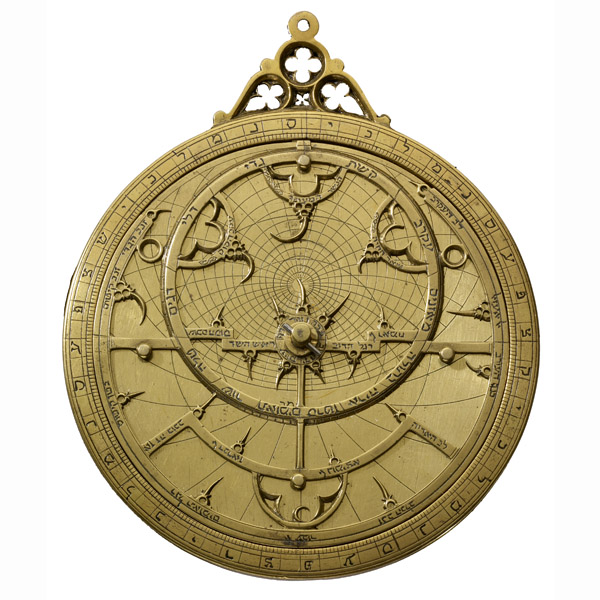
I have a favourite artefact at the British Museum.  One I never fail to go and admire, whenever I happen to be visiting this treasure trove of international archeology.

Copyright Trustees of the British Museum

Hebrew Astrolabe (front view) Copyright Trustees of the British Museum

It was a couple of years ago.  I was lucky enough to have the day off teaching, and was lazing in bed later than usual, listening to BBC Radio 4.  They had been broadcasting a wonderful series, in fifteen-minute episodes, called The History of the World in 100 Objects, but I had heard very few because of my workload.  That morning, I turned up the radio, and heard the Director of the British Museum, Neil MacGregor, talking about a fourteenth Century astrolabe.  I had no idea what an astrolabe was.  From the Greek, meaning “Star Finder”.  I was so mesmerised by his description that, within minutes of the programme ending, I had dressed, breakfasted, and dashed out of the flat.  I had made plans for my morning off but, at that moment, none seemed as urgent – or as fun – as going to see this extraordinary object for myself.  And so I took the Tube to Bloomsbury, and walked up the steps of the imposing Grecian building.

I was not disappointed.  Even now, the more I see this astrolabe, the more it fascinates me.  Peering through the glass display cabinet, my glasses on my nose, I long to hold it in the palm of my hand.  I yearn to feel the coolness of the gilt brass, and run my fingertips on the delicately engraved inscriptions and symbols.  Letters in Hebrew, Arabic and Mediaeval Spanish.  Symbols that remind me of Moorish arches and Gothic vaults.  Such a small object, yet charged with the knowledge of the man who crafted it with such precision, and the knowledge of the man who owned it.  Without doubt a highly intelligent, educated man.  Perhaps a scholar.  Or a wealthy man with a love for knowledge.

Hebrew Astrolabe (reverse) Copyright Trustees of the British Museum

Hebrew Astrolabe (reverse) Copyright Trustees of the British Museum

A small, beautiful instrument, crafted over seven centuries ago, during the Spanish golden age of the convivencia, when three religions brought their knowledge together for the love of Science and the Arts.  An instrument that can tell you the time, your geographical position with the help of the sun and the stars, draw your horoscope, and perform mathematical calculations.  A reproduction of the firmament, in the palm of your hand.  Unlike the BlackBerry from which I finally un-slaved myself, a couple of months ago, the astrolabe needs not be at the whim of signal, or charged up.  Moreover, let  us admit it – is it not aesthetically superior to any of the latest smartphone designs?

I read on the BBC website that the astrolabe was a globe, a map, a sextant, a chronometer and a compass, all in one.  So what led us to compromise our standards, and settle for objects that are inferior to this perfect and conveniently-sized one? I cannot help but consider it as yet another nugget of human brilliance which, like so any others, has been buried in the dust of modern ignorance.  We know so much more now – and so much less.

How I wish I could have an astrolabe, and someone to teach me how to use it.

I cannot recommend the episode on the Hebrew Astrolabe highly enough.  It is only fifteen minutes long, and can be heard on the BBC website here.  You can even download a free podcast.

I wish to thank the Web Team at the British Museum for kindly allowing me to use the image of the astrolabe.

Should you be planning to visit the British Museum, here is a link to the page about the Hebrew astrolabe.

Scribe Doll

Posted in Odds & Ends | Tagged , , , | 14 Comments

Epiphany and an Old Woman Bearing Gifts*

Traditionally, it is La Befana – and not Father Christmas – who brings gifts to the children of Central Italy.  It is on the morning of the Epiphany, that children would wake up to find packages under their beds.  If they had been good children for the preceding twelve months, of course.  La Befana is a dishevelled old woman in rags, covered in soot from the chimneys she slides down, and always with her broom, to sweep all the old year’s troubles away before the leaves your home.

Imagine my surprise, this morning, when I found a gift from La Befana under my bed.  Was I a child again? A glance in the mirror gave me a quick – if rather undiplomatic – assurance to the contrary.  And yet there it was, in my hand, a small velvet pouch containing six memories.  One for the first six days of the New Year.  Six gifts.  One by one, I looked at them.

ONE: an unexpected kindness 

I was broke.  I had to go into town, and the fares had just made their usual January leap.  I was queuing for the ticket machine at the Tube station, feeling miserable.  Of course, I had no one to blame but myself, but that only exacerbated my feeling of being totally useless.  Out of nowhere, a man – a stranger – walked straight up to me, a day travelcard in his hand.  He had a kind face.  “I’ve finished with this for today,” he said.  “Can you use it? It seems a shame for me to throw it away.”

I still carry that travelcard in my wallet, as a good luck token.

TWO: when animals understand

Feeling alone in a crowded Tube carriage.  I think, I speak four languages, but nobody can understand me.  I am defective and cannot be fixed.  There is no place for me in this world.    I understand you, without the need for your languages.  I look up and meet the deep, liquid gaze of a black Cocker Spaniel.  She is staring at me intently, wrapping me in the unconditional love in her glistening eyes.  You are not alone.  She is too far for me to reach out and stroke her silky head and long ears.  We stare at each-other until her master needs to get off the train.  She turns to me with a parting glance.  So now you know.  Don’t go having such silly thoughts again.  I wink back at her.


I am walking with a friend in Kensington Gardens.  Swans are loitering by the pond.  “I wish I could have a swan feather,” I say.  I walk up to one of the swans, who is grooming his silky plumage.  “Will you give me a feather?” I ask.  My friend looks on, tolerantly.  A feather drops from the swan but is carried away by the ripples in the water before I can catch it.  I ask again.  This time, the swan pulls out a long, snow-white feather, and tosses it unmistakably towards me.  My friend’s mouth is agape.  “No one would believe it,” she says.

I carry the feather inside the flap of my writing folder.


THREE: cover for a book that is to be written

I am having trouble starting my novel.  The prospect of writing 100,000 words fills me with insurmountable dread.  I do not know where to begin.  I am having tea with a friend.  He says, “Begin with this.”

He takes out a plain sheet of A4 paper, folds it half and makes it into a book cover.  On it, he writes the working title of my novel and my name.  “There,” he says.  “The cover is done.  Now you just have to write the book.”

It is so simple and yet so effective.  I go home and start writing.


FOUR: a family Easter

This friend has not known me all that long, and yet she invites me to be part of Easter luncheon with her family.  I have never met them, yet they welcome me not as a stranger, but as one of them.  There are no enquiring looks or awkward questions.  I am enveloped in the warmth of their hospitality and in the joy of the occasion, as though they have known me all their lives.    


FIVE: Doctor Theatre

This friend is my fairy godmother.  She always seems to know when I get lost in the dark oubliettes of my head, and need dragging out and throwing out in the sunshine.  She takes me to see a play.  She knows one of the actors.  I drink the carefully crafted language, the challenge of the thoughts behind it, the velvet timbre of the actors‘ voices.  I feel the joy of watching highly-polished British actors do what they do best.  No movement, no glance, no breath is out of place.  After the show, we have drinks with other actors.  I could listen to their voices for ever.  They are bewitching, mellifluous, rich.  I am in the presence of Beauty.  I dream of these voices someday speaking the words I write.


SIX: to honour two steadfast friends over land, dale and sea

I have not seen either of them for over a decade.  Yet no writer ever had such champions for her pen.  They always have a kind word to say about my writing.  They have not missed a week in nearly two years of my blog-writing.  Every week, they send encouragement.  Sometimes, it is no more than a word – but always a word chosen with the greatest care.  Just to remind me that they are right there, behind me, rooting for me.  Little do they know, just how much their support means to me.


As I pour the six memories back into their pouch, I suddenly see a seventh one, concealed at the bottom, which I had previously failed to notice.  It is a coffee shop gift card, a dear  friend gave me on New Year’s Day.  He said it will make it possible for him to buy me a hot chocolate if I really need one, and he is not around, so that I never feel quite alone.  As I put it in a safe place, I realise this card is actually a key.  A key to a story.  In fact, more than one story.

A story for every cup of hot chocolate on that card…


* Scribe Doll begs her readers to allow her just a tiny little dusting of poetic licence.


   Scribe Doll

Posted in Odds & Ends | Tagged , , , , , , | 22 Comments

A Broom to Sweep Out the Old*

In Rome, at this time of year, among the blocks of torrone and wedges of panforte piled up on the market stalls, you can also buy a scacciaguai.  It is a miniature broomstick.  People hang it just inside their front doors, to keep their homes clear of trouble for the coming year.

When I was a teenager, and we were living in a less than classy area just outside Rome, the approach of the New Year was greeted not only with fireworks and the loud crack of botti, but with the crash of glass bottles and unwanted furniture thrown off the balconies, into the street below.  The fracas was exhilarating.  Cathartic.  Getting rid of the old to make way for the new.

Getting rid of things, yes – but also, shedding relationships you no longer need.  Toxic relationships, draining, one-sided, or simply unnecessary ones.  Why clutter your life with what you do not need or want? Unclasp your arms from around people you have been fiercely clinging to for years, and stand back to see if their arms are also around you, or if they hang limp.  Unclasp your arms and see if these people suddenly jerk forward, and grab hold of you, or if they drift away without looking back, as though you had never been there.

In this strange and wondrous whirlwind that was the past year, I lost three relationships.  Three friendships I thought were for life.  Friends I had held onto for many years.  Then one day, I noticed that it was my arms alone that were holding the friendship together.  So I closed my eyes, took a deep breath, and opened my arms.  When I looked again, they were gone, without a sound.  No one cried out for me not to let go, nor grabbed at my sleeve.  They simply drifted away.  That was months ago.  There has not been even a Christmas greeting from them.  I now know they are gone for good.

Much is made of the virtues of giving without expecting to receive, but not enough is made of receiving – of accepting – passively, without engaging in return.  After all, is that not like receiving without giving thanks?

When you invite friends for a meal, you cook for them wholeheartedly.  When you help them in their careers, you do so enthusiastically.  When you involve them as part of important moments in your life, you do so spontaneously.  You do not draw up a profit forecast.  So when, at first, they do not reciprocate, you do not notice.  After all, who’s counting? Then, the years go by, and you hit the proverbial hard patch.  You are suddenly unable to give.  That is when you notice that your ‘phone does not ring.  That your e-mail inbox is empty.  That you have stopped spinning the wheel and the whole machine has stopped turning, as a result.  You notice that people clamour to see you the week before Christmas, and the week immediately after New Year’s.  But not on Christmas Day, or on New Year’s Eve.  Not on the special days.  And, in a Eureka! moment, you suddenly realise that, while you have been giving these friends starring roles on your life’s stage, you have been a spear carrier in theirs.  And who notices if the spear carrier slips off the stage? It is not their fault.  Sometime, long ago, they offered you that part, and you accepted it.

Ring ye bells! Sound ye trumpets! And bring me the broom.  I no longer want to be a spear carrier.  Bring me the broom, that I might sweep my decks clean.  It is no big deal.  After all, I am only sweeping out what was not really there in the first place.  And if, by any chance, I try sweeping out something real, then I am sure that he or she will voice a protest.  In that case, I will apologise, and keep sweeping around him or her.

Bring me the broom, that I may clear the space for the new.  This time, I know it will be real.

Happy New Year to you all!

*I wish to dedicate this piece to those precious, much-loved friends, who have constantly held onto me.  Keep holding on.

Scribe Doll

Posted in Odds & Ends | Tagged , , , | 19 Comments

Short Story: ‘Christmas Eve’

Instead of the usual blog, a short story, for a change.  A gift.  The season demands it.  I hope you enjoy it.

Christmas Eve*

She scratched the paint off the woodwork with her fingernails.  There was a hollow, there, on the side of the bannister.  Wedged inside was a piece of paper, yellowed by time.  A youthful poem in faded ink and, at the bottom, the familiar signature of an old friend.  A friend who had believed in him.  Believed in her.

*   *   *

“You’re not a poet,” Jonathan said.  “No one will publish these.  Trust me, I’ve been in the business long enough.”

Heather felt something cold in her belly.  She reached for the green hardback notebook on her husband’s desk.  She felt suddenly resentful, not because Jonathan had, once again, put a wet blanket on her poetry, but because he just sat there, already fully absorbed by his new novel, typing mechanically.  He could at least hand her the notebook back – show some kindness – instead of leaving it on the corner of his desk.  She wondered if he actually saw her standing there.  Jonathan had an extraordinary ability to switch off his surroundings, even when these included Heather, and concentrate on whatever he had to do at the time.

“I am going to make Christmas pudding,” she said deliberately loud.  Jonathan continued typing.  She wanted to grab him by the shoulders and shake him.  Say somethingTell me I should have made Christmas pudding months ago.  Look at me!

Heather kept glancing at her notebook on the kitchen table, whilst mixing the dried fruit and spices.  She needed its company.  She walked over to the counter to turn up the radio.

Once in Royal David’s city…

The treble’s voice rose up to the fan vaulting in King’s College Chapel like a moonbeam.  Heather wished she had gone to the carol service there.  As an undergraduate, she had gone every year.  Thinking back, she realised she had not been to carols at King’s since her marriage.  Jonathan was a fellow at Corpus Christi and for the past ten years, she had attended services there.  The college which boasted alumni like John Fletcher, Christopher Isherwood and Christopher Marlowe.  The college of great poets and playwrights.  She did not like the Corpus choir.  She always found women’s voices in a choir too strident.  Of course, dining at High Table, Heather could not say that she preferred trebles.  It would have been undiplomatic.

Of course, no one actually forbade her from going to King’s.  It was just another unspoken rule Heather had imposed upon herself in recent years.  In order not to embarrass Jonathan.  One of the youngest and most respected Corpus Christi Fellows.  A brilliant historian and a successful novelist.  The BBC were about to dramatise one of his historical novels.   That was all the Master and Fellows had talked about at High Table for the last few weeks.  Naturally, they were proud of their celebrated Corpustle.  Why should they not be?

A light dusting of sifted flour settled on the glossy green notebook.  Jonathan’s words echoed in her head – “You’re not a poet.  No one will publish  these.”  Heather was angry for allowing herself to be so demoralised.  After all, as an undergraduate at Pembroke, she had won poetry competitions.  She had been invincible.  She tried to remember the precise moment when she had lost all that; when she had first felt afraid.  After she had married Jonathan, she had continued writing for a while, even submitting a few of her poems to agents and publishers.   Rejections did not deter her at first.  She knew it was the normal course of things in the beginning.  Jonathan had been very supportive.  In fact, he had offered his advice as an already established writer.  First, on how to approach people with a view to publish; then, on how to present yourself as a poet.  And finally, on how to write a publishable poem.  Heather had been grateful for the interest her husband showed in her work.  He seemed to know that it was not enough to write from the heart.  One had always to bear in mind the public taste of the moment.  So Heather altered her writing style.  She wrote every new poem according to the new trend then presented it to Jonathan for constructive criticism, after which she would go back and rewrite it.  She needed her husband to guide her, help her, correct her lack of business sense.

That was all in the first three years of their marriage.  Since then, she had got into the habit of showing Jonathan everything she wrote.  And she resented this habit.  He never liked what she wrote.  Her long, slanted, Parker fountain pen handwriting would come back littered with tiny biro annotations between the lines.  Like spiders, crawling all over her writing.  In spite of that, Heather did not manage to have her poems published.  In fact, she had not submitted any for years.  Jonathan – and she – did not think they were good enough.

Adam lay ybounden

Bounden in a bond;

Four thousand winter

Thought he not too long.

Heather had liked that carol for as long as she could remember.  She found its simplicity appealing and unexplainably familiar.  She remembered that she had a shiny penny in her purse.  She took it out and washed it in the sink.

And all was for an apple,

An apple that he took

As clerkès finden written in their book.

She held the penny in her hand and tried to make a wish but could not think of one.  She dropped the penny into the pudding mixture and gave an anti-clockwise stir with the wooden spoon, without making a wish.  She then poured the mixture into a ceramic basin and proceeded to tie the greaseproof paper over it.

Ne had the apple taken been

The apple taken been,

Ne had never our Lady

Abeen heavenè queen.

“That smells nice.”  Jonathan was standing in the doorway.  “Need any help?”

“I’m nearly done,” said Heather.  “I just have to steam it.”

She took a tea towel, smoothed it over the basin and wrapped the string around the lip.

“Let me tie that for you,” said Jonathan.   He lifted the corners of the tea towel and started tying them together.

“I said, I don’t need your help!” Heather nearly shouted, grabbing the basin away from him.

She saw her notebook fly towards the counter with a crash.  Too loud a crash for a cardboard cover.  The raw Christmas pudding lay splattered over the ceramic pieces of the broken basin.  At first, Heather could not move.  Then she stepped over the magma of dried fruit and egg, and picked up the green notebook which lay on the floor, its cover spread open and pages creased underneath.

Blessèd be the time

That apple taken was,

Therefore we moun singen

Deo gracias!

“Why are you so jumpy? What’s the matter?” Jonathan’s voice was impatient.

Heather crouched down and started clearing the mess on the floor.  “Oh, God,”  she said.  “I can’t face doing this again.  I’ll pop out and buy one before the shops close.”

“Are you all right?” asked Jonathan.

“Yes – just tired.  I’ll feel better once I’ve had some air.”

Jonathan left the kitchen, with Heather scrubbing the floor.  As she put on her duffel coat, she heard the quick tip-tap sound of his typing.

The chill of dusk was a welcome sensation on Heather’s face as she cycled down Silver Street and along King’s Parade.  It was unusually cold and crisp, and Heather felt grateful for being spared the usual mild and wet Cambridge Christmas.  She locked her bicycle at the back of Corpus Christi , and rushed to the Marks & Spencer on the Market Place.

Heather picked off the shelf the first Christmas pudding she saw.  She did not want to have to choose from the half an dozen or so different types.  She wanted to have enough time for a stroll before going home.

On the Market Place, vendors were packing up their stalls.  A man strode past her, carrying a small fir tree.  She followed him with her gaze, as he rushed past Great St Mary’s.  She was sure he had a family waiting for him at home, with mince pies, tea and the scent of cinnamon and nutmeg.  He had children waiting for him at home.  Children who would have to be cheated into going to bed early, to give Father Christmas the time to leave brightly wrapped parcels at the foot of their beds.  For years, Heather had fantasised about how she would instruct her own children to leave a glass of sherry and a mince pie on the mantelpiece for the night.  Children she still did not have.  Jonathan kept saying they had plenty of time.

Waves of treble voices filtered through the stained glass window of King’s Chapel.  Heather sat on the low wall on King’s Parade, trying to catch the errant sounds.  She shuddered.  The temperature was dropping and she stood up again, and walked slowly along King’s Parade, towards Corpus Christi.

“May I have the key to the chapel?” Heather asked at Corpus Christi Porter’s Lodge.

“Of course, Mrs Fleming,” said the Welsh porter.  “And how is Dr Fleming? At home, is he?”

“Yes, he is doing some work.  I thought I’d take a walk and sit in the college chapel for a few minutes.  I’ll bring the key back.”

“You stay as long as you like.  I’m off shortly, so just leave the key on the desk here.  Happy Christmas.  Give my best to Dr Fleming.”

“Thanks, I will.  You have a good Christmas, too,” said Heather.

The college chapel was dark, except for the moonlight streaming in through the large, stained glass window.  Heather refrained from turning on the lights.  She did not want any passing Fellows noticing the lights from the Court and walking into the Chapel out of curiosity.  Instead, she fumbled around the vestry for a couple of candles and a box of matches. She lit the candles and placed them into holders in the choir stalls.  They gave sufficient light for her to see her own handwriting in the green notebook she took out of her bag.  Heather could not explain even to herself why she chose to sit on the hard bench of the choir stalls.  The Fellows’ seats were wider and made more comfortable by padded velvet.  The candlelight threw dancing shadows over Heather’s handwritten poems.  Jonathan would be wondering where she was.  She would have to go home soon.  Her mind wandered as she drifted into sleep…

*   *   *

Roderick knows he must make haste.  He whisks a stack of sheet music off the oak table.  His surplice is on the bed.  He needs that, too.  Run, run downstairs into the Court.  He wonders if Kit is still sleeping.   They drank much ale, last night, at the Eagle.  The icy wind takes his breath away as he runs through the thick snow.  A lady and a squire are standing outside the Porter’s Lodge at King’s.  Roderick runs across the street and is narrowly missed by a coach.  The coachman swears at him.  He takes a leap to avoid the horse, slips and falls flat in the snow, his sheet music scattered around.  His gown is soaked and his elbow is grazed.  He gathers the sheets of thick paper from the ground.  The paper is wet and the ink traced notes are leaking down the staves.  The choir master will be angry.  Thank Heavens, the damage is small.  He can still read the alto part.  He runs into the chapel and takes his place in the choir stalls, amidst laughter from the other King’s choral scholars because there is a tear in the sleeve of his gown, where he fell and grazed his elbow.  He must stand so the choir master does not see it.  After the carol service, he will go back to College and ask one of the buttery girls to sew it up before tomorrow.  He cannot have a torn gown on Christmas morning or his father is certain to hear of it.

Adam lay ybounden

Bounden in a bond;

Four thousand winter

Thought he not too long.

The flame from the candle flickers on his music, making it difficult to read.  It flickers on the faces of the Provost and Fellows sitting in the wood-panelled seats.  It throws dancing shadows on the face of the Dean, as he reads the first lesson.  He has a kindly face.  No sign of Kit anywhere in the stalls.  Maybe he is late.  No.  Roderick knows he will not come.  Kit does not like attending church.  Nevertheless, he could make an exception for Roderick – his friend.

The choir master glares at him, a finger on his lips.  His counter tenor voice soars too high above those of the others.  He drops his voice but the verse he has just sung too loud lives on.   It rises to the fan vaulting where it quivers awhile before dispelling in the cold air.

Here they are, twelve men and fourteen boys, singing carols for their supper.  It is his singing at King’s that pays for Roderick’s degree in Law at Corpus Christi.  The tenor next to him elbows him in the ribs and whispers in his ear.  There is a smudge of blood on the sleeve of his surplice.   He must have injured his elbow worse than he thought.

And all was for an apple,

An apple that he took

As clerkès finden written in their book.

It is dark in the street when he leaves King’s, and very cold.  He runs back to his college, taking care not to fall again.  He throws his scores on his bed, then goes to Kit’s rooms.  Kit has lit a fire and is roasting an apple on a skewer with one hand, a scribbling quill in the other.  As usual, he wears a doublet of the latest London fashion and not the sober academic dress expected of students.  A black doublet with fiery red lining.  “Writing a poem, Kit? May I read it?”

Kit continues writing without looking up but Roderick can see the beginning of a smirk.  “Later, dear boy.  Later.  Here, roast this apple, will you? You can eat it when it is done.”

Roderick is peeved but has learned, over the past few months, not to interrupt Kit whilst he is prey to the writing Muse.   Taking the skewer from Kit’s hand, he sits by the fireplace.  The sudden warmth through his soaked, cold clothes makes him shudder.   Kit looks up.  “My dear boy, you are drenched!”

As though to second his statement, Roderick sneezes violently.  Kit bounces up from his chair and proceeds to strip him of his gown and clothes down to his undergarments and hangs the wet gown and doublet over the fireplace.   He washes the dried blood from his elbow.  Kit is but three years his senior, yet he always treats Roderick as though he were much younger.  Kit reads him his poem.  Once again, he has forged music out of words.  They roast more apples over the fire.

Kit asks, “And what about your poem?”

Roderick takes another bite from the apple.  He wishes he could write poetry.  His feeble attempts at verse are always disappointing, and he tears up the paper almost as soon as he has scribbled on it.  His most recent composition is in the pocket of his doublet.  He reaches for it and sees that it has been spared from water damage.  Kit reads his mind and his usual impish expression gives way to a warm smile.  “Go on, my friend,” he says, “read it out loud.”

Roderick feels shame for his sad lack of talent.  He reads fast, for it to be over soon.  Then he throws it into the fire.

“No! For God’s sake boy – you are such a fool!”

Kit leaps out of his chair and grabs the burning paper.  He blows on the smoking flames that are devouring it fast.  “Do not ever, ever do this again!” he shouts.  “It is like burning a part of your immortal soul!”

Roderick tries to take the piece of paper from him but he keeps it away from him.  “My boy,” he says, “you have the gift of poetry and it pains me to see that you do not believe me.  How can I make you believe?”

Roderick’s eyes well up.  He does not know if he should believe him.  Kit sits by him and starts reading his poem aloud.  Roderick’s words sound better when uttered by Kit’s voice.  Then Kit picks up his quill and writes something at the bottom of Roderick’s poem.  “Come,” he says, and leaves the room, still holding the poem.  Roderick follows him into the chilly staircase.   “Look,” Kit holds up the partially burnt parchment.  Under the last verse, he has written Roderick’s name, then added, “These verses were saved from the fire by his friend and fellow poet” and inscribed his own signature.

Roderick wonders what folly he is about to commit.  Kit proceeds to fold the paper several times until it is the size of a twig.  He points at a tiny crack in the wood of the staircase bannister, right next to the wall.  Carefully, he slides the poem into a cranny in the timber.  Roderick asks why he is doing this, and whether he has gone mad.  Kit smiles, a twinkle in his eye, and says, “One day, when you and I have been driven apart by life, you will need reminding that you have a great gift.  This sheet of paper will then serve as witness.  Only remember to look for it here.”

Roderick is about to jest but Kit’s face is suddenly sad.  “I beg of you.  If you remember nothing else, remember this.”

Roderick says nothing.  He follows Kit back to his room.  It is soon time for supper.  They do not speak of poetry anymore.  Roderick sits and stares into the fire, laughing at Kit’s jests.  He laughs but his heart is heavy with a sense of foreboding.  He knows – as certainly as he has a soul – that he will not write any more verses.  Suddenly, he sees himself again, years later, as an old man with social responsibilities, a family he does not love and many dreams he let go of after he left Cambridge.  He thinks back to his youth, to his friend Kit – the poet, the Muses’ darling.  Kit was murdered, they said, in a fight over a tavern bill.  He remembers that he has hidden something in the staircase outside his college room.  Some joke.  He cannot remember what exactly.  Roderick just knows that, were Kit still alive, he would be disappointed to see what he has become.  Or not become.  He wishes.  He wishes.  But what use is it now? He is an old man.  A tired man.

*   *   *

Heather was woken up by the violence of her sob.  A dream so real.  Was it a dream? Or a memory? Of course, it was a dream.  A strange dream.  Yet she could stop sobbing, overwhelmed by a sense of longing.  Kit.  Kit.  How disappointed you would be if you could see me now, she found herself thinking.  Words that made no sense to her mind.  She was shuddering in the cold of the dark chapel.  What time was it? Nearly nine.  How strange that she had fallen asleep like this.  Jonathan would be worrying.  She blew out the candle stubs and walked out of the chapel, taking care to lock it again.  Heather’s hands were shaking as she turned the key.  She must stop crying.  She must go home.  Her husband is waiting.  She must hurry.

No.

She could not help herself.  Her legs carried her into Old Court.  It had started to snow and large flakes were settling on the lawn.  Heather ran up the staircase with a feeling of exhilaration.  There, the bannister from her dream.  She scratched the paint off the woodwork with her nails.  There was a hollow, there, on the side of the bannister.  Wedged inside was a piece of paper, yellowed by time.  A youthful poem in faded ink, and at the bottom, the familiar signature of an old friend.  Kit.

‘These verses were saved from the fire by his friend and fellow poet.’ 

A friend who had believed in him.  Believed in her.  Heather breathed in the smell of the old parchment and thought she could detect the scent of roasted apples.

*   *   *

When Heather left home the following morning, she had packed only a small rucksack.  Jonathan had offered her money to tie her over but she did not want to take anything from him.  She kissed him goodbye, unlocked her bicycle and wheeled it through the snow.  Every step of the way, Heather wanted to turn back, afraid of the future.  But she kept walking.  The sun glowed on the Cambridge snow like a promise.  She took it as a sign.

Heather had not thought of where she would go or even where she would sleep that night.  However, the one unwavering certainty was the poem scribbled on a piece of ancient paper, which lay folded in the pocket of her duffel coat.  The bell tolled at King’s, announcing the Christmas Morning service.  The choir would be singing carols.  Heather locked her bicycle outside the Porter’s Lodge.  She walked across the lawn, her boots crunching in the snow and stepped into King’s Chapel.  She wondered if Kit could see her now.

 ©Katherine Gregor 2012

A few notes:

* It is customary for English Christmas pudding to be made months beforehand, to allow for the brandy to seep into the dried fruit.

* The College of King’s College, Cambridge broadcasts a ceremony of nine lessons and carols, worldwide, every Christmas Eve.

* It is customary to throw a penny into the Christmas pudding mixture, then stirring it one, anti-clockwise, for luck, and making a wish.

* High Table is the table reserved for senior members of the college, in the dining hall.
Posted in Odds & Ends | Tagged , , , , , , | 11 Comments

The Blackbird* Outside My Window

Unable to sleep, I wept into my pillow, each note of the blackbird’s song breaking my heart.  A doomed blackbird, his life drained away by the exhaustion of singing all night, and by the damp and icy December temperature.  That is what a friend of mine, a keen birdwatcher, had told me.  That blackbirds sang through the night because they were confused by our glaring street lighting, and so thought it was still daytime.  That they sang they lungs out to mark out their territory without rest until their strength gave way and they died.  The thought of finding his lifeless little body under a bush, in the morning, filled me with unspeakable sadness.   A few times, I got out of bed to look out of the window, but could not see him in spite of the bright garden lights.  I wished I could somehow will all those lights to go out, to give the poor creature some respite.  Throwing another crumpled and soggy tissue on the carpet by my bed, I felt hatred towards my fellow humans for disrupting the natural order of things.  Disoriented whales beaching themselves, migrating birds confused by too many energy-generating windmills, and now this crazed blackbird.  Like the eponymous heroine in Donizetti’s opera Lucia di Lamermoor, he sang his demented lament, swooping through a colourful range of notes.  At times with a slow and rhythmic whistle, then flying into the crescendo of a glistening coloratura.  The blackbird’s death song.  Silence, little bird, I beg you.  Sleep.  I tried to block out his farewell recital by covering my head with my two pillows but the trill penetrated through the down, accusatory, reminding me that, as a human, I also bore the responsibility of his impending death.


The following day was a write-off.  After a sleepless night, I carried an ache in my head which made me dizzy and queasy.  In the garden, the blackbird sang still, probably with his last breath.  I could not concentrate on anything I took up.  Working on the computer made my eyes hurt, all food was unappealing, and I dragged my sore body from one place to another, unsure of where I was going, the blackbird’s song still carrying across the garden.  I cancelled an evening engagement because, come afternoon, I was a wreck of exhaustion and guilt.


Towards the evening, having given up on any kind of constructive activity, I rang my bird-loving friend.  She would understand and sympathise.  With a heavy heart, I proceeded to tell her the events of the previous night.


“Oh, he’s just courting,” she said, her voice bright and cheery.

“He’s… What?!

“Courting.  He’s obviously the top blackbird in the neighbourhood, so he’s just showing off.”

“I couldn’t sleep a wink last night.  I actually cried because I thought he was dying, and you’re telling me the [Anglo-Saxon adjective] little [archaic/derogatory noun referring to person born out of wedlock] is courting?!!

“Yes.”

“But it’s December! Can’t the stupid bird tell it’s the middle of winter?!”

“They start early.  Some baby blackbirds are born as early as early March.”

“But, a few years ago, you told me they sang themselves to exhaustion.”

“Oh, sorry.  Well, that’s what people thought then.  A lot more research has been done since.  Yes, it’s true they sing late into the night because they’re confused by the street lighting – but he’ll be OK.  Don’t worry.”

“Isn’t he freezing his [a vulgar synonym of ‘bottom’] off?!

“Oh, no, they’ve learnt to keep close to the street lights, near the heat.  So his little legs are nice and warm.” Her tone assumed a smiley, baby-talk tone.  “They’re such clever little things.”


More profanities relating to organic fecal matter, from me.


“Just think of it as a serenade,” said my friend.


I comforted myself with the thought that our communal garden is regularly patrolled by a pair of long-haired ginger felines with rippling muscles.  With any luck one of them would act as keeper of the peace that night, and intimidate the blackbird so it would keep its beak shut.


It was after midnight, and I had just drifted to sleep.  Chirp, chirp, whistle, whistle, trill.  I woke up, grumpy, resentful and totally devoid of my natural animal-loving instincts.  Where were the feline toughies when you needed them? Probably curled up on their owner’s duvet, somewhere on the next street.  That’s the problem with giving cats free food, instead of getting them to earn it, I thought.


And why didn’t that flying thing go and sing under someone else’s window, anyway? I fluffed up my pillow, and untangled my feet from the duvet.  Clearly, this was going to be another sleepless night.


Whistle.  Whistle.  Pause.  Chirp.  Trrrrrrriiiiilllllllll!


Even I had to admit it.  It was a trill worthy of anything at Covent Garden or the Met.  A coloratura like a waterfall glistening in the sunlight, permeated by a rainbow.  I wondered if any mousy female blackbirds were listening, and if any of them were charmed off their branches, or whether they thought Oh, that Casanova, again.  I listened to the blackbird’s aria.  A love song, promising sweet honeysuckle, rosy sunsets and chivalrous protection against the neighbourhood cats.  The blackbird was giving it his all.  Every musical skill was deployed just to prove he was the best lover on the block.


Oh, well, good luck to him, I thought, as I fell asleep with a smirk on my face.


* Despite several attempts, I failed to take a picture of the creature.


Scribe Doll


Posted in Animals | Tagged , , , , | 10 Comments

In the Bleakness, a Bright Green Shoot

Seedless oranges, seedless clementines, seedless grapes.  The words are displayed in large letters on the glossy supermarket shelf labels, or squares of brown cardboard on the stalls of street vendors.  Seedless.  As an incentive for buying.  I shrink in horror at this sinister word, with the sense of abomination one gets when seeing something twisted and unnatural.  “I want fruit with seeds,” I say.  People stare at me as though I am something unnatural and twisted.

Seedless fruit is barren.  Like Federico Garcìa Lorca’s Yerma, it carries no hope of bequeathing another life to this world.  Seedless fruit is unnatural.  Like the beautiful miniature roses in flower shops.  I wanted to buy a pot of magenta pink ones for a friend’s new office.  I wanted to wish for her business to grow and bloom, year after year, like the roses on her windowsill.  But the florist told me they are designed to last only a month.  I did not buy them.  I did not want to give my friend a symbol of a death sentence.

In the foreword to her collection of short stories, La Ragazza di Via Maqueda, Dacia Maraini writes about the time she bought herself some beautiful chrysanthemums in a pot, while staying at the University of Middlebury, Vermont.  She looked forward to watching new buds emerge to replace wilting flowers, then more buds after that.  Within a few days, the chrysanthemum plant began to wilt, as though breathing in poisonous air, as though weary of living.  She changed the pot from plastic to earthenware, and added fresh soil.  The plant continued its decline.  Dacia Maraini finally consulted an Agriculture student who explained that these plants were especially designed to last only one week.  So that, after one week, you would have to buy a new one.

Plants and fruits especially designed to die.  Designed. Monsters created to be controlled by humans to ensure steady financial gain.  Robots devised to be entirely dependent on  human programming, deprived of all freedom.  Products of Nature, perversely maimed to prevent them from the holiest of natural rights – the right to give life.

What do environmentalists have to say about this? Why does the Church keep silent?

Many years ago, I saw a photo of prehistoric cave paintings.  Man and Mother Nature, said the archeologists.  It showed Man hunting Mother Nature with a spear.  Then it showed man running in the opposite direction, pursued by Mother Nature armed with the spear.

*   *   *

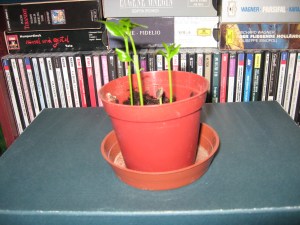
A couple of months ago, on a whim against a draining feeling of despair, I collected five pips from a lemon I had just squeezed into warm water.  Like drinking sunlight.  I pushed the pips into a small pot of soil, which I placed by my window.  Five pips.  Five hopes.  Four in a round, with one in the centre.  Like a star.  Perhaps one of the pips would give birth.  Every day, I collected a little water in the palm of my hand, and let my hope drip gently onto the soil.  Trying to give it rain.  Every evening, I moved it away from the window, before turning on the radiator.  I held the pot in my hands, and imagined the pips asleep, just beneath the soil surface.  Sleep.  Gather your strength.  You need to be strong for this world.  I fought the temptation to scratch the soil with my finger, to see if anything was happening.  Be patient.  Respect what your brain is too limited to comprehend.  Trust what you cannot see.  Five pips.  At least one of you must have enough life in it to burst through.  Just one.  Just so I know there is hope.

Several weeks went by.

IMG_0626

It was the morning of 28th November.  A bright green dot peering through the dark earth, in contrast to the grey sky outside, in defiance of my hopelessness.  There.  I’ll show you.  Look at the effort I’m putting in, pushing through the earth in this bleak winter time, just to pull you out of despair.  By evening, the glossy green head stood confidently above the soil.  I was happy.  So happy.  One of my five pips had made it.  My future lemon tree.  A few days later, just as it sprouted the indisputable shape of leaves, another little green head ventured out of the soil.  Two.  Oh, joy.  Then another…

IMG_0635

This morning, when I opened my curtains, another youngling was straightening its slender green body, shaking off the dust.  Bright green and glossy.

Number five.  The one in the centre of the star.

IMG_0632Scribe  Doll

Posted in Odds & Ends | Tagged , , , , , , , | 28 Comments

Be Yourself – At Your Peril

“Just be yourself.”  How many times have you heard that? It is the advice given by friends, psychologists, life coaches and even career advisors.  “Being yourself” is widely recognised as the best policy.

But what if that were not always the case? Of course, from other people’s point of view, if you are “yourself”, then they know exactly where they stand with you.  What I am questioning is, whether “being yourself” is always to your best advantage.

What if this “yourself” either offends, irritates, discomforts people – or simply does not fit into the socially recognised grid?

In the 21st Century, we pride ourselves with having demolished social conventions.  We have merely changed the material that constitutes our clearly defined social grid.  It is no longer made of heavy, palpable iron bars, but of invisible, though no less present, laser beams.  You get a needle-like burn through your skin if you cross certain demarcations.  As you try circulating from one box to another, you can end up covered in burns.  Scalded, frightened, unsightly, lost and so no longer presentable to Society.  At that point, you can slip off the grid all together, and try to find your way back in but the entrance is now camouflaged, like the door in The Secret Garden.

“I never fit in anywhere”.  You often hear that declared in almost boastful tones by many people in artistic professions.  This reminds me of some of the twenty year-old girls at my university who were so enamoured of Sylvia Plath’s poetry, claiming to relate to her feelings of depression.  I think if you truly related to the profound despair expressed in Sylvia Plath’s poetry, you would be so deeply horrified by it, you would find it too painful to read, let alone go around telling the whole college that you relate to it.  If you are sinking in black, sticky, scorching tar, you want to get out of it, not bathe in it and invite friends to take pictures.  I think if people truly feel that they do not fit in anywhere, they do not shout it from the rooftops.  They would be too afraid of being discovered.  If you had something you knew would make the world dislike you or feel uncomfortable around you, would you really tell the world about it? I find it noteworthy that it is so often artists who win prizes and accolades who say they do not fit in.  The very fact that they have won recognition contradicts that, surely.  Van Gogh did not fit in.  He never sold a painting in his lifetime.

Much gushing is done, nowadays, about the concept of “vulnerability”.  People all over the place encourage you to show your vulnerability.  Being vulnerable somehow equals being endearing. Why?   Every domestic cat knows not to sleep with his/her throat exposed.  It is basic self-preservation.

Yes, I am generalising, and the usual caveat applies.  I am merely exaggerating to illustrate a point.  We all know life is not all in black and white.  However, I cannot illustrate a point in grey.  It has to be in stark black and white contrast to be visible.

“Be yourself”.  What does that mean, exactly? I still do not understand.  I assume it means be honest with yourself and, by extension, with other people.

Can you always be honest?

At a job interview, do you tell your would-be employer that you really, desperately need the money? Or do you tell him/her that this is a challenging opportunity that you have been looking for all your life, and that working for this company is the sole object of your existence? When asked if you thrive under stress, do you laugh and reply, “It is medically impossible to thrive under stress” or do you say that you come alive under pressure?

Society has a list of recognised reasons for distress and, if yours falls into one of those categories, then people flock to your help.  Among them are, bereavement, divorce, loss of job and illness.  Mind, you have a time limit on those, too.  But what if your distress is outside this approved list? How many people would sympathise if (for argument’s sake) after two years, you still grieved your dead cat? Or if (again, just as an example), you hated a situation others considered as “not so bad”? It is so much easier to blame your sadness on something that makes you appear less “weird”.

When people ask, “How are you?” how many are really prepared to hear woes? It is not that people do not care.  Mostly, they do.  What most people hate, is to feel powerless.  If you tell them you are unhappy, they will try and fix it.  But if they cannot fix it, they often resent you for being “un-fixable”.  They cannot bear to have before them what they perceive as their failure to help.  So they avert their eyes – and move on.  One cannot, in truth, blame them.  Would you want to feel bad about yourself?

Our understanding is determined by familiar codes.  Like languages.  People will, I believe, almost always try and help if they understand what you are conveying to them.  But if you speak a language they do not know, how can you possibly expect them to respond? It is not that they do not want to help, it is that there is simply a communication problem.

Of course, it is perfectly possible to live off the social structure.  It helps, if you have financial security and a strong support system.  You must also perfect the art of living without regrets or expectations.

In the animal world, the odd one out is frequently either shunned, or bullied.  It appears to be a natural instinct.  Ethics and religion have spent centuries trying to root that instinct out of human beings.  The result, in this adolescence phase of the human race, is a conflict between reason and nature.

There may – I believe will – come a time when Society is truly inclusive, non-judgmental and enlightened.  I believe, with all my heart, that humans have a great capacity for kindness – even more so than they know.  They just do not always know that.  There’s the rub.

In the meantime, unless you have precious friends who happen to “get” you, appeal to your natural instinct of self-preservation.  Perhaps keep the “being yourself” to “yourself”.

Scribe Doll

Posted in Odds & Ends | Tagged , , , , , , | 18 Comments