Skiving Off

Something woke me up earlier than usual, this morning.  It was the light pushing through my curtains.  It had a different colour and texture than of late.  I switched on Radio 4, negotiated myself out of bed, and approached the window, gingerly at first, then gave the curtain a firm tug.  The bright sunlight punched me right in the face and flooded my room.  Yes – the sun was actually out.  I lifted open the sash window, and leaned out.  The wind ruffling the oak branches outside did not carry its usual, insidious chill.

Tempted as I am just to go and bask in the sun, with my scribbling notepad, I just have too much work to do.  I am going to act like a responsible adult and not an essay-delaying undergraduate.

Right.

No.  It’s no good.  I am staring at the same page for ages, and my mind keeps wandering.  I feel restless and boxed in.  I give myself licence to explore a compromise, and put my work into my rucksack.  I’ll go to the Village, and work at a café table on the sunny pavement.   My painful tennis elbow needs warming in the sun.  I cling to that excuse.

Tennis fans are already spilling out of the Tube station.  The shops are all decorated with lime-yellow tennis balls.   Tennis balls everywhere.  Stacked up in pyramids, hanging from ribbons, or just strewed in the window as if they don’t care.  Funny – the championship isn’t actually in Wimbledon proper, but in Southfields, two Tube stops away.  I walk up Wimbledon Hill.  The Village is not quite awake, yet, and the only café tables out on the pavement are in the shade.  Perhaps I can go and sit on a bench on the Common.  I get a take-away cappuccino and croissant.  On Wimbledon Common, I can’t find an empty bench that faces the sun.  Again, something feels lacking.

I miss my favourite London park.  I suddenly realise it.  I miss my park, by the river.  And so I start walking along the edge of the thick woodland, towards Fulham.  As I approach a bus stop, the 93 bus slows down but I let it leave again.  I’ll catch it at the next stop.  Or perhaps the one after that.  Along the path, I have to contend with runners.  What is it about joggers that seems to expect right of way? Does exercise endow them with a special virtue that states, “Step aside and let the jogger through – you’re only walking”?  The sun is caressing the back of my neck, and warming my elbow.  I slow down, take a sip of my velvety cappuccino, taste its richness, then take a bite from my freshly-baked, buttery croissant.  Yes! Now that feels good.  A passing jogger, trainers thumping hard on the path, face twisted in the evident discomfort of excessive physical effort, cheeks all red and floppy, catches the smug expression on my face and darts me a dirty look.  I smile back at him, feeling even more unashamedly smug.

Another bus stop.  Not yet.  I’ll walk a little further.  I feel a sense of triumph when, about four miles later, I walk down Putney Hill, along the High Street, and reach the river.  The green water ripples glisten in the sunlight.  I inhale that unmistakable river smell Rupert Brooke described as “thrilling-sweet and rotten, Unforgettable, unforgotten”.    Ducks are grooming on the bank.  Canada geese paddle expectantly.  The white band under their beaks looks like a bandage for toothache.  Above Putney Bridge, the sky is a deep blue canvas brushed with strokes of purple-grey gossamer clouds.  At the bottom of the bridge, the Tudor belfry of All Saints church marks the start of Fulham and the entrance to my favourite and, formerly, my local park.

Bishop’s Park does not have the fame of Hyde Park, the elegance of Regent’s Park, or the wide expanse of Hampstead Heath.  However, it possesses a unique charm and can cater to different tastes and moods.  Right at the foot of Putney Bridge, you can sit in the rose garden, where the breeze carries sweet, heady fragrances, as well as the sound of church bells.  There is the wide lawn at the back of the  Palace, where you can sprawl on the grass, or have tea on the stone patio of the café.  You can venture through the arch into the walled herb garden, gently brush the numerous plants with your fingers which you then take up to your face and breathe in rosemary, sage, lavender or thyme.  If it is shelter from wind and people that you seek, then you can take refuge in the courtyard of the Tudor palace that was once the residence of the Bishop of London, and listen to the playful murmur of the fountain, and the tinny old clock chiming every quarter of an hour.  Or you can sit on one of the benches on the embankment walkway, beneath the branches of horse-chestnut trees whose trunks are so wide, you would need two people to stretch their arms around them.  Old trees with centuries of stories to tell.

I turn around to see what is rustling behind me.  A squirrel is rummaging on the ground, trying to remember where the nuts are buried.  On the river, seagulls swoop, their cries exaggeratedly strident, like idle threats.  Above, the rheumatic caw of a jet-black crow, glossy in the sunlight.  I throw a handful of monkey nuts.  The crow calls out to its friends then lands next to my offering, stabs the shell with its beak, and extracts the peanut.  Deep black eyes make contact with mine.  I nod and resume my walk.

Today, I shall go and work in my favourite spot in the park.

No, I’m not telling where.

Scribe Doll


Posted in Odds & Ends | Tagged , , , | 14 Comments

People-Watching in the Village

Six weeks after moving to this South-Western corner of London (well, it’s practically Surrey), I still had not explored its better-heeled district: the Village.  It was a warm day, so I decided to take my painful, recently acquired – and oddly appropriately named – tennis elbow, to bathe in the sunshine, at an pavement table of a French pâtisserie on the High Street, and just watch passers by.  Watch and scribble in my A4 spiral notebook. And sip dense, luscious chocolat chaud, of course.

At the table next to mine, the fathers of two families are comparing the prices of their properties, and express surprise in what sounds like a competition of whose million-and-something place has increased in value faster.  I am told Village residents arrange highly-advantageous home swaps or rent out their properties for astronomical sums during the last week of June and the first week of July.  Unless, I imagine, they are tennis fanatics, themselves.  That’s right, I’m sitting and watching Wimbledon Village.

Something about the atmosphere reminds me of how Fulham used to be when I first moved there, thirteen years ago.  The stripy shirts, Rupert Brooke haircuts, velvet alice bands and strings of pearls have gone, but you can still imagine the passers by being called Miranda, Dorcas, Crispin, Sebastian – and have double-barrelled surnames.  The vowels are still glissando and the consonants brushed past.  I even catch a few elongated “Yeaaah”s that bring back fond memories of my College days, at Durham, where the term “‘Rah” was the mot du jour.  The air is imbued with that unmistakable scent of freshly-printed banknotes.  Crisp, perky, not quite worn enough to acquire self-deprecation or soft enough yet to slide into your wallet without sticking out.  Fulham, however, had always felt like London, to me, whereas this High Street could run through any picturesque town of the Home Counties.

The High Street is lined with shops displaying designer weekend wear in cornflower blue, aqua green, brilliant white and nail varnish red; boutiques selling printed scarves, silver jewellery and some politically-correct-to-purchase knick-knacks.  True to that unexplainable English belief that the first sign of chic is to have a taste for things Gallic, there is a line of French restaurants, bistrots and pâtisseries.  I wonder if this is the reason Wimbledon supermarkets have – much to my frustration – such a limited range of Italian wines (pardonnez-moi but I have always preferred Italian and Spanish wines).  You can feast your eyes on food shops abounding with French and Italian cheeses, herb and garlic marinated olives, colourful vegetables, crusty-looking bread loaves with purposefully-irregular edges and, I suspect, softer, doughy insides (we don’t want to be too Continental, after all), and fruit cakes with labels proudly stating that they are either home made or farm made.  Everything is laid out in that so-called Continental style (which never includes Germany or the Netherlands) which praises that looks-like-it-doesn’t-care rusticity, and which most self-respecting “Continental” hostesses would never bring out for respected Sunday guests.

A man is pushing a baby in a Cath Kidson pram.  I wonder how the infant feels about the pattern.  There is a striking number of dachshunds trotting from leather leads clipped to elegant collars.  In spite of the insidiously chilly breeze, most men are wearing shorts.  Shorts and flip-flops.  And sunglasses.  It seems like some kind of uniform.  Some enter the pâtisserie accompanied by their sons, who are striking, four-foot reproductions of their fathers.  Same style of shorts, of flip-flops, of sunglasses.  Oozing the self-confidence of someone born with a parachute on his or her back.  Cars drive down the narrow hill, that are a little too tall and a little too wide for a city, and which I imagine to be ideal when driving through a jungle or a desert.

There are flower baskets swaying from lamp posts, pretty buildings in pastel colours, and everything looks neat and its right place.  There is a Hemingways Bar, which I hope to explore as soon as I have a few more banknotes – crisp or limp – in my wallet (meanwhile, invitations welcome).

I love this place.  I think I’ll adopt one of cafés, and use it as a regular scribbling haunt.  I’ll wear my bright blue Mulberry man’s shirt with narrow red and yellow stripes.  Over chinos.

Yes.  I can see myself really enjoying this.

Scribe Doll

Posted in Odds & Ends | Tagged , , , , , , , | 12 Comments

‘An American in Paris’

It was the only time my mother actively encouraged me to skip school or, rather, ballet school, for reasons other than health.  “If you want to be a dancer, you must see this film.  It’s as important for your education as your classes.”

As a child, more than anything in the world, I wanted to be a dancer.  More than anything else in the world, I loved music, so getting my body to be at one with it in an expression of joyous harmony represented for me the ultimate achievement and boundless happiness.  The physical world made perfect by pulsating to the harmony of music.

The moment I could hold a pencil, I drew ballet dancers.  When I lost my first tooth, I asked the Tooth Fairy for records of Swan Lake and The Nutcracker.  I spent hours in my room, listening to Stravinsky’s Firebird, and staging a mental ballet full of colour and thrill.  I played Prokofiev’s  Cinderella so often, I scratched the record.  Even now, whenever I hear it, my auditory memory expects to hear the hiccups of the needle at specific points, and part of me is surprised when the music plays smoothly.

I begged and hassled my mother to send me to ballet school, but we could not afford it.  Finally, at the age of eleven or twelve, I was accepted by the Nice Conservatoire.  And so began a strenuous, painful and humiliating weekly class.  My body was at odds with ballet.  I was too stiff, too clumsy and just the wrong shape.  Inside, I felt fast, light and agile, but I was trapped in this chunky box that was my body.  Only last year, an osteopath dissolved over thirty years of gnawing regret and sense of failure.  “You have short tendons,” he said.  “You were born that way.  You could never have been flexible.  There is nothing you could have done.”  Strange as it may sound, it was as though he removed a rucksack full of bricks off my back, and gave me permission to stand up straight.

My mother has always loved U.S. musicals, and instilled the same love into me at a very early age.  Living in Italy and France, we would sit together and watch them whenever they happened to be on television, in black and white, with most of the songs dubbed into Italian and French.  My mother, who had seen most of them on the silver screen and in the original English, would provide a running commentary on the real colours of the set and costumes.  Afterwards, she would often sing me the songs in English.  I sang songs from South Pacific, The King and I and Carousel throughout primary school (yes, Rodgers & Hammerstein were my mother’s favourites).

I loved ballet, but what really filled me with unadulterated, bank-bursting joy, was tap.  I would push brass drawing pins into the heels and toes of my shoes, and try clicking rhythmical patterns on the tiled kitchen floor.  Sadly for me, tap classes were not an option.  No one really learnt to tap in those days.  It was then considered a thing of the past, that had gone out of fashion with the waning of the MGM musical.

I remember walking into the kitchen, one day after school, and my mother looking up from the TV listings magazine.  An American in Paris is on television, tomorrow afternoon,” she said.  It was afternoon at the Conservatoire, but the excitement in her voice promised a highly desirable alternative to yet another humiliating session with our ballet teacher, a claw-footed Madame who poked the end of her stick into our knees if we failed to lock them hermetically, and reserved her rare smiles for the one and only boy in our class.

And so, the following afternoon, we sat staring into the small black and white television, swept away by that brand of magic only Hollywood and MGM alchemy could manifest.  Luckily, this time, although the dialogue had been dubbed, the songs had been kept in English.  My mother did her best to help me imagine the vibrant colours in the ballet sequence.  “If you could only see this in colour, on a large screen!” she would exclaim, excited but powerless.  I was charmed by Gene Kelly’s shrewd yet heartfelt smile and life-affirming dancing, mesmerised by the imaginative and inspiring choreography, engrossed by (unusually for a Hollywood musical) a good storyline, entranced by Leslie Caron’s versatility in ‘Embraceable You’… And utterly bewitched by the George Gershwin’s happy and yet hauntingly wistful music.

To this day, together with Ziegfeld Follies and Broadway Melody (1940), An American in Paris remains my all-time favourite film musical.  It is a masterpiece.  In spite of a French schooling and a degree in French literature, I can only think of Paris landmarks as sets for Gene Kelly’s dance numbers.  In my early days as an English as Foreign Language teacher, I would show my classes the Georges Guétary-Gene Kelly S Wonderful scene as a prompt for eliciting English love idioms (“So why are they dancing? How are they feeling?”).  On my first trip to New York, I strolled down Fifth Avenue and 42nd Street, my heart fluttering at the thought that George Gershwin must have walked along those sidewalks.  My two favourite composers are Johann Sebastian Bach and George Gershwin.  The former reassures me that the world makes sense; the latter makes me happy to be alive in it.

As I have reached my middle years, I relate to a line in the film, spoken by Georges Guétary.  In my opinion, it is one of the best film lines ever.  When I joined the Red Room, a year and a half ago, I decided to use it as the quote below my photo.  It is spoken at the beginning of the film, as we hear the character of Henry Borel’s voice trying to introduce himself, just before we see his reflection in the drinking fountain mirror.

“I don’t mean to imply that I’m old.  After all I am only… What’s the difference? […] Let’s just say that I’m old enough to know what to do with my young feelings.”

Scribe Doll

Posted in Odds & Ends | Tagged , , , , , , , , , | 10 Comments

Corn Chowder and Conversation

I’d asked my friend B. if he liked corn chowder.  Living in one room, and sharing a kitchen, I had to think of a lunch that would fit on my small work table.  “How about a bowl of steamy corn chowder, with bread and cheese?” I’d texted.  Then added, “Unless there is a heatwave.”

A heatwave? With the winter cold and icy winds that have been making a mockery of May in London, this year?

“What kind of wine goes with corn chowder?” asked B.

“Don’t know,” I replied, “but I already have a bottle of Chianti, so don’t worry.”


It is with a mix of incredulity and hope that I leave the house without my jacket.  This Sunday lives up to its name.  After months of grey, the sudden brightness stings my eyes.  On my way to the shops, I question the suitability of corn chowder on what looks like a summer’s day.  No.  It won’t last.  It’s just another tease.  The sun caresses my neck and shoulders, which have been stiff and painful for months and feel like they will now continue to be stiff and painful for ever.  The warmth seeps through my skin and slowly trickles into my muscles.  I don’t dare relax and give in to it.  I am not going to allow myself to be lulled into a false sense of security.  I don’t trust the cold not to pounce on me around the next corner.

I sing to myself while I chop the vegetables.  Since I moved to this house, I’ve taken to singing in the kitchen.  Today, I finally realise it’s because I have always listened to Radio 3 or 4 while cooking, but here is no radio in this kitchen.

I’d love to get you on a slow boat to China,

All to myself, alone.


I’ve always liked that song.


I open a tin of sweetcorn and empty it into the pan, and watch the milk start to bubble.  I worry the chowder will taste too bland.  I reach out for the bottle of cayenne pepper, and shake vigorously.  Then I pull the cheeses out of the fridge, and lay them out on a plate.


My mobile beeps.  “On my way.  What can I bring?”

“Good conversation,” I reply.


Get you and keep you in my arms evermore.


I pull open both sash windows in my room.  It’s the first time I’ve done that, since moving here.  I lean out as far as I can, the palms of my hands firmly pressed against the windowsill.  I search the branches of the oak tree right outside but can’t see the squirrel that I often see vandalising the leaf buds.  Somewhere above me, the slightly rheumatic caw of a crow.  There is something reassuring in its gravelly sound.  Something honest.  I lift my head towards the sun, and let its warmth stroke my face.  Perhaps I could trust it, after all.


My friend B. arrives.  He tosses his hat on top of my row of dictionaries.  I knew he would not come empty-handed.  Not on his first visit here.  He holds out a loaf of crusty, fragrant pain rustique.  Bread – for good luck in my new home.  Now that’s what I call perfect.


In the white ceramic bowls, the chowder looks colourful, with yellow kernels of corn, and bits of red pepper and green courgettes shining like little gems through the milky soup.  I worry I might have overdone it with the cayenne, but B. assures me it’s not too spicy.    I hope he is not being polite.  I really should learn to cook properly, and not constantly improvise.  At least not with cayenne pepper.  I spread a generous slice of Dolcelatte on a slice of bread.  B. reaches out for the Gruyère and shaves off thin, narrow strips.  I pour us more wine.


I tell B. I have finished reading Moby Dick.  I’m afraid I skimmed through several chapters in the middle of the book.  I couldn’t get myself interested in the technicalities of whaling.  I loved the character portrayal, though.  I have resolved to read more 19th Century literature.  Lately, I noticed increasing difficulty focusing on the language and mind frame and I am scared of losing that ability.  B. needs to read more French literature.  I tell him about the brilliant translation masterclass I attended, yesterday.


Outside the window, the oak tree leaves rustle in a sudden gust of wind.  B. examines the books on the top shelf.  I have stacked up there all the ones I have yet to read.  He cocks his head to examine the spines.  “I’ve never read Christopher Isherwood,” he says.


After a few spoonfuls of Tiramisù, we go into the kitchen to make Turkish coffee.  Several years ago, one of my  students gave me a beautifully-crafted, copper-coated pot, with a smooth wooden handle.  We watch and wait for the edges of the coffee to curl up into small waves of simmering froth.


I ask B. which CD I should play.

He hesitates.  “What would go well with this weather?”

“Madrigals?” I ask.

He narrows his eyes and thinks.

“Lute? And perhaps a counter-tenor?”

He starts to nod.

“Dowland?”

“Yes.”


Sitting by window, we sip the coffee and watch the oak tree branches sway.  The leaves are glistening in the sunlight.  We sit in comfortable silence for a moment.  A counter-tenor is singing a wistful Tudor air through the CD player by my bed.  “They’re doing To Kill a Mockingbird at Regent’s Park,” says B.

I can’t imagine a show that intimate, in a park.


We continue a brief conversation of half-sentences.  Certain things, you don’t need to spell out.  Not when you’ve been friends for fourteen years.


The sun moves away from the oak tree, to warm up the opposite side of the street.  Left in the shade, the wind grows chilly.  We close the sash windows.  B. stands up to leave.  “Are you going to do some work, this evening?”

“I have to write my blog,” I say.  “I have no idea what to write, though.”


B. puts on his hat.  “Have you ever written about corn chowder?” He asks, a twinkle in his eye.


Scribe Doll


Posted in Odds & Ends | Tagged , , , , , | 18 Comments

The Backstory as Defence Lawyer

In a recent post on The Red Room, Orna B. Raz makes a very interesting case for the fiction writer’s ability to rewrite true life events, giving the stories a happier outcome on paper, than they might have had in reality.  She set me thinking about the power of fiction writing.  We can bestow upon our made-up characters everything we, ourselves, long for.  We can change the course of their lives much more easily than our own.  We can live through them in the way some parents live their unfulfilled dreams through their children… But without screwing up anybody else’s life.

Some time ago, during one of the Original Writers’ Group meetings, a member read out a chapter from her book; an account of her real-life struggle to save her seriously ill child, and of her success, against all medical odds.  A deeply inspiring testimony to courage, tenacity and hope.  Keen on being truthful, she had included minutely-recorded details of time, place, etc.  As a piece of writing, however, some of us in the group found it a little arid.  During the subsequent feedback session, one of the other writers came up with an unexpected suggestion.  “Why don’t you write it as a novel?” she said.  Seeing everyone’s puzzled expression, she added, “You could tell so much more truth if you wrote it as fiction.”

At the time, I did not follow, but her words took a firm grip in a file in my memory, resurfacing at regular intervals, for me to turn over and examine, like a Rubik Cube.  Now, I totally agree with her.  The category of Fiction allows you to penetrate and explore dimensions of human emotions that are too unquantifiable to be factualised.  That is why I have always been of the opinion that fairy tales take up where History leaves off, providing a degree of insight into the human psyche, which can be gained only with a meta-factual method of observing and learning.  Facts, no matter how comprehensive and precise, are limited, while imagination is unlimited.  Imagination sets us free to explore realms which our reason would consider out of bounds.

In addition, with sufficient skill, placing your writing under the Fiction banner can put you beyond the reach of law suits.  It’s just a story.  It’s not real.  All characters appearing in this work are fictitious. Any resemblance to real persons, living or dead, is purely coincidental, etc.

Another, non-negligible, powerful magic wand we, fiction writers, possess – and, I feel very strongly, have a responsibility to use – is to help build a path towards forgiveness.

How?

With the Backstory.

Every good actor, knows that to make a character credible and sympathetic, you need to give him or her a motivation for his or her actions.  Motivation.  Another word for Backstory.  The reason Iago is one of theatre’s most charismatic and wonderful baddies (and my all-time favourite one), is Shakespeare’s creation of motivations – a backstory – for his wickedness.  Yes, what Iago sets in motion in the play, is evil.  It would take one talented lawyer to get him acquitted.  But why does Iago trigger this bloody tragedy? Iago, is a good soldier, loyal to Othello.  He deserves a promotion.  Othello meets and falls in love with Desdemona, his brain instantly plummets far South, and he promotes pretty-faced Michael Cassio, instead.  The full force of this injustice strikes a wound in Iago, which festers and turns to poison.  He then gives out nothing but poison to others.  Yes, Iago is cruel but, dramatically, it is Othello who creates the circumstances to which Iago reacts with cruelty.  Othello is the unwitting cause to Iago’s – admittedly, disproportionate – effect.  His crime is abominable, but not senseless.

“It is what I do,” said a close friend who is a highly intelligent and deeply kind lawyer.  “I try and discover why my client committed a crime.  It’s called ‘extenuating circumstances’.”

Extenuating Circumstances is the defence lawyer’s word for the writer’s Backstory.  The crime was committed.  The victim has suffered.  The defendant is sometimes guilty.  We are not – and must not – deny or invalidate in any way the seriousness of the crime, but I think we should apply some of Atticus Finch’s advice: “You never really understand a person until you consider things from his point of view . . . until you climb inside of his skin and walk around in it.”  That involves practising a little empathy not just towards the victim, but towards the offender.  I strongly believe that if Atticus Finch’s words were inscribed in every courtroom, for juries and judges to see, far fewer people could find it in themselves to condemn an offender to death.  Capital punishment is, in my opinion, the ultimate expression of hopelessness.  And how do you walk around in someone else’s skin without resorting to imagination? Without filling the gaps between facts with a little fiction?

It goes without saying, that I mean no offence or disrespect towards those people who have suffered injustices so harrowing, I cannot begin to fathom.  When you write a piece like this, you inevitably take a stand which leads to rule-of-thumb theories.  I would also never, ever, claim that forgiveness is easy.

In her inspiring book, Why Be Happy When You Could Be Normal?, Jeanette Winterson writes, “Forgiveness unblocks the future”.  Another wise friend I have says that a backstory allows you to shift the focus from yourself as a victim, and create a larger picture in which you can see the dynamic of why something was done to you but also why you, as a person, have reacted to it the way you have.  In a way, it can make the unpleasant experience less personal to you.  It can help you stop carrying the sense of guilt that, somehow, it is your fault, even if someone else has harmed you.  It can allow you to move on.

There are some wonderful, kind-hearted people who possess that precious ability to forgive naturally, straight from their hearts.  I envy these people’s generosity.  Mark Twain’s words (and I greatly admire him), “Forgiveness is the fragrance that the violet sheds on the heel that has crushed it” makes my heart go “Aww…” but my brain equate it with a mouthful of coffee with cream, five sugars and a dollop of maple syrup.  How many people are truly able to forgive without understanding why? Someone is unforgivably rude to me during my working day.  I want to retaliate with my own rudeness.  I want to know why this person has been so unkind to me.  It was uncalled for.  I cannot ask him or her.  All I can do, is imagine a scenario in which this person had something happen to him or her, which caused so much anger and frustration, that he or she has taken it out on me.  It’s not my fault, though.  But why have I reacted with so much anger? Is it because this was the last straw at the end of a particularly stressful day?

One of my all-time favourite books is The Loop by Nicholas Evans.  In it, there is the character of an old man who has spent his life devising stomach-churning methods of killing wolves, back in the days when there was, effectively, a campaign to exterminate wolves in North America.  You hate this character, and wish for him to fall into and be mangled by one of the traps he lays for the wolves.  Then, ever so subtly, Evans makes transpire this man’s backstory and, as the novel unfolds, your feelings are transformed.  You still hate the cruel act, but you feel genuine pity – even compassion – towards the perpetrator.

Could this be tried in real life?  Someone has hurt you, injured you, done you a terrible injustice.  But why? What is the bigger picture? In real life, you can rarely discover someone’s backstory, and even if you do, you never truly know it completely.

And if you do not know the Backstory… Why not just make one up?  Build a set of imaginary circumstances for your real person, that just might have led him or her to act the way he or she did.  You write fiction, right? It does not have to be real – it just has to make sense in your head, and the rest of you might just slide more easily into forgiveness.  After all, reality is so often a matter of perspective.  Moreover, the advantage of fiction over reality, is that you create the fiction that sits most comfortably with you.  Your imagination can be your friend, in that it often feeds you just as much as you can swallow.

And, no, I never said it was easy.

But might it not just be worth a try?

Scribe Doll

Posted in Odds & Ends | Tagged , , , , , , , , | 12 Comments

Just About a Teddy Bear with a Wonky Nose*

“What does he think I am? A baby?”

Deep embarrassment was making me peevish.  I did not want my mother, grandmother – and, especially, the guests – to think I was still a little girl who liked teddy bears.  After all, I was five.  It was bad enough that I was already in my pyjamas and slippers, ready for bed, when everyone else was staying up – but rubbing it in with a teddy bear was insulting.  Luckily, my mother’s boss – the man responsible for my social discrediting, this Christmas Eve – was not present, so I was able to ridicule him with as much haughty outrage as I felt.  It was not the first time he had triggered my anger.  When I heard he went hunting pheasants at weekends, I used my mother’s mechanical typewriter to write him a letter which began, “Dear Murderer” before spiralling into accusations and heartfelt wishes that he might be appropriately punished for his crimes against animals.  I then gave the letter to my mother to take to him, never doubting that she would deliver it straight into his hands (even then, diplomacy was an alien concept to me).  When, a few months later, I heard that he had injured his thumb whilst cleaning his hunting rifle, I cheered.

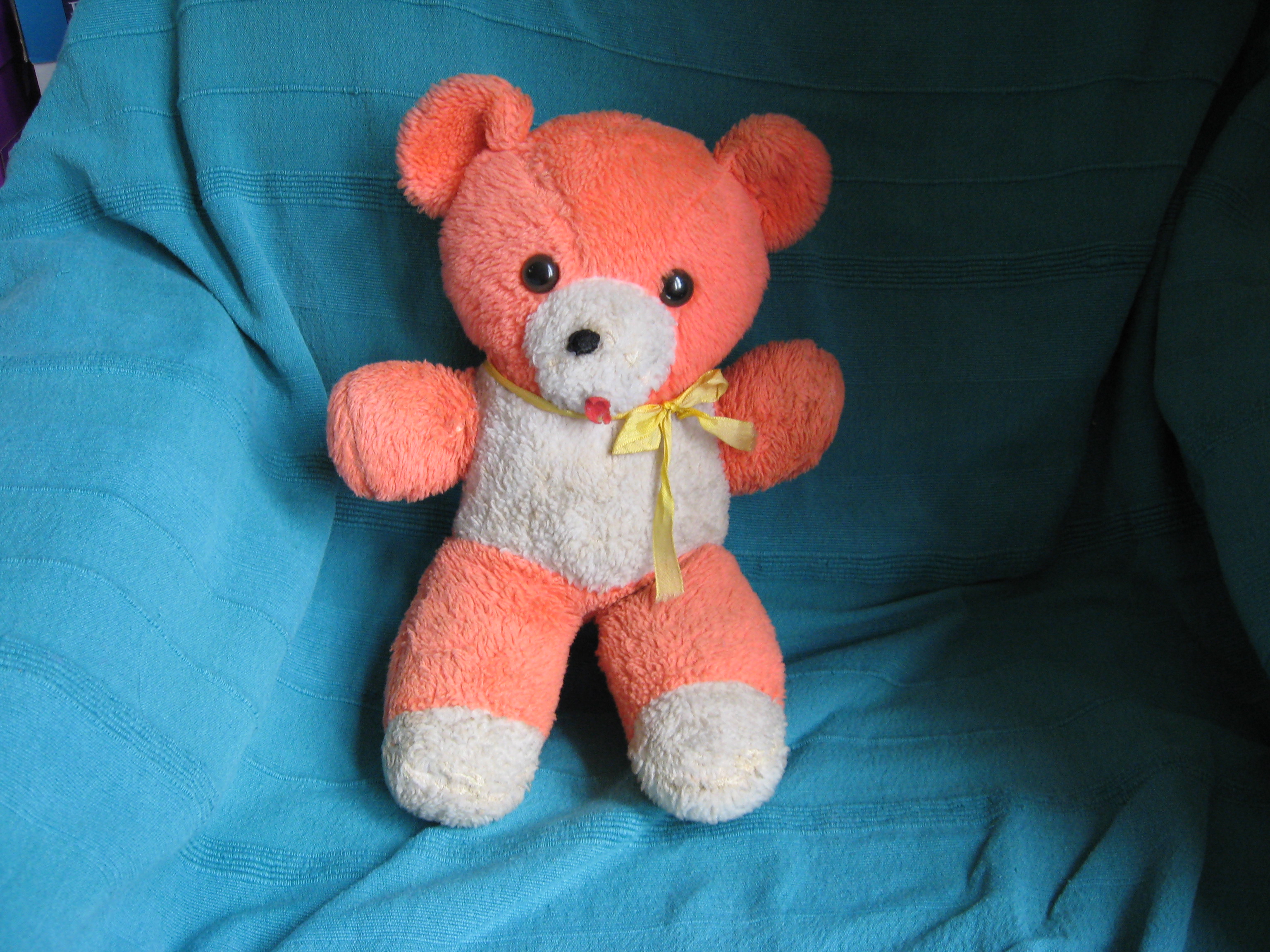
And now, that horrid man was giving me a teddy bear for Christmas.  Not just that – but a cheap and nasty-looking one.  My other teddy bear, which my mother had bought me the previous year, and which sat on an armchair, gathering dust, was made of wool and velvet, with articulated paws.  I will never know why I did not play with him, but he was a quality bear.  This one was stuffed with some kind of mediocre sponge, and was not even brown but some kind of non-descript pinkish-reddish-orangey, with white muzzle, tummy and feet.  Dark brown bead eyes with large black pupils, an upside down, vaguely  heart-shaped piece of red felt for a mouth, and a little black nose which was stuck off-centre.  A cheap teddy bear with a wonky nose.  Couldn’t my mother’s boss at least have spent a little more?

Of course, there would never be any question of my playing with such a low quality toy but I could not stop staring at the wonky nose.  Defective.  No one would ever play with him.  He would just lie there, under the Christmas tree, on top of the scrunched up wrapping paper.  Later, the lights would be switched off, and he would lie there, alone, in the dark, with his wonky nose.  Suddenly, tears were streaming down my face.  No one would ever love Teddy, and he would be thrown away.

I took wonky-nosed Teddy to bed with me, to comfort him.  I told him it would only be for that night, because it was Christmas Eve.

I fell asleep, hugging Teddy, for many, many years to come.

He now lives among my woollen jumpers.  He is still with me.

Scribe Doll

* With thanks to Rosy Cole for inspiring me to write this, with her story Elephant’s Footnote.

IMG_0663


Posted in Odds & Ends | Tagged , , , , , | 8 Comments

A Room of My Own

There is a tree outside the window of my new room.  An oak, with ivy wrapped around, embracing his body and lower branches.  His body, yes.  There is something male about this oak.  A wise old man ready to share stories about this part of South West London before there was a street here; before they built the house with the room I moved into, two weeks ago.  A room with a strip of stained glass on top of the large windows, where the morning sun floods in as soon as you part the curtains, in the morning, bathing you in bright gold.

After seven years of camping in someone else’s living room, the first room of my own.

After the removers leave, I have a moment of panic, as I step over all the boxes, knowing full well that I will never be able to fit the contents of the one-bedroom flat I had, what feels like a lifetime ago, into one, albeit large, room.  I have strained my right elbow ligaments during the move from Norwich, and my whole arm now feels inflamed, but resting it is not an option.  Slowly, I stack up into a corner the thirty photocopying paper boxes of books and CDs, then start pulling off the parcel tape, and arranging them in double rows on the two shelves that belong to the room.  After an hour, I observe a worrying hammock effect, so frantically remove the books.  The shelves straighten up, again.  I think.  The lower shelf had better carry DVDs – they are lighter.  In the centre, I build a pillar to support the top shelf with the help of my hard back collection of Harry Potter, and Mark Kurlansky’s The Basque History of the World.  All the unread books go on the top shelf, but in a single row.  The other, built-in shelves, and the bookcase I brought with me, are sturdy enough to bear the majority of my other books.  I have too many books, I know.  I resign myself to re-packing five boxes of books, and stacking them in a corner, behind the armchair.  A small price to pay for a room of my own.  The armchair, I have pushed next to the window, so that I can sit and watch the squirrel vandalise the clusters of rusty leaf buds that are bursting out of the tree branches, and throw twigs at unsuspecting passers-by.  The squirrel came close to my window, a couple of days ago, and peered at me.  Then it was the turn of the magpie.  They are spreading the word in the animal world, that the room has a new occupant.  At night, I can sit in the armchair and look up at the moon as she smiles down on me.

I have put my work table by the window, too.  This way, I have a choice between glancing out at the tree or the sky, or at the postcards I have Blu-Tacked to the cupboard door, in front of me.  Postcards with Commedia dell’Arte characters, reproductions of National Gallery paintings, and a photo of a Venetian Palazzo, which I took with a sharply-angled tripod, some years ago.  Like so many London houses, this one is also affected by land subsidence.  Furniture has to be propped up in front, so that it does not tumble forward.  My table is on a slight slant, the furthest edge higher than the end at which I sit and work.  This is a room that could feature as a character in a short story, or a novel.  A room with a personality.  I know we are going to get on well.

It takes me nearly two weeks to unpack everything.  I have left the best till last, as a treat to unwrap once the hard work is complete.  I unroll my posters.  There is room for two on my walls.  I had forgotten I had most of these.  I must decide which ones I will hang up.  There are joyful Dufys, and a Rosina Wachtmeister cat with a mouse suspended upside down in his belly.  There is a glamorous, 1951 black and white photo by Willy Maywald, of a woman in yards and yards of Christian Dior skirt.  My soul is still a little bruised, after recent tempests.  I hang up my beloved National Gallery print of Verrocchio’s Tobias and the Angel.  I need the Renaissance sense of peace for my mind.  Also, a print I bought at Villa Farnesina, in Rome, three years ago, but which has remained rolled up until now.  Sodoma’s depiction of Alexander’s wedding to Roxane.  I need the Baroque lusciousness as a balm for my heart.

Out of a box stuffed with shredded paper, I pull out another old friend.  A papier mâché Venetian Commedia mask, half gold leaf and half colourful Harlequin, complete with oversized nose.

Finally, with care, I unwrap another treasure I have not seen for many years.  Something I bought in Murano, from an artisan glass blower.  A small glass unicorn.  Transparent, with swirls of cyan blue flowing through its body.

I place the unicorn on the shelf of one of the sturdy bookshelves.  Right next to my collection of world fairy tales.

This is a room for dreaming, planning and building.

Scribe Doll

Posted in Odds & Ends | Tagged , , | 16 Comments

Images of Norwich

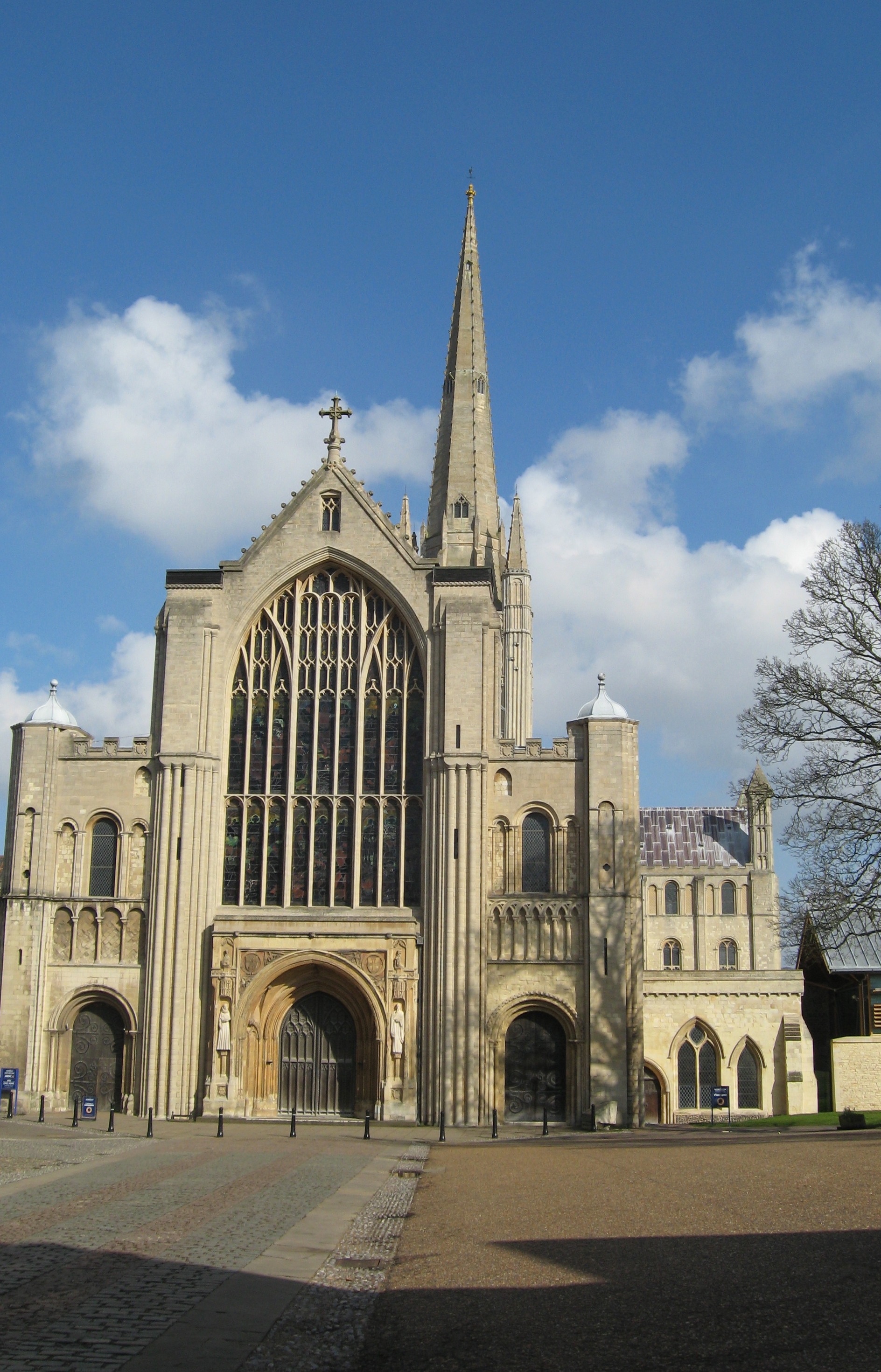
I do not have a good relationship with Norwich Castle.  I am sorry.  I thought I would get used to its odd, sandcastle mould shape on the green hill but I have not.  I find it too sinister.  Edinburgh Castle evokes memories of my happy childhood books by Sir Walter Scott.  Durham Castle brings back recollections of my happy university days.  Castel Sant’Angelo, in Rome, makes arias from Tosca swish though my head.  The Tower of London – with all its bloody past – is, for me, the home of gorgeous, intelligent, sadly maimed ravens.  The first thing I saw in Norwich Castle, during my very first visit, about eight years ago, were the disturbing death masks of men who had been hanged there for murder.  I felt queasy.  Macabre souvenirs of violence punishing violence.  Of wrong in judgement of wrong.  That is all I can think of when I look up and see the square, stout Norman cube of stone on the grass mound.

IMG_0661

*   *   *

Norwich is a treasure trove of small, independent bookshops.  At the top of a winding, cobbled street, opposite a teddy bear shop, stands the Doormouse Bookshop.  It is a jewel of a place, where the owner can tell you all you need to know about Norwich, past and present.  The wonderful collection of unusual, second-hand books covering a wide variety of subjects includes an impressive collection of children’s books.  The kind of books that make you wish you were still a child – or a parent.  You can smell the love of books as soon as you walk in.  Along St Giles Street, there is another inspiring second-hand bookshop, J.R. & R.K. Ellis.  Enter at your peril, for you will not want to leave again without an armful of books.  These are the two I have loved from the start.  There are others.

*   *   *

When I first went to live there, I read somewhere that The Golden Triangle was Norwich’s answer to London’s Notting Hill.  Well, whoever first said that may or may not have been to Notting Hill…  However, it is reputed for its good pubs and bistrots.  Because of its proximity to the University of East Anglia, it has a large student population, giving the area a youthful feel.  There is also a grocer, in one of the streets off the Unthank Road, where you can buy as much or as little as you want of vegetables, pulses, fruit and spices.  A jewel of a place, where I once bought fragrant, shiny, fresh bay leaves.  The owner just snapped a small branch from the tree for me.

*   *   *

One of my favourite places for coffee, is Cinema City.  This being Norwich, it is inside a 15th Century merchant’s hall.  In the café, the ceiling is high, arched, with dark brown timber beams holding it up, in stripy teams criss-crossing beneath the vault.

I like going there for their delicious white hot chocolate.  Edith Piaf murmurs broken-hearted love songs through the loudspeakers.  Sunday lunchtimes, though, there is live music.  A young man plays wistful tunes on his guitar, sitting in the bay window seat, below the coat of arms painted on the glass panes, sunlight bouncing off his blonde hair and goatee.  I picture him in a ruff and a velvet cap, instead of his jeans and white T-shirt, and imagine him as a Tudor lute player.  He strums Desafinado.  A Brazilian song, in Norwich, in a 15th Century building.  Anachronistic, but it works.  A guess when beauty of music meets beauty of architecture,  the alchemy produces gold.

 *   *   *

There comes a time when decisions have to be made, and when you realise that perseverance and “sticking things out” would be equivalent to meaningless stubborness.    When a door won’t open, there is no point in ramming your head against it.  It’s your head – and not the door – that’s likely to break.  When all is said and done, you need a job to live somewhere.  A job which I was not able to find.  And so time’s up for the Norwich experiment.  Perhaps we will meet again.  And so I bow to Norwich, give it thanks for its many gifts, and put my belongings back on the London train.

I shall always be grateful to Norwich for holding up a mirror to me.  I would not have seen the unrepentantly urban mouse in it, otherwise.

IMG_0654

Scribe Doll

Posted in Travel | 14 Comments

New City, New You – or New City, Real You?

There is something liberating and strangely peaceful about moving to a place where you do not know a soul, and nobody knows you.  People tell me that you can be whatever you like, then.  Reinvent yourself – that all too trendy phrase.  My experience, since moving to Norwich (where I got off the train not knowing anyone at all), last February, has not been so much of becoming a new me, as of starting to discover the original me.

IMG_0643Sadly, I cannot be “whatever I want to be”.  What I want to be – or wish I were – is for ever eluding me, in spite of my efforts.  Certainly, if I could mould my personality to my liking, I would have a different one from the one I am lumbered with.  In London, Norwich or Brussels, it is still me.  What I have found priceless, in a new city that still feels so strange, is the slow but steady discovery of who I am and what I want.  I think it gets to a stage, when you spend too long in the same place, where your pattern of behaviour becomes one of reacting, rather than acting.  If you spend too long somewhere, the inevitable repetition, or routine, of your daily life fixes you in a kind of mould.  People get used to your pattern of behaviour and start making assumptions about you.  Assumptions you do not want to disappoint for fear of losing your place on the social grid (better in a bad place than nowhere, right?).  So you make sure you stick to your pattern.  That, in turn, can stop you from meeting new people who could form a new and different opinion of you – and from altering your own opinion of yourself.  Eventually, you are no longer sure if you are doing things because you want to do them or because it is part of what is expected of you – expectations you are actually working hard to maintain just as they are.  It is a vicious circle that keeps going ‘round and ‘round.  In a way, you become still.  Motionless.  You sprout roots which, over time, reach further into the soil, and become tangled around large rocks.  Secure.  Impossible to pull out unless you cut down the tree.  Except that you are not a tree.  You were born with legs, for walking.  And, surely enough, you can sometimes lose track of what it is you really want and are (not that anyone really knows that one).  Italian playwright Luigi Pirandello had a theory that we exist only in function of other people’s perception of us.  Typically Pirandellian in its bleakness but he does have a noteworthy point there.

IMG_0644

In a new city, you do not have the pressure of remembering the lines of your role.  There is no one around you to pick up the cues, anyway, so you can devise a new script.  There is no one to give any new acquaintances you make a potted biography of you by way of introduction, so your new acquaintances are given the rare freedom of making up their own minds about you, without outside influence.  Similarly, you have the luxury of the same freedom.  You can even start thinking differently about yourself.  Oh, look – I had no idea I liked that.  I didn’t know I could do that.  In a new city, where you have not yet fixed a routine, you walk more slowly, you look around, you allow yourself to hear new sounds rather than listen out for ones you expect.

IMG_0649

Perhaps it is this state of reduced expectations (in the sense of preconceptions) that leaves room for surprise and awe.  And I do not mean awe in the misused and abused sense that US and now British teenagers (and now, infuriatingly, so many adults) give it when they say that a film or pair of jeans is awesome (I could weep!).  I mean the ability of being overwhelmed, swept off your feet by surprise before something that fills you with respect and wonder.  I think for as long as you can feel awe, you are alive.

IMG_0652

In a new city, since you do not have a road to follow, so you have to find new stones to build another one.  So you can, once again, enjoy the creative process of building, with all the stress, hardship but also dreams and hopes that come with it.

Scribe Doll

Posted in Travel | Tagged , , , , , | 16 Comments

Easter Break in London

Massaging warm olive oil into my hands, face and legs, then wrapping in hot wet towels. To heal cracked fingertips, smooth hardened cheekbones, and soothe sore red skin irritated by too many layers of clothing.  It is the Norwich cold.  Standing on the bathroom scales and shrieking.  I have acquired an extra five kilos in Norwich.  It must be the cold.  All the extra eating and yet feeling constantly hungry.  All the extra chocolate to keep warm.  I have never eaten this much chocolate before.  Just when my friends are putting an end to their Lent chocolate renunciation, I begin mine.  I put on a skirt and high-heeled shoes – oh, hello, I can see my ankles, again – to go to the theatre.  I hide my rubber-soled, practical boots out of sight.  I do not want to see them for the next few days.  I also bury my green waxed jacket, large enough to accommodate the two thick jumpers I have been wearing over each-other for the past few weeks.  I slip on my tailored gun metal coat with the black velvet collar, instead.  I arrange a black beret on my head, pinching the edges to make them sharp, and pulling it down at a slant.  Although it is very cold in London, I can risk exposing my left ear to the elements.  There is no wind blowing in straight from the Urals to stab my eardrums, here.  I dare take a peak in the mirror.  Good.  Well – better than the recent Michelin man reflection.  As I walk up the Old Vic Theatre staircase, my step feels lighter than of late.  Funny how too many layers of clothing restrict your movements and make you feel clumsy.


Two hours of wonderful, beautiful words and highly-polished acting.  Henry Goodman is perfect as the proud Arthur Winslow.  The Winslow Boy, by Terence Rattigan.  If only I could write like that.  No word out of place.  Characters with layers and layers of conflicting motivations.  “Let right be done.”  It is easy to do justice but not so easy to do right.  Inspiring words that send me floating back to Waterloo.


After Norwich, I am very aware of the London crowds and loud voices.  In Norwich, even on a Saturday lunchtime on the Market Place, you do not brush other people.  One night, about two weeks ago, in Norwich, I was walking home from a writers’ do.  I walked for over half an hour without seeing a single human being.  I had taken the wrong turning and was following a long, tree-lined road, unsure whether I was heading towards the Golden Triangle area – or Edinburgh.  The wind bent the tree tops, and their dark shadows swooped before me, teasing my anxiety with threatening shapes.  It began to snow.  The kind of snow that blows into your eyes, nose and mouth, and finds its way in the nook between your scarf and your throat.  In London and other cities, I have walked through some rough districts and felt more in control of my anxiety.  As an urban mouse, I have developed a different kind of alert system.  It is based on a split-second assessment of faces, body language, and on adapting your own bearing to the circumstances.  On making yourself either larger or invisible.  Here, in this empty street, I slid into panic mode.  I feared I had lost my way.  And the streetlights would be switched off for the night, soon.  I pulled out my mobile and dialled a friend’s number, in London.  “Please talk to me,” I said.  “About anything.  Just talk to me.”  Finally, the glimpse of two human shapes by the traffic lights ahead.  I ran as fast as my cold-constricted breathing would allow.  Two women.  I asked the way.  They clearly viewed my terror with amused puzzlement.  Like a child scared of things adults know do not actually exist.  Later, when I recounted the episode, someone asked, “Why didn’t you just knock on the door of one of the houses and ask for directions?”

I stared in total bewilderment.  Knock on a stranger’s door? At night? What planet is this?

One where there is still kindness, decency and where fear has not dug in its claws.  May it never do so.  A different world, worth safeguarding.

This morning, Langlais’ Messe Solennelle at the Temple Church.  The first outing of the organ, after two years of restauration.  A clear, proud, uncompromising tone.  The choir voices, brilliant like diamonds against the stone pillars.

After the service, I walked towards St Paul’s, listening to its baritone bells fly towards Ludgate Circus.

To those who observe it, happy Easter!

http://www.youtube.com/watch?v=SQ1OdhT7s9o

 Scribe Doll


Posted in Odds & Ends | Tagged , , , , , , , | 12 Comments