The Sweet Sound of Pear Wood

It had lain in its case, on top of the CDs, since I moved here last April.  Occasionally, I would pick it up and blow the dust off the black cloth case, but never open it, even though I longed to.

You see, two of my flatmates are professional musicians.  A flautist and a pianist.

Yesterday morning, when I got up, I put the black case on my bed, in full view.  In the afternoon, I sat watching streams of golden light peering through the dark, purple-grey skies, bathing the oak tree outside my window.  Its leaves have recently turned into quivering jewels of ochre tipped with sienna, terracotta, glowing like gold leaf stencils in the soft autumn sunlight.

I looked at the black rectangle on my bed.  It was time.

I pulled the velcro apart, spread open the flaps, and slid the three wooden sections out of their pockets.  I squirted a small amount of almond oil on a cloth, and gently rubbed all three sections with it.  Then I poured some on the long, round-edged brush and oiled the hollow centre.  The wood looked glossy, revived.  Then I opened the small jar of grease, scooped out a generous dollop with my finger, and applied it to the cork coating on the tenons.  I joined the three sections together in a slow, twisting motion, until they were snug.  I checked that the mouthpiece was aligned with the top holes in the middle section.  The third section, I turned slightly off centre, so that the pad of little finger of my right hand could land straight on the two bottom holes.

I inhaled the comforting scent of the wood.  Pear wood.  As always, the deeply-buried pagan part of me, perhaps handed down by my Cornish grandmother, thanked the anonymous tree that, however many years ago, had yielded a part of itself for unknown German craftsmen to carve this magnificent instrument.  I thanked them, too, for their skillful workmanship.

I spread my fingers, so the pads covered all the holes, then listened, holding my breath.  No sound from the house.  I hoped my flatmates were out.  No musical ear could have tolerated, unoffended, the unskilled sounds I was about to produce.  I raised the labium to my lips and blew a slow, shallow breath.  The note was split, wobbly and strident.  Funny how musical instruments tease and throw tantrums when they know they are not in expert hands.

I blew more firmly.  E, F, G… a discordant sound spoilt the sequence.  I had forgotten the alto recorder requires that quirky finger movement to produce the A.  Start again.  My scales sounded more like a late night pub song than the authoritative primary colours of music.  Once more.  And again.  Eventually, I managed a steady, smooth sequence, although my fingers were stiff through lack of exercise.  I paused to catch my breath.  My lungs, too, were out of practice.

I had to take the leap.  I took a deep breath, and appealed to what I had left of muscle memory, from months ago…

It was on the fifth of August

The weather fair and mild

Unto Brigg Fair I did repair

For a love I was inclined

In the absence of practice, the tips of middle and ring fingers of my right hand had gone back to crossing over each other, instead of landing straight over the holes.  A teenager’s sacrifice to her love of writing.  When I was fourteen, I broke my right hand.  The metacarpal bone snapped and slid apart, forming a painful dome on back of my hand.  At the hospital, they pulled my middle finger out hard (they probably thought anaesthetic was for wimps) and stretched it over a metal splint, before binding my hand in plastercast.  They told me not to use my hand for a month.  My teachers let me off all writing tasks.  I followed the doctor’s instructions to the letter.  Well, almost.  I could not bear not to be able to write my stories.  So, at night, I would unstick the tape that secured my middle finger to the metal support and, despite the pain, curled it around my fountain pen, and traced slow, hesitant letters on my notebook pages.  When I had finished – or the pain became to sharp – I secured my finger back onto the splint.  When, at the end of the month, they removed the plaster, they noticed that my fingers had become crooked.  They simply noted that down on my file, and let me go home.

I got up with the lark in the morning

And my heart was full of glee

Expecting there to meet my dear

Long time I’d wished to see

The soft notes filled my room, and seeped through my skin.  They reached deep into me, like a balm.  I felt as though my body was singing in tune with the recorder; as though every muscle, nerve and cell was at peace with itself and the world.

I looked over my left shoulder

To see what I might see

And there I spied my own true love

Come a-tripping down to me

I have always loved that song.  A folk song from Linconshire, but which always evokes my beloved East Anglia.  A song of flatlands where the horizon is at your feet, of Fens, and skies so low you can almost touch them.  A song of elm trees lining a river, and of academic spires reaching up high.

I took hold of her lily-white hand

And merrily sang my heart

For now we are together

We never more shall part

*   *   *

This evening, I knocked on the door of my musician neighbours.  I apologised in advance for any outrage to their ears.  “I really want to learn to play this properly,” I said.  “Do you mind if I practise a few minutes every day?”

They replied with beaming smiles.  They would not let me go back into my room until I had played something.  In for a penny, in for a pound.  They would hear me, sooner or later.  I might as well get over the embarrassment now.  So I played I verse of Brigg Fair.  They still encouraged me after that.  Their kindness inspired me even more.

Back in my room, I blew more confidently into the labium.

For the green leaves, they will wither

And the roots, they shall decay

Before that I prove false to her

The lass that loves me well

Scribe Doll


Posted in Odds & Ends | Tagged , , , , , , | 20 Comments

No Post Today

Apologies.  With a bow worthy of the Royal Ballet.

Posted in Uncategorized | 2 Comments

Befriending Lady E.

VIP transport was arranged for her relocation from Ukraine.  Her immediate members of staff had moved to London ahead of her to get everything ready.  The flat, in a quiet, tree-lined street, was furnished; the fridge was stocked with her favourite delicacies, and shelves filled with large jars of vitamins and minerals.  A glass and earthenware dinner set was purchased for her sole use.

The day before her flight, the PA – who is one of my clients – gave me the etiquette to follow if I were ever in the presence of Her Ladyship.  I was told that mostly, however, she would keep to her quarters, upstairs, engaged in meditation, carpet hockey (played with a small and fast ball), catching up on her beauty sleep after a night of heightened activity or – most probably – busy devising numerous diplomatic techniques of negotiation aimed at obtaining the most advantageous business transactions.  It was a skill, her staff assured me, at which she was second to none.  She always got what she wanted.

Moreover, I was warned never to address her directly, or approach her uninvited.  Should Her Ladyship wish to form an acquaintance with me, she would either come halfway down the stairs – at which point the protocol stipulated that I should walk up towards her – or she would take a seat in the centre of the room– a tacit invitation for me to approach just close enough to pay my respects.

Throughout my career as a language and communications solutions consultant, so far, I have had dealings with aristocracy, people from finance, and politicians, as well as stars from the world of entertainment.  This was the first time I was nervous.

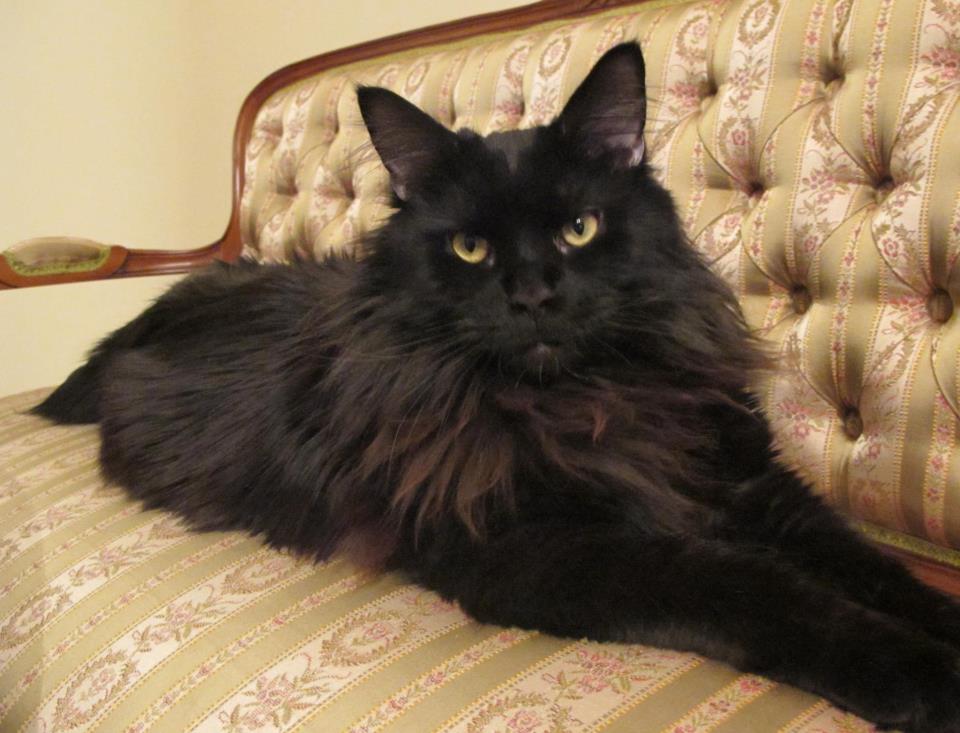
It happened a couple of days after Lady E. took up residence in London.  I was working with my client, sitting with my back to the door, when my client’s facial expression changed, and she motioned to me with her eyes, that there was someone behind me.  Slowly, I turned around.  She was in the doorway, staring at me with an expression that suggested mild interest.  An imposing figure in a black fur coat – brown tips slightly tousled – and translucent amber eyes.

I stood up and greeted her.  She returned the compliment half-heartedly.  A tone of lassitude and the vague suggestion of a foreign accent.  She seemed content just to watch us from a distance, so I sat back down and resumed my work with my client, her PA.

A couple of minutes later, I suddenly felt something soft brush against my ankle.  I looked down and met the amber stare.  I remained as still as I could, whilst Lady E. examined the contents of my open handbag and rubbed the side of her face against my attaché case.  “That’s very unusual,” whispered my client.

Since, sadly, I speak no Ukrainian, I addressed Lady E. in Russian, and paid a few compliments on the elegance of her coat, the luminosity of her eyes, and the grace of her demeanour.  Then I proferred my hand.  She gave it a thorough olfactory examiniation.  I seems my scent met with her approval, because the next thing she did was to recline on my attaché case – which she had knocked on its side – expose her furry belly and, in case I were in any doubt as to her precise instructions, gave my hand a gentle tap with her paw.  That was my cue to stroke her head, scratch behind her ears, and give her belly a rub.  “Most unusual with a stranger, “ said my client.  “She is paying you a great honour.

A great honour I was keenly aware of.

Since that day, it has become customary for Eureka (we are now on first-name terms) to make an appearance during our training sessions, and exchange a few expressions of mutual affection.

Last week, I decided the time had come to take our relationship to the next level.  After scratching behind her ears, I picked her up, and placed her on my lap.  “She may hiss and jump off,” warned my client.

I heard no hissing.  What rumbled in my ears, as I buried my face in the glossy coat and kissed the top of her silky head, was a soft purr.

“I cannot believe it,” said my client.

And just to have a proof that neither of us was dreaming this moment, she reached out for her camera and took a picture of it.

Scribe Doll

20131002_151646Eureka 4

Posted in Animals, Uncategorized | Tagged , , , , , | 22 Comments

No Post Today

Sorry – Scribe Doll is chasing her tail.

Posted in Uncategorized | 4 Comments

Lunch with the Russians

“The whole N. family is coming for an impromptu lunch at three o’clock,” says my friend L.  “Why don’t you come, too?”

I know N.’s family.  An artistic painter father, a philosophical mathematician mother, and a  polyglot, poly-talented daughter who could reason Descartes out of his logic.  Russians.  I arrive shortly before three.  L. sweeps out of her kitchenette, built entirely in the vertical and designed for skinny, people over 7 ft.  White hair in disarray, wearing a flowy skirt and a blue-patterned kaftan, she gives me a warm, earthy hug and a kiss on the cheek.  “The Russians are late,” she says.  “Not sure when they’re coming – probably around four – and I’m still not ready.”

I take off my jacket, and offer to help.  We sit a few minutes at her dining table to catch up on news. I munch Polish gherkins and English cheddar, and sip Spanish red wine.  L.’s studio flat, brimming with books, music scores, paintings and colourful knick-knacks – all scattered in laissez-faire style, looks even more cluttered with dishes and bowls overflowing with food.  There is not a square inch of free surface.  Even the upright piano is covered in towers of reclining books, and objets d’art.  The whole place is a cacophony of colours, shapes and textures which, somehow, seem to concord in an atmosphere of joy and mentally stimulating discussions.

I try and clear the table, and the cloth which vibrates with poppies, daisies, bluebells and sunflowers.  “Pass me the plates,” I say, and get handed large, heavy plates with a colourful mock Chinese design of wisemen, willows and dragons.  “How old are these?” I ask.

“Oh, very old,” she says.

From what I know of L. I imagine they must have been in her family for at least three generations.  I arrange six place settings, then go to the cutlery box.  There I pick out knives and forks.  There are not two that match, but each is a carefully crafted individual.  The water glasses are also different colours and shapes.  I arrange the settings to suit the personality I attribute to each guest.  There is not enough room on the table for all the food L. has prepared, so I clear a space on the windowsill, to accommodate the large bread board.  I slice the spelt loaf and the sperlonga, try and arrange the slices somehow artistically but give up.  L.  hands me something that looks like a ceramic flower pot, and I throw all the bread into that.

The doorbell rings.  It is L.’s partner with the N.’s husband.  They are deep in conversation, and do not appear to have noticed that they have arrived.  “Where are the women?” asks L.

“I don’t know exactly, but they’re on their way,” replies N.’s husband.

The two men sit at the table, and continue their discussion.  L. and I exchange glances.  “Tweedle Dum and Tweedle Dee,” she says.

I watch them, from the kitchenette doorway.  Nothing can interrupt their animated exchange of ideas. It is like a chess board they can carry with them wherever they go, without disrupting the game.  N.’s husband, light brown hair tousled, narrows his eyes and purses his red, full lips, which makes his pasty face into an impression of freshly-kneeded bread dough.  Bare elbow on the table, he shakes a podgy fist to drive the point home.  L.’s partner listens, his round glasses low on his nose, pale eyes sharp.  His head is shaved.  He makes return comments in the rich Russian baritone of his actor-trained voice. A dark moustache curves around his lips, corners descending down to his jaw.  L. offers them a drink, in English, but they do not hear.  The Russian dialogue continues with unwavering intensity.  I listen, and soon realise it is punctuated with non sequiturs.  “It’s like a scene from Gogol,” says L.

“With some Beckett thrown in,” I add.

“Yes.  Definitely.”

Although L. and I both speak Russian, for some reason, our exchanges are in English.

“So where are the others?” L. asks again.

The artist picks up the ‘phone, and dials his wife’s number.  “They’re close.”

“Let’s start eating,” says the actor.  “They’ll be up in a minute.”

The logic, therefore, of waiting for them occurs to no one.  Large dollops of food are spooned onto the plates.  Flaxen mounds of steaming, buttered mashed potatoes; glossy emerald spinach and blood-red beetroot, drenched in olive oil and feta cheese cubes tainted in balsamic vinegar; glistening black olives.  L. lifts the lids from two earthenware stockpots.  First, the air is filled with purple aubergines, scarlet tomatoes, green courgettes and white garlic; then, rusty chicken, burgundy wine, and brown cardamom.

Within minutes, the doorbell rings again.  N. and her daughter arrive with apologies for the delay.  L. and I pile up food high on their plates, while hugging and kissing them at the same time.  N. sits next to me.  A small-framed, dark-haired woman in her middle years, dressed in quiet, elegant style.  She is full of ideas and projects.  Her daughter, opposite me, has her father’s alabaster skin and moon face, and her mother’s black-brown eyes, which sparkle with a love for theories and ideas.  I watch her, and think of the Russian beauties of my grandmother’s fairy tales.

The table is alive with voices.  L.’s soft Irish tone encourages umpteenth helpings of food, while N.’s daughter is telling her about her recent travels, in English.  The men start a new debate in Russian, with more non sequiturs.  N. and I discuss future projects, our sentences made up of Russian and English words – with the odd French je ne sais quoi.

Scribe Doll

Posted in Odds & Ends | Tagged , , , , , | 6 Comments

Theatre Magic – Seven Scenes from Show Business

“Let’s meet at the office,” says D., our producer.

The “office” is Muffinsky’s, in Covent Garden, where the first one to arrive grabs the table by the back window, overlooking St Paul’s Church.  The Actors’ Church.  D. pulls out the A4 spiral notebook where he keeps amending the figures of the budget.  I hand out copies of the amended script, and B. spouts tap dance choreography terms, while ensuring the cups of cappuccino, Americano and steamed milk with hazelnut syrup do not get knocked over.  “The script has to grow organically,” says B.

“I don’t want any tinny synthesisers in my show.  I want strings – lots of strings,” I say.

D. pulls out the calculator.

Three people trying to put on a show.  A musical.  Three people no one has ever heard of – yet.

*         *         *

T. slipped a disc, this morning.  He walks into the theatre, holding onto the door frame, and winces as he makes his way onto the stage two hours before the show opens.  My directorial debut.  “You can’t go on like that,” I say.  “You’re in too much pain.  I’ll go and cancel tonight.”

T. grabs my wrist and holds it tight.  There’s anger in his pale green eyes.  Also intense disappointment.  The disappointment of one who fears he has failed topass on his craft to his apprentice.  “Listen to me, little one.”  His voice is deep and his articulation like a finely cut diamond.  “Listen and learn.  You never cancel a show.  Never – unless the actor’s dead or the theatre’s burnt down.”

He releases his grip.  I slide my wrist out, take his hand and give it a firm squeeze.  “All right.  We’ll go on.  Let’s just re-block that scene so there’s less pressure on your back.”

I’ve worked with T. before.  I watched him go on stage, play a comedy and bring the house down the night after his father died.  Nobody knew.  Nobody suspected.

 *         *         *

Looking around, you would think the 2008 Credit Crunch isn’t happening.  Waiters in black waistcoats rush to top up your glass of champagne.  Others bring trays overloaded with hors d’oeuvre.  Expensive food.  Photographers snake through the crowds and flash a spurt of bright white light in people’s faces, which bounces off the metallic glitter on women’s dresses.  Arms go around shoulders, groups huddle together, champagne flutes are held up high, smiles are fixed in anticipation.  You never know, your picture might be in The Stage, next week.

You can barely hear yourself think in the hub.  You peer through the dim light, trying to spot that elusive casting director.  You congratulate the star of the show.  “Oh, did you really like it, darling? Oh, that’s so lovely of you.”

You decide to travel up the wide, winding staircase, just so you can swoop down it.  You imagine yourself as Mame, or Dolly, or any Jerry Herman heroine.  You float down evenly, balletically, back straight, head high and always level, wearing a faraway look.  You’re Eliza Doolittle at the Embassy Ball and everyone is looking up at you, their jaws down to the floor.  Well, one person is looking at you.  The one trying to walk up past you, wondering why you are taking up the entire width of the staircase.

The opening party of a West End musical.  All glitter, champagne and dreams.  It’s just a business.  But it’s magnificent.

*         *         *

His footsteps tip tap on the linoleum floor as he walks down the corridor.  The girl outside the audition room ticks his name off the list on her clipboard.  He looks older than the others.  He sits on the free chair, and changes his brogues into a pair of two-tone tap shoes.  He checks that the steel taps on his toes and heels aren’t screwed on too tight.  Just loose enough to vibrate against the wooden floor.  The girl hears the auditionees whisper to one another.  “That’s him.  He taught me to tap.  I owe it all to him.  If he’s auditioning for this, I might as well go home.”

One of the boys stands up and shakes the older man’s hand.  The girl with the clipboard is intrigued.  She goes into the audition room, to ask if they are ready, and asks if she may watch this one.  “Do come in,” she then tells the man with the two-tone tap shoes and introduces him to the panel.

He hands the pianist a music score and sets the tempo.

Afterwards, the girl with the clipboard listens to the director, choreographer and producer.

“He can certainly tap.”

“The best we’ve seen, by far.”

“He’ll wipe the floor with everyone else.”

“He’s like Astaire.”

The girl with the clipboard smiles to herself.

“Yes, but his style isn’t quite like the others’.”

“Perhaps he’ll be too sure of himself.”

“He’ll start telling us what to do.”

“Hmm… He won’t fit in.”

The girl with the clipboard bites her tongue.  The sense of injustice is burning inside her.

*         *         *

He knows it will take him at least half an hour to leave the theatre.  There’s always a group of people waiting for him at Stage Door.  When he comes out of his dressing room, they hand him programmes open at the page with his photo, ready for him to sign.

His number gets the biggest cheer in the show.  An acrobatic number in which he dances his way up a tall scaffolding, at full speed and well-rehearsed recklessness.  He always makes it look so easy.  As he swings off the metal poles, and pirouettes on the wooden platforms, the audience hold their breath, afraid he might fall.  By the time he reaches the top, the roaring applause is a blend of admiration and relief.

He hands his costume to the dresser and begins to unwrap the bandage on his knee, revealing several surgery scars.  That’s when the pain hits him.  He steps into the shower.  The fans will have to wait.  The hot water helps soothe the pain.  He digs his fingertips deep into the knee cap, massaging gently.  Recently, the pain in his knee has worsened.  The orthopaedic surgeon has advised him not to dance for a while.  A while.  That is what doctors call it.  The beginning of the end.  He forces himself out of the panic.  He is thirty-nine.  Still a few more years to go – up to ten, if he’s lucky.  Most other dancers he knows did not retire till their fifties.  He strokes his knee, pleading silently.

*         *         *

It’s a small theatre above a South London pub.  Nobody gets paid, unless there’s a profit.  Of course there’s never a profit.  The only profession you fight to be in, stay in, even when you know you won’t get paid.  No teacher, lawyer, stockbroker or politician would work unpaid for this long.  But then this isn’t a job – it’s a lifestyle.  It’s not your profession – it’s who you are.  Take that away, and you take away the very thing that is you.

The Company gathers on stage for the Act I Finale.  Everyone belts out the song, as though every note were the last.  There is no holding back.  This is the real thing.  A strand of your soul flies out there with every word and every dance move, yet you know that a new, even stronger strand grows back in its place.  You are limitless.  You more you give, the more you have to give.

There’s a woman sitting in the front row, her smile beaming at all the performers.  She knows you all.  Something in her eyes seems a part of you and of all this.  Yet her eyes are sad.  And she is dressed not like an artist but as someone who works in the City.  During the interval, she walks down the stairs to the bar.  Her friend supports her.  The theatre manager notices her from a distance.  “Hey! Look who’s here!” he shouts.  “How’s your new well-paid job, stranger?”

The woman does not reply and he is suddenly running up the steps towards her.  He hugs her.  “There, there, darling, it’s only a show,” he says, kissing her on the head.  She is sobbing, her tears soaking through his shirt.  She cannot speak.  She just trembles as he holds her tight.  “I know, I know,” he whispers.  “You miss showbiz.”

 *         *         *

End of Act I.  An open top car is racing along the coast, chasing after baddies from a country called Vulgaria.  In it, a widower and eccentric inventor, his two children, and a blonde young woman with a pink frock and a cut-glass accent.  It’s dark and foggy and the driver can’t see the edge of the cliff.  The car is falling off the cliff at Beachy Head.  The passengers scream.  The car nosedives.  The audience hold their breath.  Suddenly, the car sprouts wings.  Red and yellow wings spread open under the side doors, and lift the car up again.  There’s a loud applause as the car flies off the stage and swerves over the heads of the people in the front rows of the auditorium.  Suddenly, everyone – you included – is six years old.  The car is actually flying over your head, all glossy, all lit up, with its red and yellow wings billowing in the wind.  You clap as hard as you can, happiness swelling in your chest, practically bursting through your rib cage.

Scribe Doll
Posted in Odds & Ends | Tagged , , , , , , | 12 Comments

Autumn as a Touchstone

I asked to have my latte at my usual small round table just outside the door, on the step above the pavement, while the weather still allows it.  Soon, it will be too cold or too wet, and I will relocate to a table indoors, and watch life parade along Wimbledon Village High Street through the window with wooden frames painted in aqua green.  Soon, the soundtrack of passing cars will be replaced by the clunk of cups and the roar of the coffee machine.

But not yet.

The chill in the breeze that makes waves in the canvas canopy of the Pâtisserie is just a warning of the cold to come.  The sky, mottled in purple grey, is still but an idle threat.  At the neighbouring tables, people are clinging to what is left of the summer, although vests are now hidden under hooded tops, jeans cover the fading tan on shins, and solid colour cardigans are thrown over the bright floral patterns of cotton dresses.

A man walks past, carrying a bouquet of pink roses.  He smiles to himself.  I picture him, in a few months’ time, still be smiling to himself, and carrying – if no longer roses – then something appropriate to the season, but always with a gift for his beloved in his hands.

Across the street, a woman leans out of her window and waters the plants in the long, stoneware pot on the sill.  Plants that have grown and flowered over the summer, which she will soon wrap in protective cellophane and keep warm, that they may survive the winter and bloom again in the spring.  The woman has no power over the elements, so she puts her trust in them.

The High Street is suddenly bathed in soft golden sunlight.  A couple walking hand in hand stop in front of my table, kiss, then smile at each other, their eyes aglow with promise.  I watch them resume their walk, and imagine their sunlit kisses turning into warm embraces by the steady glow of a winter fire.

As though it has been reading over my shoulder, and taken umbrage at my earlier assumptions about it, the sky grows dark and unleashes a heavy shower onto the canopy above my head.  The wind decides to join in the mischief, and blows the rain towards the tables.  There is a sudden rush and upset chairs, as people grab their cups and plates, and take refuge indoors.  My table is in a sheltered corner, so I do not have to move.  Seeing my complacency, the wind dares me by splashing a few drops of rain onto my notepad.  The black ink spreads into a few splotches on the page.  That’s all right.  I can take a joke, and the wind knows you do not take the game too far with friends.  It retreats from me and, instead, gives the canopy a violent shake, swipes a soggy newspaper from one of the tables, then blows into the necks of passers-by who have broken into a run in an attempt to escape.  The wind is showing off but the sky, bored with the game, summons back the rain.  Deprived of its playmate, the wind quiets down.  The late summer sun peers through to inspect the damage.  It glares at the puddles on the black metal tables and mirrors disapproval at the glistening flagstones.  I am not gone, yet, it seems to say, but its statement has lost some of its confidence.  It knows it has grown weary after the last few weeks, and the time has come to hand over the sceptre to autumn’s youthful vigour.

Autumn is the touchstone coming to test the worthiness of all that has been built over the summer.  It will tug at all the knots that have been tied, and those that are secure will pass the test.  The wind is coming to shake all the bright green sprouts, and those with strong roots anchored deep in the soil will remain unbroken.  The cold is coming to check the steadfastness of leaves on the trees.  The weightless optimists will wither and fall.  The strong evergreens will remain proudly green, their hopes intact.  The rain is coming to wash away all nonsense, so what is true will remain free of rust, untarnished, ready to glow again in the spring sunlight.

Scribe Doll

Posted in Odds & Ends | Tagged , , , , , , | 14 Comments

River Voices

Let me speak to you about rivers*.

The sea is the protagonist of plays, symphonies and operas.  The sea is a power than can break man, and man has wrestled with the sea, trying to tame it, since the dawn of times.  The sea is a force to be reckoned with.  It is a world in its own right.  I have always held the sea in deep respect – but I have never felt any love for it.  I find its roar too imposing, the smell of salt too intrusive, its sheer size disconcerting.  I do not trust the sea; it has a violent streak.  But rivers – ah, rivers – are gentle, and soothing, and inspiring.  They caress my soul when it is weary, wash away dark thoughts when I am sad, bring fresh ideas to feed my imagination, and lull me with stories whenever I ask.  They hear my innermost secrets.

Rivers come together to make the sea.

Rivers make loyal friends and confidantes.

There is the Tiber, that rushes through Rome with the confidence of one who feels equal to the splendid buildings it passes on its way.  It reflects the fortress of Castel Sant’Angelo, with stories of crimes, of torture, secrets and plots.  It plays arias from the second act of Tosca.  It brings love songs in Roman dialect, ritornelli, wisecracks from Trastevere and the common sense of Trilussa’s poems.  Like Rome, the Tiber is loud.  Like a beautiful woman with a rugged-accented, husky voice unafraid to flaunt – rather blatantly – her sex appeal.

There is the Wear, that hugs the Peninsula of central Durham.  Local people tell of that morning when German bombers were heard in the Northumbrian sky, and a blanket of thick fog rose from the river, and wrapped itself around the Cathedral and Castle, making the  Peninsula invisible.  So the bombs did not touch the heart of the city.  They call it St Cuthbert’s Miracle.  When I was at university, at Durham, I spent many an afternoon sitting on the steps of the College boathouse, writing in my notebook, the water gurgling to and fro at my feet, teasing, and listened to stories of illuminated manuscripts and theological discussions.  Or I stood on Prebends Bridge, admiring the reflection, in the river waters, of the Norman Cathedral towers, “half church of God, half castle ‘gainst the Scots.  At the end of the academic year, we would all gather on Prebends Bridge to listen to madrigals, sung from boats, my favourite being Delius’s To Be Sung on a Summer Night by the Water I.  Ethereal voices carried up by the breeze.

There is the Cam, that snakes between the Colleges of Cambridge, its surface caressed by weeping willows.  For a brief time – in a fruitless attempt to acquire teamwork skills – I joined the College boat club, and coxed a crew of eight, before dawn.  Ducks would voice loud protests at the intrusion, and swans were known to bite the oars, as I learned to pull the rudder string in time before the boat bumped into the bank.  The Cam is a gentle river, full of East Anglian magic that seems to giggle at Academia.  It is a river for punting, whilst trailing a bottle of champagne on a string, chilling it in the cool water.  In the city, it carries you under the romantic Bridge of Sighs (which I find more beautiful than its Venetian namesake), Clare College Bridge, with its stone globe missing a section, and Newton’s Mathematical Bridge, reputed to have been held together without a single nail or bolt.  There are other, more understated bridges, with stories to tell about Varsity folk.  When it leaves Cambridge, the Cam takes you into the Fens, past Grantchester, and as it flows across the flat landscape, you can hear Delius and Vaughan Williams.

Now that I live in London, I have made friends with the Thames.  Like this wonderful city, the Thames has many tricks up its sleeve.  At the foot of Westminster, it is majestic, mirroring the amber lights of the Houses of Parliament and the platinum glow of Big Ben.   As it struts beside the South Bank, it becomes trendy and theatrical, tossing at you the odd snippet of orchestral music, mixed with whatever tune the resident buskers are improvising.  When it reaches the Globe Theatre, it mutters Shakespearean insults at the tourists.  Arriving at St Paul’s, it is all pomp, circumstance and Purcell brass.  Personally, I am especially fond of the Thames when it reaches the shade of Putney Bridge.  It is where I go and converse with philosophical crows.  It is where I listen to the whispers of plane trees with branches swaying over the waters, and white trunks so wide, two people could hold hands around them.  Ducks congregate on the bank, and couples of swans glide past.  When the tide is low, herons stand, motionless, staring into the shallow waters, waiting, or stride with Royal Ballet poise.

And, all the time, the river is ready to lend an ear, and be your loyal confidante.


* With thanks to H.

Scribe Doll

Posted in Odds & Ends | Tagged , , , , , , | 2 Comments

In Grantchester.

My friend C. has a sticker on her vehicle, which says, “My other car is a broom”.  She keeps it by the back door, ready to sweep out dust and other unwanted dirt.  To keep the house clean from unpleasant thoughts.  Clear of prejudice, sorrow and fear.  “We cannot afford the luxury of fear,” she once told me, a quarter of a century ago.

I notice her as soon as I get off the train at Cambridge.  She stands out from the crowd.  There is a soft glow around her.  White, with a hint of lilac – echoed in the lilacs, purples and violets she so frequently wears.  Twenty-five years ago, when I first went to see her, I knocked on a lilac front door.

Today, her long, abundant hair is braided.  Its rich, chestnut brown has only just begun to fade.  Age, however, has not dulled the knowing and gently amused glint in her deep blue eyes.  Eyes that look at life’s problems with inquisitiveness, like on puzzles to be solved.  Lessons to be learned.  Her hug is gentle yet full of healing warmth.  Everything about C. is healing.  She once cured me of an ailment two years’ worth of medics could not get their heads around.  All it took, was a little sideways pressure on an area on my feet.  C.  knows the map of the foot like an expert geographer.  When I told her I was suddenly better, she said, “Oh, good,” the way she would respond to someone telling her the weather forecast promised sunshine, or that the post had been delivered early.  Then there was the time when she suggested a herb which dissolved an ugly scar.  Then, it was a flower, then an oil.  It was C. who helped me see that illness can be a teacher and thus a friend.  C. who inspired me to study the precious art of observation, of questioning, and of trusting in nature.

She drives us through vibrant green meadows so flat they could go on for ever and ever, where the horizon is at your feet.  Along the river, elm trees sway against an expressive Cambridge sky.  The moody East Anglian wind moulds lead-grey clouds into purple mountains, golden valleys, and cyan blue oceans.  We reach the village, and turn at the church.  I look up at the clock, always expecting it to show ten to three, and begin reciting lines from The Old Vicarage, Grantchester.  We go past The Green Man, apparently named after the ghost of a headless knight that is rumoured to wander across the Fens on moonless nights.  Or so I was told, when I first arrived in Cambridge, as a teenager.

We have coffee sitting on deck chairs, in a orchard.  The blades of grass tickle my ankles, and a cheeky breeze slips its cool fingers under the collar of my jacket and brushes my skin.  We air is laced with pear, moist soil, dewey grass and coffee. A wasp sits on my bare forearm and begins grooming its antennae, my skin a temporary sunbed.  Not wanting to startle it, I use my other hand to lift my coffee cup.  A perfect creature, lemon yellow with black stripes, and a waistline to envy.  A ladybird flies onto the table, and begins to promenade on the edge of C.’s saucer.  We listen to each-other’s news.  We have not seen each other for a couple of years.  In between words, we listen to the Fens, and stories as old as the land, older than the University.  From a time when you could hear the river Cam giggle, the willows sigh, and when sprites came out to play.

I ask C.’s advice on a matter important to me.  She does not give her opinion.  Instead, she helps find stones to rebuild the interrupted path between my head and my heart, so I can find my own way to my answer.  She helps me not be afraid of my decision.  I grin, relieved to have been reconnected to myself.  She smiles that otherwordly and yet very real smile , as though that is no big deal.  “Take care of yourself,” she says, later, as she drops me off at the train station.  I know behind these ordinary words, there is a gift of true friendship.  A blessing.

Scribe Doll

Posted in Odds & Ends | Tagged , , , , , , | 10 Comments

Turandot – A Story of Redemption

One of my favourite operas – if not my actual favourite – is Turandot.  Inspired by the Persian fairy tale Turan-Dokht, it was Giacomo Puccini’s swansong, left unfinished at his death and completed by Franco Alfano.

There is something profoundly different about Turandot – a kind of power that is absent from Puccini’s other works.  Something absolute and overwhelming.  Tosca grabs you by the gut, La Bohème captures your heart, but Turandot – at least for me – bewitches you, then capsizes you.

716hZ5fNWzL.Image._My mother had a 1959 recording, with Birgit Nilsson in the title role, Jussi Bjoerling as Calaf, and Renata Tebaldi as Liù  Six heavy records in a square cardboard box with the picture of a fierce-looking, scary Chinese dragon on the cover.  I do not know how this opera found its way onto our record shelf.  I do not remember anyone else in the family ever listening to it, beside myself.  I have a blurred memory of my mother sitting on the Persian rug, libretto spread open beside her, telling me, “… but Turandot says to her father, the Emperor of China, ‘I know the name of the Stranger.  His name is Love.’”

I must have been nine or ten.

On many an afternoon, I would stack the records on our Phillips record player, and hold my breath in anticipation as the sapphire landed on the edge of the glossy black disc.  No matter how many times I heard it, that solemn sweep of the opening notes and the subsequent rhythmic chords, never failed – and still never fails – to hit me right in the centre of my chest.  A Mandarin reads out an edict to the people of Peking.  Princess Turandot will marry the prince of royal blood who will solve the three riddles she sets him.  However, should he fail, then, as the moon rises in the sky, his head will fall on the executioner’s block.  And so exiled Prince Calaf, his blind father and their devoted slave girl, Liù, arrive in Peking to witness the execution of the hapless Prince of Persia, little more than a boy.

200px-Poster_Turandot

Turandot is the icy maiden, the embodiment of cruelty.  She takes pleasure in shedding blood.  Her beauty lures men to madness and death, since no one can solve her riddles.  Although the opera concludes with a marriage and love triumphant, this is not a happy ending, for it comes at a heavy cost.  To conquer Turandot, Prince Calaf loses his father’s love, and sees Liù make the ultimate sacrifice.  As Turandot declares her love for Calaf, it is very difficult to believe in her sincerity.  As my friend Sue says, “If I were Calaf, I’d have her killed straight after the wedding, before she has a chance to get me! You don’t seriously believe she can ever change, do you?”

Like my friend, I always felt the ending to be contrived.  For one thing, I always disliked Calaf.  He is so overwhelmed by Turandot’s beauty, that he becomes utterly selfish.  He cares little for the wellbeing of his blind father, and fails to see true, selfless love in Liù.  A man who will smash anything and anyone who stands in the way of his desire.

Blinded by love, Calaf strikes the baleful gong in the public square, announcing his intention to contend for the Princess’s hand.  Even the old Emperor cannot dissuade him.  Turandot appears, and sets the three riddles.  Calaf puts fear in her heart from the start, because she sees in his eyes the glow of impending triumph, the hand of destiny.  She knows that he sees her, through her.  When he solves her riddles, she falls prey to panic, recants on her vow, and begs her father not to give her to the stranger.  At this point, Calaf performs an act of generosity.  He sets Turandot a riddle of his own.  “Guess my name,” he says.  “Guess it by sunrise, and I shall die.”  And so the people of Peking are kept awake all night, whilst soldiers and guards search for the stranger’s name.  His name, Turandot’s only hope of escape.  Only Liù admits to knowing that name, but she takes the secret away with her to her death.

Yes, Turandot is cruel – but she has a backstory, which she tells us in her aria In questa reggia.  A backstory that goes back generations, to gentle Princess Lo-u-Ling, who reigned in peace and joy until her kingdom was conquered  in war.  The invader then raped and murdered Lo-u-Ling, her terrified scream echoing through the land.  It is Lo-u-Ling’s angry, humiliated soul that lives again in Turandot, and seeks revenge.  Revenge, or a settling of accounts.  Turandot/Lo-u-Ling cannot believe in love, since her memory is that of pain.  And so, she sets love riddles, hurdles, and tests, unable to emerge from a past of horror until the lesson is learnt, and order restored.  Only, this order can be restored with love, and not revenge.  It is Calaf’s destiny to put a stop to this cycle of destruction and self-destruction, and begin a cycle of rebuilding, of nurturing and of creativity.  Trapped in her pattern of distrust, Turandot is deeply afraid of change.  In a way, Calaf’s love exorcises the demons that have kept her prisoner for centuries, and sets her free.  Moreover, it is Liù that shows her what love is.  As the slave girl is tortured, the princess asks, “What gives your heart so much strength?”

“Princess, ‘tis love,” replies Liù.

“Love?” echoes Turandot in the same musical phrase, in disbelief, for she does not know what it is.  Love, in her memory, is nothing but pain and she is puzzled by what she sees in Liù.

450px-MaiNessun As a romantic love story, Turandot is as flawed as it is unsatisfying.  It does not add up.  Look at it as a story of destiny, redemption, accounts settled and order restored, though, and it suddenly makes perfect sense.  It is all in the libretto by Giuseppe Adami and Renato Simoni.  Once you know that, you realise Puccini’s music has been telling you that all along.

Scribe Doll

Posted in Odds & Ends | Tagged , , , , , , , | 18 Comments