A Bookshop for Free Thinkers

It was advertised through Twitter as a book launch cum Charles Dickens’ birthday party, two years ago.  I decided it was the only way to spend a snowy February evening.  Trying to keep my balance on the icy Chelsea street, I reached the corner bookshop.  bookHaus, with a prominent red ‘H’ sign.  The windows were all steamed up.  I opened the door and a wave of body warmth, wine and conversation poured out.  The tiny bookshop was bursting at the seams with an eclectic crowd of people trying to balance their glasses and not spill wine on their neighbours’ coats.  The good humour was palpable.  That was the first of many bookHaus parties for me

photo 42I am not really a party person.  I am shy and find small talk exhausting.  The thing is, it’s never small talk at bookHaus.  History, geography, philosophy, literature and films are discussed in assorted languages by individuals from different countries and backgrounds, while the wine flows and exquisite nibbles are passed around.  Making conversation is never difficult at a bookHaus book launch party, where those present seem fascinated by what you have to say.

Barbara Schwepcke – the owner of Haus Publishing – towers over the guests, hugging and smiling, dimples in her cheeks, genuinely excited to see so many people.  Her voice is deep, with a trace of German.  There’s no mistaking it:  Barbara is passionate about books, languages, words and ideas, and positively glows when surrounded by them.

Her mother, whom I always address as Frau Schwepcke, floats among the guests, making photo 43sure glasses are kept filled and everyone is content.  A tall, distinguished lady with a self-possessed, quiet manner and blue eyes that see through you.  You can easily imagine her, a few decades ago, giving the other undergraduates at Heidelberg an intellectual run for their money.

Harry, Barbara’s associate publisher, stands in a corner, peering through his glasses, holding his wine with both hands.  As I walk up to say hello, his courteous expression is a blend of “lovely to see you” and “oh, no, what is she going to spring on me now?”

Ellie, the editor, edges her way through the crowd, carrying a tray of canapés, describing the composition of every morsel.  Her eye is keen, her speech precise and her words accurate.

By the window, Edoardo, the sales executive, holds court.  His tone is earnest.  His face reminds you of the Florentine paintings of the 1500s and when he speaks his native Italian, he turns his ‘c’s into ‘h’s, in authentic Tuscan fashion.

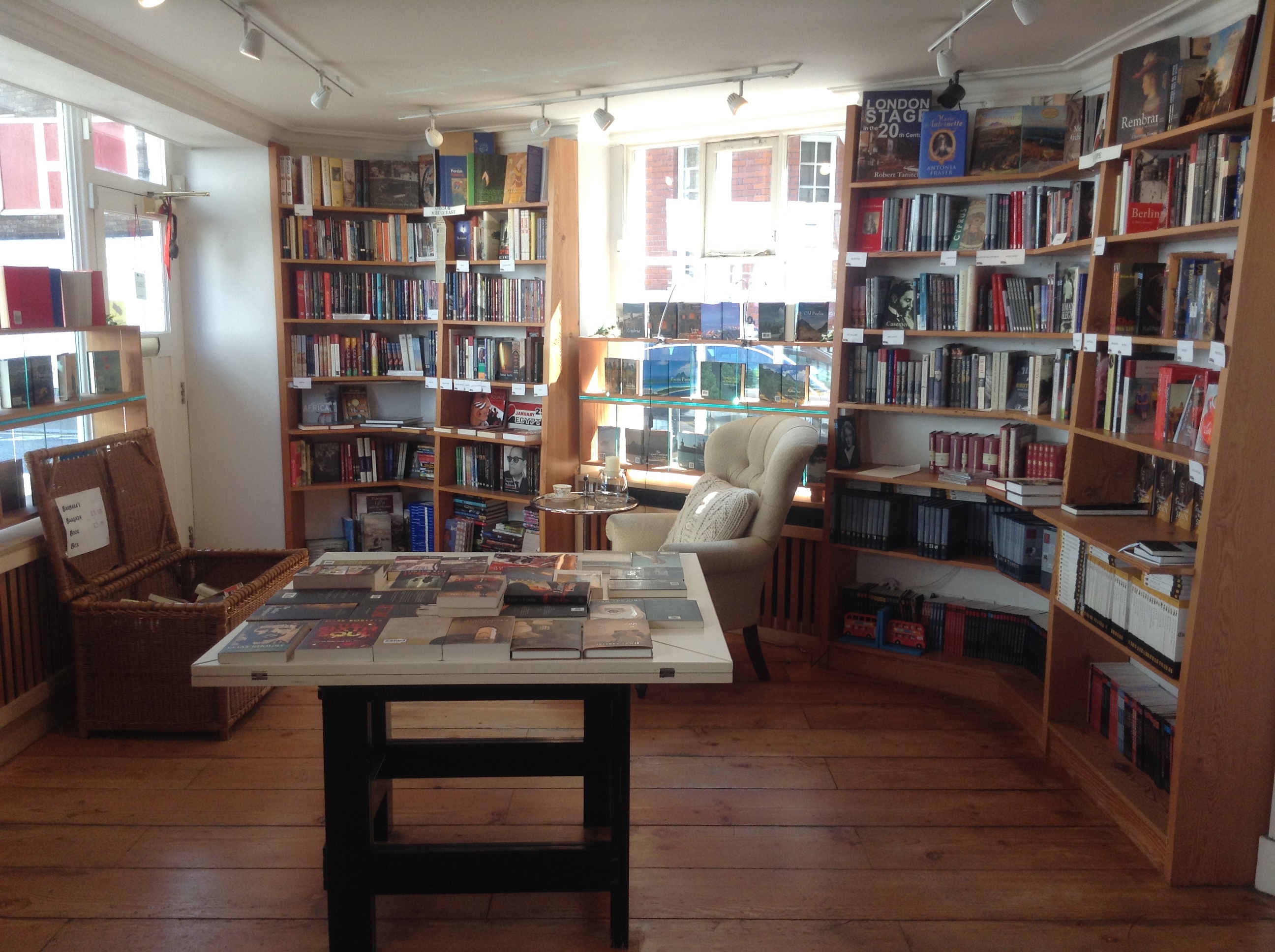
When Dr Barbara Schwepcke acquired this Belgravia corner building for the offices of Haus Publishing, she had not thought of opening a bookshop.  However, the leasehold stipulated that the ground floor should contain premises open to the public.  And so, in 2008, bookHaus was born.  At first, it was an outlet for books published by Haus but, in time, volumes by other publishing houses found their way onto the shelves that line the walls.  Many are translations from other languages.  Although the range of Haus-published works remains as varied as ever, bookHaus has recently become a travel bookshop.

photo 21

Eighteen months ago, Barbara gave me my first “proper” break as a literary translator.  Over an espresso from the stylish coffee machine in the corner, by the large, soft armchair, she provided advice, e-mail addresses and encouragement.  Then she took a punt on me, and gave me a book to translate.  Le balene lo sanno, by Italian writer Pino Cacucci.  A jewel of a book by a man who truly sees and lives the lands he visits.  A travel log about Baja California, where the author travelled in the footsteps of John Steinbeck.  My first real translation, published by a real publisher, as a real book.  Eighteen months on, under the title The Whales Know, it’s a real, cherry-red, cloth-bound book, with my name printed beneath that of the author.  “Translated by Katherine Gregor”.

I still can’t quite believe it.

Wow.

photo 11

Scribe Doll

Posted in Odds & Ends | Tagged , , , , , , , , , , | 16 Comments

Picking Up The Pen Again

Just start.  Take that first – hard – step.

“I haven’t written since before Christmas,” I say to H.  “If we stay at home, I’ll just keep working.  I really want to write something – anything – today.  Besides, we both need fresh air and some good coffee.”

So we stroll up the hill to the Village, past daffodil and crocus buds, to the little French pâtisserie where I spent so many Sundays over the summer and autumn, scribbling away while people-watching.

I open the A4 spiral notebook at a white page full of possibilities and take a deep breath.  That’s not enough.  I take a gulp of cappuccino.  The coffee glides down my throat and injects some clarity into my fogged-up brain.  Across the table from me, H. is engrossed in a large, hard-bound volume about Gabriele D’Annunzio.  Without taking his eyes off the book, he reaches for his latte and takes a sip.  I know I’ve dragged him away from his work, so we can’t go home until I have written something – anything.

One… Two… I pick up my Faber Castell and slowly unscrew the chrome cap.  The pearwood barrel feels smooth in my fingers.  I haven’t used my fountain pen for nearly two months.  Well, I haven’t used it for anything important, that is – for anything creative.

I get a pang of anxiety as I hold the pen suspended above the page.  I don’t know what to write.  I suddenly think I can’t write.  Was there ever a time when I could? I make a conscious effort to lower my hand, and the nib lands on the paper.  An instant of thrill and anticipation.  Like the moment when a sapphire needle lands on a spinning glossy black record and you wait for the music to begin.  Two months of not writing.  Weeks of trying to breathe whilst caught up in a whirlwind of work deadlines, teaching, translating, home-hunting, life changes, etc.

Swirls of shiny black ink start waving along the faint lines, slowly gaining momentum.  I am suddenly a cauldron bubbling with emotions.  Excitement, fear, longing, passion, joy and the overwhelming realisation of just how much I have missed writing.

My thoughts are shapeless forms floating, whizzing and sagging inside my head.  They need a pen to sort them and give them a clear identity and purpose.  My feelings are like a garden overgrown with weeds.  They, too, need a pen to groom them into a sharper definition.  I am an overworked bundle of uncontrolled emotions.  I need to be written down, so that I can read myself and so see myself clearly.  I can’t see because everything is inside me.  So I slowly let it all pour out of me through the tip of the nib, and watch myself take shape in the glossy ink loops and curls that run across the white page where I begin to see myself.

I look up and meet H.’s eyes, full of gently amused kindness.  He’s been watching me for a while.  “Your face…” He looks for the right words, although I already know what he’s going to say.

“Is my face giving a theatrical performance?” I ask.

“Yes,” he says, smiling.  “All those contrasting expressions.”

 Scribe Doll

Posted in Odds & Ends | Tagged , , , | 19 Comments

No Post Today (Again!)

Not being lazy – I promise.

Posted in Uncategorized | 2 Comments

No Post Today

Scribe Dolls begs your patience.

Posted in Uncategorized | 4 Comments

No Post Today

Apologies.

Posted in Uncategorized | 2 Comments

No Post Today

Scribe Doll is working hard.  She is buried under bilingual dictionaries, monolingual dictionaries, Roget’s Thesaurus, typing furiously with two fingers, and munching on Yorkshire Wensleydale with apricots.  She is casting regular glances at the bottle of Jameson’s next to her CDs.

Thank you for all your kind comments and support over the past year.

May I wish you all a happy, successful, creative and dreams-coming-true 2014!

Scribe Doll

Posted in Uncategorized | 4 Comments

Winter and the Art of Waiting – and Trusting

One of my recurring nightmares is missing Christmas.  When I am under intense stress and feel like I am losing control of my life, I start dreaming that, somehow or other, I’ve overslept, miscalculated the dates, forgot to look at the calendar, or simply got stuck at work, and Christmas has passed me by.  And I get very upset.  I love Christmas.  For about two weeks of the year.  This year, however, I am resenting the seasonal bullying which kicked in minutes after Hallowe’en.  I find myself cowering under its aggressiveness and wishing I could hide in a dark corner where I could fall asleep until Twelfth Night.

It’s four o’clock and, having worked on my translations since about six, I feel the justification – and the necessity – to get some air.   Also, there is something I want to buy.

It’s time.

The first shop I enter tells me they’ve sold out.  I have more luck in the hardware store down the street.  I buy a box of twenty.  I want coloured ones, this year.  For the past twelve Christmases, I have used white ones.  I want coloured ones, because I want to trust in their brilliant hues against the dark green leaves.

In every shop, there are representations of Santa Claus.  An old man with flushed cheeks, paunch, bright red costume and vacant eyes, and who seems capable of uttering only the monosyllabic “Ho! Ho! Ho!” My heart sinks.

Keep that Santa Claus.

Instead, give me a Father Frost – a Sir Christèmas – with a knowing face, and a cloak like the earth – green and brown and gold, glistening with icicles and embroidered with frost patterns.  A shapeshifter with hazel eyes and the arcane knowledge of Merlin, who knows words to move the elements, spells and incantations; who’s as old and wise as the earth.  A winter Green Man whose silver hair will grow dark again, and pale skin will catch the sun,  on the morning of the Spring Equinox.

I pull the box of Christmas CDs from under the bed.  Bing Crosby and the rest of the Fellowship of Crooners.  No.  I cannot abide the saccharine this year.  I take out a recording of Mediaeval carols, conducted by Andrew Parrott.  Songs full of mystery, hope and awe.  I pull my purchase out of its box, and disentangle the long, twisted green wire.  I cannot face taking out my miniature Christmas tree, this year.  Instead, I arrange the string of fairy lights over the fine branches of my droopy ficus plant.  It belonged to a Bahamian friend I knew in Cambridge, thirty years ago.  She gave me the ficus plant when she moved back to the Bahamas and so, for the past three decades, it has travelled with me from Cambridge to London, from flat to flat.  I plug in the lights and a constellation of blues, greens, reds, yellows and pinks – like a comet’s tail – trickles down the dark green foliage.  I want to trust in their brilliant, joyful hues and the promise they make me.

Trust.  Christmas is about trust.  Trust that magic exists.  Trust that goodwill and love truly exist.  Trust that words will be kept and intentions carried out.  Trust that all will be well.  After all, isn’t Winter all about trust?  Trust that beneath the frozen, hard earth bright green shoots are sprouting, even though we will not see them for months, yet.  Trust that the cold and bleakness will eventually give way to sunshine and blossoms.  Trust that, next year, things will be better.  Trust, though at times, you feel you have little evidence to fuel your hopes.  And trust is about waiting.  Waiting patiently.

The branches of the oak tree outside my window are bare.  I strain to remember the luxuriating glossy green foliage that dressed it not three months ago.  I strain to imagine tiny green buds sprouting on it once more.  But I must wait and trust.  Wait for the tree to be ready and trust that it will be.

I pour a few drops of pine needle and rosemary essential oil into the pottery burner, and put peel of an orange on the radiator.  Their scents mingle and fill the room with Yuletide.  It’s evening, and I light the red Advent candle on my table.  I sit in the armchair by the window.  Up in the sky, the Moon has a soft glow and a deeply sympathetic expression.  Her beams are washing over the dark branches of my oak tree.  I understand, she seems to whisper, trusting is hard, but do trust – all will be well.  I catch a glimpse of something at the foot of the oak.  I look down and meet the amber gaze of a fox.  His eyes catch the headlights of a passing car.  He shudders, cowers, but then straightens up and looks up at my window again.  The Moon is speaking the truth, he seems to say.  He looks peeved with my doubts.  Trust, his eyes command.  In their glint, I see something ancient and arcane.  Suddenly, the fox is a fox no more, but a tall figure standing against the trunk of the oak.  I blink and it’s vanished.  Once again, the fox is staring up at me and his eyes are merry and wise.  I stare back.  For a fraction of a second, I thought he’d turned into a tall man with a knowing face and a cloak like the earth – green and brown and gold, glistening with icicles and embroidered with frost patterns.

I will trust,  I reply.  I do trust.

Scribe Doll

Posted in Odds & Ends | Tagged , , , , , , , , | 14 Comments

Chatting to Peter O’Toole in Kit Marlowe’s Theatre

We happened to find ourselves in the same corner of the room, looking at a print on the wall, sipping our drinks.  We gave each other a polite nod.  I was trying not to look too starstruck.  Ordinarily, I am quite blasé about being in the presence of famous actors.  But this wasn’t someone ordinary – this was Peter O’Toole.  

The first screen man I had a crush on when at the age of eleven, I saw Lawrence of Arabia.  I am sure those innocent but deeply intelligent blue eyes contributed to my fascination with T.E. Lawrence.  For months, I combed the local library for any book I could find about this man I saw as an unconventional, idealistic, free-thinker.  My favourite scene in the film remains the one where Lawrence, with a theatrical gesture, extinguishes a match between his thumb and index finger, without wincing.  One of the other soldiers, William Potter, tries it and burns himself.  “It damn well hurts!” he says.

“Certainly, it hurts,” replies Lawrence with nonchalance.

“Well, what’s the trick, then?”

“The trick, William Potter, is not minding that it hurts.”

It was a launch party at the Rose Theatre, Bankside, on a cold February night, about ten years ago.  And so there I was, standing next to Peter O’Toole.

I cannot remember which one of us started the conversation.  I think he made a comment about the print on the wall – a plan of the Rose Theatre*.  Before long, we were discussing the symbolism of the rose throughout the centuries.  We talked about Dante and his rose-shaped Paradiso.  The rose as purity, as perfection, as essence, as beauty.  In poetry, history, art and mysticism.  His eyes shone as he spoke.  He told me about a special rose he grew in his garden in Ireland.  Eyes full of passion for knowledge, and impatient intelligence.

He asked what I did for a living.  At the time, I was combining my thespian pursuits with my work as a complementary medicine practitioner.  “You’re like Schiller,” he said.

“Well, he was a doctor,” I said.  “I practise alternative medicine.”

I said I thought theatre was one of the most honest professions in the world.  Peter O’Toole  gave a cynical snort.  “Honest?”

Yes.  Honest.  Theatre people are not in it for the money – not with the pittance we earn – but for the sheer, incurable love of it.  Theatre people don’t promise to cure, build, manage or rule – or even change your life in any way.  They just offer you a good night out, and a performance they weave their hearts and souls into.  What could be more honest?

He heard me out.  “What’s you name?” he asked, his eyes apparently trying to establish whether I was interesting or mad.

He suggested going to look at the actual archeological digs of the Rose.  I was about to follow him when I noticed a small crowd forming behind me.  “There’s all these people waiting to talk to you,” I said.

He did’t seem to hear me or, if he did, he chose not to acknowledge my words.  He just said, with a hint of irritation, “Are you coming?”

And who am I to refuse if Peter O’Toole offers to show me around Christopher Marlowe’s old theatre? So I followed him down the wooden steps, into the damp archeological digs, sections partitioned with orange lights.  “That’s where the groundlings would have stood.  And that’s where…”

I was transfixed.  I knew it was a moment to remember.

When we returned to the main foyer, I said goodbye to him.  “What’s your name?” he asked again.  I wonder whether he had decided between the interesting and the mad, by then.

A few years later, when I became a theatrical agent, I staged a performance at the Rose Theatre with my clients.  Peter O’Toole was the first person I invited.  Sadly, I did not hear back  from his agent.

A couple of hours ago, when the news of Peter O’Toole’s passing away flashed on my computer screen, I burst into tears.  He was a great actor.  He was also brilliant to talk to on a winter’s evening, in Kit Marlowe’s old theatre.

*Please see also A Poesy Ringful of Stories.

 Scribe Doll


Posted in Odds & Ends | Tagged , , , , , | 16 Comments

“I feel guilty, it’s all my fault, I’m a bad person” – a Cop-Out?*

I’ve been thinking about the guilt emotion.  Wondering if guilt can sometimes provide a secure – albeit uncomfortable – hiding place.  Guilt gnaws at our insides.  It pinches so hard at the bottom of our lungs, that we cannot take a full breath.  It tastes like tar.

But, in a strange kind of way, it is self-inflicted punishment and so, by definition, under our control.  Please don’t punish me – I’m already punishing myself.  And at least I know the limits of my discomfort zone.

“I feel guilty.”

Response: “Oh, you mustn’t.”

Result: Twofold

1. You think feeling guilty makes you a better person and exonerates you from the wrong you have done or are doing.

2. The other person’s response helps validate you as a good person, thereby providing a kind of forgiveness.

“It’s all my fault.”

I would believe “It’s my fault” but “It’s all my fault” rings the alarm bell of doubt in my head.  Considering that, by the law of averages something is seldom 100% just one person’s fault, vocally assuming a disproportionately large portion of responsibility inevitably makes me wonder why you would make yourself out to be worse than you actually are.  Is it (unconsciously) to make yourself look like a good person… better than you actually are?

“I’m a bad person”

Cue for me to say, “Of course, you’re not!”  Instead, what I sometimes want to say is, “So are you saying it’s in your nature to be ‘bad‘ and therefore you feel let off the hook from trying to improve?”

Here’s news for you.

Guilt is not the equivalent of soap and water – but of a mirror.  Guilt is not a hiding place to wallow in – but a call to action.  At least the person who does not feel guilty is possibly unaware of doing wrong.  What’s your excuse?

Just wondering… Could be guilty of ignorance on this one.

Oh, and yes, I am guilty of all that, too.  How else would I recognise it in others?

* Usual exceptions apply.

 Scribe Doll

Posted in Pet Hates | Tagged , , , | 15 Comments

Yes

A sea of people rushes forth as soon as the traffic lights turn green.  A faceless crowd all looking down as they stride.  I dodge them to avoid collision.  I try in vain to catch someone – anyone’s – eye.  A man’s large frame clips my shoulder.  My shoulder bends back, like on a hinge.  Like the rearview mirror of a car caught by another vehicle.  I am winded, surprised by the hardness of the impact.  Not a body made of soft flesh and warm blood, but a chunk of metal.  I turn back but the man keeps walking.  He hasn’t noticed.  I continue crossing the street, against the tide of individuals following an invisible corridor of their own.  They’re not looking right.  Not looking left.  No one looks up,  and I think how the only way you can let in change is by taking your eyes off the ground and looking up at the sky.  Even just for a moment.  Trust that during that moment you will be shown something else, something new, something better. A sea of people following invisible corridors.  Not even dreaming of change.  I am suddenly frightened.  I look up.  I have to.  Otherwise, I’m scared I may be swallowed up by the crowd and lose my self.  Above, in the dark early morning sky, a streak of rosy glow.  I want to breath it in.

Trapped.

At the entrance to the building where I am to meet my client, I slip into the narrow pie chart semi-circle gap of the revolving door and push against the heavy glass.  On the other side, the street noise of traffic is replaced by the echoing of steps against the gleaming stone floor.  Metallic sounds, distorted and chaotic.  Stone  floor, steel bannisters, glass front and wall partitions.  Glass lift that will soon take me up like a shuttle through the void.  The electric light bounces off every hard surface and stabs into my eyes.  Like a concentration of laser beams.  Grey.  The humans whose shoes are clicking against the stone floor are wearing grey.  Gunmetal grey, pearl grey, ash grey, lead grey.  Grey.  And black.

Hardness.

Green.  There is a huge, symmetrical Christmas tree in the lobby.  There is something robotic in the regular intervals between the identical gold and red baubles, something eerie in the blueish whiteness of the fairy lights.

Cold.

It’s too early for Christmas.  Nearly three weeks to go.  Every shop window sparkles with tinsel and bright flashing lights.  There is nowhere to rest your eyes.  Your ears are assaulted by crooners whose names no one under forty knows, singing of snow, jingles and chestnuts.  On television, a stream of slushy, saccharine-seeped seasonal U.S. films about characters who are too sentimental, too naive and too nice who, in spite of financial constraints, seem to have large houses crammed with expensive-looking Christmas decorations.  Acquaintances tell you they want to see you before the 15th.  They have important commitments closer to Christmas.

I look at the synthetic Christmas tree in the lobby.  There is no promise of warmth or inclusiveness in all this overwhelming advertising of Christmas.  Rather, it is like a warning siren to all those who don’t fit into the “normal” social set up, so they get out of the way of the approaching avalanche, lest they be crushed by it.  It’s a Christmas for those with children, those who can be with loved ones, those who have cars in this city where there is no public transport to link people together on the day we are told we should not be alone.

Bullying.

After I finish teaching this client, I make my way to another one.  Another building with a glass revolving door, a glass and steel front, a gleaming stone floor.  Between two blocks of concrete, I glimpse the Shard.  Its jagged point pierces through the soft blue sky.  The sheer unexplainable violence of it constricts my throat and brings tears to my eyes.  Why build something so aggressive?

I am early, so I stroll along the grey City streets.  Men and a few women walk past me, mobiles against their ears, or in their the palms of their hands while they key in text with strokes of their index fingers.

A church.  I notice a little church with a steeple, with a little pond outside the front doors, and a couple of stone benches.  It’s too cold to sit outside, so I turn my ‘phone onto silent, and venture in.  I read on a leaflet that this church was rebuilt by Sir Christopher Wren after the Fire of 1666.  I hear music filtering through the thin glass door, and am filled with a sense of longing.  I walk in, genuflect and cross myself.  Gentle organ music caresses the fresh white walls decorated with gold trimmings.  I sit on a pew and the dark timber creaks.  I inhale the comforting, warm smell of wood.  I close my eyes and let the music seep though me, fill me with its colours, and bring all the shreds of my soul back together into my body.  Peace.

Wholeness.

“Good morning, Ma’am.”  The security staff smile as I walk up to the chrome reception desk.  They see me week after week.

“You know, I’ve just discovered a lovely little church not far from here.  It’s so peaceful.  Do you know it?” I say.

The smile freezes and the eyes look away from me.  “No.”

It takes me a while to understand.  That’s right.  I said “church”.

On the Tube, on my way home, there is a baby boy in a pram.  He is fast asleep.  I smile and try and catch his mother’s eye but she doesn’t see me or her child.  She is sending a text message on her mobile.  I look out and notice a glow on the horizon, against the darkening sky.  A bright golden light that turns into a deep orange with shades of pink.  A glorious sunset.  I look around the Tube carriage, needing to share this moment with someone – even voicelessly, just with a look.  I search for eyes but see blank stares into the void.  White earphones insulating from the world; smartphones with games, e-mails or text messages distracting from new ideas and experiences.  The horizon is now a pool of fire that spreads like a cauldron brimming with magic.  With life.  I feast my eyes on the intense colours.  I look around again.  I want to shout at the other passengers to look at this miracle.

I see an old lady staring at the horizon.  A dreamy expression in her eyes.  I lean over.  “Isn’t it magnificent?” I ask, my tone too excited, and too familiar, but I don’t care.  She smiles at me, without the slightest hint of surprise.  “Yes,” she says.

We turn to look at the shifting of shapes and colours in the sky.  At this manifestation of life.

Hope.

Life.

Scribe Doll


Posted in Odds & Ends | Tagged , , , , , | 12 Comments