What Exactly is Your Job?

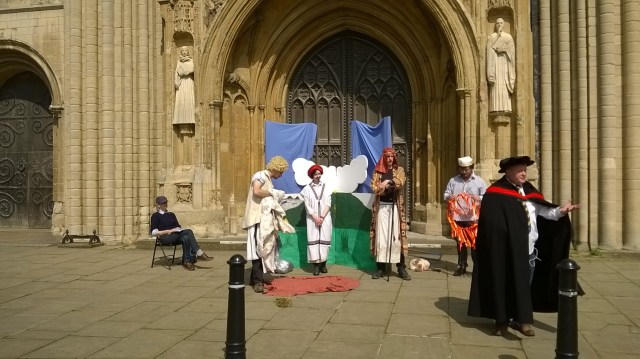
Last weekend, I had the joy of seeing members of the Norwich Stonemasons‘ Guild perform a Mystery Play outside the doors of the Cathedral.  It was a warm, sunny afternoon, a brief summer interlude before putting our coats, scarves and gloves back on in time for June.  The first Mystery Play to be acted by a Norwich guild for five hundred years – Cain & Abel.

WP_20160528_001

As an eager crowd gathered outside the Mediaeval Benedictine cathedral, the Beadle of the Guild, in his black velvet cap and cloak, and gold-tipped staff, announced, in imperative tones, “You will enjoy it. You will laugh,” triggering the first giggles among the willing audience.

I couldn’t begin to describe the sheer delight and fun of this ten-minute performance.  I couldn’t do justice to its highly imaginative props, to the brightly-coloured, makeshift set, to the hysterically funny performance by the actors, who, fuelled by the audience’s laughter, gave into corpsing themselves, thereby increasing the overall giggling.  There was something so earthy about the whole event, so uniting.  Inevitably, I thought of the Mechanicals of Athens performing Pyramus and Thisbe.  An unwitting trigger to laughter was also the organ player in the Cathedral, where that evening’s concert was being rehearsed, whose notes from Fauré’s Requiem thundered through the stone walls at a couple of appropriate Biblical moments.

WP_20160528_004


At the end of the performance, after the cheers and bows, the Clerk came on and spoke of the history of this Guild, and repeated the last line of the performance, “Perfection in an imperfect world.” Summa Inter Mediocria, the St Stephen and St George’s Guild motto.

WP_20160528_007

These words sent a tingle up my spine.  I often walk past the Church of St Clement, and catch a glimpse of the stonemasons at work, complete with their square white caps.  Everything about their body language and that of the Master Stonemason who supervises them oozes something we seldom see nowadays: fierce pride in one’s work.  A refusal to produce anything less than as perfect a job as any human can aspire to.

Over the days that followed, I pondered over something that has been much on my mind, recently.  Job titles.  Pride in one’s job. A sense of achievement when performing a task.  The refusal to compromise quality and “make do”.

Stonemason.  Baker.  Translator.  Writer.  Carpenter.  Lawyer.  Priest.  Journalist.  Teacher.  Actor.  The words immediately tells me clearly what the jobs entail.  It took me ages to work out what a CEO did.  Chief Executive Officer.  What’s that? What’s wrong with “boss”? Or MD.  Managing Director.  What is “manage”, exactly? Is it to regulate? To direct? To organise? When I taught Business English, the majority of my clients’ job titles weren’t words but abbreviations.  I often had to ask them what they did exactly and, in most cases, still couldn’t put my finger on what precisely their professions involved.  After many a lengthy explanation, I frequently yearned to ask “What do you actually make? What is the tangible, physical result of your work?”

I once worked for an oil company for two months.  The second month was to work out my notice.  My job title was also an abbreviation.  Much of it seemed to involve entering long serial numbers into a computer.  I wasn’t quite sure why.  One day, when one of the top honchos of the company circulated through our department, shaking everyone’s hand, and asking what they did, I embarrassed myself.  His question suddenly stumped me and I replied, “I don’t know.  I’m not really sure what I do.” He laughed politely, probably assuming I was joking, but I was totally serious.  Inappropriate for the occasion, but serious.  I had no idea what I actually did.  I couldn’t be proud of a job I didn’t understand.

Recently, at the London Book Fair, I asked a woman if she was a publisher.  She replied, “No.  I facilitate publishing.”

I stared, totally at a loss.  What’s “facilitating publishing” when it’s at home?

In one of the very executive London language schools I used to teach (“executive” – another hermetic word for me – executing what?), we weren’t called teachers but “trainers”.  I wondered if the management considered the word “teacher” to be too authoritative, too passé, or – what the heck – too politically incorrect.  Similarly, students were referred to as “course participants”.  I went around feeling like a rubber sports shoe, facilitating learning rather than teaching – which is what I’d signed up to do when I qualified in Teaching English as a Foreign Language (there, the word is “teaching”!).  As for “course participants” as opposed to “students”, the difference in connotation made me somewhat uncomfortable, the latter suggesting in my mind individuals who were simply required to attend my classes and not necessarily learn from them.

Other job titles that have recently puzzled me are “Community Banker” referring to the advisors/clerks at my local bank, “Presentation Team” printed on the uniforms of cleaners,   and anything with the nouns “Consultant”, “Executive”, “Corporate” and “Officer” (outside the military) attached.

Stonemason.  Baker.  Translator.  Writer.  Carpenter.  Lawyer.  Priest.  Journalist.  Teacher.  Actor.  These I understand.  But perhaps I’m too simple-minded.

Scribe Doll

Posted in Odds & Ends, Uncategorized | Tagged , , , , , | Comments Off on What Exactly is Your Job?

Adventures with Chicken Soup

My acupuncturist takes a quick look at my tongue. “You’ve got a low blood count,” she says.

I smile and roll my eyes, thinking of how my GP had to draw blood and process it for a whole week before working that out.

The acupuncturist carries on her diagnosis with remarkable accuracy.  As part of her list of suggestions, she advises me to have chicken soup.

“I very seldom eat meat – I haven’t liked it since I was a baby,” I reply.

“Well, try it,” she says, “and see how you get on.  It does wonders for the immune system.  Only make sure you boil a whole chicken, to get all its goodness.”

“Dearest, will you make us some chicken soup, please?” I say to H. – a meat eater – as soon as I’m back home.

Once he’s processed his surprise at my request for meat, and my explanation for it, he stares at me, his eyes momentarily blank behind his glasses.  “Why can’t we just buy some ready-made?” he suggests, clearly trying to be helpful.

“Because this is supposed to be for my health, not something in a plastic tub, full of additives and preservatives.  In fact, we’d better get an organic chicken.  So will you make us some clear chicken soup? You keep talking about the one your mother made with Kneidel…”

I don’t know how to make chicken soup…”

It’s my turn to look blank. I finally burst out, “Your family were Ashkenazi Jews from Poland – how can you not know how to make chicken soup?!”

“My mother was the one who made it.”

“And didn’t you ever watch her in the kitchen?” I say, and immediately realise the futility of my question when addressed to a man.  I remember, not without resentment, the hours spent – under duress – in our family kitchen.  My Armenian grandmother would say, in a self-satisfied tone, “Watch, Katia.  Watch and learn.”  Being a girl can be so unfair.

“Where can I buy an organic chicken?” I ask no one in particular.

H. gives a constructive shrug.

“OK, I’ll go and find one – and a recipe – but I’ve never handled raw meat, so you’ll cook it, right?”

H. nods with deliberate obligingness.

Before my irritation degenerates into an accusatory rant, I grab the shopping bag and venture to the supermarket.

An hour later, there’s a small, organic chicken on our kitchen counter.  I’m on the phone to my friend Sue.

“Now whatever you do, don’t wash it first,” she says.

“Oh, but my grandmother always used to wash meat thoroughly before cooking it.”

“So did my mother.”

“Then why?–”

“They’re now saying it’s safer not to.”

“‘Safer’?”

“Yes.  They tell you to cover every surface with clingfilm, and if any raw chicken touches anything at all, then make sure you clean it with anti-bacterial detergent.”

I suddenly remember stories of the extraordinary precautions taken by my mother, when giving me the polio vaccine when I was a baby.  Holding my hands to prevent me from putting them in my mouth.  Boiling or burning any contaminated bibs, towels, or kitchen utensils.

“Why do people eat chicken if it’s so dangerous?” I inevitably ask.

“Oh, it’s perfectly safe.  They just tell you to be very careful because of the bacteria.”

“Who are ‘they’?”

“The experts.”

Oh, them

After half an hour on the ‘phone, I read out all the health and safety instructions to H.

“Oh, yes, everybody knows that!” he says, casually.

I briefly consider hurling the chicken at him, then remember that, at all other times, I do love my husband.

I watch him at work.  As he cuts the string that holds the dead bird together, its limbs suddenly pop apart.  I gasp and jump back.  Perhaps I should leave the kitchen… No, I’d better watch and learn.

We take our largest pot but even that doesn’t look big enough to contain the chicken.  H. stuffs it in with difficulty.  I hear something crack and feel nauseous.  I struggle to remember why I suggested all of this in the first place.  We cover it with water and add my home-made vegetable stock.  As it starts boiling, some disgusting-looking froth forms on the surface.  Neither of us knows what to do with it, so we take the executive decision of skimming off with a spoon and throwing it down the sink.

Then, something unexpected and terrifying happens.  The chicken, the dead chicken, slowly starts to move of its own accord.  It spreads its wings, its legs rise over the edge of the pan, and the whole carcass floats up, emerging from the stock.

“What the hell is that?” I say, wondering if I should reach out for the rolling pin.

H. is very calm before this unexpected development.  “I don’t know,” he replies, “but I definitely think we should add some pearl barley.”

An hour later, the flat is heavy with the smell of fat, the sick ward in a hospital, the sour, musty smell of a second-hand clothes shop.  We sit down to eat.  I stare into the swirls of fat forming shapeshifting paisley patterns in my bowl, stir the slippery barley, keep telling myself this is good for me.  I finally muster the courage to lift the spoon to my lips.

A smile is beaming over H.’s face, as he wolfs down his second bowl of soup and reaches out for a third helping.  “Mmm… Just like the soup my mother used to make,” he says, dewy-eyed.

I push my bowl away.  The yellowish, viscous liquid has gone cold.

I go and raid the kitchen for bread, cheese and olives.  There’s a bag of curly kale in the fridge.  Tomorrow, I’ll bake it to a crisp in olive oil and salt.  I’m sure it will raise my blood count.

Scribe Doll

Posted in Odds & Ends, Uncategorized | Tagged , , , , , | 10 Comments

Luxembourg Wine

In Anglo-Viking-Flemish Norwich, a Londoner and a Roman invited a Venetian for dinner at their home.  The Venetian had some Austrian, Spanish, and Moroccan blood, the Londoner originally came from a Polish-Jewish family, and the Roman was of Armenian-Welsh-Cornish descent.  All three were Europeans to the core.

While the meal – a Sicilian dish – was simmering in the kitchen, the hosts and their guest sat in the living room, chatting in an English interspersed with Italian words, and an Italian with the odd English expression slipped in, listening to a Bruxellois singer on CD, and sipping wine from Luxembourg.  A smooth, silky, golden, elegant Riesling with a twinkle in the eye.  It had been sent courtesy of a newly-formed acquaintance who was not only very knowledgeable about classical music but – all three agreed – clearly a connaisseur of good wine.

There was a strong difference of opinion regarding the absence, in English grammar, of gender for nouns.  The Venetian argued that this lack made English colourless.  The Londoner insisted that there was no logic in arbitrarily deciding that a chair was “she”, a book “he”, or vice-versa.  The Roman expressed outrage that animals should be referred to as “it”, as though they were inanimate objects, then went all sentimental when mentioning that in Russian, белка – squirrel – was feminine.

“Why? Don’t they have any male squirrels in Russia?” the Londoner asked.

“In Italian, scoiattolo is masculine,” said the Venetian.

“So are all Italian squirrels female, then?” the Londoner enquired.

Nobody answered his questions and, during the brief pause in the conversation, the Roman brought in a steaming bowl of pasta with Sicilian caponata, into which she had stirred some creamy French goat’s cheese.  They all tucked into this dinner, the ingredients of which had been thought up by Jews, Chinese, Normans, Arabs and North Americans – in other words, a European dinner.

As they ate, they discussed travel.  It’s only an hour’s flight to Amsterdam, or Paris, or Hamburg.  You’re an hour away from Dutch, French and German.  Here, we don’t fly for hours and hours and still hear the same language when we land.  Because our small continent is like the colourful pattern of Harlequin’s costume, with lozenges of different, contrasting colours, all sewn together.  Over the centuries, we have complemented one another, enriched one another, challenged one another’s comfort zones.  Foreign winds have blown new seeds onto our lands, and sprouted into new fruits, and our winds have carried our seeds abroad.  We have destroyed any dams that threatened to turn our limpid, gurgling rivers into stagnant, smelly ponds.  We have knocked down fortresses that imprisoned people within their walls and restricted their human rights.

“Oh, look, there’s still some Luxembourg Riesling left,” says the Roman, toying with her napkin, wondering what she’s going to do with all the food left over despite everybody’s triple helpings.

The Londoner picks up the slender bottle and pours the remaining golden liquid into the three glasses in equal measures.  “What shall we drink to?” he asks.

“To this wine – from a country none of us has been to – for bringing us all together this evening,” the Venetian suggests.

“To peace and unity within this dear Old Continent,” the Roman adds, raising her glass.

Scribe Doll

Posted in Odds & Ends | Tagged , , , , , , , | 6 Comments

Future of the UK or Dystopian Nightmare?

The UK borders have closed.  There is no longer free travel in or out of the country and a tourist visa is granted only to travellers able to prove a bank account balance of 1 million pounds minimum.

London has been cordoned off by a “wealth belt” and only individuals with a proven bank balance of 5 million pounds are entitled to take up residence in the Capital.

Public transport fares have gone up by 150%.

Service industry workers do not qualify for London residence (seeing their earnings do not allow for savings of 5 million pounds), live beyond Zone 6 and cannot afford to travel to and from their jobs. Therefore, they live on their work premises.  They receive the minimum hourly wage (£8 an hour), paid six months in arrears.  All have to sign a Zero-Hour contract which stipulates that the employer does not guarantee them a fixed number of employment hours, while they must pledge to remain available, are forbidden from taking on any other job, and must give a year’s notice if they wish to leave.

The UK has left the European Union.  Foreign languages are not taught in schools.  Books translated from other languages are not available in UK bookshops. Foreign newspapers and magazines are not available at newsagents.

There is total freedom of speech, as long as it is in accordance with the Ministry for the Political Correctness and Inclusiveness of Language.  In order to facilitate this, heavy fines are imposed on the public use of the following words and expressions:

– God

– Happy Christmas

– Happy Easter

– Stupid

– Ignorant

– Fat

– “‘Bless you!” when anyone sneezes has been replaced with “Include you!”

Legal Aid has been abolished.  So has the right to defence.  Anyone arrested is assigned a defence lawyer only as the police and magistrate/crown court consider it appropriate.

Electricity, Gas, Water and Telecommunications are owned by off-shore companies.  Users are legally obliged to take out a contract with these providers but only the said providers have a legal right to terminate these contracts.

It is illegal for anyone, including family members, to have any physical contact whatsoever with children under the age of 18.  All essential physical contact (i.e. dressing, washing, feeding, first aid, as well as “emotional bonding time”) with under 18s is to be  strictly carried out by a specially programmed robot approved by the Health and Safety Department.

All newborn babies are vaccinated with a quintuple all-purpose vaccine.  Since this blanket vaccination programme, many viruses of childhood diseases have mutated into much more powerful forms that are difficult to treat.  Therefore, the quintuple vaccine has to be repeated every two years, and its potency increased every time.  Consequently, we are experiencing a new medical phenomenon: a generation born without an immune system.

All babies are microchipped and barcoded for their safety.

All telephone calls, e-mails, text messages, tweets and paper correspondence are recorded and stored under the Permanent Security Act.

All benefits have been abolished.  Homelessness now affects 6 people out of 10 and is classified as a criminal offence under the new Keep the UK Wealthy Act.  Anyone caught being homeless is arrested and tagged with an electronic device.

The UK is ruled by a mono-party system in which the Government is regularly reshuffled, thus abolishing the need and unnecessary expense of elections.

Scribe Doll

Posted in Odds & Ends, Uncategorized | 20 Comments

Just a Bit of Fun at the Expense of One English Social Stereotype*

We went to London last week, and stayed in Fulham, where I lived for several very happy years.  For the information of non-Londoners, it’s an area in the South-West of the capital, a twenty-minute Tube ride from the West End and Theatreland.  Part of Fulham covers a stretch of river between Hammersmith Bridge and Putney Bridge.  A truly idyllic mile frequented by crows, seagulls, ducks, cormorants and herons.

When I first moved to Fulham, in 2000, I used to joke that the night bus 14 wasn’t as threatening as other London night buses because the drunks on that line were intoxicated by champagne.  Another joke I heard from more than one person (or perhaps it wasn’t a joke) was that the most frequent reason for admission at Chelsea & Westminster Hospital Accidents and Emergency was a cut to the hand caused by a large knife slipping while trying to remove the stone from an avocado.  There is a pub called The White Horse, but which the locals know as The Sloaney Pony.  That is a fair illustration of one of the social types that reside in that area.  Indeed, Fulham is filled with what, at the University of Durham, we called screaming, stonking ‘Rahs.  Again, for the benefit of those who have never had contact with this sub-group of the English middle classes, ‘Rahs are second and third-generation Sloanes.  In other words, the banknotes in their wallets are so new, you can still smell the ink a mile away.  ‘Rahs tend to speak with a plummy accent but not with the clarity of cut-glass English.  Their speech is sloppy, lazy, and their vowels half swallowed because, let’s face it, oh, yeaaarrrh, it’s just t’much effort like to pr’nounce th’m.  Male specimens of this social sub-group are sometimes called Sebastian, Crispin, Oliver, Tristan or Rupert.  They often wear stripy shirts and chinos or corduroys.  Lace-up shoes are mandatory.  Back in my youth, they were seen sporting V-neck cricket jumpers or stripy rugby shirts.  Nowadays, they prefer crew neck lambswool jumpers.  Their female counterparts, often Isabellas, Mirandas, Juliettes, Dorcases and Chloes, can be recognised by their trademark string of pearls no matter the outfit, or, these days, a piece of “ethnic” jewellery.  Still, whether they’re wearing the green Barbour jacket of my generation or the more modern cropped tweed blazer or short mac, one characteristic remains unaltered: they still have longish blonde hair.

Last week, as H. and I were strolling through Bishops Park, there was a group of them standing outside an infants school, having dropped off their mini Ruperts and Mirandas in  Baby Gap and Cath Kidson outfits.  They stood there, chatting to carbon copies of themselves, jangling keys to people carriers and oversized Volvos.  “Look!” I said to H.  “I told you Fulham raises the national average for blondes by a large percentage.”  He looked at them with an expression of disbelief.  There were six or seven of them, all of them blonde.

There were more of them in the coffee shop where we went to have breakfast.  The table next to ours was a veritable aviary, with screeching, high-pitched giggling, and shrill outbursts of excitement.  It was nearly ten o’clock, and I wondered – as I did while living in the area – why these women weren’t somewhere else, engaged in money-earning employment.  Who pays for their leather designer handbags, their suede boots, their wide silver bangles, their smoothies and their pains au raisin? I guess some things don’t change, whatever the efforts of the various feminist movements.

* Gentle, genuinely affectionate fun.  To quote Mr Bennet, “For what do we live, but to make sport for our neighbours, and laugh at them in our turn?”

Scribe Doll

Posted in Half-English Observations | Tagged , , , , , , | 5 Comments

Books: Challenges, Traumas and Pure Pleasure

I remember a stormy night when I was about eleven.  We were living in Nice.  I don’t remember what prompted me.  I stood on a chair to reach the top shelf of my mother’s bookcase where she kept – along with other never-read books – The Complete Works of Shakespeare.  I sat at the kitchen table, ploughing my way through Macbeth.  I couldn’t understand any of the language, so I looked up almost every other word – without much success – in the Concise Oxford.  Electrified by the flashes of lightning and thunderclaps bursting outside, I was mesmerised by this hermetic text I could not fathom, convinced that within its lines were locked up great secrets I yearned to discover.

About a year later, my mother authorised the local library to allow me access to the adult section.  After my first visit there, I came back home with a book about Confucianism.  Only one sentence remains anchored in my memory: I spent my entire life trying to change myself but have still failed.  The only words I remember.  The only ones I understood, probably because the paramount importance of self-improvement was much advocated at meal times.  Still, when I finally returned the book to the library, I felt a deep sense of satisfaction, as though I’d been given the key to important knowledge.  Where this knowledge was stored, or what it concerned, I had no idea, but at least having the key to it was a good start.

That same winter, I got the mumps.  I was kept indoors, warm, and waited on for a month.  I was allowed more television than usual, and my mother brought me books from the library.  Owing to my illness, the self-improvement programme was put on hold, and she did look disapprovingly at my reading for the sheer pleasure of it.  I asked her to borrow Joseph Bédier’s rendition of Tristan et Iseut and that was the first book I remember reading which filled me with magic, and infected me with a passion for Mediaeval literature, art and music.  And words.  Beautiful words.

When I was fifteen, we moved to Rome.  One day, I found my mother’s copy of Friedrich Nietzsche’s Thus Spake Zarathustra lying on the coffee table.  She’d enthused about it over dinner, so I picked it up and began to read it.  I was bowled over by the histrionic wit of this man.  Shaken, turned inside out and zapped with new energy.  A God that danced.  It was as though my brain had just expanded so violently, it was about to break free from the constrictions of my skull…. even though I had no idea what Nietzsche actually meant.  I just felt that he was telling me that there was something out there that was so big and awesome, I wanted to access it too.

The summer after my sixteenth birthday was the summer I was traumatised by Dostoyevsky.  For some time now, there had been an awareness on the part of my mother and grandmother that my Russian was embarrassingly bad, given that it had been the first language I had learnt as a toddler.  Although my speaking was fluent, my spelling was atrocious and I read one syllable at a time, like a five-year-old.  What neither of them chose to be aware of was – for reasons pertaining to a twisted, dissatisfied teenage psyche I eventually grew out of – my deep dislike of the language.

So, that summer, judging the French school three-month holiday period to be “too long for doing nothing”, my grandmother decided to traumatise me with Crime and Punishment.  As she was also teaching me to knit, she saw the hot Roman afternoons as the perfect opportunity to combine manual and intellectual education.  So, while all sensible Roman residents would sink into a refreshing siesta, she and I would sit in the shady part of our balcony and take it in turns to read aloud and knit.  My knitting being as unenthusiastic as my Russian, when it was my turn to read, my grandmother would correct my pronunciation while undoing several rows of uneven loops.  Thinking about my schoolmates, who were probably bathing in the Sardinian sea or strolling in the Alto Adige mountains, I resented my lot, hated knitting, hated Dostoyevsky and (almost) hated my grandmother.  By the end of the summer, I was less familiar with the crime aspect of the novel than with the punishment.

For many years, I hardly ever read fiction, except when it was prescribed by school or university.  I found it hard to shake off the deeply-inculcated notion that you read in order to acquire information or improve yourself, and that novels, precisely because fictional in nature, were somewhat less valid forms of literature.  I envied people who said they loved to read, who described the pleasures of immersing themselves in a book.  I knew I was missing out on something but didn’t know how to remedy the situation.  Once again, I felt there was a whole, wonderful world out there but, this time, it wasn’t my intellectual inadequacy that prevented me from accessing it – it was something deep inside me, so intrinsically part of me that I didn’t know how to root it out.

The novel for me that opened the doors to other novels was Miss Garnet’s Angel, by Salley Vickers.  It was the summer of 2000, and I was attracted by the cover design: the reproduction of a Renaissance angel.  I picked up the book from the table display at Waterstone’s and read the back cover.  I saw that the story took place in Venice.  I’d just returned after a few days there, and longed to go back.  I bought the book and became totally engrossed in it.  I loved the main plot being interwoven with the apocryphal story of Tobias and the Archangel Raphael.  I loved Salley Vickers’s acute observation of human behaviour and her deep insight into emotions.  I loved her descriptions of Venice.

With Miss Garnet’s Angel, my reading habits changed.  Reading suddenly became something I gave myself permission to do simply for the fun of it.

My favourite Saturday morning activity became browsing in charity shops.  The advantage of cheap, second-hand books was that it allowed me to take risks on novels and buy them on a whim.  As a result, I discovered many wonderful books.

Fifteen years on, I love reading.  I feel free to pick up whatever I feel I will enjoy, whether it’s Booker Prize material or a thoroughly enjoyable crime novel.  I just swim among its words, let myself be carried away by the story, and form new acquaintances with the characters.

It’s delectable.

Scribe Doll

Posted in Odds & Ends, Uncategorized | Tagged , , , , , | 10 Comments

London Night Sounds

The rumbling of the occasional car, speeding past our house.  A murky grey sound.

Snippets of human voices.  A woman’s giggle.  A crimson sound.

The arrhythmic clicking of stiletto heels on the pavement.  A copper sound.

The roar of the night bus.  A faint white sound.

The rustling of leaves, disturbed by the wind.  A golden sound.

The yelp of a fox.  A scarlet sound.

The shriek of a motorbike.  A black sound, like tar.

The rhythmic clang of the train, not too far.  A brass sound.

The high-pitched whirr of the light bulb in the angle-poise lamp on my desk.  A tinny sound.

Sweet recorder sonatas by Telemann, wafting out of my CD player.  A dark honey sound.

The tick-tock of the second hand of the alarm clock by my bed.  Black and white sounds.

The click of the front door; one of my flatmates coming home after a wedding reception.  A candy-pink and sky-blue sound.

The thud of the front door; another flatmate returning after a night on the town.  A red sound.

The translucent harmony of moonlight, floating through the air.  A silver sound.

A cat meowing across the street.  An emerald-green sound.

A night wind, blowing through the streets.  A diamond-cut sound.

Stars, shining in the sky.  A myriad of colours, like the notes of a glockenspiel.

I cannot sleep.

Scribe Doll

Posted in Odds & Ends | Tagged , , , , | 10 Comments

Seven Quirks of British Restaurants

No.1

Is everything O.K.?

Have you noticed how waiters wait for the exact moment when you have your mouth full, before they ask you that? I often try and cheat them by staging my forkfuls when they’re not around but, almost as though they’re watching me from a distance, no sooner am I munching away, than they pounce.  “Is everything O.K.?” Naturally, all I can emit is an unintelligible groan, and a nod.  I wonder if their timing is purposefully strategic.  Perhaps they’re trained to schedule their question precisely when you cannot speak.  Yes, I know, as my mother – or the Aunt Alicia in Colette’s Gigi – would say, you could train yourself to chew and speak at the same time, elegantly.  But still…

It was a relief going to cafés and restaurants while living in Brussels.  There, nobody comes to intrude on your meal unless you specifically request their attention.  Only at the end, as you’re settling the bill, does the waiter ask Ça a été?

No.2

The cake on top of the napkin

I don’t know if this is a strictly British practice, but I’ve not encountered it in Italy, the U.S., Germany, France, Greece or Spain.  You order cake, or a sandwich, and it arrives lying on the napkin, as though it needs to be comfortable on the cold, hard plate.  Surely, the point of the napkin is to be spread on your lap, and used for dabbing your lips and fingers – a point defeated from the start if, by the time you have slid it out from under the cake or sandwich, it’s covered in chocolate, cream or dressing.

No. 3

The parmesan and black pepper rations

In too many establishments, once your meal is served, the waiter approaches and offers you black pepper.  Then s/he gives the oversized mill a couple of twists over your plate, and walks off.  I might want to add pepper halfway through my meal, but the option is not available.  Is black pepper so expensive, restaurants cannot afford to keep a small mill on the table, together with the salt shaker?

The same discourse applies to grated parmesan.  When your pasta is served, the waiter brings a bowl of parmesan, and sprinkles a spoonful on your dish.  If you say nothing, he sprinkles a second spoonful.  At that point, s/he marches off, unless you specifically request more.  If you do, s/he expresses shock, as though you’re being unreasonably greedy.  Sometimes, I tell the waiter, “just leave it here, I’ll help myself” and that creates a mini panic response…

No. 4

Salt mills

I know this is entirely a matter of personal preference but who actually enjoys crunching large salt crystals? What’s wrong with a salt shaker that dispenses fine salt powder which blends in easily with the food?

No. 5

Salt and pepper mills/shakers

“Katia, the table is off-balance,” is what my grandmother would say if, while setting the table, I’d forgotten to put the salt shaker in the centre.  Time and time again, I go to restaurants and cafés where there is no salt on the table and I have to ask the waiter to bring it to me.  The other day, I asked why they didn’t just keep salt and pepper on every table.  “People steal them,” the waitress replied.

I was speechless.  Are we so poor a nation? Or so thieving?

No. 6

Iced water

Personally, I think automatically serving water with ice cubes in a country as cold as England is somewhat peculiar.  Still, at least thus far, this is a free country, so people are entitled to order iced water if they wish. But why do waiters insist on bringing me iced water after I’ve specifically ordered it “without ice”?

No. 7

Halloumi, Hollandaise, etc.

I doubt I’m breaking the Official Secrets Act by stating that traditional English food errs on the side of – how can I put it diplomatically? – well, let’s say on the side of the bland, and is, originally, far from vegetarian-friendly.  We’ve come in leaps and bounds since my introduction to English cuisine, at the age of nineteen, when it was meat and two veg, no salt, and pudding consisted in drowning anything at all in custard.  Still, perhaps cafés and restaurants should expand their horizons a little further and, once they’ve discovered a new ingredient, not it serve exclusively over and over and over again.

Yes, halloumi cheese is lovely, and made a welcome change from mozzarella, after the latter had outstayed its welcome as the successor to cheddar.  Now, however, wherever you go, it’s halloumi.  Halloumi burger, vegetable hash with halloumi, salad with halloumi.  Why don’t we also try various varieties of goat’s cheese, manchego, ossau iraty, fontina, asiago, blue Shropshire, to name but a few?

Another relatively recent feature in restaurant menus is hollandaise sauce.  A tangy addition to many eggs and asparagus dishes.  In small doses, though.  Sadly, British enthusiasm for this perceived bit of sophistication means that   eggs Florentine and eggs Benedict are served drowned in it, the way custard used to drown stodgy puddings.

Scribe Doll

(This is a revised version of  a post first published on 24 July 2011)

Posted in Half-English Observations | 14 Comments

Voice, Stone, Wood and Air as One

I love Early music.  I love its level-headedness, its lack of mood swings.  It’s everlasting YES.

Part of the reason I listen mostly to Mediaeval, Renaissance and Baroque music  throughout the day is because, besides its being soothing and immensely reassuring, it doesn’t distract me from my work.  I am a literary translator, and I spend most of my waking hours like the 21st Century version of a Mediaeval scribe, hunched over my laptop, a shelf full of heavy dictionaries behind me, perhaps one or two lying open on the messy table, writing in somebody else’s voice, trying to read their thoughts, second-guess their intentions, and “Englishing” them.  I need music in the background to centre me, calm me and, above all, music that will not distract me.  I cannot work with passionate music that throws tantrums, asks questions, is emotionally egocentric, or demands that I get up every couple of minutes to either turn up or turn down the volume. I need music content in its serenity, stable, with certainty that will provide a sturdy, friendly support to the doubts and anxieties that go hand-in-hand with trying to pass for somebody else in another language.

So, day in, day out, I am accompanied throughout the day by friends like Léonin, Pérotin, Josquin des Prez, Salamone Rossi, Guillaume de Machaut, Jean Mouton, Guillaume Du Fay or Gilles Binchois and – if I am in the mood for something a little more modern – J.S. Bach, Telemann, Vivaldi, Von Biber, Hume, Tartini or Thomas Baltzar.

*   *   *

One piece I often listen to is Guillaume de Machaut’s Messe de Notre-Dame.  I’ve had a splendid recording by the Hilliard Ensemble for Heaven knows how long but, like most Mediaeval music, one hardly ever has the opportunity to hear it live.  Then, last Friday, I went to a concert of Lent-appropriate music – mostly Early – at Norwich Cathedral.  The  programme included the Kyrie from Messe de Notre-Dame.

It was a revelation, like hearing a completely different piece of music. Like going from a monochrome, mono-dimensional photograph to a colourful bas-relief.  A rich embroidery, an illuminated manuscript, that takes shape before your very eyes.

Although I knew, of course, that early polyphony was intended for the arches and high vaults of Gothic architecture, hearing it for the first time in Norman-Gothic Norwich Cathedral vividly brought home just how flat and colourless it sounds by comparison on CD.  You suddenly realise that this music was intended to come alive when human voices, stone architecture, wood carvings, stained glass and the air itself join as one despite their separateness.  Like a murmuration of individual starlings that form a single, shapeshifting form that swirls, shrinks then spreads across the evening sky.

I hadn’t until then been so keenly aware that it’s the counter-tenor part that is the guiding force that holds everything together and gives energy to the whole piece, like a golden thread weaving through the blue of the tenors, the deep red of the basses, and the purple of the baritones.

The human voices are released into the air, which carries some notes to the wood carvings, as though contact with the latter would give them a richer, earthier sound.  Other notes it sweeps up and hurls against the white stone pillars so that they might bounce off them with more brightness and brilliance.  Others again it slides over the bright-coloured stained glass windows, and lifts them slowly up to the fan vaulting, where they quiver before spreading like a gossamer cloak over the entire cathedral.

And, as I sit in the wooden pews where, nearly a thousand years ago, Benedictine monks sat, listened and prayed, I am in awe of this miracle of mathematics, in which human voices, stone, wood, glass and air all come individually alive by coming so perfectly together.

Scribe Doll

Posted in Odds & Ends, Uncategorized | Tagged , , , , , , , , | 13 Comments

A Tree with a Name Beginning with S

“I need a new tree friend,” I say to S.  “A tree like my oak Merlin, outside my window in Wimbledon.”

My new friend S. is a children’s and young adult fiction writer.  She doesn’t find anything odd or unusual about a middle-aged adult being friends with a tree, or, for that matter, that the tree should be called Merlin.  She takes a sip of coffee.  “Have you tried Lion Wood?”

“It’s too far to walk and up that steep hill,” I reply.  “I need a tree nearby.  Somewhere I can get to easily and say hello whenever I feel like it, without it becoming an expedition.”

Through her rimless glasses, S.’s blue eyes look sideways, to that corner of her mind where she probably stores her list of suitable trees.  I know she’s making a mental note to find me the perfect rooted confidant.

I’ve been within easy reach of one specific, special tree, for most of my adult life.  In Cambridge, it was the copper beech watching over Leckhampton Gardens, and the canopy – practically a tent – offered by the trailing branches of a weeping willow.  In London, there was the wise cedar of Lebanon in Bishops’ Park, and, later, in Wimbledon, my room looked onto a large, powerful oak.  It was a tree with stories and insight.  Merlin.  I don’t know why Merlin.  The name just kept popping into my head whenever I looked it him.  Him.  Because, for some reason, to me he was unmistakably a he.  On the night of St Jude’s Storm, I went to bed with the certainty in my heart that he would not crash against my windows, that he would keep me safe.  And he stood sturdy all night.

*

H. and I were strolling in the Cathedral precinct, a few weeks ago, when I suddenly stopped in my tracks.  “There it is!” I said.

H. also stopped and looked around.  “There what is?”

“My tree!”

Your tree…”

“Look! There! Straight ahead.”

H. accepts, with infinite patience and warm indulgence, that I was born with a certain amount of madness, so did not query my use of the possessive pronoun but followed my pointing finger with his eyes.  “Wow. That is impressive,” he admitted.

WP_20160207_002Before us, at the back of the Cathedral, beneath the flying buttresses, the most majestic of trees.  A cedar of Lebanon.  Tall, dark green, sprawling, some of its branches trailing on the grass, with round cones bobbing gently in the wind.  Alive.  Very much alive.  I slowly approached, took off my glove, and stroked its needles.  His needles.  Immediately, I felt many eyes turn towards me, watching me, studying me.  Quizzical, wary, judging, alert.  A chubby, pale green chiffchaff.  A couple of blackbirds.  A sparrow.  Wood pigeons.  And all the eyes I felt upon me but did not see, could never see with my eyes.  Chirping, whistling, tweeting, cooing.  Who is she? Friend or foe? What are her intentions? Shall we allow her into our world? And then there were all the voices I could never hear with my ears. Among them, a deep, booming voice.  A bass baritone full of warning but also promise.  A warning against contempt, a promise of reward for honour.  I couldn’t hear it, and yet I knew it was there.  The voice of the tree.  I leaned against the trunk and ran my fingers on the bark.  His bark.  A name suddenly resounded through my chest.  An ancient name.  S –.  What was that name? Yes, it definitely starts with an S, I sensed again, the healing power of the tree penetrating my hands and my back.  Tremendous power.  The kind of power whose respect you long to earn, whose friendship you want to deserve.  And a storyteller tree, custodian of mysteries, of knowledge.  A keeper of secrets.

I wonder how old it – I mean he  – is.

*

I text our friend J., who is a tree surgeon.  “Are you acquainted with the cedar of Lebanon at the back of the Cathedral? Do you know old it is?”

He replies, “Measure its girth.  One inch for every year.”

I take the tape measure from my sewing basket, and recruit H.’s help.  184 inches.  One hundred and eight-four years? It looks older, given its size and sprawl.  I try asking the Cathedral staff.  They don’t know.  “Ask one of the guides,” they say.  “If it’s a historical tree, one of the guides is bound to know about it.”

I suppress a snort.  A “historical” tree? Aren’t all trees historians, record-keepers of man’s fleeting visits?

*

“Let’s go and visit S –,” I say to H. after breakfast this morning.

“That’s an excellent idea,” he replies enthusiastically.

As we approach the cedar of Lebanon, as always, I find myself slowing down, stepping with caution, with deference to his awe-inspiring majesty and gravitas.

WP_20160207_004I get it into my head that I would like a cone.  In all the times I’ve come, I’ve never seen one lying around.  I ask politely.  Suddenly, I am convinced that I will be given one today.  I start walking slowly on the soft carpet of needles beneath the sprawling branches.  Nothing.  I am surprised, given the recent gales.  Perhaps after the next gust of wind.

There it is.

I pick it up.

Thank you, S –.
I hold it gently as I take it home and place in on my work table.  It has a wonderful smell of resin.  It’s beautiful.

It’s perfect.

Thank you.

Scribe Doll

Posted in Odds & Ends, Uncategorized | Tagged , , , , , | 14 Comments