The Alchemy of Turning Darkness into Light

A text message the day before, signed in both names, gently confirms that H. and I are to go the the Castle museum entrance a few minutes before the ceremony.

It’s a grey morning but unusually mild for December.  We walk over the bridge leading to the Norman keep, where for centuries, those convicted of crime were hanged.  I’ve always had an uneasy relationship with Norwich Castle.  For one thing, I find its sugar-cube shape on the hill dominating the city rather ugly.  It lacks the charm of Durham Castle’s irregular edges, or the Gothic feel of Edinburgh Castle.  There is something eerie about its bland squareness.  I first set foot in it about ten years ago.  I walked in, bought my ticket, caught a brief glimpse of a series of busts on display, and promptly and almost involuntarily dashed back out at full speed, overwhelmed with a totally unfathomable feeling of terror.  I couldn’t account for my reaction, which seemed utterly irrational, so the following day, determined to act like an adult, I went back, bought another admittance ticket, and marched in.  I saw the busts again and, as I drew closer, saw that some of the faces had twisted expressions.  I read the signs and only then realised that they were the death masks of men who had been hanged. Men who had been murdered by legal means, by the laws of other men who thought their right to judge and punish was equal to that of God.  Laws that respond to violence with more violence, to evil with more evil, and to despair with more despair.

But this morning, I am here not to visit a museum that keeps the memory of fear and suffering alive, but to attend a wedding.  The Norwich marriage register office has recently moved many of its ceremonies from the beautiful building near St Giles to the Castle.  We are shown into the waiting room and are welcomed by the sister of one of the grooms.  With a broad smile, she introduces us to the other eight or so guests, although I protest I’ll never remember everybody’s name.  It’s a small gathering but international.  English, Polish, French and Italian, among others.  The variety of accents all giggling with excitement at this happy occasion immediately dissolves my innate nervousness at social events and I mentally bite my thumb at all the Brexiteers out there.

Photos are snapped in various combinations of family plus friends, then more photos, in case some don’t come out well.  Everything must be done to immortalise the day and, especially, crystallise its happiness.

After a few minutes, the door to the ceremony room is opened by a tall, elderly lady with a kindly face.  H. and I give a little exclamation of pleasant surprise.  She reciprocates our grins.  “Did I marry you?” she asks. “I’m sorry, I can’t remember but when people look at me like that, it generally means I’ve married them.”

She squeezes my hand and hugs me with the tenderness of a dear old friend.

When the two grooms walk in, I am struck by how young they look.  I know they are both in their middle years and yet today, there is a youthful glow about them.

They stand by the registrar’s table.  Vows are exchanged.  For ever. There is a slight crack in the voice, a moment when tears are kept in check. When an overwhelming burst of gratitude, relief and unbridled hope fills the room.  Rings are slipped on fingers.  Gold, like sunshine.  Circular, like perfection.  Like timelessness.

When the ceremony is over and names have been signed in the large book, the registrar comes up to H. and me, and tells us this castle has a special meaning for her.  “When I was fourteen,” she says, “a friend and I came for a walk here one afternoon, to see if there were boys.”  She gives a mischievous grin.  “But we got followed by two American G.I.s – it was at the time they were stationed here – and got scared.  So we walked up to two local boys and I said to one of them, ‘Can we stand with you until the two G.I.s go away?’ Well, I’ve been with him ever since.  We’ve been married fifty-seven years.”

And now, over half a century later, she officiates at weddings in this very castle.  “I love doing weddings,” she says, and her beaming smile makes it clear that she does, indeed.

It truly is a Good Day.  Into this Norman castle, a building scarred by violence, fear and despair, these two beautiful humans who have just embarked on marriage are bringing love, kindness and hope.  And all of us in that room help shine some light where darkness has lingered for centuries like a sticky cobweb.  It’s time to infuse joy and love into these tear-soaked Caen stones.  Little by little, one wedding, one promise to love and be kind at a time.  One beam of light, then another, and then another, until the shadows have faded away.

Scribe Doll

Posted in Odds & Ends | Tagged , , , | 5 Comments

Sunday Concert

It’s a string quartet today.  Beethoven.  It’s what people enjoy.  The folding chairs have been put out.  The seat cushions have aged flower patterns and were last washed probably sometime at the end of the last century.

Audience members, mostly in their sixties and seventies (though the odd fifty-something can be seen, too), and regulars at this venue, collect their tickets and photocopied programmes from the table at the entrance.  Glances scan the room, lips on smile alert, in search of familiar faces to greet or impress.  In all the rush of opening their handbags and manoeuvring their purses while paying for their tickets, many women have forgotten to put away their car keys.  These jangle in their fingers, the pendant with the car manufacturer’s logo swinging prominently.  A homage, perhaps, to their husbands’ career – or financial – achievements.

The room begins to fill with block-coloured jumpers and block-dyed hair, faux-silk (a.k.a. polyester) floral scarves, large pearl, plastic and wooden beads around necks and wrists, as well as smiles that bear witness to the uncommon bliss of self-approval.  Many have known one another since their children were small.  Children who now have children of their own.  Some wave at other people who, just like them, have a holiday home in South-West France.  They did consider Italy and Spain when they were younger, but they already had some school French, and with so many other Brits already in that area, it was practically home from home.

There is a predominance of chequered and stripy shirt collars peering out of the men’s crew-neck woollen jumpers that look like old favourites.  They trudge with modest, respectable stoops behind their wives.  It’s as though the latter know best, after all.  They’re the ones who always organise everything.  They’re amazing, really.  What with keeping track of the children and grandchildren, remembering birthdays, getting the wallpaper replaced and volunteering one day a week at the charity shop, and lunch with the other female friends every second Tuesday, of course they’ve never had time for a job.  Many probably have a very uninhibited relationship with their husbands’ credit cards, even using them to buy their spouses’ birthday presents.

Before the music starts, I take out my little notepad and scribble away furiously in atypically for me small handwriting, so nobody can read it over my shoulder.  I look around.  I am not a huge fan of 19th-century chamber music, but an aficionado of people watching.  I giggle to myself.  I wonder what these people make of me and if they’ve made up an entire backstory for me, as well.  H. asks me what I’m finding funny.  I share with him, sotto voce, a few of my observations.  He frowns.  He doesn’t like my social generalisations.

He is a kind person.

I am less so.  I, like Mr Bennet, think, “For what do we live, but to make sport for our neighbours, and laugh at them in our turn?”

Then the members of the quartet walk onto the stage area.  Four young people.  Much younger than anybody in the room.  They bow and take up their instruments.  They start playing and the music, uncompromisingly Romantic, speaks to each and every one of us equally, yet with different words.  I stop writing, and think that, actually, 19th-century chamber music can speak to me, too.

Scribe Doll

Posted in Odds & Ends | Tagged , , , , | 12 Comments

The Secret of Winter

When winter envelops you in its embrace, the only place you can look is within.  Summer makes you look outwards.  It entertains you with a spectacle of colours, intoxicates you with its heady, floral scents, dazzles you with its bright sunlight, distracts you, takes you out of yourself.

Winter is about turning inwards and making peace with yourself.  It’s about contemplating, imagining and trusting.  It’s about guarding – and, if need be, keeping secret – the flame that those who fear the infinity of its possibilities may try to extinguish.

Summer is for those who believe only what they see, while Winter favours those who see not just with their physical eyes but also with the eyes of their soul.  For those who can speak with animals, trees and the winds.  Those who love Winter are not afraid to let their inner flame grow and burn with endless possibilities.  They do not allow their imagination to be fenced in but dare picture wonders others declare to be impossible.  Those who love Winter are those who trust, those who can already see what cannot yet be seen: that the tree’s bare branches will bloom with bright green leaves again, that the desolate-looking soil will yield fruits and crops anew, those who sense the miracle of birth and rebirth in the darkness of the earth’s womb long before the first green shoot springs out onto the surface.

Those who truly love Winter are privy to Magic.  They smile indulgently – the way one smiles at a yet ignorant child – at the paunchy, red-clad, doll-eyed image of Santa Claus, and, instead, wink at a very different Father Frost.  It is a Sir Christémas with a knowing face and a cloak woven with the colours of the earth – green and russet and gold, sparkling with icicles and embroidered with silver and diamond frost patterns.  An ageless figure with hazel eyes and the arcane knowledge of Merlin, who knows words that can alter elements, can cast spells and brew potions.  A shapeshifter who appears to you in the amber eyes of the russet fox that glint in the street in the middle of the night.  Or the mysterious green eyes of the tabby cat that looks up at your window as you close the curtains in the early evening, and says, if you can hear it, “It’s going to be a long, dark night, so guard the flame that glows within you well.  Cherish it, nurture it for when the time comes for it to grow into a fire that will turn imagination into reality.  A fire full of magic.”

Scribe Doll

Posted in Odds & Ends | Tagged , , , , | 14 Comments

Winter Lights

H. dislikes Christmas, which is why I am surprised he suggests we go to the Norwich switching on of the Christmas lights.  “Yes, but they’ve put up a tunnel of light that’s supposed to look like the Northern Lights next to St Peter Mancroft,” he says.

I decide to be cooperative, for once, and not mention my dislike of crowds, the cold, the rain, the absurdity of all Christmas-related events two weeks before Advent, and the fact that I simply don’t feel like going out.  Instead, I put on my down coat, hat, gloves, boots – and a cheerful face.

It has stopped raining by the time we leave home, and the remaining shreds of clouds are drifting away, unveiling brilliant stars on an almost black sky.  The residents of Norwich, from micro-people in prams, cheeks all red and eyes sparkling, to University students, to senior citizens, are gathering in the market place, outside the Millennium Forum and Town Hall.  There is something heart-warming about living in a city small enough to gather everyone in the same place on special occasions.  One gets the feeling of belonging.  In Norwich, the Town Hall is an important focal point.  It’s where the 28 foot Norwegian spruce is positioned for Christmas, where rainbow banners are displayed on Gay Pride day, where an inflatable pumpkin leans out of the balcony at Hallowe’en, and where many of us gathered to protest against Brexit.

University of East Anglia students are handing out flyers for a season of Russian plays entitled Тоска (Toska).  I try and explain to H. how the word can be translated into English.  I ask one of the students and, after a brief exchange of ideas, decide that’s it’s a blend of depression, boredom, melancholy, and sense of unexplained longing.  Very Chekhov.  Very Tolstoy.  Very Dostoyevsky.  Very Russian.  We promise the undergraduate we’ll go and see at least one of the plays.  There’s a smell of toffee apples, caramelised nuts and roasted chestnuts wafting through the street.  A small parade is marching across the market place, towards the Millennium Forum.  There are children carrying paper lanterns, emerald green-clad elves on stilts, and a rather slim Santa.  There are also the boy and girl choristers from the Cathedral, in cerise cassocks, singing carols.  We follow the procession.  While waiting for the official lights to be switched on, we strike up a conversation with an old gentleman wearing the blue vest of the tourist information volunteers.  He says he’s been here since 1946.  An engineer, he was sent here and told that Norwich was “the graveyard of ambition”.  He felt so at home, he never left.  Like the woman who cooks the delicious breakfasts in the café we frequent most Saturdays, who came here from Wales for a weekend party fifteen years ago, and decided to stay.  Like so many others.

Finally, the moment comes for the local celebrity – in this case Ed Balls – to switch on the lights.  A chorus of excited “Aah”s rises from the crowd as fireworks squirt up from the Town Hall and the rooftop of Jarrolds, the department store, bursts of flame shoot up into the air, festive images are projected on the façade of the Town Hall and the wall of the Norman castle keep, and the 50,000 LED lights making up the Tunnel of Light next to Saint Peter Mancroft are switched on, its flow of colours producing the effect of the Northern Lights.  We walk through it, everyone’s face changing hue every couple of minutes, as the lights alter.

There is a gently joyous atmosphere in the city centre and, after over two years of doubt and feeling homesick for London, I smile to myself, and think I’m starting to like Norwich.  Truly.

http://www.eveningnews24.co.uk/news/can_you_spot_yourself_in_our_photos_from_the_norwich_christmas_lights_switch_on_1_4782164

Scribe Doll

Posted in Odds & Ends | Tagged , , , | 10 Comments

A Day Bearing a Unique Gift

I look at the clock.  It’s 5:50 a.m.  Beyond the windows it’s still night and yet I’m wide awake, with a sense of renewed hope and purpose.  Then I remember: the clocks have gone back an hour.  It’s the start of that special day that comes bearing a gift not even Father Christmas can bring – the precious grace of an extra hour.

I’m always excited on this day.  It gives you another chance to make a clean start, the possibility to put into practice new ideas that are better than the ones you’ve just swept out of your life along with cobwebs, possessions you’d been hoarding just in case, and people whose friendship had wilted beyond any nurturing.  A whole extra hour to do something you didn’t have the time to do yesterday, perhaps, or something you’ve longed to do for ages, or else something spontaneous and unexpected.  A potentially magical sixty minutes pregnant with all sorts of wonderful opportunities and possibilities.  So I’d better get out of bed now and not waste this charmed hour.

I sip a cup of warm water, then treat myself to half an hour of gentle yet invigorating Qi Gong practice.

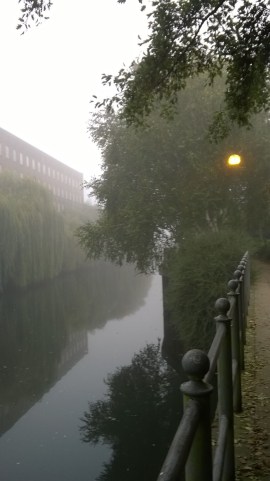
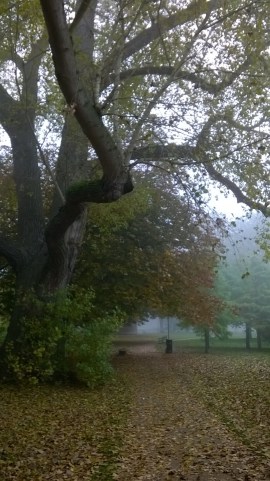
wp_20161030_002The night sky is growing pale when H. and I go out for a walk.  A cushion of fog softens the contours of the River Wensum, the trees and the buildings, and throws a dream-like veil over the fiery autumn red, ocher and gold.  There are very few people about and those we encounter smile and say good morning in subdued voices, as though we humans are all aware of being out-of-hours trespassers in what is left of a night that belongs to hooting owls, amber-eyed foxes, and witches making last-minute preparations for Hallowe’en tomorrow.

A seagull calls out uncharacteristically shyly above our heads as it swoops slowly across the milky sky.  Somewhere deep in the thick, yellowing mane of a weeping willow, there’s the rattle of a magpie.  A squirrel runs across the path and scurries up a horse chestnut tree, then pauses to observe us from the top.

“Look!” H. says and points at a bush on the riverbank.

We approach slowly.  A cormorant is sitting heavily on a slim branch, causing it to sway, as though trying to hide from the solitary, ethereal swan that’s gliding on the far side of the water.

wp_20161030_003

By the flint building of Pulls Ferry, a red-breasted robin is hopping on the wooden gate post, eyeing us with curiosity.

He’s not the only one.  I can feel hundreds of eyes watching us benevolently as we walk, while golden leaves drop down from the trees and float towards us in swing-like motion.

As we reach the Close, the fog starts to dissipate, slowly unveiling the Cathedral spire that now looks like an Impressionist painting.  The sound of the bell drifts through the air, announcing Morning Prayer and the start of this human day which, today, carries the magic of more time.

wp_20161030_005-copy

Scribe Doll

Posted in Odds & Ends | Tagged , , , | 12 Comments

More Things in Heaven and Earth…

There has been much news coverage, during the past week, of the experimental Mars probe, Schiaparelli, which is now suspected to have exploded upon landing on Mars.  No doubt, in time, another spacecraft will be sent to the Red Planet with the purpose of investigating whether there has ever been, or currently is, life there.  Personally, I fail to see how this astronomically high expense can be justified, given the lack of funds alleged by our various governments to tackle the pressing problems on this, the Blue Planet.  But that’s an issue apart.  Listening to various scientists speculating about whether or not there is life on Mars made me wonder – how would we know for sure?

If the sophisticated machines show that there is life on Mars, then I suppose the proof will be irrefutable.  If, however, they find no evidence of life, how could we be 100% certain that these findings are accurate and true, in other words, that they correspond to actual reality? I can’t see how lack of evidence can possibly be considered as proof either way.

It’s been widely observed that animals exhibit unusual behaviour and sometimes even flee before an earthquake.  I don’t mean domestic animals, of course, many of whom have been overbred to serve and depend on us to the point where they have lost many of their survival instincts (once, as a teenager, I woke up in the middle of the night because I felt my bed being jolted and saw a couple of books fall off the shelf, while my dog, curled up at my feet, was fast asleep, snoring away).  How do these animals know there’s an impending earthquake when human machines are unable to predict them? One can deduce that they possess a way of sensing them either through glands or other perception organs that are more refined and sophisticated than human-made machines.

In medicine, successful experiments have recently been conducted with dogs and cancer detection.  It appears that dogs can “sniff” certain cancers with an accuracy rate of over 90%.  This suggests that their senses are far more developed that those of humans.  Many pet owners will have observed that their cats and dogs know instinctively which grass or herbs to eat in the field when they are ill.  Most humans are not so in tune with their own bodies and require a doctor to tell them what to eat or not eat.  One could say that the authority of technology and science has bred instinct out of us, too.

My cat, Genie, knew when I was coming home despite my erratic working hours.  I’m told that about twenty minutes before I arrived, she would go and lie by the door, thus announcing to anyone at home that I was on my way.  How did she know? Do you sense when your spouse/partner/flatmate is about to come home?

There are countless examples of cases where animals are aware of realities we, humans, are not, which goes to prove the limits of our perception of the world.

*   *   *

Humans have manufactured technologies, machines, tests and probes that are supposed to reveal more than our senses can, especially in the field of medicine.  The purpose of a blood test, scan and X-ray is to detect what is, we believe, undetectable by our five senses.  Machines have been known to show more sensitivity than humans.  I remember one particular instance where my own experience showed this to be true.  When we were living in France, a nightingale sang on the hill outside our balcony every morning at about 4 a.m.  One day, my mother got up and tried recording the bird’s song on her National Panasonic cassette player.  When we tried listening to it over breakfast we couldn’t hear the nightingale over the numerous rustling, humming and clicking sounds made by the other creatures of the night, which our ears were unable to pick up.

Still, I think it’s a fair assumption that we can only manufacture machines that our imagination allows us to manufacture.  After all, we cannot make what we cannot imagine to be possible.  By extension, our imagination is limited by our sensory perception, since it is the latter that informs us of the reality that surrounds us.  Therefore, the same way as, being someone with “bat ears”, I can hear distant sounds people around me generally can’t, our knowledge of reality is made possible, and consequently also limited, by what we or our machines – designed within the span of our sensory abilities – can perceive. Just because we can’t see, hear, smell or touch something is not sufficient proof that it doesn’t exist.

*   *   *

On occasion, when the topic has arisen, I have been challenged by atheists to prove that there is a God.  I can’t.  Their conclusion was that because I can’t prove the existence of God, He doesn’t exist.  I’ve responded by pointing out that they, equally, are unable to prove that He doesn’t.

I have come across people, in England, who assure me that not only do fairies exist, but that they have seen them with their own eyes.  Personally, my automatic reply to anyone asking me if I believe in fairies would be, “Of course, I don’t,” but, if I were consistent with my reasoning, I would have to reply, “I don’t know.  I have no experience of fairies.”  After all, do I not see fairies because there are no fairies (or unicorns, or ghosts, or other apparitions) to be seen or because my senses are too obtuse to see them? I can’t answer that truthfully.

*   *   *

Back to Mars.

If our machines eventually detect a life form on the Red Planet, that would suggest that there is.  However, if they don’t, it is equally possible that there isn’t life there and that there is.  There could be a life form unlike any we can imagine, therefore undetectable by our machines and probes.  It is also possible that creatures of this life form have destroyed the Schiaparelli probe, to discourage humans from encroaching on their space.  And if it were so, who could blame them?

There are more things in heaven and earth than are dreamt of in our philosophies…

Scribe Doll

Posted in Odds & Ends | Tagged , , , , | 14 Comments

Arcolaio

Last week, when I was visiting my mother, I found an old toy spinning wheel.

I had forgotten all about it and yet, by a mysterious coincidence, it had briefly surfaced in my memory last June, when H. and I were in Rome.  We were on our way somewhere and I suddenly noticed an almost identical one in a shop window. About 20 cm tall, made of solid walnut.  I remember pointing at it and saying to H., “I used to have one just like this when I was a child,” and I suddenly felt a powerful tug somewhere deep in my chest, almost pleading to be let out, though I couldn’t make out what it was exactly, or whether it was happy or sad.  We were in a rush and as we walked away I forgot all about it.

“Look through this box of old toys I found, will you?” my mother said last week, “and throw away what you don’t want.”

Toys? I knew that couldn’t be the case.  My mother has kept practically nothing from my childhood.  She’s not the type.  She has always given or thrown away any object steeped in emotional memories with a determination bordering on ferocity, as though holding on to it might somehow hinder her or weigh her down.  Almost as though she is afraid of getting trapped in it.

Part of this is linked to our frequent house moves.  There was no attic where any material companions to various stages of our lives could be stored.  It was by a whisker that I managed to save my favourite teddy bear and, after my grandmother passed away, her old family photos and the censored letters her own mother sent her from the Soviet Union.

“What do you mean, Mum? We didn’t keep any toys.”

“Yes, yes, wooden toys,” she said, pointing at a box in the corner of her bedroom.

With my customary ungracious huffing, I opened the said box and began unwrapping various chipped, discoloured wooden knickknacks.  Not toys exactly but ornaments – mainly gifts from other people – that had stood on top of the television, on the book case or a shelf and which, yes, had unofficially featured in my games.  Russian dolls with the smallest ones missing, a decorated wooden egg, and other junk not even good enough for the charity shop. I couldn’t begin to fathom why my mother had kept this stuff when she’d got rid of much better possessions.  She must have packed it all in haste during one of her house moves, some twenty years ago, and only just got around to looking through it.

I must have gasped so loudly when I found it that my mother came in from the next room.  A small, solid walnut spinning wheel.  “I remember this,” I said to her.  “In fact – it’s so strange – I saw one just like this in a shop window in Rome when we were there last June.  You gave it to me when I must have been about five or six.  Where did you get it?”

My mother couldn’t even remember ever having seen it before.

“Everything in this box can be thrown away,” I said, “but I’m taking this home with me.”

*   *   *

I have wiped the wood with a soft, damp cloth and replaced the rotted dark brown elastic that was tied around the wheel with a piece of gold string I found in my sewing basket.  Every time I hold the spinning wheel, and run my fingers along the smooth, dust smelling wood, a powerful emotion presses out from inside my chest.  But I can’t find where exactly it’s coming from, or even work out if it’s sad or happy.  I have but the faintest impression of playing with the spinning wheel, pretending to be Sleeping Beauty.  I can recall nothing else.  I have no idea if this beautifully crafted object was designed to be a child’s toy or an ornament, but it has the energy of one of those objects that have been made by a craftsman who imbued his craft with great skill and much love and thus gave life to his creation.

wp_20161016_001

As I look at it now, it suddenly occurs to me that I don’t know the Italian word for a spinning wheel.  I look it up.  Arcolaio.  What a beautiful word.  Its sound fits perfectly the carefully sanded edges of the dark walnut.

Arcolaio.

At this time in my life when I’m shedding so much of what is old and no longer needed, it feels very appropriate that I should suddenly discover this beautiful spinning wheel.  A spinning wheel that now has a golden thread running through it.

Scribe Doll

Posted in Odds & Ends | Tagged , , , | 22 Comments

Clearing

The catalyst was a book I was translating, referred to by my friends simply as that book, since I don’t divulge the titles of jobs I hate.  Luckily, although not all the books I’ve translated so far have always captured my heart and imagination, most have made a tolerable if not pleasant day’s work.  But, after a few pages, I began to hate that book with every fibre of my being.  I hated the plot, I hated the characters so much that I kept hoping against hope that they’d meet a swift, painless demise over the page. I prayed for a deus ex machina to kick that book out of my life with a bend that would make David Beckham envious.  As the weeks dragged by and no supernatural force came to deliver me from it, that book slithered deeper and deeper under my skin and began spreading its venom through my veins.  I felt as though I was trudging through a dense, sticky, malodorous fog, my legs weighed down by thick, gluey mud, and my very life force ebbing away.

So, when I finally sent off the translation of that book, I did something that goes against the grain of any thinking individual.  I burnt that book.  As a matter of fact, the prospect of annihilating the thick volume was what kept me afloat for the last couple of weeks of the job.  I planned the act in its minutest detail to ensure there would be no danger to anyone or anything.  I went to the hardware store and purchased a metal incinerator manufactured in accordance with health and safety.  I waited for a day when I knew a couple of my immediate neighbours would be away, warned the others that I would be burning “some old papers” and apologised in advance for the smell of smoke.  I made sure the area in the courtyard was clear and placed the incinerator away from any potential gust of wind.

I tore the pages out a couple at a time and pushed them down the funnel as the flames glowed through the air vents.  In my mind it wasn’t just that book I was burning but all the physical, mental and emotional exhaustion, all the anger and resentment, all the fear and despair of the past few years.  Moreover, I was willing the dancing flames to clear away the old and no longer needed so that a Firebird might rise from the ashes, with the plumage all glossy and so bright не в сказке сказать, не пером описать*.

Three hours later, I poured the cold ashes into a bag and gave them to a neighbour who said they’d make a good fertiliser for her allotment of fruit and vegetables.

Burning that book triggered an overwhelming desire to do some major cleansing and clearing.  Outside and in.  And so I’ve begun…

*   *   *

I pull out from under my desk boxes that were packed two house moves ago and haven’t been opened since.  Papers from when I used to teach English as a Foreign Language.  Lesson plans, newspaper articles, colour and animal idioms, vocabulary of interest to journalists, doctors, MEPs, politicians, bankers and miscellaneous.  Why keep all that? I don’t want to teach again. I fill large black bin liners.

Out with the old, the stale, to make room for the new and fresh to flow in!

I drag a box of cassettes from under the bed.  Treasures of radio plays, music and inspiring interviews.  Treasures I have not listened to for at least five years.  I keep a few.  The rest is thrown away.

Out with the old, the stale, to make room for the new and fresh to flow in!

It’s the turn of our small, cluttered kitchen.  The shelves in the wall cupboard H. calls “the pantry” are crammed with foodstuffs we can’t see because they’ve fallen behind other foodstuffs under the shelves.  I discover enough packets of spaghetti to open an Italian restaurant and, unnoticed on the floor, several boxes of fennel teabags I kept buying because I thought I’d run out.  I decant all my infusion herbs from their scrunched up plastic packaging into glass jars which I label.  Vervain.  Rose Petals.  Skullcap.  Lemon Balm.  Plantain.  

I can’t bring order into my mind unless I bring order to my surroundings.

I sift through my clothes.  Elegant shoes that pinch so I never wear them, comfortable shoes that are so old they’ve lost their original colour and shape.  Skirts I’ve kept on the off-chance I might regain the figure I had in my thirties.  My misplaced optimism makes me laugh.  The smart black coat I’ve never really liked but bought all those years ago because it was a bargain in a charity shop in Notting Hill.  I shove it all into bag destined for a local charity shop, then peruse the online catalogue of a ladies clothes shop I rather like.   I set my sights on a coat to dazzle all coats, russet, with a wide collar, generous and warm, a coat for an entrance worthy of a Jerry Herman musical.  A coat that requires a cameo appearance by my credit card.  They don’t have this coat in the Norwich branch of the store.  “We won’t be getting it,” the sales assistant says glumly.  “That’s a Chelsea or Kensington branch kind of coat.”

So much the better, I think, that I will be the only woman in Norwich wearing such a coat! And I ring Kensington and get them to send the coat over here.  The sales assistant smiles when I try it on.  “It’s my only opportunity see this coat in the flesh,” she says.

Under the coffee table, there’s my fat, black Filofax, bursting with loose bits of paper.  Names and addresses of people I’m no longer in touch with, of people who have passed away, of theatre, film and TV contacts I had when I was a theatrical agent.  Why keep them? I don’t want to be a theatrical agent again.  Business cards with names I don’t recognise.  Contact details of friends from whom I’ve drifted apart but which I keep in case… in case of what? It’s time to let go of some people, and to make room for new friends to make their entrance.  I copy about 10% of my original address book onto a small, light turquoise organiser, and feed the rest into the shredder.

Out with the old, the stale, to make room for the new and fresh to flow in!

My dear new friend, the sunny Bernie Strachan says that, actually, I should be grateful to that book, since it’s been the trigger for all this much needed, long-awaited clearing.  I hadn’t thought of it this way, so I’m grateful to Bernie for this creative perspective.

And the clearing continues…

Out with the old, the stale, to make room for the new and fresh – and the Firebird.

* “that no fairy tale or quill could describe”: a set phrase in Russian fairy tales to refer to something extraordinarily wonderful.

Scribe Doll
Posted in Odds & Ends | Tagged , , | 22 Comments

Should these Connotations Always Apply?

Dark

Just read any book or film review.  Dark implies deep, complex, fascinating, intelligent, and, therefore, somehow worthy.  I tend to think that dark is just dark.  It’s not good, it’s not bad.  It’s just dark.  But, since we’re on the subject, I believe that, for reasons possibly akin to the force of gravity, which bodies obey without needing to make any effort, it is easier to depict something dark that something Light.  The same way as it is easier to write a tragedy than a comedy.  The elements of tragedy are the same throughout nations, cultures, and centuries.  Their weight keeps them fixed, unchanged.  Comedy, however, is therefore ever-changing.  A sense of humour alters over time, and doesn’t necessarily translate from one culture to another.  So, surely, writing enduring, internationally appreciated comedy requires true genius.

Light

You hear this word and you think weightless, low-fat, superficial, not requiring much thought, lacking in substance.  And yet think of the actual meaning of the word Light when it’s a noun.  Light.  Sunlight.  Daylight.  How many of us can stare at a light without wincing and shying away? Brightness.  Truth.  Speed.  All the colours of the spectrum.  Understanding.  LIGHT.

Comfort Zone

For some reason, people described as “not wanting to leave their comfort zone” are always viewed with disapproval.  The comfort zone is a synonym of limitations, of fear, of narrow mindedness.  What exactly is wrong with comfort, anyway? Besides, a comfort zone could be a choice that fits our strength and abilities.  In my experience, people who accuse others of remaining in their comfort zone are, quite often, people who are very firmly set in their own comfort zones.

Can I be honest?

Since when has the term honesty equalled negativity, insult, rudeness and unsolicited opinions that are too personal? Someone says, “Can I be honest?” and you can bet all you have that a negative comment is about to follow.  Not only, but that the speaker feels that the word “honest” somehow entitles him/her to impose their opinion on you, and judge you.  “Can I be honest? I don’t like the way you’ve furnished your house.” “Can I be honest? I think you have such or such a defect.” When was the last time you heard, “Can I be honest? I think you’re a wonderful person”?

Real People

For some reason, only working-class, underprivileged, socially and financially disadvantaged individuals are referred to as Real People.  A play, film or book about Real People.  So not Downton Abbey, then.  Rich, privileged people are therefore imaginary.

I once had a play workshopped in a London theatre.  The characters were a barrister, a Cambridge academic, and a polyglot photographer.  During the feedback session, the man chairing the discussion asked the audience, “Yes, but don’t you think this play isn’t about Real People”? At that moment, I mentally measured the distance between my fist and his face, and wondered how real or imaginary he’d feel my punch landing on his nose.

Organic

The buzz word of the decade.  Of course, I do believe that everything should be grown organically, i.e. without harmful pesticides, or GMOs.  But I do find that the word Organic is being somewhat overused and abused.

I ask, as I order breakfast in a café, what their baked beans are like.  “Oh, they’re organic,” the waiter replies, as though that means the baked beans are automatically in a league of their own in terms of high quality, flavour, health benefits, and probably ability in guaranteeing eternal youth.  I have had food poisoning from so-called organic vegetables just as I have had from non-organic ones.  Organic is politically, correct, healthy, tasty, and generally superior.  The other day, swayed, I bought a box of organic cherry tomatoes.  Their skins were so hard, I could probably have used them to re-sole my shoes.  There’s a wonderful scene in the film version of David Auburn’s play Proof.  A do-gooder older sister is insisting her rebellious younger sister try a hair conditioner with jojoba.  The girl asks if it’s a chemical. “No, it’s organic,” the older woman replies.

“It can be organic and still be a chemical.  Haven’t you ever heard of organic chemistry?”

Natural

There is Natural, and there is good.  They two are not necessarily synonyms.  A hairdresser I used to go to kept asking me if we should have my hair look “natural”.

“No,” I replied.  “‘Natural’ would mean I don’t come here to have my hair cut at all.”

I have a natural tendency towards being impatient and abrupt.  Left in my natural state, my presence in a social scenario would be intolerable to many.

Popular

Sales assistant seem to think that if they tell a customer that a particular item is Popular, then you’ll think it’s automatically worth buying.  This is based on an assumption that the said customer believes that the majority is always right.  Wrong.  Whenever I’m standing in a clothes shop, dithering over a dress or a handbag, and the sales assistant tells me it’s a very Popular dress or handbag, then my knee-jerk reaction is NOT to buy the said item.  I wouldn’t want to turn up at a party and see another woman wearing the same dress.

Scribe Doll

Posted in English Words, Words and Civilisation | Tagged , , , , , | 20 Comments

If Martin Luther had taken some Vitamin C…

In my final year at University, where I was reading for a degree in French Literature, thanks to a new syllabus tried out by the French Department, I was allowed to specialise by choosing four options.  I was only too happy to drop 19th-century Romantic moaning (as I saw it) and 20th-century anxiety and depression (as I saw it), and throw myself into (again as I saw it) the certainty and serenity of the Middle Ages, 14th, 15th, and 16th centuries.  This covered, among others, a course entitled “Literature of the Reformation”.

Eager to get ahead, I took a walk to the Theology Department, and asked if I might attend the relevant lectures, to gain better knowledge of the historical and religious background of the French literature I was about to study.  Dr F., a specialist in the subject, was thrilled with my enthusiasm.  “Yes, of course, you’re very welcome to come to my lectures. It will be a pleasure to have someone from the French Department,” he said in his soft Irish accent, green eyes sparkling with eagerness to share his scholarly passion.

His classes were popular, and for good reason.  Dr F. not only seemed to know everything there was to know about the Reformation, but – unlike some of his fellow academics – was a good communicator and a charismatic teacher.  And, yes, he was also a very good-looking young man.

Then, one day, he set an essay about Martin Luther’s doctrines.  “Oh, no, that’s all right,” I said. “I shan’t trouble you with extra marking –” (Meaning: I don’t want to have to write an extra essay on top of my French Department workload.)

“Oh, please do write it.  It will be a pleasure to have your essay, too.”

He may have added something about how interesting it would be to have the point of view of a non-Theology student.

I was stuck.

It was approaching midnight before the morning the essay was due.  I sat in my room with a mug of coffee, staring at a blank page from my Oxford pad, with no idea whatsoever what to write.  I glanced at Owen Chadwick’s book about the Reformation, on my desk.  I hadn’t read it yet and it was a little too late to start.  I chewed on my pen, put another Lyons’s coffee bag into my mug, reached out for a chocolate hobnob, and thought of Martin Luther.  The monk who married a nun.  The monk who brought Protestantism to Germany.  I suddenly remembered something else Dr F. had mentioned: that Martin Luther suffered from constipation, and spent a considerable amount of time on the loo, where he thought up many of his theories.  Constipation.  I wondered why.  Come to think of it, what caused constipation? I decided to take a little break from the essay and consult my slowly-but-surely growing collection of layman medical and nutrition books.  I had recently developed an interest in medicine, health and anatomy/physiology, and read anything I could lay my hands on on the subject, and which was formulated in a language I could understand.  While leafing through my books, I remembered once accidentally causing myself diarrhoea by taking an excessively high dose of Vitamin C.  Consequently, would a regular intake of ascorbic acid or a diet rich in Vitamin C alleviate constipation? I knew that chronic constipation contributed to toxicity in the blood stream, which – I assumed – could then affect one’s perception.  I also suspected that spending hours shut in a toilet, just waiting for your body to make up its mind to evacuate unwanted matter, could give you a lot of time to think and develop philosophical hypotheses.

Suddenly, I was on a roll, chasing after a crazy theory.  I scattered all my nutrition books on my desk.  I can’t remember the exact details of what I thought I discovered on that long autumn night, twenty-five years ago.  What I do remember is not going to bed at all and writing pages and pages about the effect of a vitamin or mineral deficiency on our cognitive abilities and even emotional states, about the optimum dose of specific vitamins in terms of units and milligrams, of the anti-oxidant effects of ascorbic acid, otherwise known as Vitamin C, and its benefits to – among many other things – a healthy digestion.  Having been drilled by my French academic education that every essay should follow the Introduction-Thesis-Antithesis-Synthesis-Conclusion pattern, I set out to prove that Martin Luther’s theological doctrines and thought process was heavily influenced by his chronic constipation which, in turn, had been caused by a vitamin deficiency.  If Luther had taken some ascorbic acid, there may not have been a Reformation.  QED.  I wrote and wrote, almost feverish with enthusiasm for my “discovery”.

By morning, the top knuckle of my right middle finger was black with ink, and, despite the total lack of sleep, my eyes were wide open with satisfied excitement and elation.  I picked up my essay and, after a quick breakfast, went to put it into Dr F.’s pigeon hole.

A week later, we all got our essays back.  Dr F. kept mine till last.  I waited impatiently to see what mark I’d received.  He approached my desk with a slightly puzzled expression.  He handed me my work.  There was a slight frown.  “I’m afraid I haven’t marked it,” he said.  “To be honest, I didn’t quite know how to.  What you say is very interesting but, well, it doesn’t really belong in the Theology Department.  I’d say take it to the Medical Department, but there isn’t one here…”

He was very kind, not once suggesting I’d been a smart arse.  I collected my work with a sigh of slight disappointment.  In retrospect, I realise I was lucky he didn’t throw me out of his class.  He stopped setting me any more essays, though.

Scribe Doll

Posted in Odds & Ends | Tagged , , , , | 21 Comments