Books: Challenges, Traumas and Pure Pleasure

I remember a stormy night when I was about eleven.  We were living in Nice.  I don’t remember what prompted me.  I stood on a chair to reach the top shelf of my mother’s bookcase where she kept – along with other never-read books – The Complete Works of Shakespeare.  I sat at the kitchen table, ploughing my way through Macbeth.  I couldn’t understand any of the language, so I looked up almost every other word – without much success – in the Concise Oxford.  Electrified by the flashes of lightning and thunderclaps bursting outside, I was mesmerised by this hermetic text I could not fathom, convinced that within its lines were locked up great secrets I yearned to discover.

About a year later, my mother authorised the local library to allow me access to the adult section.  After my first visit there, I came back home with a book about Confucianism.  Only one sentence remains anchored in my memory: I spent my entire life trying to change myself but have still failed.  The only words I remember.  The only ones I understood, probably because the paramount importance of self-improvement was much advocated at meal times.  Still, when I finally returned the book to the library, I felt a deep sense of satisfaction, as though I’d been given the key to important knowledge.  Where this knowledge was stored, or what it concerned, I had no idea, but at least having the key to it was a good start.

That same winter, I got the mumps.  I was kept indoors, warm, and waited on for a month.  I was allowed more television than usual, and my mother brought me books from the library.  Owing to my illness, the self-improvement programme was put on hold, and she did look disapprovingly at my reading for the sheer pleasure of it.  I asked her to borrow Joseph Bédier’s rendition of Tristan et Iseut and that was the first book I remember reading which filled me with magic, and infected me with a passion for Mediaeval literature, art and music.  And words.  Beautiful words.

When I was fifteen, we moved to Rome.  One day, I found my mother’s copy of Friedrich Nietzsche’s Thus Spake Zarathustra lying on the coffee table.  She’d enthused about it over dinner, so I picked it up and began to read it.  I was bowled over by the histrionic wit of this man.  Shaken, turned inside out and zapped with new energy.  A God that danced.  It was as though my brain had just expanded so violently, it was about to break free from the constrictions of my skull…. even though I had no idea what Nietzsche actually meant.  I just felt that he was telling me that there was something out there that was so big and awesome, I wanted to access it too.

The summer after my sixteenth birthday was the summer I was traumatised by Dostoyevsky.  For some time now, there had been an awareness on the part of my mother and grandmother that my Russian was embarrassingly bad, given that it had been the first language I had learnt as a toddler.  Although my speaking was fluent, my spelling was atrocious and I read one syllable at a time, like a five-year-old.  What neither of them chose to be aware of was – for reasons pertaining to a twisted, dissatisfied teenage psyche I eventually grew out of – my deep dislike of the language.

So, that summer, judging the French school three-month holiday period to be “too long for doing nothing”, my grandmother decided to traumatise me with Crime and Punishment.  As she was also teaching me to knit, she saw the hot Roman afternoons as the perfect opportunity to combine manual and intellectual education.  So, while all sensible Roman residents would sink into a refreshing siesta, she and I would sit in the shady part of our balcony and take it in turns to read aloud and knit.  My knitting being as unenthusiastic as my Russian, when it was my turn to read, my grandmother would correct my pronunciation while undoing several rows of uneven loops.  Thinking about my schoolmates, who were probably bathing in the Sardinian sea or strolling in the Alto Adige mountains, I resented my lot, hated knitting, hated Dostoyevsky and (almost) hated my grandmother.  By the end of the summer, I was less familiar with the crime aspect of the novel than with the punishment.

For many years, I hardly ever read fiction, except when it was prescribed by school or university.  I found it hard to shake off the deeply-inculcated notion that you read in order to acquire information or improve yourself, and that novels, precisely because fictional in nature, were somewhat less valid forms of literature.  I envied people who said they loved to read, who described the pleasures of immersing themselves in a book.  I knew I was missing out on something but didn’t know how to remedy the situation.  Once again, I felt there was a whole, wonderful world out there but, this time, it wasn’t my intellectual inadequacy that prevented me from accessing it – it was something deep inside me, so intrinsically part of me that I didn’t know how to root it out.

The novel for me that opened the doors to other novels was Miss Garnet’s Angel, by Salley Vickers.  It was the summer of 2000, and I was attracted by the cover design: the reproduction of a Renaissance angel.  I picked up the book from the table display at Waterstone’s and read the back cover.  I saw that the story took place in Venice.  I’d just returned after a few days there, and longed to go back.  I bought the book and became totally engrossed in it.  I loved the main plot being interwoven with the apocryphal story of Tobias and the Archangel Raphael.  I loved Salley Vickers’s acute observation of human behaviour and her deep insight into emotions.  I loved her descriptions of Venice.

With Miss Garnet’s Angel, my reading habits changed.  Reading suddenly became something I gave myself permission to do simply for the fun of it.

My favourite Saturday morning activity became browsing in charity shops.  The advantage of cheap, second-hand books was that it allowed me to take risks on novels and buy them on a whim.  As a result, I discovered many wonderful books.

Fifteen years on, I love reading.  I feel free to pick up whatever I feel I will enjoy, whether it’s Booker Prize material or a thoroughly enjoyable crime novel.  I just swim among its words, let myself be carried away by the story, and form new acquaintances with the characters.

It’s delectable.

Scribe Doll

Posted in Odds & Ends, Uncategorized | Tagged , , , , , | 10 Comments

London Night Sounds

The rumbling of the occasional car, speeding past our house.  A murky grey sound.

Snippets of human voices.  A woman’s giggle.  A crimson sound.

The arrhythmic clicking of stiletto heels on the pavement.  A copper sound.

The roar of the night bus.  A faint white sound.

The rustling of leaves, disturbed by the wind.  A golden sound.

The yelp of a fox.  A scarlet sound.

The shriek of a motorbike.  A black sound, like tar.

The rhythmic clang of the train, not too far.  A brass sound.

The high-pitched whirr of the light bulb in the angle-poise lamp on my desk.  A tinny sound.

Sweet recorder sonatas by Telemann, wafting out of my CD player.  A dark honey sound.

The tick-tock of the second hand of the alarm clock by my bed.  Black and white sounds.

The click of the front door; one of my flatmates coming home after a wedding reception.  A candy-pink and sky-blue sound.

The thud of the front door; another flatmate returning after a night on the town.  A red sound.

The translucent harmony of moonlight, floating through the air.  A silver sound.

A cat meowing across the street.  An emerald-green sound.

A night wind, blowing through the streets.  A diamond-cut sound.

Stars, shining in the sky.  A myriad of colours, like the notes of a glockenspiel.

I cannot sleep.

Scribe Doll

Posted in Odds & Ends | Tagged , , , , | 10 Comments

Seven Quirks of British Restaurants

No.1

Is everything O.K.?

Have you noticed how waiters wait for the exact moment when you have your mouth full, before they ask you that? I often try and cheat them by staging my forkfuls when they’re not around but, almost as though they’re watching me from a distance, no sooner am I munching away, than they pounce.  “Is everything O.K.?” Naturally, all I can emit is an unintelligible groan, and a nod.  I wonder if their timing is purposefully strategic.  Perhaps they’re trained to schedule their question precisely when you cannot speak.  Yes, I know, as my mother – or the Aunt Alicia in Colette’s Gigi – would say, you could train yourself to chew and speak at the same time, elegantly.  But still…

It was a relief going to cafés and restaurants while living in Brussels.  There, nobody comes to intrude on your meal unless you specifically request their attention.  Only at the end, as you’re settling the bill, does the waiter ask Ça a été?

No.2

The cake on top of the napkin

I don’t know if this is a strictly British practice, but I’ve not encountered it in Italy, the U.S., Germany, France, Greece or Spain.  You order cake, or a sandwich, and it arrives lying on the napkin, as though it needs to be comfortable on the cold, hard plate.  Surely, the point of the napkin is to be spread on your lap, and used for dabbing your lips and fingers – a point defeated from the start if, by the time you have slid it out from under the cake or sandwich, it’s covered in chocolate, cream or dressing.

No. 3

The parmesan and black pepper rations

In too many establishments, once your meal is served, the waiter approaches and offers you black pepper.  Then s/he gives the oversized mill a couple of twists over your plate, and walks off.  I might want to add pepper halfway through my meal, but the option is not available.  Is black pepper so expensive, restaurants cannot afford to keep a small mill on the table, together with the salt shaker?

The same discourse applies to grated parmesan.  When your pasta is served, the waiter brings a bowl of parmesan, and sprinkles a spoonful on your dish.  If you say nothing, he sprinkles a second spoonful.  At that point, s/he marches off, unless you specifically request more.  If you do, s/he expresses shock, as though you’re being unreasonably greedy.  Sometimes, I tell the waiter, “just leave it here, I’ll help myself” and that creates a mini panic response…

No. 4

Salt mills

I know this is entirely a matter of personal preference but who actually enjoys crunching large salt crystals? What’s wrong with a salt shaker that dispenses fine salt powder which blends in easily with the food?

No. 5

Salt and pepper mills/shakers

“Katia, the table is off-balance,” is what my grandmother would say if, while setting the table, I’d forgotten to put the salt shaker in the centre.  Time and time again, I go to restaurants and cafés where there is no salt on the table and I have to ask the waiter to bring it to me.  The other day, I asked why they didn’t just keep salt and pepper on every table.  “People steal them,” the waitress replied.

I was speechless.  Are we so poor a nation? Or so thieving?

No. 6

Iced water

Personally, I think automatically serving water with ice cubes in a country as cold as England is somewhat peculiar.  Still, at least thus far, this is a free country, so people are entitled to order iced water if they wish. But why do waiters insist on bringing me iced water after I’ve specifically ordered it “without ice”?

No. 7

Halloumi, Hollandaise, etc.

I doubt I’m breaking the Official Secrets Act by stating that traditional English food errs on the side of – how can I put it diplomatically? – well, let’s say on the side of the bland, and is, originally, far from vegetarian-friendly.  We’ve come in leaps and bounds since my introduction to English cuisine, at the age of nineteen, when it was meat and two veg, no salt, and pudding consisted in drowning anything at all in custard.  Still, perhaps cafés and restaurants should expand their horizons a little further and, once they’ve discovered a new ingredient, not it serve exclusively over and over and over again.

Yes, halloumi cheese is lovely, and made a welcome change from mozzarella, after the latter had outstayed its welcome as the successor to cheddar.  Now, however, wherever you go, it’s halloumi.  Halloumi burger, vegetable hash with halloumi, salad with halloumi.  Why don’t we also try various varieties of goat’s cheese, manchego, ossau iraty, fontina, asiago, blue Shropshire, to name but a few?

Another relatively recent feature in restaurant menus is hollandaise sauce.  A tangy addition to many eggs and asparagus dishes.  In small doses, though.  Sadly, British enthusiasm for this perceived bit of sophistication means that   eggs Florentine and eggs Benedict are served drowned in it, the way custard used to drown stodgy puddings.

Scribe Doll

(This is a revised version of  a post first published on 24 July 2011)

Posted in Half-English Observations | 14 Comments

Voice, Stone, Wood and Air as One

I love Early music.  I love its level-headedness, its lack of mood swings.  It’s everlasting YES.

Part of the reason I listen mostly to Mediaeval, Renaissance and Baroque music  throughout the day is because, besides its being soothing and immensely reassuring, it doesn’t distract me from my work.  I am a literary translator, and I spend most of my waking hours like the 21st Century version of a Mediaeval scribe, hunched over my laptop, a shelf full of heavy dictionaries behind me, perhaps one or two lying open on the messy table, writing in somebody else’s voice, trying to read their thoughts, second-guess their intentions, and “Englishing” them.  I need music in the background to centre me, calm me and, above all, music that will not distract me.  I cannot work with passionate music that throws tantrums, asks questions, is emotionally egocentric, or demands that I get up every couple of minutes to either turn up or turn down the volume. I need music content in its serenity, stable, with certainty that will provide a sturdy, friendly support to the doubts and anxieties that go hand-in-hand with trying to pass for somebody else in another language.

So, day in, day out, I am accompanied throughout the day by friends like Léonin, Pérotin, Josquin des Prez, Salamone Rossi, Guillaume de Machaut, Jean Mouton, Guillaume Du Fay or Gilles Binchois and – if I am in the mood for something a little more modern – J.S. Bach, Telemann, Vivaldi, Von Biber, Hume, Tartini or Thomas Baltzar.

*   *   *

One piece I often listen to is Guillaume de Machaut’s Messe de Notre-Dame.  I’ve had a splendid recording by the Hilliard Ensemble for Heaven knows how long but, like most Mediaeval music, one hardly ever has the opportunity to hear it live.  Then, last Friday, I went to a concert of Lent-appropriate music – mostly Early – at Norwich Cathedral.  The  programme included the Kyrie from Messe de Notre-Dame.

It was a revelation, like hearing a completely different piece of music. Like going from a monochrome, mono-dimensional photograph to a colourful bas-relief.  A rich embroidery, an illuminated manuscript, that takes shape before your very eyes.

Although I knew, of course, that early polyphony was intended for the arches and high vaults of Gothic architecture, hearing it for the first time in Norman-Gothic Norwich Cathedral vividly brought home just how flat and colourless it sounds by comparison on CD.  You suddenly realise that this music was intended to come alive when human voices, stone architecture, wood carvings, stained glass and the air itself join as one despite their separateness.  Like a murmuration of individual starlings that form a single, shapeshifting form that swirls, shrinks then spreads across the evening sky.

I hadn’t until then been so keenly aware that it’s the counter-tenor part that is the guiding force that holds everything together and gives energy to the whole piece, like a golden thread weaving through the blue of the tenors, the deep red of the basses, and the purple of the baritones.

The human voices are released into the air, which carries some notes to the wood carvings, as though contact with the latter would give them a richer, earthier sound.  Other notes it sweeps up and hurls against the white stone pillars so that they might bounce off them with more brightness and brilliance.  Others again it slides over the bright-coloured stained glass windows, and lifts them slowly up to the fan vaulting, where they quiver before spreading like a gossamer cloak over the entire cathedral.

And, as I sit in the wooden pews where, nearly a thousand years ago, Benedictine monks sat, listened and prayed, I am in awe of this miracle of mathematics, in which human voices, stone, wood, glass and air all come individually alive by coming so perfectly together.

Scribe Doll

Posted in Odds & Ends, Uncategorized | Tagged , , , , , , , , | 13 Comments

A Tree with a Name Beginning with S

“I need a new tree friend,” I say to S.  “A tree like my oak Merlin, outside my window in Wimbledon.”

My new friend S. is a children’s and young adult fiction writer.  She doesn’t find anything odd or unusual about a middle-aged adult being friends with a tree, or, for that matter, that the tree should be called Merlin.  She takes a sip of coffee.  “Have you tried Lion Wood?”

“It’s too far to walk and up that steep hill,” I reply.  “I need a tree nearby.  Somewhere I can get to easily and say hello whenever I feel like it, without it becoming an expedition.”

Through her rimless glasses, S.’s blue eyes look sideways, to that corner of her mind where she probably stores her list of suitable trees.  I know she’s making a mental note to find me the perfect rooted confidant.

I’ve been within easy reach of one specific, special tree, for most of my adult life.  In Cambridge, it was the copper beech watching over Leckhampton Gardens, and the canopy – practically a tent – offered by the trailing branches of a weeping willow.  In London, there was the wise cedar of Lebanon in Bishops’ Park, and, later, in Wimbledon, my room looked onto a large, powerful oak.  It was a tree with stories and insight.  Merlin.  I don’t know why Merlin.  The name just kept popping into my head whenever I looked it him.  Him.  Because, for some reason, to me he was unmistakably a he.  On the night of St Jude’s Storm, I went to bed with the certainty in my heart that he would not crash against my windows, that he would keep me safe.  And he stood sturdy all night.

*

H. and I were strolling in the Cathedral precinct, a few weeks ago, when I suddenly stopped in my tracks.  “There it is!” I said.

H. also stopped and looked around.  “There what is?”

“My tree!”

Your tree…”

“Look! There! Straight ahead.”

H. accepts, with infinite patience and warm indulgence, that I was born with a certain amount of madness, so did not query my use of the possessive pronoun but followed my pointing finger with his eyes.  “Wow. That is impressive,” he admitted.

WP_20160207_002Before us, at the back of the Cathedral, beneath the flying buttresses, the most majestic of trees.  A cedar of Lebanon.  Tall, dark green, sprawling, some of its branches trailing on the grass, with round cones bobbing gently in the wind.  Alive.  Very much alive.  I slowly approached, took off my glove, and stroked its needles.  His needles.  Immediately, I felt many eyes turn towards me, watching me, studying me.  Quizzical, wary, judging, alert.  A chubby, pale green chiffchaff.  A couple of blackbirds.  A sparrow.  Wood pigeons.  And all the eyes I felt upon me but did not see, could never see with my eyes.  Chirping, whistling, tweeting, cooing.  Who is she? Friend or foe? What are her intentions? Shall we allow her into our world? And then there were all the voices I could never hear with my ears. Among them, a deep, booming voice.  A bass baritone full of warning but also promise.  A warning against contempt, a promise of reward for honour.  I couldn’t hear it, and yet I knew it was there.  The voice of the tree.  I leaned against the trunk and ran my fingers on the bark.  His bark.  A name suddenly resounded through my chest.  An ancient name.  S –.  What was that name? Yes, it definitely starts with an S, I sensed again, the healing power of the tree penetrating my hands and my back.  Tremendous power.  The kind of power whose respect you long to earn, whose friendship you want to deserve.  And a storyteller tree, custodian of mysteries, of knowledge.  A keeper of secrets.
I wonder how old it – I mean he  – is.

*

I text our friend J., who is a tree surgeon.  “Are you acquainted with the cedar of Lebanon at the back of the Cathedral? Do you know old it is?”

He replies, “Measure its girth.  One inch for every year.”

I take the tape measure from my sewing basket, and recruit H.’s help.  184 inches.  One hundred and eight-four years? It looks older, given its size and sprawl.  I try asking the Cathedral staff.  They don’t know.  “Ask one of the guides,” they say.  “If it’s a historical tree, one of the guides is bound to know about it.”

I suppress a snort.  A “historical” tree? Aren’t all trees historians, record-keepers of man’s fleeting visits?

*

“Let’s go and visit S –,” I say to H. after breakfast this morning.

“That’s an excellent idea,” he replies enthusiastically.

As we approach the cedar of Lebanon, as always, I find myself slowing down, stepping with caution, with deference to his awe-inspiring majesty and gravitas.

WP_20160207_004I get it into my head that I would like a cone.  In all the times I’ve come, I’ve never seen one lying around.  I ask politely.  Suddenly, I am convinced that I will be given one today.  I start walking slowly on the soft carpet of needles beneath the sprawling branches.  Nothing.  I am surprised, given the recent gales.  Perhaps after the next gust of wind.

There it is.

I pick it up.

Thank you, S –.
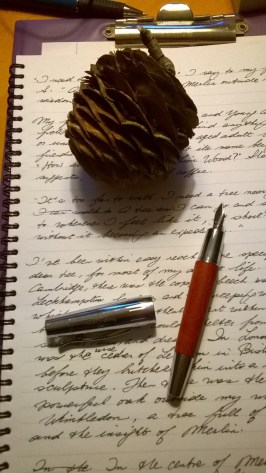
I hold it gently as I take it home and place in on my work table.  It has a wonderful smell of resin.  It’s beautiful.

It’s perfect.

Thank you.

Scribe Doll

Posted in Odds & Ends, Uncategorized | Tagged , , , , , | 14 Comments

Zebras at the Opera House

Last night, I eagerly tuned in to the BBC Radio 3 live broadcast from the Metropolitan Opera, New York, of Giacomo Puccini’s Turandot.  It’s one of my favourite operas.  I didn’t listen to it till the very end, though, because I wasn’t grabbed by the performance.  I found Nina Stemme’s Wagnerian soprano too heavy and too lacking in crystalline quality for Turandot.  I felt that her diction was a little sloppy and, on several occasions, I thought I heard her swallow consonants and leave out vowels.  Marco Berti’s tenor, for me, was too thin, too deprived of richness, too throaty for Calaf.  I also didn’t care for the pace of Paolo Carignani’s conducting.  I found it too fast and lacking in drama.

Some of the above comments are a matter of personal taste and preference.  However, when the Met audience applauded uproariously, sounding as though they were about to bring the house down, I suddenly realised something: the audience always applauds uproariously at the Met or Covent Garden.  It’s almost expected.  It’s totally predictable.  And I wondered: is it a matter of manners or lack of discernment? Does the audience take its cue from the critics? Does fame equal quality, equal wild applause?

There was a time when audiences would hurl tomatoes, boo and hiss at performances and performers who failed to live up to their standards.  I don’t agree with such abusive behaviour.  Of course I don’t.  My many years working in the theatre has taught me just how hard everyone involved in a production works, and their efforts should be met with respect.  But, surely, it should also be an audience member’s privilege to express disappointment with a show or a performer, if s/he feels that the quality is inferior to expectations.  After, all, shouldn’t clapping and shouting “bravo!” be like restaurant tipping, i.e. subject to the standard of service received? There are many respectful ways an audience can convey the fact that it doesn’t like something.  Not clapping, for example.  Another, more drastic, expression could be leaving during the interval.  I know some people do that, but then how come whenever I attend an opera or listen to a live radio broadcast, there’s always – always – such roaring applause? Sometimes I almost wonder if it’s pre-recorded.

* * *

I first started going to the opera when I was sixteen, in Rome.  The Teatro dell’Opera hadn’t been revamped yet, and much of the upholstery was the worse for wear. The place was drab. On the rare occasion when a famous singer was scheduled to appear, you would have to start queuing for tickets at the crack of dawn.  The first person to arrive would take it upon him or herself to tear up little pieces of paper with numbers scribbled on them, and hand them out to anyone joining the queue.

I have fond memories of many a Sunday afternoon spent in the galleria, surrounded by characters who lived and breathed music, and were not afraid to express their opinion, even in voices that carried across the  auditorium in the silence that preceded the opening bars of the second or third act.

A ticket in the gods cost less than admission to the luxurious Barberini cinema, where the latest films were shown first, so I went very often.  Moreover, since I mostly went everywhere on my own, I found it much less intimidating to go the opera than the cinema.  Nobody up in the galleria found it odd that a teenage girl should turn up without parents, friends or boyfriend.  Before leaving home, I would wrap a piece of milk chocolate in foil and put it in my coat pocket.  By the interval, it would have softened exactly to my liking, and I would snack on it while listening to the other music lovers provide an in-depth, no-prisoners-taken, critique of the performance.  Mostly, they were music students from the Santa Cecilia music academy, and other, older, opera aficionados who could not afford a seat in the stalls.

In any case, the stalls were where the fur coats sat.  And the fur coats, we galleria regulars all knew, would applaud at anything that moved on the stage.

I remember a Rossini Semiramide with a spectacular set, and a Massenet Manon (which, my galleria betters, assured me, sounded far better in Italian than in French) where Raina Kabaivanska’s dress caught on the banister of a staircase, preventing her from walking down until rescued by a slow-on-the-uptake Des Grieux.  Then, Italy being well known for its art, its fashion, but also for its frequent strikes, there was the time when I attended a chorus-free performance of Wagner’s Tristan und Isolde.

My first opera was Puccini’s La Fanciulla del West.  My heart pounded at the opening bars.  The singing was excellent.  The set, however, was another matter.  At one point, the curtains swished open on several plywood or cardboard cut-out horses.  One of them had an unusual pattern of pink and orange stripes.  The conductor raised his baton.  The man next to me was watching through his binoculars. His voice carried loud and clear across the void.

“Look at that – they’ve even got zebras!”

The conductor lowered his baton amid a crescendo of shushing from the fur coats down in the abyss, and supportive giggles from the galleria occupants.

Now that‘s what I call audience power.

Please also read ‘Turandot – a Story of Redemption’

Scribe Doll

Posted in Odds & Ends | Tagged , , , , , , , , , | 17 Comments

Borzoi

I couldn’t believe my eyes, so I dodged my way through the Saturday lunchtime crowds by the market, and strode towards him.  Two women were stroking his cream head.  When he saw me, he slid past them and lifted his long aristocratic muzzle to my outstretched hand, from which I’d made sure I removed my glove.  I don’t like to stroke animals with my gloves on.  Just as I don’t like to shake hands with my fellow humans except with my bare hand.  I stared in disbelief at the rounded bust, the sharply tapered, greyhound waist, the wavy, silky coat that formed a kind of fur collar around his neck, the tall, slender legs, the long, bushy tail, the elegant demeanour.  I hadn’t seen one for over forty years.  “Is this a Borzoi?” I asked the owner.

“That’s right,” he replied with obvious pride.

I stood caressing the Russian wolfhound, then crouched before him, and he immediately wiped my face, all the way up from my chin to my nose, with his soft tongue.

A Borzoi.  I could barely believe it.  In Norwich.

The last time I had seen a Borzoi was back in the mid-Seventies.  In Nice.  I was nine.  On sunny winter days when there was no school, my grandmother and I would often take a walk along the Promenade des Anglais, and sit on a bench, our backs to the glitzy casinos that remained closed until the evening and the domed entrance of the Hôtel Negresco, looking at the sea so blue it seemed to have been painted cyan by Dufy.  La Baie des Anges.  I had semi-chronic bronchitis and dark rings under my eyes, and my grandmother said the sea air would help cure my cough.

Among the other strollers, we would often see individuals who were clearly not French.  There was something proud and other-worldly about them, I thought.  Sometimes, as they walked past our bench, they would overhear us speaking Russian, and stopped to engage in conversation.  The men would tip their hats at my grandmother, sometimes even lift her hand and brush it subtly with their lips.  The ladies would sit next to us.  All were considerably older than my grandmother.  Distinguished, formal, their hats and coats sometimes a little the worse for wear.  All overjoyed at meeting another Russian speaker.  “Oh, such a pleasure! Have you been here long? When did you leave? Before or after ’17? And does your granddaughter speak Russian? Oh, good, well done.  It’s so important.  My own grandchildren hardly speak a word.  I keep telling my daughter and son-in-law, but they just speak French at home.  ‘Katia’? Oh, how wonderful, you gave her a Russian name! And your family? Yes, many of my relatives disappeared, too.  Terrible times.  How could they do such things to their own people? Yes, we also received letters with half the pages missing.  And now so many of us are here.  At least the climate is mild.”

After they had gone, my grandmother would impress upon me that these were Russians.  Russians – not Soviets.  And, back in those days, their accent was noticeably different.

Some of these Russian émigrés would stroll with their dogs.  Borzois.  There was something about these hounds’ genteel demeanour and their sad eyes which, in my child’s imagination, very much symbolised the vieille Russie of the books my grandmother read and the stories she told, as well as the conversations I overheard among these émigrés.  Long, snowy winters.  Fairy tales.  Ballrooms with crystal chandeliers.  Rhymes by Pushkin and Lermontov.  Tchaikovsky’s heart-wrenching music.

One of these, a tall, formidable lady with steel-white hair gathered under a sable hat and piercing-blue eyes, befriended us, and would often invite us to her flat in the exclusive Cimiez area of the city.  Somehow, she had managed to smuggle part of her wealth out of the USSR, so lived in relative comfort, and – if I remember – paid the occasional visit to a plastic surgeon in Germany.  She had an impressive collection of fur coats and jewellery, and took it upon herself to “educate” me in matters which she felt my family clearly lacked the means in which to instruct me.

“Now, Katia, this is important: look at this mink.  How can you tell that it’s of the finest quality? Hmm? Remember, I told you last time.  You look at the long hairs, thickly set, the sheen… Wouldn’t you like to have one like this when you’re grown up? Now this one here is cream Astrakhan – very rare.  And this is leopard, of course…”

I listened politely while trying to catch my grandmother’s eye and send her a silent plea.

Later, at home, I wrote a fairy tale about a leopard fur coat that comes to life whenever a lady wears it, roars and sinks its teeth into the owner’s flesh, mauling her to death.  Eventually, I also made up variations on the theme with alligator handbags and snakeskin shoes.

As I crouched by the silky, friendly Borzoi outside Norwich market, I wondered if he was the descendant of a line that came from Old Russia.  Whether any of his ancestors had ever  strolled along the Promenade des Anglais, in Nice.  Whether I had ever stroked them, age nine, more fascinated then by them than by their owners.

Scribe Doll


Posted in Odds & Ends | Tagged , , , , , , | 21 Comments

“So What Brought You to Norwich?”*

When I tell the truth, they don’t believe me.

I was brought to Norwich by a sheet of paper, a pen, and a china mug.

It was winter 2013, and I was at odds with my life.  There appeared to be an ongoing breakdown in communication, since my life seemed deaf to all my needs, and I was most definitely deaf to its guidance.  I had been living in London for nineteen years, although struggling to keep afloat would be a more accurate description of my existence.  I had been a theatre telephone box office clerk, a telephone market researcher, a theatre press agent, a reflexologist, a theatre producer, an English as a Foreign Language teacher, and an actors’ agent.  So, the previous autumn, I had finally reached the stage where, tired of swimming, I didn’t even care where or how far the next shore was.  I had no job, no home, no money, and only a moderate amount of will to live.  I was drained, shattered, off the grid.  I would fantasise about a friend – any friend – inviting me ’round for a bowl of hearty soup, a rich chocolate pudding, a glass of whiskey, then handing me a large box of tissues and being gently sympathetic while I cried my eyes out and wallowed in a bath of self-pity and self-hatred.  But friends, no matter how close, tend not to invite ’round folks who create black holes the size of asteroid craters in their living-room floors.  And that’s fair enough.

“I want to leave London,” I told a few people.

“But where would you go?”

I didn’t know.

“You must never run away from your problems.  You’ll only be taking them with you.”

Shame there’s no copyright on platitudes.  The Authors Licensing and Collecting Society would need to hire extra staff.

But where would I go?

My brain, of which I had up to then been inordinately proud, had not – I had to admit – served me all that well over the past four or so decades, so I figured I had nothing to lose by resorting to my instinct.  That was the point.  I had nothing to lose.  I was alone.  My misery was also my asset.

I took a sheet of paper, a pen, and a china mug.  I cut the paper into seven sections, and on each, wrote the name of a city at most two hours’ train journey from London.  Oh, yes, and it had to be an old, beautiful city.  I like to stroll amid buildings with stories to tell.  I folded each piece of paper, and put them all into my favourite china mug.  One with a black and white cat sitting on the windowsill of a house with gables, a roaring fire and comfortable furniture inside.  I placed my hand over the mug, shook it up and down, closed my eyes, and pulled out Norwich.

Norwich.  The country’s first UNESCO City of Literature.  The first city in the country where a female writer was published – Julian of Norwich.  The city with the ugly, sugar-cube castle over a slightly eerie shopping centre.  But a city blessed with temperamental, expressive, East Anglian skies.  I’d been there once, for a weekend, several years earlier, but could not remember anything much, except for the Castle and the Cathedral Close.  I didn’t know anybody there, and that was a point in its favour.  If you need a real, total change, no point in going to a place where familiar faces expect you to enact familiar patterns.

I told very few people about my plan.  I didn’t think many would notice my absence, anyway.  When I mentioned it to my dear friend P., he said it so happened his wife’s cousin lived in Norwich, and rented a room in her house.  I booked it.  I now had a home – albeit a temporary one.  Things were looking up.

A book I had been hoping to translate, and the rights to which the British publisher had been negotiating for months, was finally secured.  The day before my departure, the publisher rang to say my contract was ready to sign.  My first real translation contract.  Things were definitely looking up.

And so, one freezing February afternoon, as I dragged a suitcase crammed with dictionaries from Norwich Station, I discovered that Norfolk, despite what Noël Coward wrote, is not flat.  I also discovered that – as Northwickians are proud to point out – the winds here blow straight from the Urals.  Yes, that means they can be very, very cold.

I arrived in Norwich on Shrove Tuesday, and left again shortly after Easter.  Two months I would not trade for the world. Sometimes, when you’re drowning in problems, it’s useful to run from them just far enough uphill to get a full, panoramic view of them.  If you see how they’re laid out, you can plan your way out of them.  In a new place, where everything you react to is new and unfamiliar, you’re less tempted to react – and consequently, act – according to old patterns.

When he saw me off at Liverpool Street, my friend B. had said, “I wonder if, now you’re leaving London, things will unexpectedly unblock for you here.”

I remembered his words when I went back to London for the Easter weekend and, unexpectedly, was offered a wonderful, affordable room in Wimbledon.  A room with an old, wise oak tree outside the window.  A room where I knew I would be very, very happy.  A week later, I moved back to London.  Two days later, I was offered two well-paid teaching jobs, working for nice, appreciative employers.

Among my friends, Norwich became synonym of a gamble that pays off.  A re-set button.  A place to find yourself.

Two years ago, when H. and I were living in Brussels, and wondering where we could move since we couldn’t afford the obscene London rents, I joked, “There’s always Norwich.”

H. looked at me very seriously.  So seriously that, eighteen months ago, we moved here.  The friends I’d made here nearly three years ago welcomed me back.  The contacts I’d made and the knowledge I’d acquired here served me well.  Although I still miss London, I’m gradually learning to love Norwich more day by day.  One would think someone sent me here, three years ago, to lay the foundations of the home we’re making here now.

Perhaps that’s what life said to me, on that grim December night, as I was pulling a piece of paper out of a mug.  Perhaps I wasn’t completely deaf to its guidance, after all.

* If you would like to read about my 2013 Norwich adventure, please read from this blog post.

Scribe Doll

Posted in Odds & Ends, Uncategorized | Tagged , , , , | 22 Comments

– and that’s Jazz.

It’s 7.45 and all the tables are already occupied.  The staff are carrying in more chairs.  Drinks are sipped.  The hubbub of chatter hovers over the room, an evocation of the cigarette smoke of yesteryear.

The jam session is advertised for 8 o’clock and, as always, I wonder why everyone arrives so early, since the music never starts before about 8.30.  8 is when the odd musician strays in, casual, as though he happened to be passing and decided to drop in.  He deposits his instrument on the stage area, then backtracks to the bar.  A couple of other musicians drift in and slowly start tuning up.  They catch sight of a familiar face in the audience, nod, smile, go and say hello.  Totally oblivious to the social convention of time.  Someday, someone will explain to me what makes jazz musicians think they are exempt from the professional courtesy of starting their performances on time.  Classical musicians manage it.  Actors manage it.  The audience don’t seem to mind waiting.  Maybe the fact that the performers are free to be themselves, faults included, makes the audience feel loved.

Eventually, the musicians start playing and the audience starts nodding and foot-tapping in time with the rhythm.  Everybody knows the drill: about two-thirds of the way into the song, it’s solo time.  The double bass player strums, pinches and boings, eyes closed, Dum-dum-dum-ing to himself.  It’s the cue for the audience to applaud.  Then it’s the turn of the bass guitar.  Eyelids scrunched up together, face tense, suggesting a painful orgasm.  Audience duly applauds.  Last, but not least, comes the percussionist’s exhibition.  It’s often the longest, with all the hide, wood and metal getting an extensive thrashing that culminates in another hail of applause.

The singer steps onto the stage, with perfected languor and stylised weariness.  She brushes her mane of hair from one side of her neck to the other.  Eyes closed, head slightly thrown back, the mic almost brushing her lips.  It’s just her and the song in a private, intimate space.  Shall we all tip-toe out and remove our voyeuristic presence?

I observe that everyone on stage has either his or eyes closed, or half-closed with a vacant, expression suggesting sense-altering, direct communication with an extra-terrestrial dimension.

A jazz trademark seems to be to cut the verse of the song and attack it straight from the chorus.  Maybe doing what the composer and lyricist intended for the song would be too banal, too conventional, too conformist?

Ah, jazz.  Jazz is life. Or is it life is jazz?

Let’s just drop all that jazz.

Scribe Doll

Posted in Odds & Ends | Tagged , , , | 10 Comments

Welcoming In The New Year*

Raid all the cupboards and drawers.  Throw into the charity shop bag anything you no longer want, toss into the bin liner anything nobody would want.  Make room for the beautiful, the useful, the new.

Vacuum the carpets, remove the old footprints, that old and new friends may walk in and leave their footprints, instead.

Wash the windows, that golden sunlight may stream into the house, bringing strength to your enterprises, and the silver moonlight may permeate through, carrying inspiration into your dreams.

Scrub the kitchen, chase away stale old smells, that the stove, pots and pans may be ready for new, tasty dishes to bring together friends, and make the body healthy.

Tidy the clutter from the living room, light the fire, that its glow might kindle sparkling conversations, its magic inspire storytelling, and its warmth encourage laughter.

Clean the bedroom, erase all tiredness, that rest may become refreshing, chase away all nightmares, that happy dreams may take root, dispel all doubts, that pleasure may enter smiling, sweep away any anger, that love may flood in.

Put order in the study, that good ideas may find their way in.

Clear the desk, that work, creativity and good fortune may have a place to land.

Burn frankincense or sage, clap your hands, ring bells, make the bowl sing, that all goblins may flee and fairies fly in.

Take all dead and dying plants out of the house, to the nearby wood.  Nature knows better than the rubbish bin what to do with them.

Write down on pieces of paper the names of all men and women you no longer want in your life.  Say “Thank you”, “Sorry”, and “That’s all right” and drop the pieces of paper into the river one by one.  As you watch them being carried away by the stream, wish them well, that they go on to be gifts in other people’s lives.  Let them float away, that they may make room for new people to come into your life.  People who bring love, wisdom and laughter.

Stand under the shower and think rainbows flowing through you.

Fling open all the windows, open the front door, that health, wealth, inspiration, love, laughter may pour in.

And may 2016 sweep into your lives with fulfilled dreams by the armful!

You might also enjoy A Broom To Sweep Out The Old

Scribe Doll


Posted in Odds & Ends, Uncategorized | Tagged , , , | 15 Comments