Learning about Mink

There was a black-and-white photograph of Anna Sergeyevna* in Spanish dress, standing on one of the many cluttered, dusty surfaces in her Cimiez flat.  It stood out amid numerous pictures of family members scattered around the world and assorted knick-knacks she’d accumulated on her extensive travels.  

“Don’t touch anything, darling,” my mother said, then, when she noticed the photograph that had grabbed my attention, whispered, “She was a very beautiful woman.”  

“That was shortly after my first cosmetic surgery,” Anna Sergeyevna said from across the room. “The man was a genius: took fifteen years off my face.”  

In the silver-framed picture, Anna Sergeyevna stood in a proud pose, her shoulders back and her chin raised just enough to signal her unchallenged authority, the brightness and piercingness of her blue eyes captured even on a black and white film.  She wore a dark dress with a wide sweatheart neckline, a tall peineta rising from behind her blonde hair gathered in a soft chignon, and a black lace mantilla cascading on her shoulders.   I was ten years old and thought that, with that fair colouring, Anna Sergeyevna would have looked better in a Dutch costume with a lace cap or a brightly-patterned Russian shawl with tassles. 

My grandmother and I had met Anna Sergeyevna on the Promenade des Anglais.  We were sitting on a bench, chatting, looking at the cyan-blue sea, my eyes squinting in the winter sun, and my grandmother had taken a small metal file from her handbag to sand down the sharp corner of a fingernail.  A broad old lady, considerably older than my grandmother, sat down heavily on the edge of the bench.  Her white hair, yellowed at the tips, was secured in a tight bun, her grey coat  was threadbare and there was a hole in her tights, just below the knee.  I immediately fell silent, as I always did on such occasions, to avoid attracting attention to us as foreigners.  I couldn’t bear any more questions from strangers.  What language are you speaking? Where are you from?  The old lady produced an apple and, saying something in French, extended her hand towards my grandmother.  We had only been in France for a few months and I was only just learning the language, but made out the word Prêter.  My grandmother handed her the nail file.  I frowned at her, trying to catch her eye.  The old lady was probably going to walk away without returning it and we couldn’t afford a new one.  She then proceeded clumsily to peel her apple with it, the juice running all over the metal.  Once she’d finished, she gave the sticky file back without even wiping it clean, said, “Merci, Madame,” and started eating her apple.  I wished we could get up and leave, but my grandmother resumed talking to me.  Sure enough, I sensed the old lady leaning forward and eavesdropping.  Everything inside me shrank.  “Vi govorite po Ruski?” she said a few seconds later.
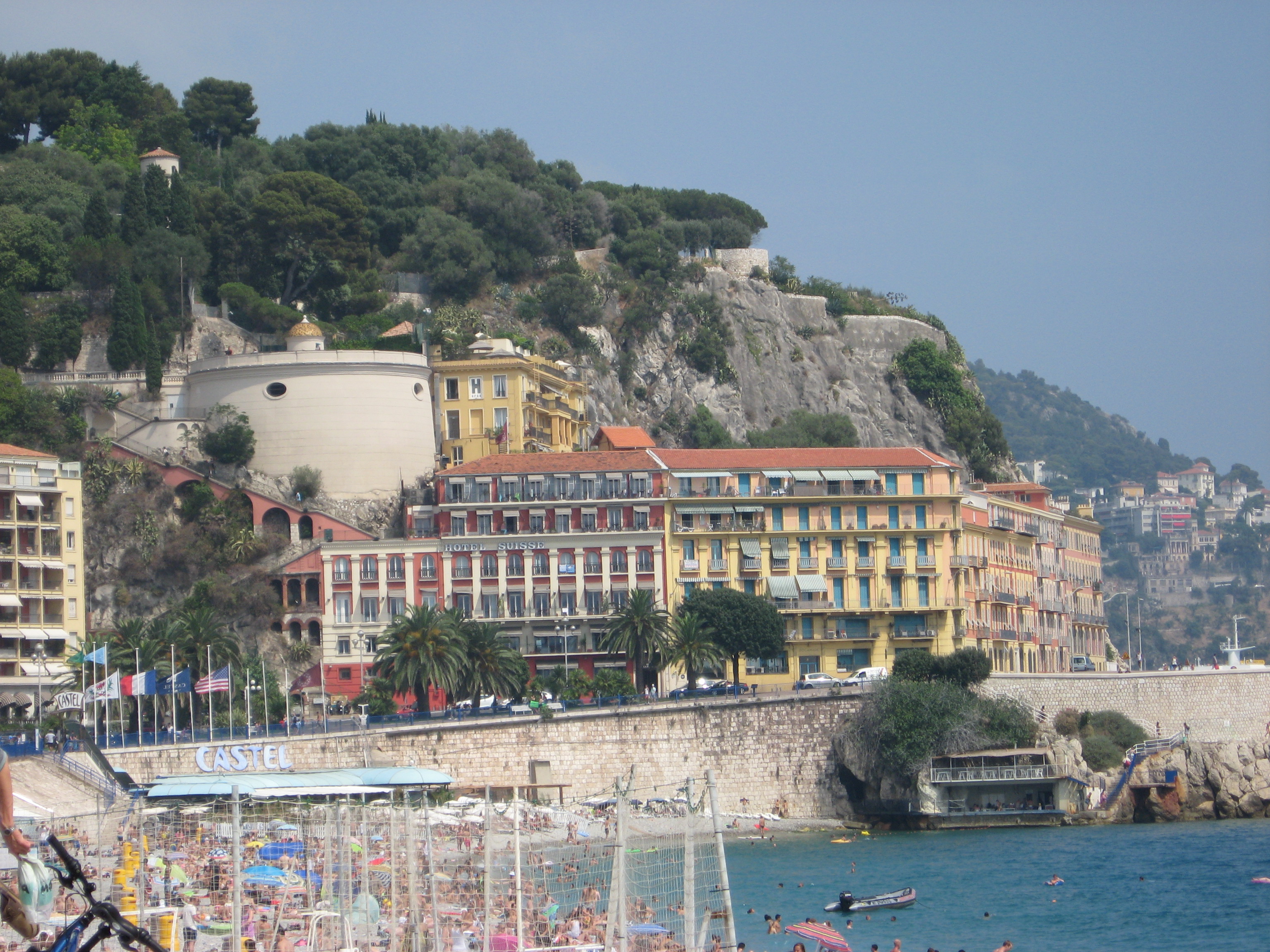
Meeting Russians, Old Russians, as my grandmother called them, was a frequent occurence on the Promenade des Anglais.  After losing the world as they’d known it, Nice seemed to have become a refuge for many such émigrés.  We would see them stroll along the picturesque seafront, their furs the worse for wear, quiet resignation and indelible pride on their faces.  At least that’s how I remember them.  I also recall their Borzois, as aristocratic-looking and as wistful as their owners.  I would stroke and hug the dogs while their owners engaged in the usual exchange.  “How long have you been here?”, “When did you leave Russia?”, “And your family? Oy, kakoi ujas – how awful!”, “And your granddaughter speaks Russian? Molodetz – well done – my grandchildren speak only French, sadly.”

Vi govorite po Ruski?” the old lady said, more as a happy observation than a question.  A half hour or so later, as we finally stood up from our bench, my grandmother had Anna Sergeyevna’s card in her handbag and we were expected for tea the following Sunday.   

We made our way up the hill to Cimiez, to the address on the business card: an upper-floor flat in an expensive building with sliding French windows and cantilevered balconies with frosted glass guarding.  A dull, caramel Murano glass chandelier that had obviously been intended for a larger room and a higher ceiling spread its tentacles over the lounge.  We sat on the canapé and armchairs with ornate gilded legs, and were served tea in china cups and saucers decorated with girls in straw bonnets and abundant lace petticoats, swaying on swings, watched by young men in redingotes.  Anna Sergeyevna had settled in France after spending years decorating apartments various countries, then renting them out or selling them.  She remarked on how overpriced everything in France was, but at least the climate in Nice was kind to her rheumatism.  She apologised for the mess.  Apparently, she’d recently dismissed her maid and was looking for another, easier said than done, since everybody demanded absurdly high wages.  Her daughter-in-law, who was squandering her son’s hard-earnt money as if it grew on trees, had the nerve to call her stingy.  She’d told her son so many times that marrying an aristocrat’s daughter would only bring ruin, but when men fall in love with a pretty face, there’s no reasoning with them.

Having recently moved to France ourselves, we had no other acquaintances, so calling on Anna Sergeyevna became a regular feature in our lives.  Occasionally, she came to our tiny flat on Boulevard Pasteur, but since our furniture consisted of the bare minimum and we had no sofa or armchairs, we ended up accepting her hospitality more often than we were able to return it.  Still, in the name of her pride, my grandmother would never let us head up to Cimiez without a freshly-baked priannik, kalach or a tray of coffee éclairs from the pâtisserie.  Sometimes, since Anna Sergeyevna still didn’t have a maid to cook for her, my grandmother would take her a pan with something delicious she had prepared herself.  

When Anna Sergeyevna did come to visit us, she would appear not in the grey, threadbare coat I’d seen her in on our first meeting, but  in one of what I soon discovered to be a large collection of fur coats.  “Guess what it is, Katia,” she’d order.  The only one I’d recognise was the umistakable leopard and the tightly-curled Karakul.  My grandmother had told me how newborn or even foetal lambs were slaughtered to make these coats, so, much to Anna Sergeyevna’s disappointment, I refused to feel its softness.  Instead, one weekend, I wrote a story about a leopard fur coat that comes back to life and sinks its fangs into the neck of its owner, in order to avenge the murdered animal.

“How can you expect to get ahead in life if you can’t tell good quality fur from bad?” she once said to me, getting me to stroke her prized, chocolate-brown mink coat.  I felt like Gigi in Colette’s novella.

Once, she came to see us after vanishing for a couple of weeks to have cosmetic surgery abroad, where the procedure was cheaper than in France.  “Wait, don’t move!” she said as soon as she stepped out of the lift at the end of our corridor.  “Now be honest: how old do you think I am?”

I could see my mother and my grandmother struggling to find the right answer.  The skin of Anna Sergeyevna’s face had been lifted and stretched, but her bulk, her heavy step and her swollen ankles were unchanged.  

As we made more acquaintances and I became fluent in French, Anna Sergeyevna became the unhappy, lonely woman my grandmother was kind to after my mother ran out of patience and I refused to frequent an accessory to animal murder.  My grandmother continued to call on her, take her cakes and humour her, until we left France, six years later.  

I still always think of Anna Sergeyevna whenever – increasingly seldom – I see a woman in a mink coat, and find myself automatically assessing the sheen, length, thickness and quality of the fur.

* Name changed.

Scribe Doll

Posted in Uncategorized | 9 Comments

Searching for LouLou

I’ve always prided myself on not being influenced by commercials. As a girl, I made many of my own clothes, summer dresses and skirts especially, and would tweak the model, so it would be slightly different from the pictures in fashion magazines.  Whenever a sales assistant tells me that a pair of shoes, a perfume or a coat I’m interested in is “very popular” and that “many people buy it”, I look for something else.  I mean: why would you want to blend into a crowd?  Also, I never wear anything with an visible designer logo on it – why would you actually pay for an item of clothing, then advertise someone else’s business for free? 

Having said all that, there was one time, back in the mid-late Eighties, when I was not only influenced by an ad, I became almost obsessed with it.  I was in my early twenties.  It was the music.  A flute solo, a simple, gentle, wistful melody.  I remember the music caught my attention and I immediately focussed on the television screen.  A very pretty young woman, French, with a beret and a long coat.  She leaves a film set and as she walks away, she removes her beret and reveals a short, glossy bob.  Meanwhile, there are voices asking if anybody’s seen LouLou.  The next shot is of the young woman sitting at a dressing table.   She has pale-coloured eyes, and the heart-shaped face I always imagined typical of a Frenchwoman. “LouLou?” a male voice asks. 

Still from commercial on YouTube
(please see link below)

Oui? C’est moi,” she replies, delicate, yet uncompromisingly confident.

Then the camera zooms in on a blue and red bottle of perfume.  “LouLou, le nouveau parfum de Cacharel,” the male voice-over says.

I began watching commercials in the hope of catching this one.  I couldn’t get enough of it.  I had my hair cut in a short bob, except that my hair, although a dark brown with reddish tones – but naturally wavy – didn’t follow the fluid motions LouLou’s straight and possibly conditioned hair did (I’ve never used conditioner: it’s always made my hair feel too soft, like cat fur).  I did have and wear French berets, but my figure, although slim in those days, was a pronounced hourglass with broad shoulders and wide hips so, much to my sadness, long, straight-cut coats didn’t hang on me with the casual grace they did on LouLou’s waif-like, appealingly androgynous haricot frame.  Above all, though I wasn’t able to admit it to myself, deep down I knew I didn’t have the self-confidence that flashed in LouLou’s eyes as she said, “Oui? C’est moi.”  

I saved up and went to La Rinascente department store to buy myself a bottle of LouLou.  I planned my shopping trip with excitement as I kept playing and replaying the music from the commercial in my head.  At the Cacharel perfume counter, the sales assistant placed the small bottle on the glass surface.  I felt a twinge of disappointment.  I’d been so carried away by LouLou’s assured grace and the haunting music that I hadn’t really taken in the picture of the actual perfume and here it was, a bright, cyan blue base with a kind of barn-red top.  I’d somehow visualised something delicate and made of crystal.  Then came the perfume on the inside of the wrist test.  I cannot remember its scent, only that I jerked my head back, overpowered by its boldness.  Perhaps it was too self-assured for me.  I thanked the sales assistant and left La Rinascente downhearted, my dream of gliding down the streets of Rome, hearing a man’s voice calling “Katia!” down Via del Corso and turning towards him, my bob swept off my face by the wind, replying, “Sì? Sono io,” had been shattered. Perhaps I didn’t know who I was yet.

For several years, I continued to use my mother’s favourite eau de toilette, Cabochard by Grès; its gentleness with a soupçon of bitterness was not only pleasing, but – given how difficult it was to find in the shops – pretty unique.  Eventually, I discovered other perfumes I likedStill, even after I stopped wearing my hair in a short bob and gave up on straight-cut clothes, I could still occasionally hear in my head the music from the commercial.  Gentle, understated, simple, but with layers of colourful undertones: indigo blue, forest green, moonlight silver and flecks of burnished gold.  I realised that it was that, more than the image of a waif-like Frenchwoman, that had made me dream.  I asked friends if they knew what this piece of music was called.  No one did.  How do you find out the title and composer of a few bars that get under your skin, except by humming them to people in case they might recognise it? That, or else you wait and hope.   

There it was, one day, on my beloved BBC Radio3.  That unmistakeable solo flute introducing the melody, soon joined by a like-minded oboe, before the rest of the orchestra flows in.  I held my breath and waited for the presenter’s voice at the end of the piece: Gabriel Fauré’s Pavane in F-sharp minor, Op. 50I had been given the title, the key to my dream.

I now have three recordings of Fauré’s Pavane: orchestral, choral, and for solo piano, as originally composed.  Each conveys slightly different sounds, emotions and colours.  Only last night, while writing this post, I discovered another gem: a piano roll of Fauré himself playing it.  It’s much faster than any of the recordings above, and perhaps the brightest and most exquisite. The gold in it gleams, and gives you a little wink.

Scribe Doll

Posted in Odds & Ends | Tagged , , | 5 Comments

My Work Space

I spend my days at a 60 x 60 cm table with a laminated beech surface and folding steel legs.  It’s an exam desk, really, the kind I sat my school exams at, with a groove for pens. I couldn’t fit anything larger in the corner of the room where I work.

H. and I refer to the room where I work as the bottega. I think he might have come up with it when we first moved to this flat.  It was intended to be my study as well as the guest room, and so has a small double bed on which I sometimes sprawl when sunlight floods in, imagining myself on the terrace of a top-floor flat in Trastevere.  Since most of the hours spent here are taken up with translation from Italian, bottega sounded much more appropriate than workshop, and, let’s face it, its connotations of creativity and genius sound much more inspiring – and carry the hope that wondrous things will produced here.  Once I learn to prioritise and put my life before my work.

You might say that 60 x 60 cm isn’t a proper desk for a professional adult, that I can’t possibly spread out.  Well, that’s true, I can’t spread out as I would wish, but there are advantages to that. For one thing, when my table gets seriously cluttered, the clutter can take up only a 60 x 60-cm area, so, instead of a large, unsightly expanse of mess, it appears like a miniature mess, a bijou mess. Moreover, a mess that’s quick to tidy up.  As for spreading out, this is still possible – and happens daily –  thanks to a little inventiveness.  

My work space can occupy up to two different surfaces, depending on need.  My 60 x 60 desk, also known in our household as the scriptorium, is where I do the bulk of my work.  On it, resting on a Botticelli’s Birth of Venus mouse mat to stop it from sliding, raised on a shoe box from a Regarde le Ciel pair of ankle boots, rests my beloved, hard-working 13-inch personal assistant or MacBook Pro.  In front of it, there’s a silver Bluetooth keyboard and, to its right, a salmon-pink mouse on a mousepad with colourful Rosina Wachtmeister cats enjoying a smiling yellow sun.  Or at least that’s what the artist intended.  I had to cut the side with the smiling yellow sun off because it hung over the edge of the 60 x 60 cm table.  

On the shoe box on either side of the laptop, I keep a chip of smoky quartz and chunk of rainbow fluorite.  I toy with one or the other while searching for a word or struggling with the structure of a sentence.  In the far left corner of the scriptorium stands a smallish, square box painted with pink roses, that came from a pair of Laura Ashley china cups and saucers decorated with the selfsame pink roses.  It’s my mess-reduction box, where all the bits and pieces the 60 x 60 surface won’t tolerate are thrown: post-it notes, bits of paper scrawled with reminders, business cards, bookmarks, a bottle of Faber Castell black ink and a tiny hand mirror.  I can’t remember why the mirror is there, perhaps a necessary accessory to a brilliant idea I may have once had.  The box is primarily used as a support for a small, bright red angle-poise lamp.   I’ve always loved angle-poise lamps and, since childhood, I’ve always liked them red.  Next to it on the box lives a piece of blue-grey celestite.  Next to the bright red lamp, its understated sparkle has a soothing effect.  When translating a particularly lacklustre piece of prose, I sometimes pick it up and look for the rainbows hiding in its clusters of crystal points.

On the far right-hand corner of the scriptorium stands a miniature wooden crate with “FULHAM SW6” engraved on it.  I have no idea what this container was ever intended for and the owner of the bric-a-brac shop in Norwich where I  bought it didn’t have a clue either.  But since I spent my happiest years in London in Fulham, SW6, I had to have  it.  It’s perfect for holding  pens, scissors, a rectangular magnifying glass, a wood and brass candle snuffer, a wide paint brush for cleaning the computer keybard, several highlighters, the plastic orange geometry triangle I’ve had since school, a cloth for wiping the laptop screen and other odds and ends.

And, of course, there’s a candle – sometimes a pillar candle in a glass dish, other times a dinner candle in a bottle, or a nightlight in a holder, but always a candle: I’ve kept one on my desk since my mid-teens. 

Oh, and there’s a tiny pottery owl with colourful mosaic patterns, which I picked up in Dijon after touching its magical stone counterpart carved in the cathedral wall and making a wish.  Someone on Twitter once asked me if my mosaic owl had a name.  I quickly called it Rabelais and decided it had to inspire my original writing.

And so the scriptorium has all the necessities for my work.  Of course, when I translate, although I overtype in English the original text, I still like to glance at the paper copy of the book, its pages kept open with a large paper clip, resting on a bamboo stand for which there is no room on the 60 x 60 surface, so matter how strategically arranged its contents.  This is when I need the secondary work area, and so I put up another folding table, a 48 x 37 cm folding pine table, not very steady on its legs, but a perfect annex desk with enough room for the bookstand and even a mug of tea.  Its small size and light weight make it a versatile travelling writing table I sometimes carry to the living room if I want to scribble while the news or the football is on, or onto the balcony if I want to pretend I’m a writer living in a warm climate, that the gutter where the pigeons nest is actually a dovecote, and the delightful terracotta water feature where the lady blackbirds come to splash around energetically is actually a marble fountain sculpted by Lorenzo Bernini. 

On Friday evenings, my working space undergoes a small transformation.  Bluetooth is disconnected on my MacBook, and keyboard, mouse and cat mousepad, rainbow fluorite and smoky quartz are put away into the shoe box, which is then removed from the scriptorium and placed under the jute basket on the floor next to the table, where I keep the books I’m translating and the bamboo bookrest folded flat, the clipboard with my daily to-do list, my personal notebook, a book or two I’m reading for pleasure, two or three books I mean to read as soon as possible, various notebooks and my Belgian tapestry pencil case with Flemish gable patterns, which contains all my fountain pens, drawing mechanical pencils, travel ink jar.  The laptop is also closed and pushed to the back of the table, ready for my command, but no longer commanding me.  In its place, real paper, real pens and real, glossy black ink.  No translating until Monday.  I can unlock that door in my head and let my thoughts and wishes out to have a good stretch, fill their lungs and breathe words into my pen. 

Scribe Doll      

Posted in Odds & Ends | Tagged , , , | 10 Comments

After the Solstice

A sound.

I become aware of a sound.  It finds its way to me through the whirring of my laptop, the hissing of the electrical devices, the faint but constant buzzing of wattage adaptors in the ceiling, the dull, oppressive hum of the metal in the roof, my own blood singing in my ears.  I try to focus on my translation, but the sound has now caught my attention and I am drawn to it, want to let it in.  It’s insistent, and what makes it especially persuasive is that it’s alive.  Something between a breath and a voice.  A voice that tells me Listen to me.  What you’re doing is not important… and deep down you know it.  I can’t accept that.  I stare at my computer screen, try to whip my focus back in step with the wishes of the author of the text I’m translating.  Something in my belly rises up to my chest and swells, but I block it in my throat, because I know that if I let it out, it will gush out in a scream.

The sound gently persists and now mutates almost into a song.  I close the lid of my laptop, get up from my desk and tune my ear to the sound, trying to locate it’s origin.  It has a modulating tone, like a voice.  My eyes wander to the French windows and I suddenly see where the sound is coming from.  Well, I can’t see, exactly, but I know it’s edging through the tiny gap between the two halves of the double door.  The same way as I know that there are many colours in this sound, many music notes in this voice – colours I could never find on an artist’s palette, notes never written on any score.  It’s the wind, singing through the gap in the steel-framed doors.

I open the French windows and step out on the balcony, where I am greeted by a multitude of other sounds.  There’s the steely, constant background hum of the traffic on the main road, of course, but the voice of the wind guides my ears towards another frequency.  The high-pitched peeps of baby pigeons in the roof gutter, the swishing of seagull wings in the air, the faraway call of a jackdaw. I fine-tune my ear a little more and look at the Corsican pines in the distance.  Their branches are gently swaying, their needles rustling, their cones softly crackling.  It’s like a perfectly conducted orchestral concert. 

There’s a chill in the air.  I am reminded that the summer solstice was a few days ago, and that the days are imperceptibly beginning to draw in.  A hint of yin to balance the yang. I smile.  I have all these weeks of bright sunlight ahead, to help see things clearly, to gather all the elements needed for the autumn.  All these weeks of sunlight for looking out for things to store for when the weeks come when I will be looking within.  All the bits and bobs, all the odds and ends required to weave wishes into intentions, brew impressions into thoughts, kindle sparks into a fire for when the evenings grow darker, turn hopes into magic.  Magic.  How could I not look forward to that?

Scribe Doll  

Posted in Uncategorized | Tagged , , , | 2 Comments

Brownie & Sentinel

“It’s like when you’re happy that two people you really like get together,” H. announced, smiling, after witnessing Brownie and Sentinel engaged in an intimate act on our kitchen balcony. 

I understand it was a blink-and-you-miss-it, straight-to-the-point performance, but long enough for H. finally to establish that Brownie is – as previously suspected – a female, and Sentinel a male.

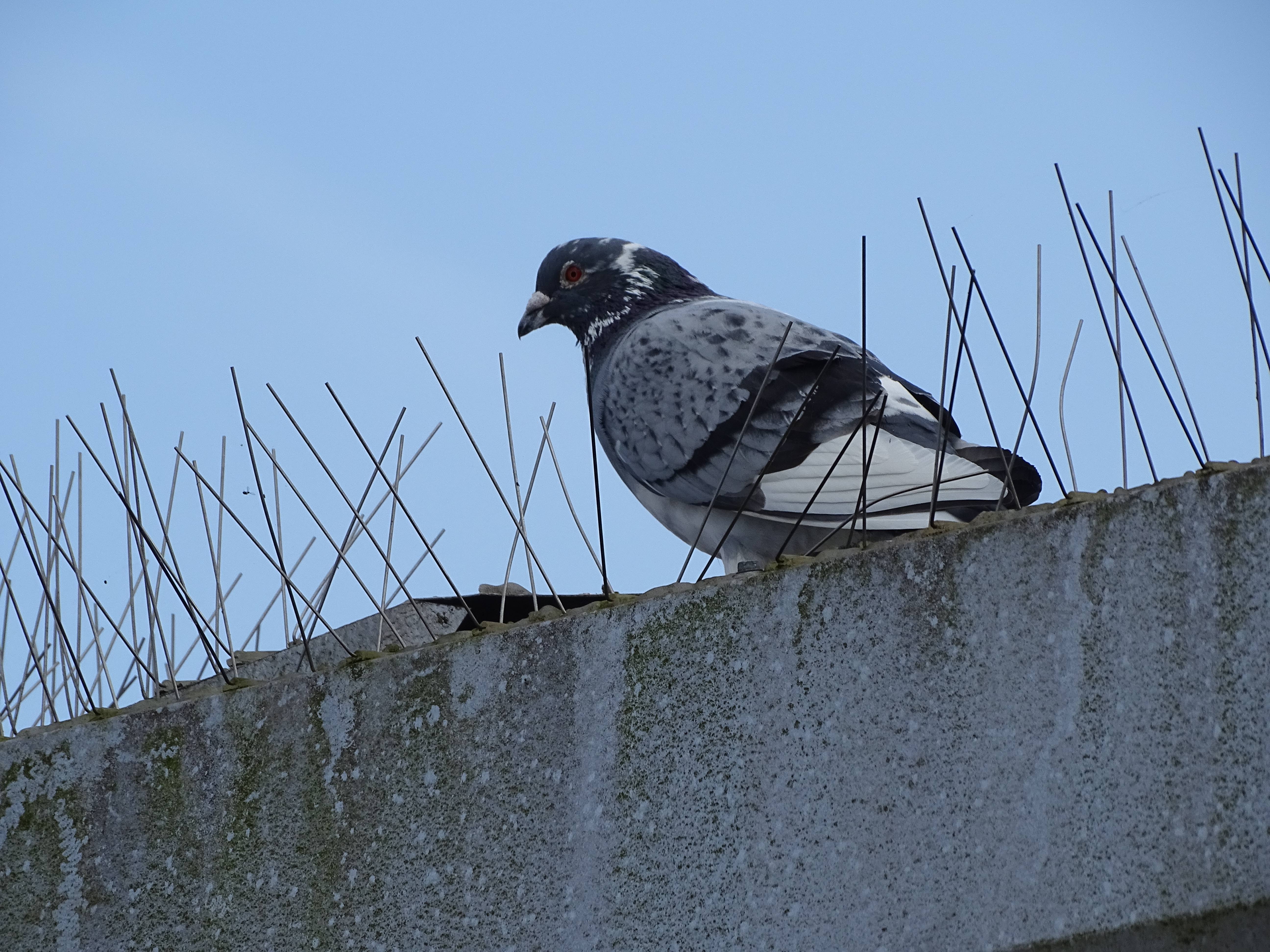
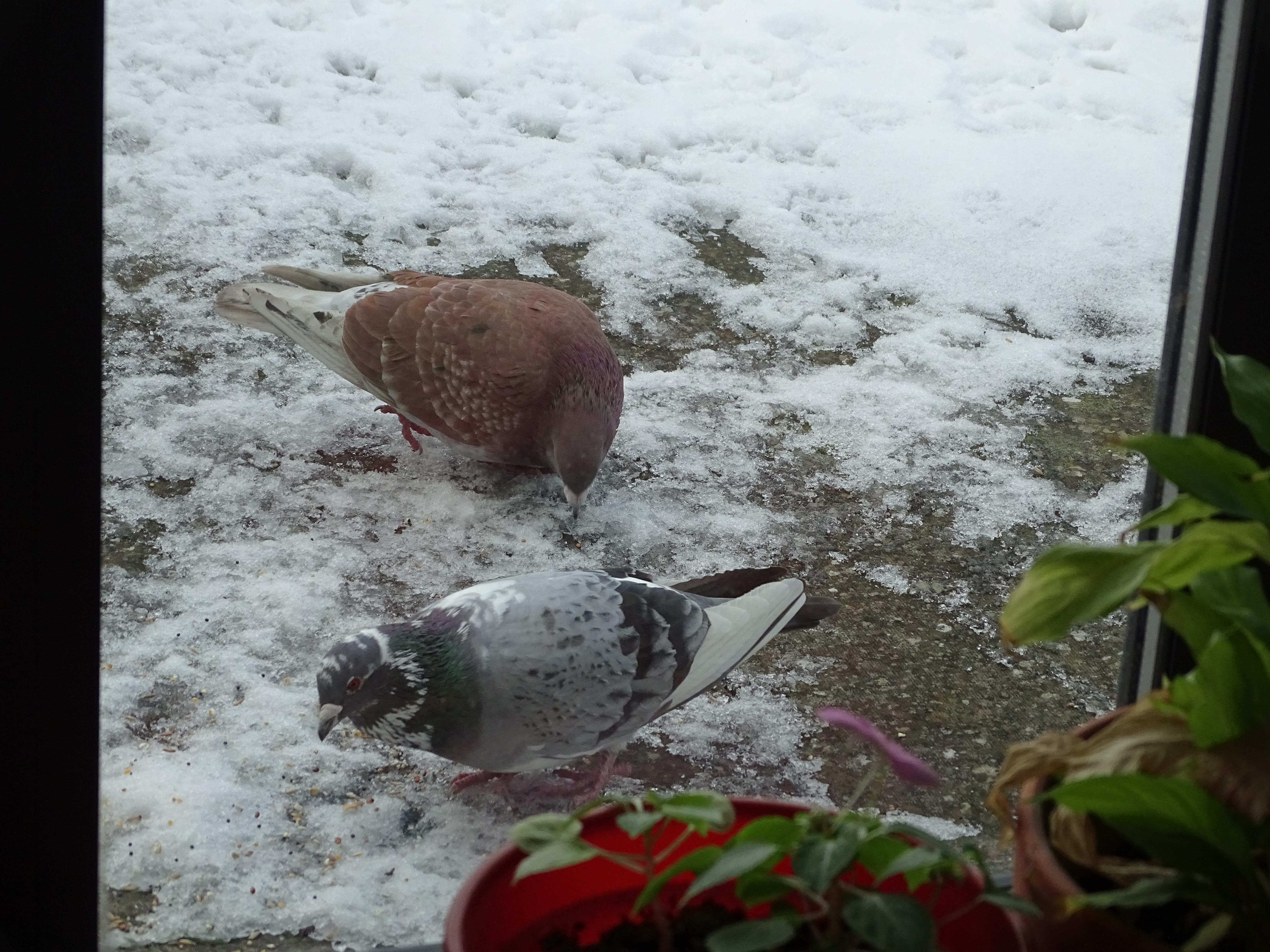
Brownie has been loitering on the balcony outside my study for a couple of years, by no means the only one of her kind (we are woken up every morning by a chorus of chesty cooing) but her brown and white plumage immediately caught my attention.  As did her persistant observation of me even though I never fed her. I’d look up from my computer and see her perched on the railing or standing right on the other side of the French window, staring at me. In the summer, when I sat in the sunshine, she was the only one to waddle up quite close to my feet, head bobbing. I’d start talking to her and, as far as I was concerned, she listened, her orange eyes fixed on me. 

At the same time, on the other balcony, the one outside our kitchen, there was Sentinel. H. called him that because he seldom left his position on the roof, and would look over the gutter, like a diligent watchman. Grey, but with very distinctive white markings on his head, as though he’d been caught in a crossfire of white paint squirting. There was another reason for our getting attached to him. About two years ago, we found him – for the first time – not at his usual post but on the kitchen balcony, barely moving, eyes closing, hiding in a corner, then behind the shed. We tried calling the RSPCA and the RSPB without any luck.  So, for three days, we kept checking he was alive, worried, I improvised some Qi Gong distance healing, and we hoped. On the third day, he vanished and we were joyfully relieved to look up and see him peering down at us from his usual observation post.

During the first lockdown, I began feeding Brownie. She and I quickly developed an understanding: I would throw seeds on the balcony outside my study once a day, but only when there were no other pigeons around. After all, I didn’t want to turn my balcony into Trafalgar Square. If I didn’t see her for a couple of days, I’d be concerned and stand outside calling, “Brownie? Brownie?” while shaking the glass jar with the birdseed. Sometimes, if I was absorbed in my work, she’d come right up to the window pane and start cooing until I looked up and served her breakfast. We kept up this arrangement for several months, it was our little secret. 

“I think that’s Brownie up there with Sentinel,” H. said one day. 

I rushed into the kitchen. Indeed, there she was, on the roof, next to Sentinel. It was the first time we’d seen her on that side of the flat. Even so, I continued to feed her only on the balcony outside my study.

Then, one morning, as I looked up from my computer, I saw that Brownie had brought Sentinel along. She hopped off the railing as soon as I opened the French window and was soon followed somewhat gingerly by Sentinel. And so I began to feed them both. He gradually became more forward, and now there are times when he’s pacing up and down outside the window even before Brownie.

Only now there’s also Bluto. Large, dark grey, with a prominent nostril cere, an insufferable bully who starts chasing and pecking Brownie and Sentinel as soon as the seeds are on the concrete. Once, I had to resort to a water pistol. So I try and make sure he’s not around before I feed the friendly couple. 

Brownie and Sentinel have been an item for nearly a year now. While the seagulls were nesting on the roof, in early spring, and engaged in regular killing sprees, sending all the terrorised pigeons flying in every direction, they’d often take refuge behind the shed and wait for the commotion to die down before stepping out into the centre of the balcony. They’re an attractive pair. She with her soft brown plumage, he with that shock of white on his grey head and neck. I sometimes see Sentinel puff himself up, spread out his tail, and circle around slender, younger females like an aged Lothario, under Brownie’s watchful eye. His flirting is never successful and the young females fly away as soon as they see him approaching. And Brownie knows that. She just perches on the railing and watches him try anyway. He thinks he’s still young and handsome. Why disillusion the poor fellow?

Scribe Doll

Posted in Animals | Tagged , , | 8 Comments

The rain is calling

The rain is calling. Stop hiding.

I’m sitting at my work table, reading the Saturday papers online while trying to psych myself up to work. My eyes keep drifting away from the screen to the raindrops landing sharply on the pane, like a volley of thin arrows. To the dove-grey sky. Pale but determined. My ears are teased by the creaks and groans of the French window frames in the wind. By the patter on the roof. Weather for staying indoors, weather people call filthy. But weather that strikes me as true to its intentions and so what if it’s May. The rain is calling. 

I put on my wellies and my jacket quickly, so the speed of my gestures can drown out the hesitation in my head. “I’m going for a walk,” I tell H., avoiding his eyes in case I see something in them that may weaken my intention. I glance at the fruit bowl on the dining table. “We’re out of bananas,” I say and immediately wonder why I need a purpose for going out beyond the simple purpose of going out. 

I wish I could just wear my tweed cap to keep the rain out of my eyes and let the rest of my face get wet, only there’s the issue of the mask, these days, the mask that must stay dry, so I pick up my large, orange umbrella.

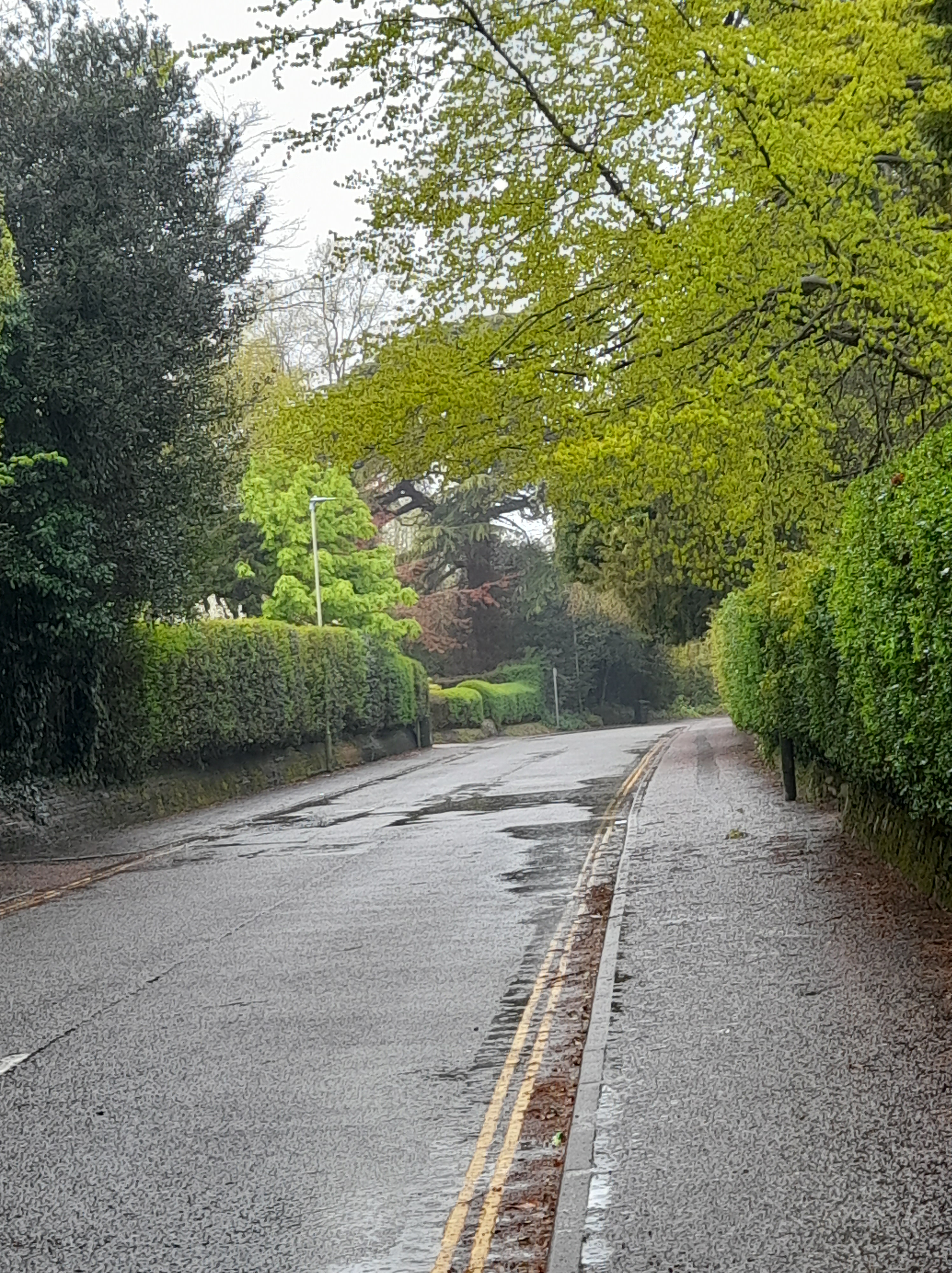
I walk up the main road, keen to turn off into a side street to get away from the loud sizzle of cars driving in the rain. A sound that’s always made me anxious. I venture into a narrow, residential street and the traffic noise suddenly fades, even though it’s only a few metres behind me. I can hear the rain calling again and I slow down to listen. The trees on both sides of the street form a kind of gallery, I mentally close off reality and imagine that there aren’t expensive houses behind the row of trees but more trees, and more. That there’s a vast expanse of forest. I breathe in the cold, damp air, the scent of wet wood, of raindrops filled with spring blossoms and linden flowers, the rich, moist soil. 

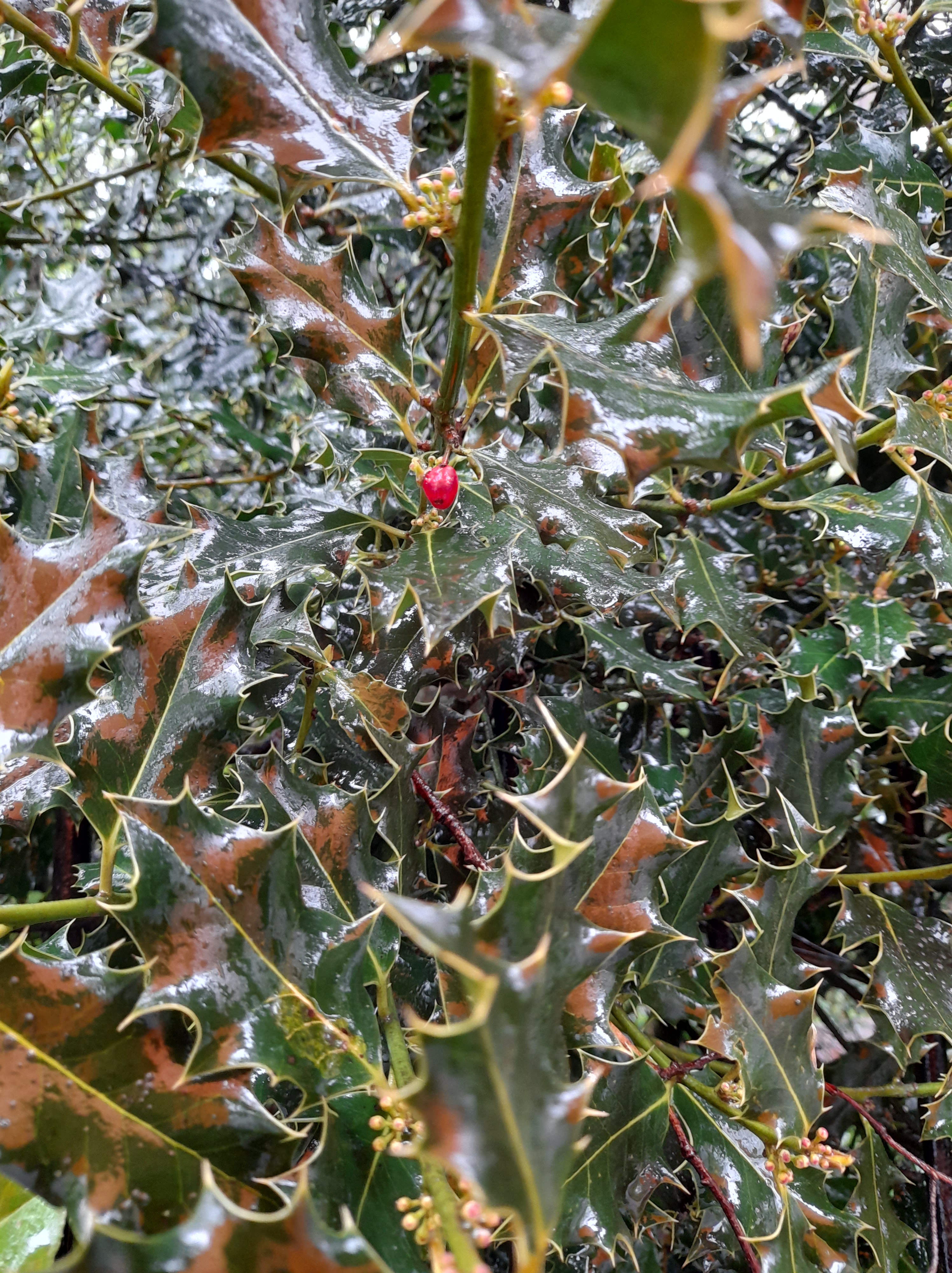
I feel elated. As so often happens when I walk on my own, words and pieces of sentences start rushing into my head. I try and hold onto them, store them in my memory so I can write them down when I get home. I treasure these odds and ends. I walk past a holly bush. The dark, glossy leaves are bejewelled with a few blood red berries. I pick up a couple of soaked, muddy cones fallen on the pavement from pines that reach high into the sky. I stop to look at the bubbles and ever-expanding circles in a puddle. My cord trousers are wet at the knees and the rain is sliding down my ankle-length wellies, the chill prodding at my skin under my socks. I listen to the drops drumming on my umbrella. The rain is calling. 

I want to write all this down as soon as I get home. The colours, the sounds, the scents and above all this feeling of freedom, of being myself. 

I haven’t written anything in a long time. The ink is caked in the feed of my fountain pen. When I do write, what I produce feels inconsequential, lightweight. Fluff. A sentence flashes through my mind that suddenly lifts my spirits. I wish I had a notepad with me to jot it down.

I put on my mask and pop into the supermarket to buy bananas. The artificial lights bouncing off the chrome fittings are hard on my eyes, the nondescript sound of shoppers booms in my ears and there’s that metallic supermarket smell. I grab the bananas – there’s only one bunch left, anyway – swipe my card and dash out into the street again, into the welcoming greyness of possibilities. As I stroll back home, I recall that there was a sentence, something that filled my heart with hope. What was it? I was going to write it down. I thought of it just before I went into the supermarket. I search the corners of my brain. I can’t find it. Oh, no, I can’t remember it. My heart sinks and the grey sky suddenly seems blank. I stop in my tracks. Please, give it back to me. Please.

My writing feels lightweight. Fluff… Yes, but the inside of birds’ wings are also made of fluff,  so they can be weightless enough to fly. 

I hear the rain’s peremptory call. Step forward.

The rain is calling me. 

Scribe Doll

Posted in Uncategorized | Tagged , , , | 14 Comments

And what of Italian Fairy Tales?

I would like to draw your attention to an interview I did with fellow Italian-English translator Lori Hetherington about her recently published translation of Emma Perodi’s TUSCAN TALES.

There is a link to the interview on the website of the Italian Cultural Institute in London.

Posted in Uncategorized | Tagged , | 5 Comments

Evening Prayer Before Lockdown

I went to evening prayer the night before this second lockdown began.

I’ve always loved choral evensong.  The first one I ever heard, in the Chapel of King’s College, Cambridge, in early Michaelmas Term 1984, made such a life-changing impression on me that I ended up attending it every evening for the next year and a half.  

DSC00949When people ask me if I’m a churchgoer, I’m never sure how to respond.  Before discovering the comforting, grounding nature of Anglican evensong sung by a choir of men and trebles, preferably helped by the acoustics of high stone arches, I went to church quite often but only outside Mass or service times, when I could sit quietly in the half-light, let the drunken monkey inside my head calm down and be inspired by the architecture which, of course, had to be at least five hundred years old before I could trust the wisdom absorbed by its walls.  I’ve never felt – and still don’t feel – comfortable at Sunday morning services.  I find them too long, my mind frequently wanders during the sermon and hymns to me are a minor endurance test.  Moreover, I find myself becoming irritated and ill-at-ease in what I perceive as the respectable, pillars-of-society atmosphere of Sunday morning Eucharist or Mass.  Evensong, on the other hand, has something therapeutic and accepting about it.  I love the mind-appeasing chanting of psalms, the lulling of plainsong, the night falling behind the stained glass windows, and I love the fact that it’s only forty or so minutes long.  I love sitting there, in communion with the music and the centuries-old walls.  Nietzsche could not imagine a God that didn’t dance.  I cannot imagine the Divine without music – and professional, at that.

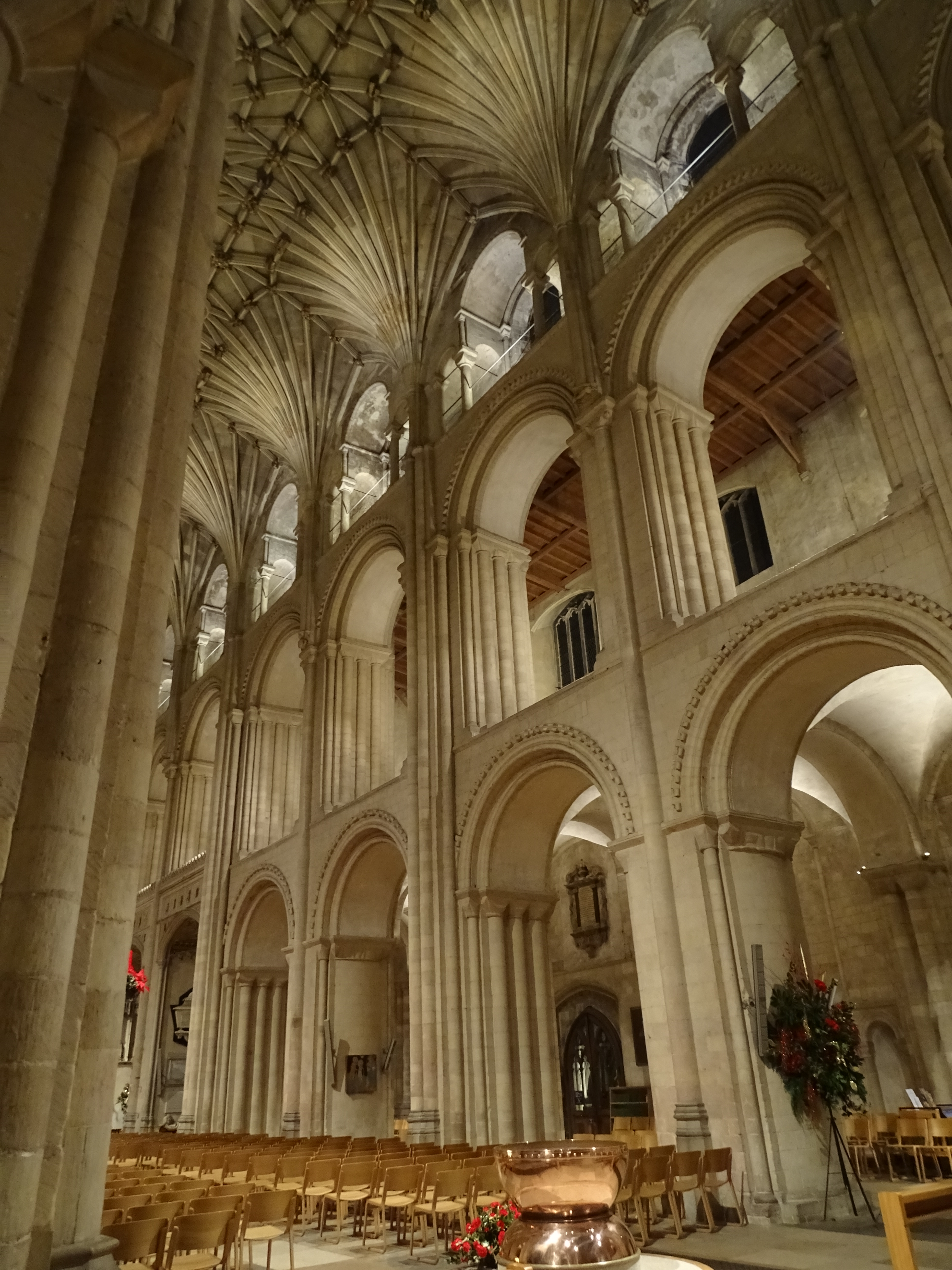
I went to evening prayer on Wednesday night, just before lockdown.  There is no music at evening prayer but I felt like being in Norwich Cathedral, among the Caen limestone walls that have seen many a plague and war over their almost thousand years.  I felt like showing support to the people who care for it at present.

Since the end of the first lockdown, services have not been sung in the choir stalls, as per custom, but in the nave.  Seats far apart.  Everybody, including the clergy and the choir, wearing masks.  What strange times, when our very breath – breath, that is what makes us alive – should carry the danger of death.  A pillar candle on the floor, where just over five hundred small, wooden crosses are arranged in rows.  One for each Norfolk person who died from Covid-19.  

As soon as I walked in through the South door and reached out towards the electronic hand sanitiser, I was surprised to hear music.  The choir was singing.  I wasn’t expecting it. “Music!” I said to the verger.  

DSC01606He directed me to St Saviour’s Chapel, one of the side chapels off the ambulatory, and told me the choir were recording music, in case the lockdown was prolonged beyond 2nd December.  In case, I thought and wondered how many people besides myself fear that it will be extended.  There were just eleven of us in the congregation and I recognised faces I’d seen at evensong over the past couple of months.  As the priest began the prayers, I could barely hear him: his voice was drowned out by the choir in the nave, the choir singing a joyful familiar melody.  I suddenly realised it was the Sussex Carol.  Every now and then, they would pause, probably to listen to the choir master’s instructions.  A Christmas carol, in early November.  Is there a chance that the lockdown will go on for much longer than we anticipate? To the point where there may not be carols on Christmas Eve?  Funny, the  traditions you cling to for a sense of continuity and normality.

On Christmas night all Christians sing

To hear the news the angels bring

I smiled and hummed along into my cloth mask.  I like the Sussex Carol. My eyes wandered towards the retable ahead.  English, 15th century.  Three central panels representing the Annunciation, the Crucifixion and, in the centre, the Resurrection, and a panel on either side with men in mitres, either bishops or saints.  Bright, mediaeval colours.  I’d never taken in these paintings before and feasted my eyes on them.

News of great joy news of great mirth

News of our merciful King’s birth

Then why should men on earth be so sad

Since our Redeemer made us glad?

H. says Christmas carols make him sad.  All that promise of peace and joy, he says, and yet it’s the same wars, violence and suffering year after year, century after century, millennium after millennium and we never learn.  I never know what to reply to him.  He’s right, of course.  I cannot give him an intelligent argument to make him change his mind – at least not a rational one.  All I can do is retreat to that place inside me where certainties are not connected with empiricism. How can I find the words, products of my limited brain, to convey the truth of unlimited imagination?

Then out of darkness we see light,

Which makes all angels to sing this night

I smile and hum into my mask.  I’m glad I came to evening prayer.  I did get music, after all.  And with it, a glimmer of hope in these dark times.

Scribe Doll

Posted in Odds & Ends | Tagged , , , , | 5 Comments

My Citrine Quartz Ring

My friend F. gave me a ring two summers ago.

Even elegant Autumn stomped in this year, perhaps sensing that subtlety was wasted on us.  The bay tree on our balcony is waterlogged, the French windows are streaked with rain, the East Anglian sky is a drama of shapeshifting charcoal clouds and the gale is bullying the delicate leaves of my young olive tree.

F. and I first met in Autumn 1986, queueing with other first-year undergraduates outside the Anglo-American lecturer’s door, at Rome University. One woman was complaining about her fingernails chipping despite the various products she applied to them.

“Just take some vitamins.”

Short, to the point, sensible. Almost imperceptibly impatient.

I turned to agree and saw F. 

We were both starting university a little late, at twenty-one.  Both Roman-born. Both Italian – she by blood, me by adoption.

What kind of winter is heralded by this brash, uncouth autumn? Will it give way to a winter cloaked in pandemic that will sweep over the country further, sowing more destruction in its wake or does its brusqueness conceal a desire to clear the putrid air we have created over the past few years and cleanse us before the season for soul-searching, dreaming and seeding? Is this second lockdown a way of forcing us to practise introspection? 

We talked, we went out for pizzas, then ice-creams at Giolitti’s.  Then she would take me home in her Fiat Panda, stopping to take in the view from the Gianicolo and driving over the cobbles of a Saint Peter’s Square floodlit in gold, across the unashamedly magnificent Eternal City.  

We were both restless and cast our glances abroad.  I thought we would leave together but when the moment came, she stayed.  “This is my home,” she said.  

I had yet to find my home, so I wandered away to England.  It was my father’s land.  “Maybe that’s enough to make it my home,” I said.

“You’ll need a fashionable Italian coat,” she replied and took me to Max Mara on Via del Tritone (you could still afford a Max Mara coat, back then).  It was a forest-green coat, cut Italian-style but with English duffle toggles.  A hybrid, like me.

In this all-permeating uncertainty and anxiety, in this world turned upside down, where the very concept of normality is challenged at every corner, the darkness is palpable.  It’s oppressive, deceitful, ruthless. It lies in wake, ready to pounce.  Only it doesn’t really pounce like a tiger, challenging you to a fair fight.  Instead, it penetrates your pores insidiously.  It then whispers in your ear that the sun is black, that the moon is made of base metal, and that joy is a thing for the deluded.  Until you’re afraid to breathe.

I made a kind of home in England.  Whenever I return to Rome, F. and I hug and talk and walk on the sampietrini cobbles.  In the post-9/11 world, cars are no longer allowed in Saint Peter’s Square but she still drives me to see the view from the Gianicolo after we’ve had ice-cream at Giolitti’s.  Over the years, I have watched her grow, learn and become wise.  We are different and don’t agree on everything but I know that if ever I were in need, F. would drop everything and rush to me.  She was a bridesmaid at my first wedding.  When she met my second husband, H., she welcomed him with unreserved warmth, as though she had known him for as long as I had.

On top of this pandemic, will we really have a period of food and medicine shortages in January, once Brexit severs us from Europe definitively? Will flights really be grounded for a while and will we really become an island not just geologically and geographically but also mentally and emotionally?

For a few years now, F. and I have taken to giving each other a piece of jewellery whenever I go and visit.  H. and I were having dinner with her and her family in a trattoria, two summers ago, in the lilac Roman dusk.  She gave me a citrine quartz ring.  I gave a small gasp.  I was sure it wouldn’t fit: I have large hands and even my wedding band had to be made to a man’s size.  Moreover, I feared it was too glamorous for me.  A silver ring with two small, embossed silver flowers that hold two large, pear-shaped, diamond-cut citrines in a diagonal.  A ring that glittered proudly, unafraid to be noticed.  Surprisingly, it fit my ring finger perfectly.  I still haven’t got around to asking F. how she knew my size.  Or that citrine was my favourite stone.  I kept the ring on for the rest of the evening, mentally deciding that it would step out of its box only on super-dressing-up occasions.  Only these are few and far between: I live in Norwich.  I wore the citrine ring for the rest of our holiday, sometimes on my right hand, sometimes on my left, over my gold wedding band.  I enjoyed moving my finger and watching the diamond facets flare up in a soft, lemon-gold glow, and the embossed silver flowers sparkle like small diamonds.  I started to wonder why I was so afraid to be noticed.  The more I wondered, the more I began to find the possibility of not being afraid of it and, on the contrary, embracing it, joyously seductive.  

I continued to wear my ring after we returned to Norwich.  Its yellow light would cheer me up when I felt lacklustre.  Its unashamedly baroque splendour told me everything was possible, even to feel and be visible again.     

I took the citrine ring out of its little box today.  I hadn’t worn it for months.  Lockdown can make you feel invisible even in your own eyes.  My heart sank.  The stones looked opaque and the silver rather grey.  I left the ring in a solution of bicarbonate, vinegar and salt for a few minutes and this restored it to its rightful splendour.  Splendour.  I like this word.  It talks of sunshine, of joy, of magnificence.  Like unreserved, generous hospitality, a table brimming with food, like the first bars of Monteverdi’s Vespers or a field of sunflowers. 

The gale is shaking the French windows and howling in the gaps.  But I have amber fairy-lights on my wall and a candle on my table.  It only takes a little light to frighten off the darkness and dissolve it inside and out.  

The citrine ring is sparkling on my finger.  What were you thinking? it says.  Don’t you remember that the sun is magnificent gold and the moon a splendid silver?

Of course.  I’d forgotten.  Splendour.  I allow it in and start to breathe again.  Joy. I feel cleaner, clearer, more hopeful.  And that feels truly magnificent.

Scribe Doll 

Posted in Odds & Ends, Uncategorized | Tagged , , , , , | Comments Off on My Citrine Quartz Ring

Twenty-Five-Hour Day

I’ve written about this before.  After Christmas Eve, this is my favourite day of the year.  I look forward to it for weeks and, the night before, I go to sleep cradled by the joy of genuine hope and anticipation, my head brimming with projects, intentions and promises to myself.  It’s my once-a-year opportunity for a fresh start and I mustn’t waste it.  I just put all my clocks back by an hour just before going to bed and the following morning, like in a magic spell worthy of Harry Potter, I get a 25-hour day.  Think about it, it’s not the summer solstice that’s the longest day of the year; it’s the day British Summer Time ends.  Yes, I know, technically speaking, the extra hour isn’t a gift; it’s no more that a fair refund for the hour the authorities stole from us eight months earlier, but on this day I am willing to forgive them that first week I spend grouchy and disorientated. Because, strangely, I’ve never had jet-lag but that first week after the clocks go forward in the spring always throws me. I resent it.

Needless to say, I don’t use this precious extra hour on sleep. It’s my miracle hour, a  fleeting window of opportunity when I can do anything and anything can happen. Like a banknote you unexpectedly find in the house and allows you to buy something you hadn’t budgeted for.  A treat.  

An extra hour pregnant with possibilities, like a blank cheque waiting for you to write, inserting any figure you like. A gift.

Scribe Doll

Posted in Uncategorized | Tagged , , , | 11 Comments