FEASTS & FANCIES @ CHOCOLATE NOTES: Chocolat à l’Orange

It sounds unmistakeably early Franco-Flemish, but as I am nearer the ignorance end of the musical knowledge gamut, I hesitate to hazard a guess that might land me not only in the wrong country, but the wrong century all together.  Instead, as I step into the welcoming warmth of Chocolate Notes*, I stop abruptly, rooted to the white floor decorated with jet-black, curly clefs and notes, and translucent fragments of scores, waiting to catch Jan’s eye. He is sitting on the stool behind the counter, frowning into a large book.  

“One of your favourites,” he says, looking up and seeing me theatrically narrow my eyes  and bite my lip.  He turns up the volume slightly.

“… Dufay?” I blurt out.

“Yes.  Sung by…?”

I release my grimace and raise an eyebrow.  “No, not this morning.  My brain’s too cold.”

“You have this CD, Katia – I sold it to you last summer.”

“Of course!” I say, knowing the confidence instilled into my voice won’t fool Jan for a minute.  “Huelgas Ensemble.”

I leave my spot, where I’ve left a small puddle of melted snow, remove my coat, mittens and the sheepskin hat with ear flaps that makes me look like a Cocker Spaniel, and head to my usual table by the window.  It’s available today, as are all the other tables. “Where is everybody?”

“There hasn’t been a soul for over an hour,” Jan says, his almost imperceptible over-pronuciation of the diphtongue in “hour” hinting at his mother tongue.  He gestures at the glass door, outside which the snow is falling in soft, fat flakes.

“I’ve known it to snow in March in Norwich once before,” I say, spreading my duck down quilted coat over the backs of two chairs.  “In 2013, when I first came to Norwich to see if I wanted to live here.  In fact, it snowed on my birthday.”

“And you decided to stay?” 

“No – yes – long story.” 

Jan closes his book, apparently glad to have a customer to chat to this morning.  Not that “chat” is the right word for Jan, Fiamma’s part-time barista.  The most one can have with him is an exchange of a few anodyne words or else a lengthy, highbrow and always enjoyable conversation.  Today doesn’t feel like one of those occasions.  I feel too sheepish at not recognising the music on a CD I bought here not eight months ago and have played many times.  Maybe I have too many CDs.  Yes, that’s it.

“What are you reading?” I ask, so as not to retreat into too antisocial a silence.

Jan holds up the bulky, hardback volume.  There is an illustration of Vermeer’s Geographer on the glossy dust jacket.    

“Fascinating,” I say politely, although the title, three lines long, doesn’t convince me.

“It would be if it weren’t written by an academic,” Jan replies with a scowl.

“I guess you have to read it for your work, right?”

Jan nods slowly, suppressing a yawn.

“Fiamma not in today?” 

“She’s in London, attending a couple of concerts.”

I open my rucksack and take out my notebook, fountain pens and glasses case, all the time glancing at the large blackboard above Jan’s head, and the twenty or so hot chocolate options.  “I can’t make up my mind this morning…” I say.

“Do you want to leave it to me?” he offers, a twinkle in his eye.

I can’t help grinning.  “Yes. Choose something for me.”

“What are you writing this morning?”

“I thought I’d start a novel.”

“Right – I know just the thing.”

Jan turns the volume down to how it was when I first came in.  I like the fact that neither he nor Fiamma ever play the music too loud, unlike in other places.  I take the chrome cap off my Faber Castell and jot a few words on the lined  A4 page, while Jan busies himself behind the counter.

I am lulled by the comforting, gentle polyphony of Dufay’s isorhythmic motets. The ethereal voices of the Huelgas Ensemble throw a sound like gossamer over the air, the perfect soundtrack to the snow outside.  They remind me of the diaphanous, absent Flanders sky.  Of its soft, grey-white translucency.  Of its shy, hazy light.

Jan places on my table a sparkling white saucer with a small glass filled two-thirds with chocolate and capped with peaks of whipped cream that look like mini Alps.  He has sprinkled a dusting of what smells like nutmeg on top.

“Wow.  I don’t think I’ve had this one yet.  What is it?”

“It’s my Chocolat à l’Orange,” Jan says, his eyes narrowing knowingly.  “Let me know how you like it.”

(To be continued.)

* Please see https://scribedoll.com/2023/02/12/feasts-fancies-chocolate-notes/

Chocolat à l’Orange

(all measurements are approximate, see https://scribedoll.com/2023/01/15/new-blog-feasts-fancies/)

Makes two 150 ml glasses:

❧  2 teaspoons of raw organic cacao (100%)

❧ Grated rind of half an orange

❧ Whipping cream (oat or dairy)

❧ ½ teaspoon of honey

❧ A little grated nutmeg to taste

❧ Boiling water

Boil the kettle and let it stand for 20-30 seconds or so before pouring the hot water into a glass where you have already spooned the cacao and the grated orange rind mixed with the honey.  Stir thoroughly, then let stand for a few seconds.  Carefully spoon dollops of whipped cream so it floats on top of the hot chocolate.  Add a dusting of powdered nutmeg and, if you wish, you can decorate with a little more grated orange rind.  

Posted in Feasts & Fancies | Tagged , , , , , , , | 10 Comments

FEASTS & FANCIES: CHICKEN SOUP WITH SPINACH AND MUSHROOMS

My acupuncturist  takes a quick look at my tongue. “You’ve got a low blood count,” she says. 

I smile with admiration: my GP had to draw blood, bruise my arm and have the lab process the sample for a whole week before working that out.

The acupuncturist carries on her diagnosis with remarkable accuracy.  As part of her list of suggestions, she advises me to have chicken soup. 

“I very seldom eat meat – I haven’t liked it since I was a baby,” I reply.

“Well, try it,” she says, “and see how you get on.  Only make sure you boil a whole chicken, to get all its goodness.”

“Dearest, will you make us some chicken soup, please?” I say to Howard – a meat eater – as soon as I’m back home.

Once he’s processed his surprise at my request for meat and my explanation for it, he stares at me, his eyes momentarily blank behind his glasses.  “Why can’t we just buy some ready-made?” he suggests, clearly trying to be helpful.

“Because this is supposed to be for my health, so not something from a plastic tub, full of additives and preservatives.  In fact, we’d better get an organic chicken.  So will you make us some chicken soup, please? You keep talking about the one your mother used to make, with Kneidel –”

I don’t know how to make chicken soup!”

It’s my turn to look blank, then I reply, “Your family were Ashkenazi Jews from Poland – how can you not know how to make chicken soup?!”

“My mother was the one who made it.”

“And didn’t you ever watch her in the kitchen and learn?” I say and immediately realise the futility of my question when addressed to a man.  I remember, not without resentment, the hours spent – under duress – in our family kitchen.  My Armenian grandmother would say, in a self-satisfied tone, “Watch, Katia.  Watch and learn.”  Being a girl can be so unfair.

“Where can I buy an organic chicken?” I ask no one in particular.

Howard gives a constructive shrug.  He’s too much of a gentleman to point out that I couldn’t make filo pastry if you paid me, even though I am of Armenian heritage.

“Okay, I’ll go and find one – and a recipe – but I’ve never handled raw meat, so you’ll cook it, right?”

Howard nods with deliberate obligingness.

Before my irritation degenerates into an accusatory rant, I grab the shopping bag and venture to the largest supermarket.

An hour later, there’s a small, allegedly organic chicken on our kitchen counter.  I’m on the phone to my friend Sue.  

“Now whatever you do, don’t wash it first,” she says.

“Oh, but my grandmother always used to wash meat thoroughly before cooking it.”

“So did my mother.”

“Then why?–”

“They’re now saying it’s safer not to.”

“‘Safer’?”

“Yes.  They tell you to cover every surface with clingfilm, and if any raw chicken touches anything at all, then make sure you clean it with anti-bacterial detergent.”

I suddenly remember stories of the extraordinary precautions taken by my mother, when giving me the polio vaccine when I was a baby.  Holding my hands to prevent me from putting them in my mouth.  Boiling or burning any contaminated bibs, towels or kitchen utensils.

“Why do people eat chicken if it’s so dangerous?” I inevitably ask.

“Oh, it’s perfectly safe.  They just tell you to be very careful because of the bacteria.”

“Who are ‘they’?”

“The experts.”

After half an hour on the phone, I read out all the health and safety instructions to Howard. “Oh, yes, everybody knows that!” he says, casually.

I briefly consider hurling the chicken at him, then remember that, at all other times, I do love my husband.

I watch him at work.  As he cuts the string that holds the dead bird together, its limbs suddenly pop apart.  I gasp and jump back.  Perhaps I should leave the kitchen… No, I’d better watch and learn.

We take our largest pot but even that doesn’t look big enough to contain the chicken.  Howard stuffs it in with difficulty.  I hear something crack and feel nauseous.  I struggle to remember why I suggested all of this in the first place.  We cover it with water.  As it starts boiling, some disgusting-looking froth forms on the surface.  Neither of us knows what to do with it, so we take the executive decision of skimming it off with a spoon and throwing it down the sink.

Then something unexpected and terrifying happens.  The chicken, the dead chicken, slowly starts to move of its own accord.  It spreads its wings, its legs rise over the edge of the pan, and the whole carcass floats up.  

“What the hell is that?” I say, wondering if I should reach out for the rolling pin.

Howard is very calm.  “I don’t know,” he replies, “but I definitely think we should add some pearl barley.”

An hour later, the flat is heavy with the smell of fat, the sick ward in a hospital, the sour, musty smell of a second-hand clothes shop.  We sit down to eat.  I stare into the swirls of fat forming paisley patterns in my bowl, stir the slippery barley, keep telling myself this is good for me.  I finally muster the courage to lift the spoon to my lips.

Howard beams as he wolfs down his second bowl of soup and reaches out for a third helping.  “Mmm… Just like the soup my mother used to make,” he says, dewy-eyed.  

I push my bowl away.  The yellowish, viscous liquid has gone cold. 

I go and raid the kitchen for bread, cheese, olive oil and olives. 

<><><>

That was seven years ago.  We have since perfected the science of chicken soup to a version we both enjoy thanks to mushrooms, which both like, and a leafy green plant that often provokes strong disagreements in our household: spinach.  I could eat it morning, noon and night.  Howard dislikes it intensely unless its flavour is toned down by other ingredients.  The following chicken soup is our current happy compromise.

CHICKEN SOUP WITH SPINACH AND MUSHROOMS

Components:

❧ Chicken broth 

(I make ours by boiling leftover bones and skin after Howard has made his superb  roast chicken.)

❧ Spinach

❧ Mushrooms

❧ Haricot beans

❧ Butter

❧ Salt, pepper

❧ Oat (or dairy single) cream

Soak the haricot beans overnight, then boil in salted water until soft.

Wash the mushrooms thoroughly, cutting off the very ends of the stalks, slice them, then fry them gently in a little butter, adding salt and pepper to taste.

Wash the spinach thoroughly, drain the excess water, stew for a few minutes until wilted, then cut into tiny pieces with a knife and fork (or put into a blender).

Add the cooked spinach, mushrooms and haricot beans to the chicken broth, bring to boil and simmer gently for a little while (I usually leave it for 20 or so minutes), to allow the soup to come into its own.  

When serving, add cream to taste.

I like to make this soup the day before I need it, because I find that it always tastes better the next day (needless to say, this soup has to be kept refrigerated once cooled).  I sometimes add potatoes or a little brown rice, to make it thicker.

Posted in Feasts & Fancies | Tagged , , , | 6 Comments

FEASTS & FANCIES: OMELETTE à la Gregoryan

In Lasse Hallström’s heartwarming film, The Hundred-Foot Journey, Helen Mirren plays Mme Mallory, a Michelin-star restaurant owner with very definite ideas about what cooking should be.  Before she decides whether or not to employ a new cook, she sets them a task: to make her an omelette.  Just one mouthful and she knows whether the cook has the required talent to become a chef. 

One of the best omelettes I’ve ever had was in Paris, in a family restaurant in the Marais district, called Robert et Louise. It was a mushroom omelette: simple yet rich in flavour. But then everything there, even the house red, was a caress to the palate, a pleasurable rub to the belly.

At this stage I must confess something which would no doubt immediately disqualify me in Mme Mallory’s eyes – it certainly disappointed my husband early in our relationship: in general, I don’t like omelette cooked in butter.  Olive oil, please.  Extra virgin, dark green, deep with a note of bitterness.  Oh, and I don’t like my omelette folded while cooking either, to produce that fluffy centre.  I prefer it cooked evenly on both sides, enough to for it to be a dark golden-brown. 

Despite the current much-covered fresh food shortages in England, something we have so far in abundance in good supermarkets is packets of fresh herbs.  I love herbs.  My dream is to have a herb garden.  I did try starting one on our balcony, but our roof is the Norwich centre for feral pigeons, who dig up anything I sow and crap on the rest.  After four years of creative negotiations, trying to persuade them to move their headquarters to a different location, we’ve had to accept cohabitation with the flying creatures.  Apparently, we should take their presence as a great compliment, since pigeons roost only where they feel safe.

A herb garden is like a French parfumerie, only much better.  It’s like a garden full of fairies, each with its own spirit, its own personality, ready to cast its own individual spell.  Next time you walk past a rosemary bush, stroke it then lift your fingers to your nose and breathe in its smell of home, of cosiness, of safety.  The leaves of fresh oregano are like velvet, and smell like pizza, like the Trevi Fountain on a spring evening, like a Roman love song sung by a gravelly mezzo-soprano.  Basil is brash, bright, uncompromising.  Have you ever drunk a glass of cool water after chewing fresh tarragon? It tastes silvery, irridescent, like a glassful of moonlight.  I could (and at some point will) go on.

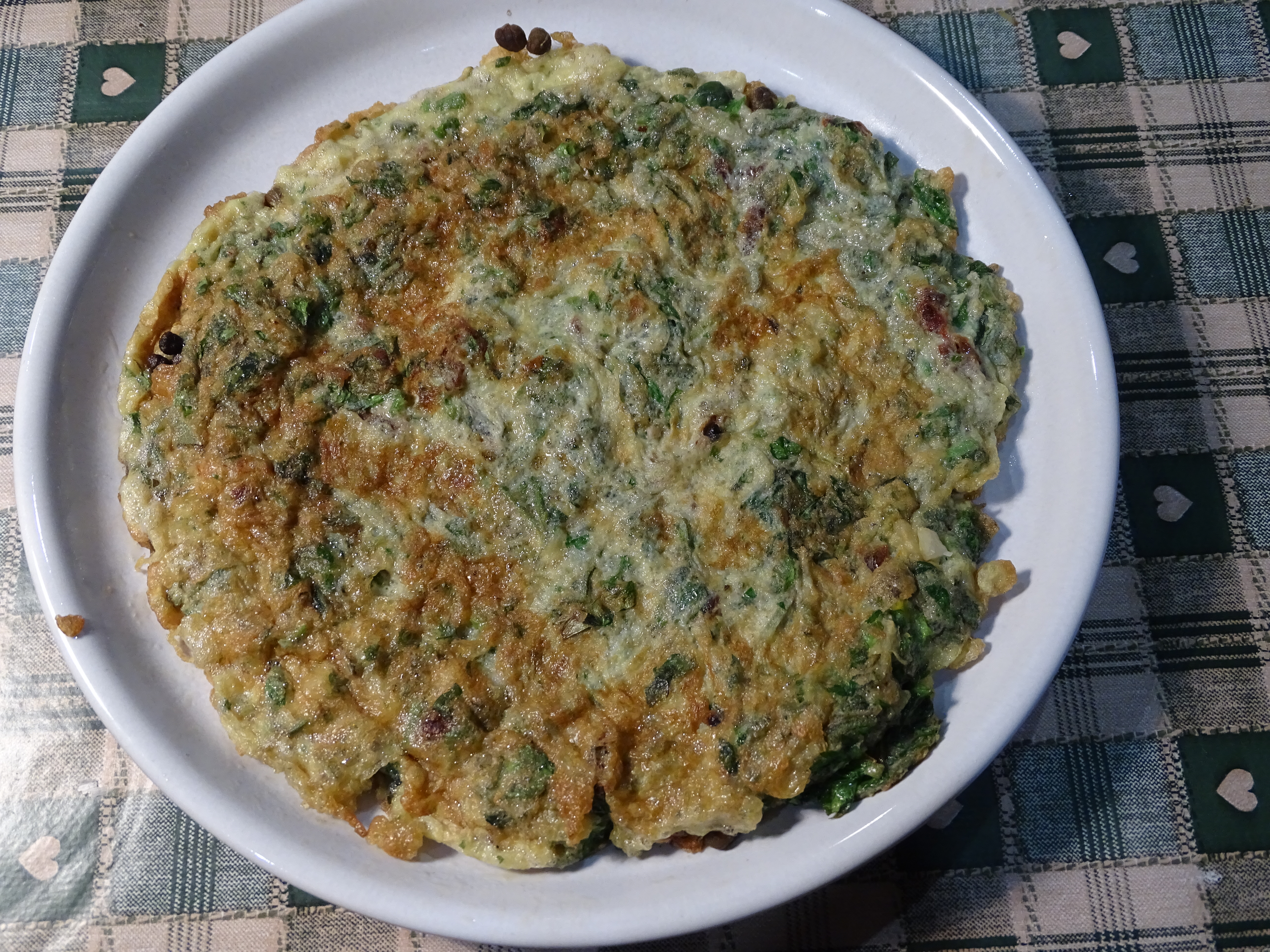
This is one of my favourite omelettes.  It’s not Michelin-star standard, but if you like fresh herbs, you may find it to your taste.  Howard asked me what it’s called, and I said flippantly –

OMELETTE à la Gregoryan

Your fairy assistants: 

(all measurements are approximate, see https://scribedoll.com/2023/01/15/new-blog-feasts-fancies/)

❧ 3 Eggs

❧ Basil

❧ Flat leaf parsley

❧ Sage

❧ Oregano

❧ Tarragon

❧ Rosemary (just a tiny amount)

❧ Thyme

❧ Dried capers

❧ 2 Sundried tomatoes

❧ 1 -2 Cloves of garlic

❧ Olive oil

❧ Salt, pepper  

Soak the sundried tomatoes in a cup of boiling water for twenty minutes or so, to soften them a little.  Sundried tomatoes lift the overall tone of a meal and, if used very sparingly, do not overwhelm it like fresh tomatoes.  Besides, if, like me, you live in a cold climate, sundried tomatoes are at least an assurance of flavour fresh tomatoes can’t always give, since they’re either grown under plastic, picked while still green to be shipped across the Channel or seriously deficient in sunlight. 

Chop all the herbs as finely as you can, mix them all together on your board and chop them some more.  Allow them to produce a perfume symphony, a togetherness with each individual scent discernable, complementing the others.  Add finely chopped or crushed garlic.  Garlic is the strong personality you invite to your table to ensure the conversation is bubbly.  

Drain the sundried tomatoes and slice them into tiny strips. 

Break the eggs into a bowl, then whisk them until slightly frothy.  Add all the herbal mixture and the sundried tomatoes, as well as a small tablespoon of dried capers (please note that if these are already salted, you will not need to add salt to the omelette – I learnt that the hard way).  If you like, add just a couple of twists of freshly milled black pepper – just a couple of twists, black pepper can be a bully if allowed free rein.  Let the concoction rest for five minutes, so the ingredients get acquainted enough to make a good team.

Heat a little olive oil in a frying pan and once it’s warm enough to emit its fruity smell, pour in the mixture.  Turn down the heat to medium so it cajoles your omelette into frying instead of attacking it.  Once one side is a nice golden-brown, turn the omelette over and wait for the other side to cook till golden.  

Serve.  Eat slowly, with respect and wonder, allowing each ingredient to sing its solo to you, each flavour to whisper something beautiful.  

If you have enjoyed this post a little, please leave a comment.  If you have enjoyed it more than just a little, please share it.  I will appreciate it. 

Posted in Feasts & Fancies | Tagged , , , , , , | 3 Comments

FEASTS & FANCIES: VEGETABLE STOCK

Another thing that never ceases to surprise me in England is the amount of processed food consumed.  I remember that it struck me even when I first arrived here, nearly forty years ago.  In most homes, the world-famous English custard was made up from powder, meat gravy from granules.  When people proudly served home made mince pies, I discovered that these were generally filled with shop-bought mincemeat.  I also realised that most people buy tinned pulses instead of a packet of dried ones to soak overnight, come Dio comanda*, as the Italians would say.  I’m told it’s a hassle to have to soak beans overnight.  What’s easier than covering them with water and doing nothing for 10-12 hours?

Convenience and pre-packaged foods were and still are very popular.  My personal bête noire is pre-peeled, frozen potatoes, ready to stick in the oven.  I mean pulleeease… Yes, people work and food preparation is very time consuming. Moreover, the proportion between preparation and eating time is frustratingly uneven, and unfair.  You spend at least half an hour or even an hour crafting a dish you then eat in fifteen minutes.  That’s not counting washing up time.  But, surely, isn’t it better, healthier, to have a freshly-made, plain omelette than something out of a plastic tub covered in clingfilm you have to pierce in several spots then stick in a microwave? 

Sadly – and to the shame of our Government – the popularity of processed foods is largely due to poverty.  Perversely, the more processed, the more filled with additives and chemicals, the cheaper it is.   Cooking from scratch is expensive.  Eating natural, fresh produce is becoming more and more costly.  It used to be the case that only the rich could afford sophisticated, refined foods, while the poor fed on wholesome, even if scarce, fruit and vegetables.  It is now the other way around. 

Taking this important, unforgivable reality of 21st-century Britain into account, it is perhaps also true that, unlike in France and Italy, cooking from scratch is not exactly part of British culture.

I have a full-time job that all too often stands in the way, preventing me access to my life, so I certainly don’t cook elaborate meals every day.  Spaghetti drizzled with olive oil with roughly flaked parmesan (because I am too lazy to grate it) and fried eggs on toast or with half an avocado frequently feature on our table.  As are scrambled eggs with rice. During our long, cold winters, hearty soups are always popular, since I can make enough to last three days… so – yippee! – no cooking required for two of them.  The washing up is also minimal: only 1 bowl + 1 spoon per person.

Sometimes, a simple soup, stew and even sauce can be vastly improved with good stock.  Here again, it sounds complicated but making vegetable stock from scratch is one of the simplest things in the world… and the most pleasing to your olfaction.

* As God ordains.

VEGETABLE STOCK

Your allies: 

(all measurements are approximate, see https://scribedoll.com/2023/01/15/new-blog-feasts-fancies/)

❧ Parsley

❧ Rosemary

❧ Bay leaves

❧ Thyme

❧ Sage

❧ Oregano

❧ Dried porcini mushrooms

❧ Sundried tomatoes

❧ Celery

❧ Carrot

❧ Onion

❧ Garlic

❧ Peppercorns

❧ Salt (just a pinch)

❧ 1 litre of water

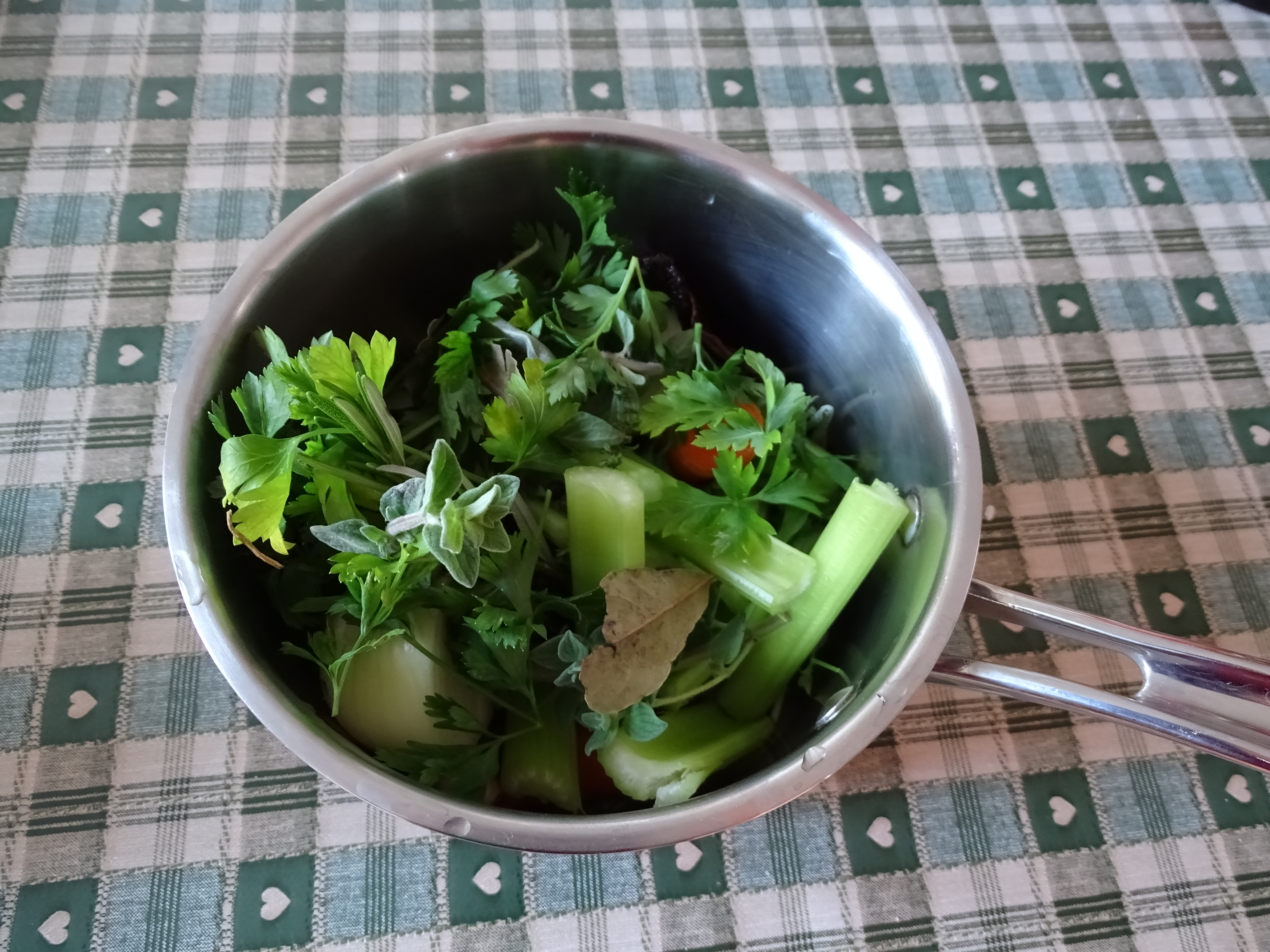
The above ingredients are what I used to make my own batch of stock a couple of weeks ago.  It will last us at least six months, and next time I make it, the components may be different.  Making vegetable stock is an exercise in improvisation and using up whatever you may have left in your fridge vegetable drawer and herb rack.  In this case, I used fresh herbs because I happened to have some.  Usually, I use dried ones.  They are, of course, stronger, so for 1 litre of water, I would recommend 1 teaspoon of each herb, a couple of bay leaves, and three peppercorns.  Tweak as you see fit.  Have fun with it.

If you’re using fresh herbs, chop them very roughly – not forgetting to breathe in the aroma they leave on your fingertips – and put them into a saucepan.  Peel 1 medium-sized carrot, 1 onion (cut it in half) and three large cloves of garlic and add these to the pan, together with two small bay leaves, 3 or 4 celery sticks (ideally with the leaves left on), a few dried porcini mushrooms and a couple of sundried tomatoes.  3 peppercorns and just a small pinch of salt will help bring out all the flavours even more.  

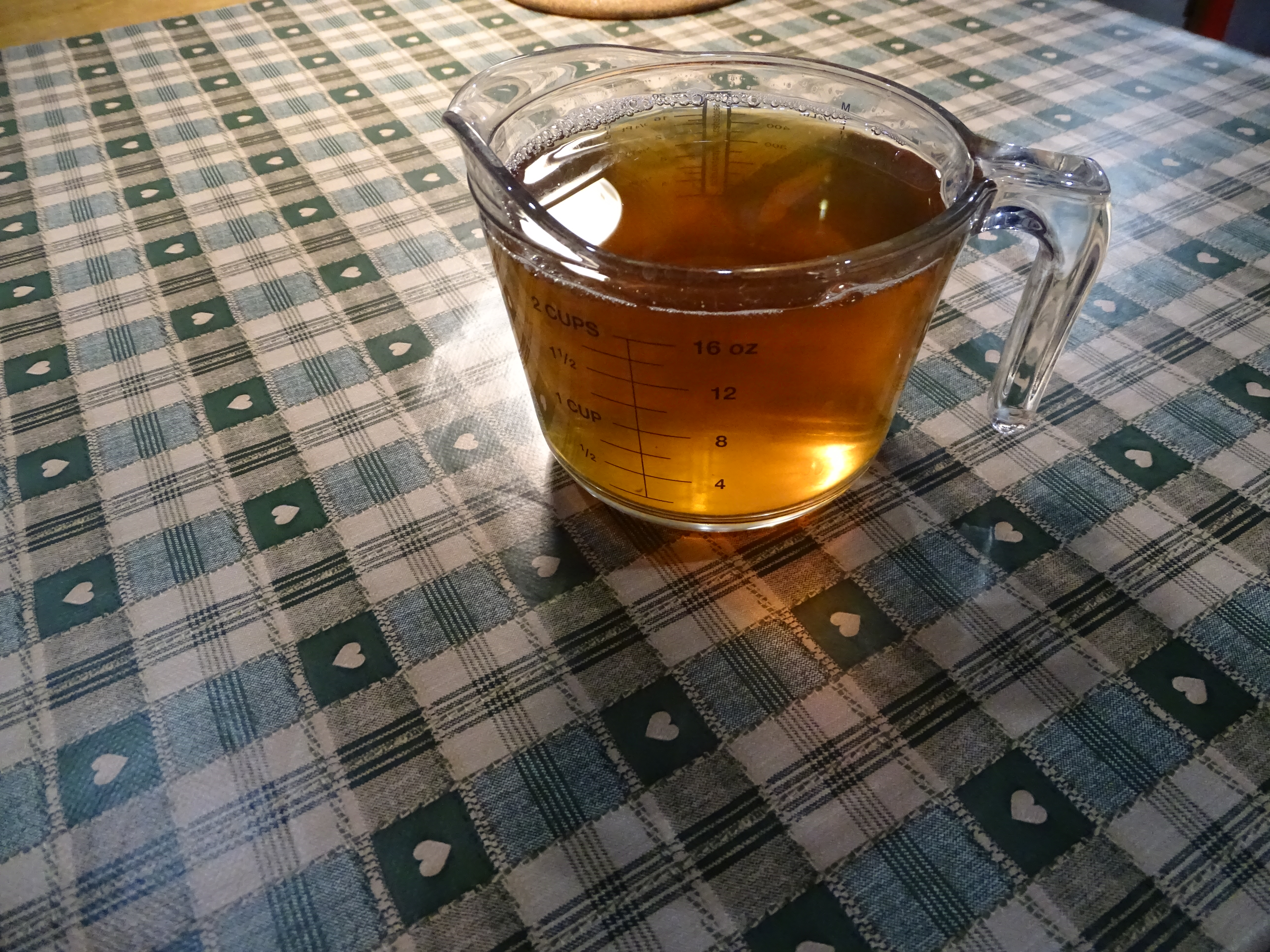
Cover with 1 litre of water, bring to boil and simmer on a very low heat for 15-20 minutes, taking care the water doesn’t evaporate too much.  Then turn off the heat, cover the pan.  I then let it stand either overnight or all day, to allow all the fragrances and flavours to perform their alchemy.  Of course, if your kitchen is warm, you will need to refrigerate the stock as soon as it has cooled down.

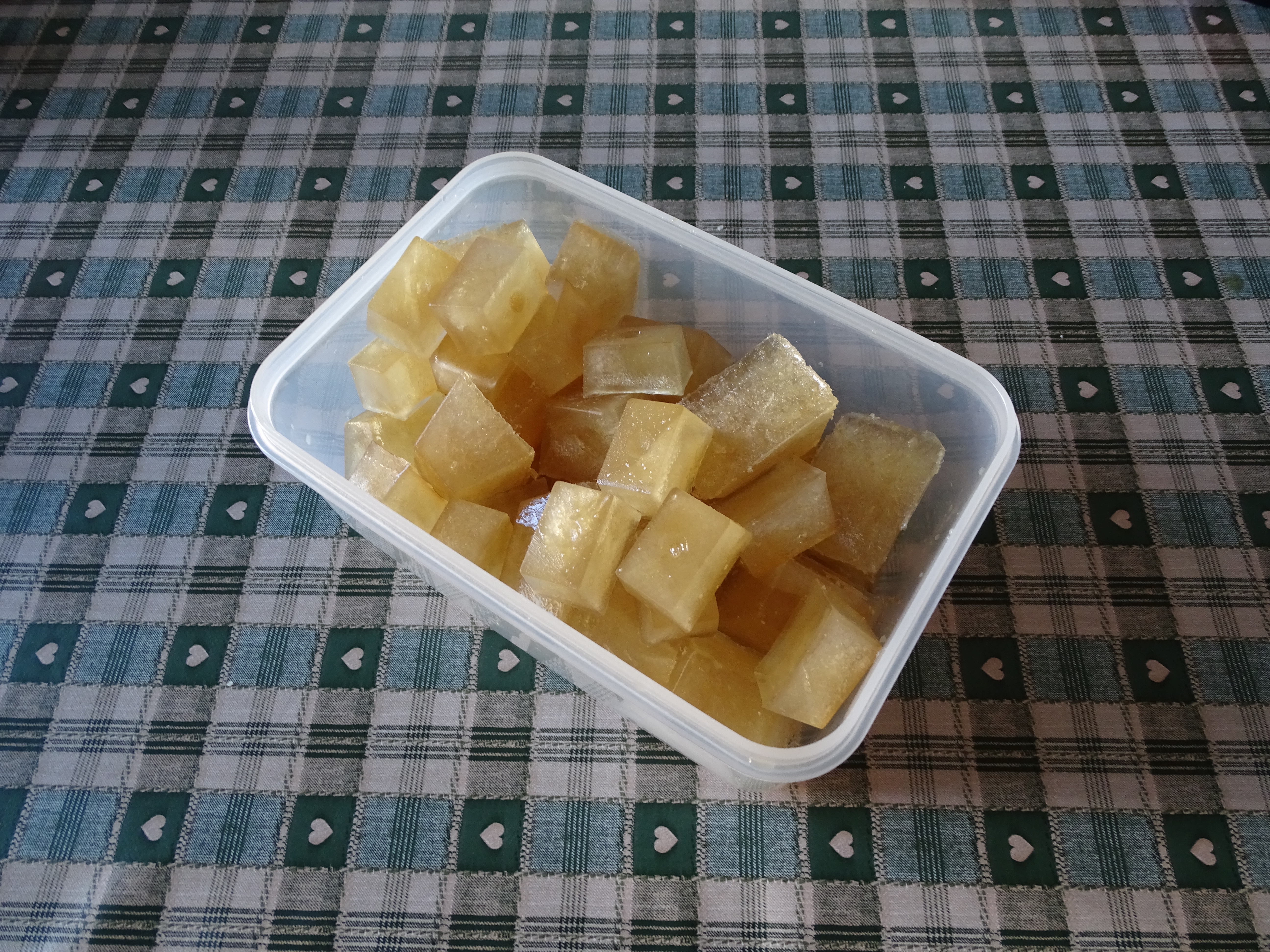
Once cold, strain into a jug, discarding the herbs, peppercorns and vegetables, and decant the broth into ice-cube trays.  Once the liquid is frozen, store in an appropriate container in the freezer compartment of your fridge.  

Whenever you need to add stock to your recipe, just use 1 or 2 (or more) iced stock cubes.

It’s as easy as that.

Posted in Feasts & Fancies | Tagged , , , , , | 10 Comments

Feasts & Fancies: Chocolate Notes

One of my favourite haunts is Chocolate Notes.  

Norwich, where we live, could possibly be described as the city that always sleeps, in that – unless you resort to a chain (and I prefer independent cafés) – it’s near impossible to have breakfast before about 8 a.m. because everywhere is still closed, and quite a challenge to have afternoon tea after 4 p.m., because most places close around about then.  The beauty of Chocolate Notes is that you can enjoy a steaming bol of chocolate with a freshly baked, buttered baguette as early as 7 a.m., while being gently woken up by a cello suite by J. S. Bach, and pop in for a late night malted cocoa just before midnight, lulled by soft madrigals by Byrd or Gibbons, before a slow stroll home across a ghost town where you can hear your footsteps tip-tap on the flint cobblestones and meet only the odd prowling cat.  During the day, I often pop in for a “choc-express”: a large thimble-size shot of black, 100% raw cacao, knocked back while standing at the counter, the way Italians get their fix of coffee in bars in Rome.  It is also the only place in town where you can sit and read all the main international broadsheets. They even have the literary supplements.  Consequently, the café area is like a miniature version of London, where you can hear several languages being spoken at any one time. 

Chocolate Notes is a hot chocolate and classical CD shop in one.  The owner, Fiamma, a viol player, lived in about twenty different countries and on at least three continents before moving to Norwich.  “I fell in love with the dramatic, shapeshifting skies,” she says, brushing her mane of wavy, pre-Raphaelite red hair over one shoulder. “I like having 180º of sky when I step out of the house.” 

Whether you’re a fan of concertos, symphonies, opera, lieder or Early Music, Fiamma either stocks it or can order it for the following week.

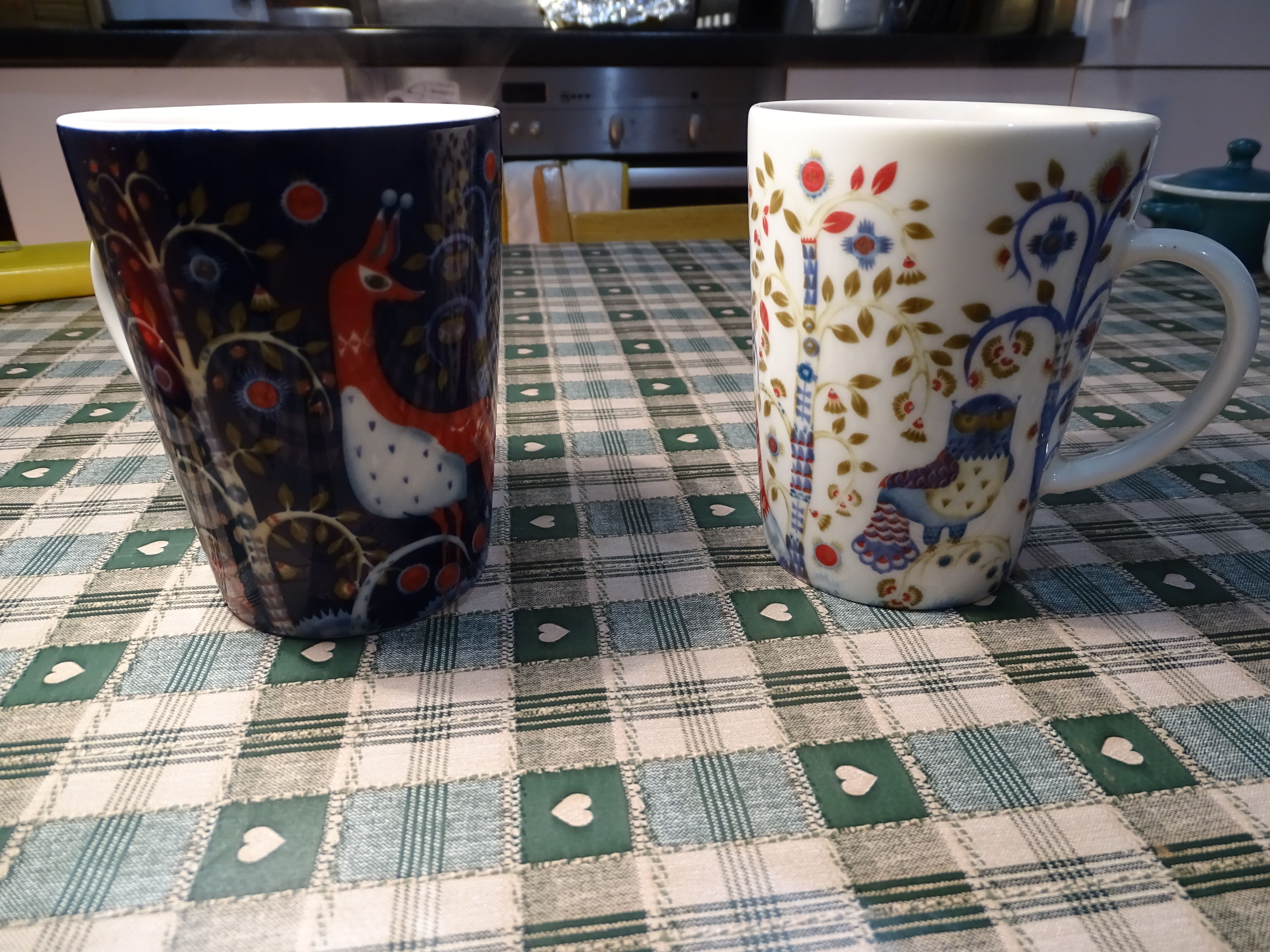
As well as being one the very, very few shops in the UK where you can not only purchase real, physical CDs, but also listen to a couple of tracks on state-of-the-art heaphones before buying them, Chocolate Notes is probably the world’s only hot chocolate café – and what a café.  The board behind the bar lists about twenty different options, all made from 100% organic cacao beans.  White chocolate with ginger or nutmeg; thick dark chocolate with a soupçon of cayenne and a dollop of crème fraîche; dark, bitter chocolate with a twist of mint; rich, medium brown chocolate perfumed with orange peel;  the “choc-express” mentioned earlier: 100% raw cacao and water, served in small espresso cups.  These are just a few and let’s not forget the “Guest Hot Chocolate of the Month”, which has included “HazelChoc”, “Morello Cherry Velvet” and “Coconut Fancy”.  Of course, there also the liqueur versions.    Like Belgian beers, every hot chocolate comes in its own special signature mug, cup or glass.

Most drinks are unsugared, unsweetened.  “You’d never dream of serving pre-sweetened coffee,” Fiamma says, raising an eyebrow, “so why not equally leave people the freedom to add sweetness to their hot chocolate if they wish to – or let them have it black if they choose?” 

On this front, there is a wide range of options available: golden sugar, dark moscovado sugar, date syrup, honey and maple syrup.  

I am a chocolate lover who never used to order hot chocolate because I always found it too sweet, so for me Chocolate Notes is a dream come true*.  I often go there in the evening, after dinner, and sit at a corner table and write.  “Just pick a drink for me,” I tell Fiamma.  She’ll ask me what I’m writing, and usually bring me my favourite:

Hot Chocolate with Cardamom   

(this one is for my dear friends Lee and Jane, who love hot chocolate)

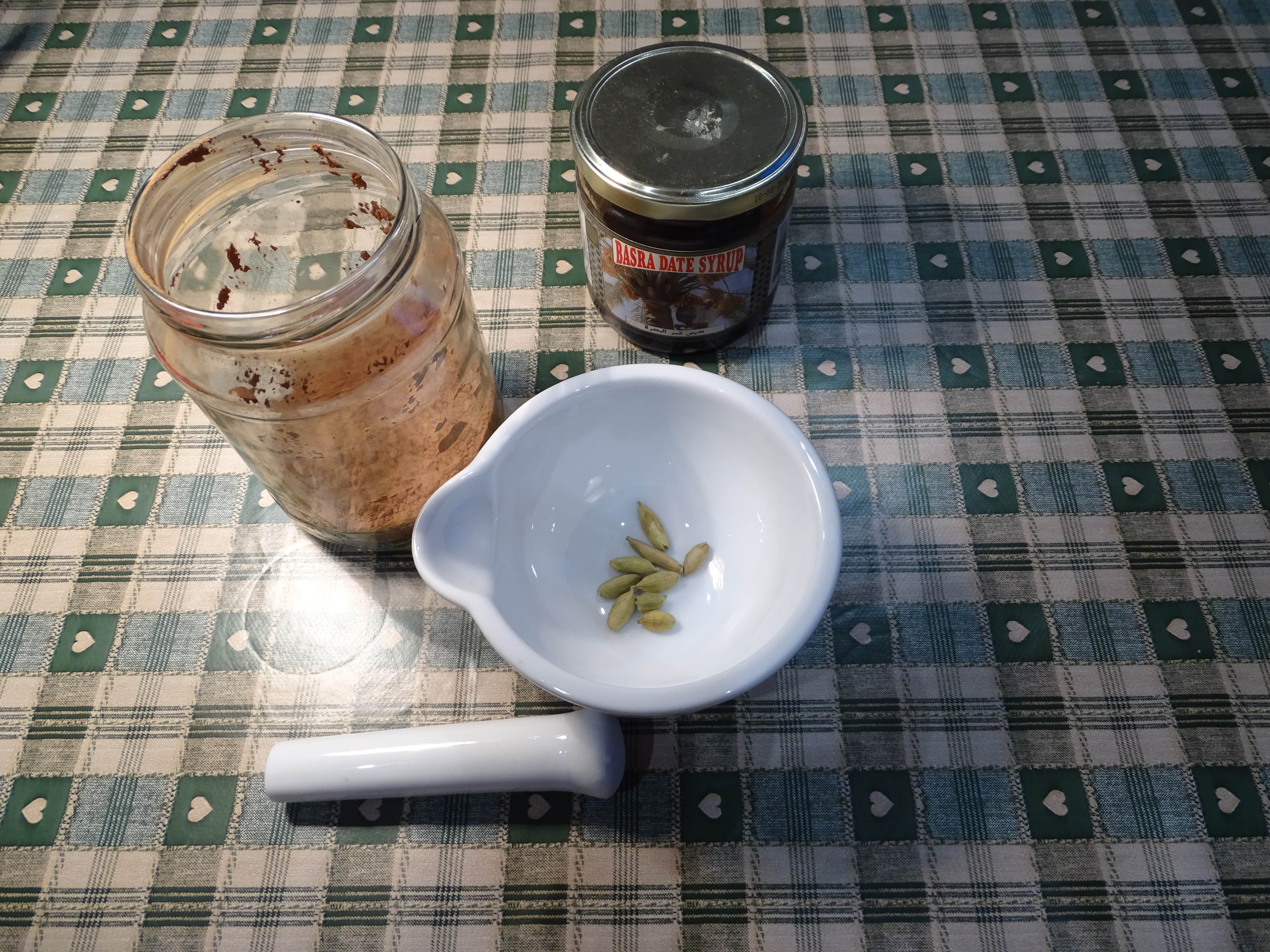
Your essentials for one mug of hot chocolate:

(all measurements are approximate, see https://scribedoll.com/2023/01/15/new-blog-feasts-fancies/)

❧ Either goat’s or full-fat milk 

❧ 1 heaped teaspoon of raw, preferably organic cacao

❧ 1 teaspoon of date syrup

❧ 3 or 4 cardamom pods

❧ a non-stick milk pan

❧ a non-scratch whisk

❧ a little patience

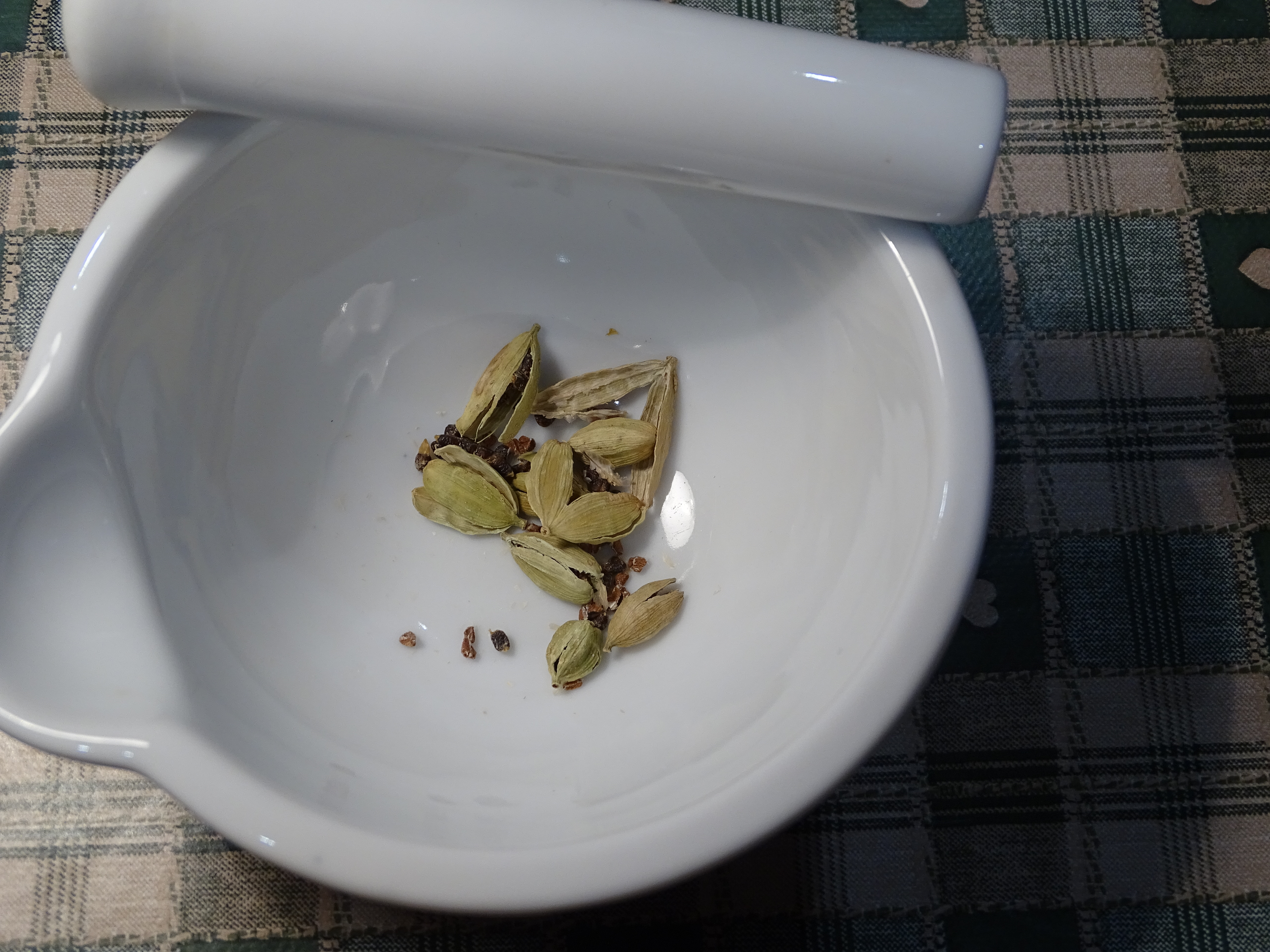
Crush the cardamom pods with a pestle in a mortar.  I tend to remove the shells before putting the seeds into the pan because I like chewing them, but if you’re planning on straining the drink before serving it, then you can throw everything into the pan, although I recommend crushing the cardamom first to release the fragrance.

Once the cardamom is in the pan, add the cacao and the date syrup.  Cover with milk and let it stand for five or ten minutes.  Give the ingredients time to get acquainted.

Put the pan on a medium-low heat and start stirring slowly with the whisk.  Don’t rush, let the milk warm in its own time, the cardamom release its flavour, the cacao blend in, the date syrup give the brownness a hint of red.  Heat it for about ten minutes, stirring slowly, rhythmically, respectfully.  Watch for the first bubble (don’t let the milk boil – it will impair the flavour) and remove from the hob.  Strain if you don’t want the cardamom in your cup.  

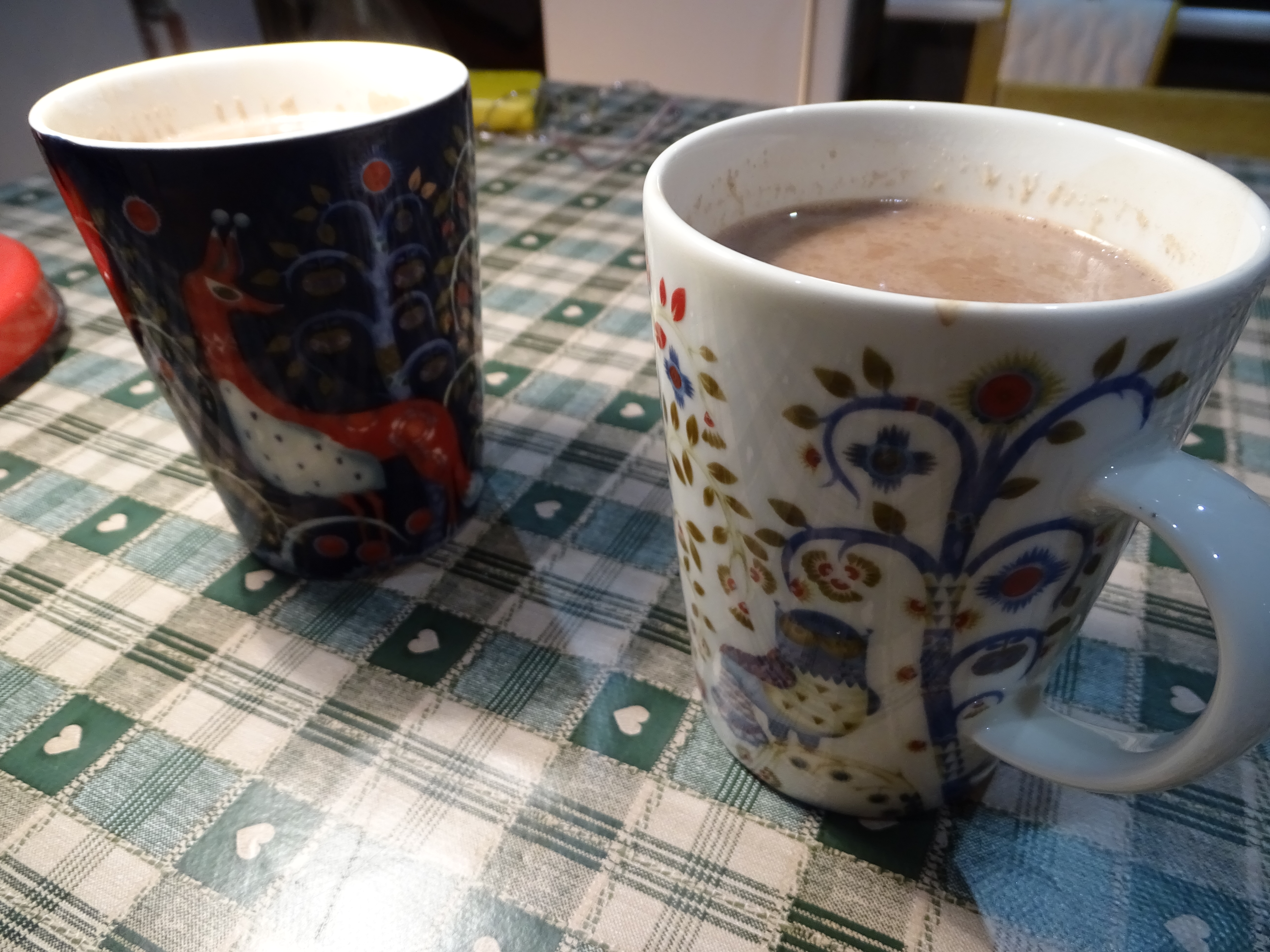
Serve this hot chocolate in the kind of mug or cup you want to curl your fingers around, your palms to hug.

* Err…. not yet.

Posted in Feasts & Fancies | Tagged , , , , , , , | 22 Comments

Feasts & Fancies: Polenta Cobbler

When I first came to England as a late teenager, in 1984, the biggest culture shock I experienced was undoubtedly the natives’ frugal attitude towards food.  It seemed to be perceived as an undeserved luxury rather than a basic right.  Moreover, there was a code to follow, which I needed to learn.

For instance, when my first English landlady remarked, “If my children had half your appetite, I’d never worry about their health,” something told me she didn’t mean it as a compliment.  When a host handed you a plate on which the food occupied about 25% of the surface area, with a benevolent, “Is that all right, my dear, or is that too much?” you did not reply, “Does it come with a magnifying glass?”  And when you were offered a second helping of the main course, “Yes, please!” was not always the best response.  You might just embarrass the host with too much directness.   It was preferable to resort to:

“Oh, all right, you’ve twisted my arm”

or “Are you sure? I feel I’m being greedy”

or “Well, perhaps a very, very tiny bit more”

and if you really wanted to make your host beam at you, then, “Oh, that’s so kind, that was truly delicious… but I couldn’t possibly… I’m so sorry.”

As a nineteen-year-old used to fighting off insistent offers of food in Italy, France, Greece and in her own family, I learnt, after the first few invitations in England, to wolf down a bowl of pasta at my home before going for a meal at someone else’s.  That way, not only could I assure the host that 25% of my plate area was such a huge amount of food and I didn’t know how I would manage to eat it all, but I could gracefully decline any subsequent offers with the sincerity of a full stomach.    

Of course, this is something of a generalisation.  My experience of English hospitality is limited to East Anglia, London, the Home Counties and the West Country.  I am not very familiar with Northern customs. Moreover, eating mores have changed in recent decades.  However, there is even now an assumption that women eat less than men.  More often than not, at a dinner party, my husband is offered a second helping before I am.  There is a persistent tendency for the hostess to coax a young man to finish the rest of, say, the salad left in a bowl, and ignore the young woman next to him, who might actually quite like the rest of the salad for herself because she is still hungry.

I no longer devour the vast amounts of food I used to as a young woman, but I still like to play it safe and whenever I am invited to someone else’s home for a meal for the first time, I generally have a small snack beforehand, and if I stay with friends overnight, I slip a packet of oatcakes into my bag.  Just in case.

In England, when you’re given a cup of tea, you’re often asked if you would like a biscuit.     Perhaps this is out of genuine concern for your figure or your blood sugar levels, although, oddly enough, whenever I place a heaped plate of biscuits before my own guests, I see them munch their way through several.  I guess they are so eager to be polite, they don’t mind sacrificing their own health and waistline in the process. 

There is a scene in the film My Fair Lady that always makes me cringe.  When Freddie Eynsford Hill rings the doorbell at Professor Higgins’s house, looking for Eliza Doolittle,  the housekeeper, Mrs Pearce, says, “Wouldn’t you like to come in, sir? They’re having dinner but you may wait in the hall.”

Yes, Higgins is a self-centred eccentric, but whenever I watch this film, I am horrified by the fact that Mrs Pearce doesn’t convey an invitation to join the household for dinner – or at least coffee and dessert.    Yes, it’s a Hollywood movie, and that makes it even more embarrassing: even often innacurate 1960’s Hollywood was aware of our hospitality traditions.

We were recently invited for dinner in a large Elizabethan house by a well-to-do couple.  It was a jolly party all round, and we all duly complimented the hostess on the main course.  She smiled.  “Who would like some more?” and just as we all looked at her expectantly, she added, her smile losing some of its brightness, “There are only a few potatoes left.”

I don’t know if it’s Protestant austerity or the fact that the climatic conditions of the island don’t favour a plentiful, varied crop, or if – as older English people have often told me – it’s a leftover of World War II privations (rationing for certain foodstuffs went on as late as 1954).  The fact remains that a degree of thriftiness is considered virtuous and sensible where food is concerned. 

Perhaps because of my upbringing, or my personality, I like meals to be hearty and abundant.  Here’s one that lends itself to merry conviviality and, given the time it takes to prepare, good to share – in several helpings – with as many friends as can fit at your table.

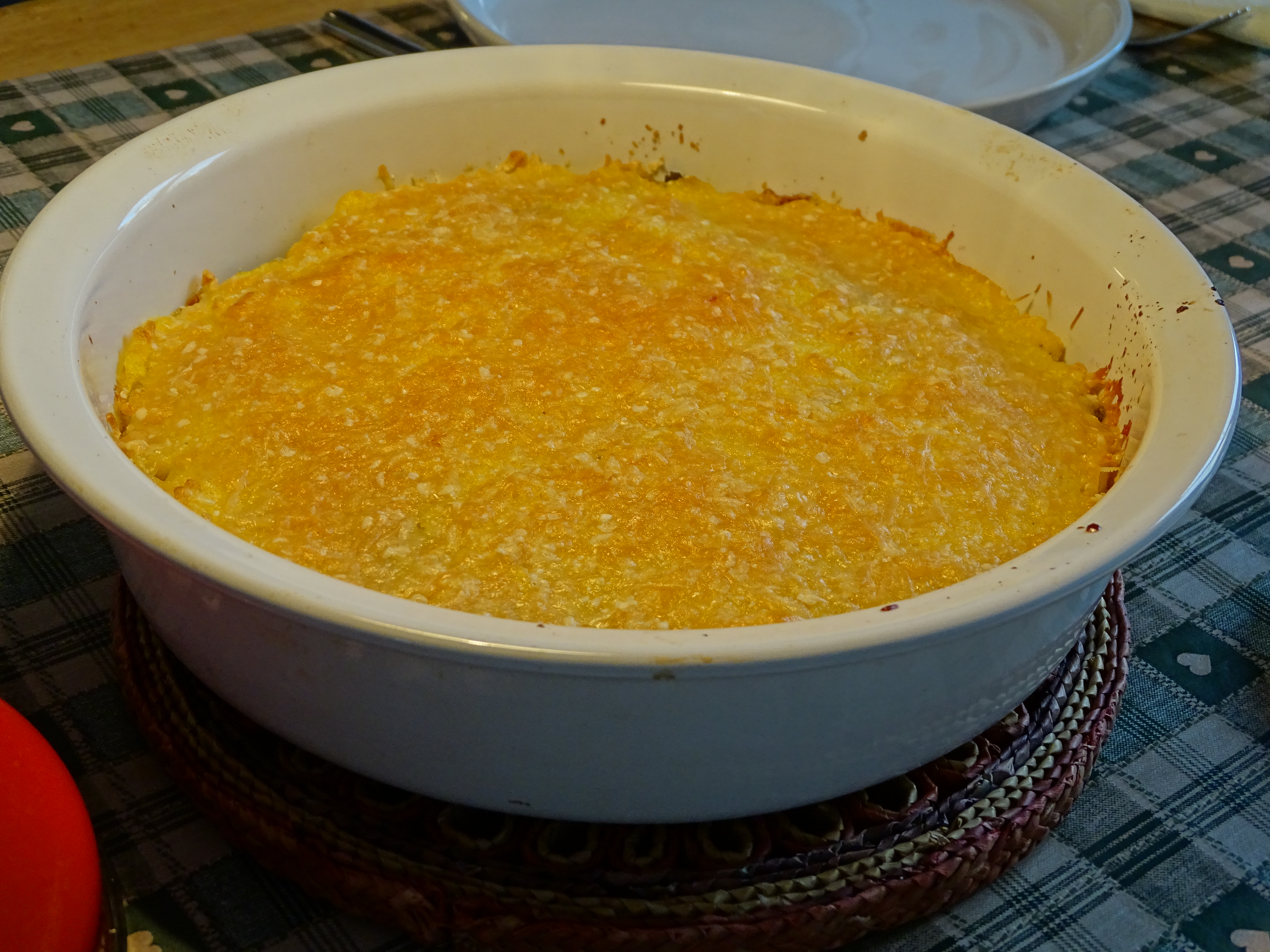
POLENTA COBBLER

Your allies: 

(all measurements are approximate, see https://scribedoll.com/2023/01/15/new-blog-feasts-fancies/)

❧ Polenta

❧ Pinto beans

❧ One or two bay leaves

❧ Mushrooms

❧ Butter

❧ Sprout tops (or other cabbage greens)

❧ Grated parmesan

❧ Olive oil, salt, pepper

Soak the beans for at least 10 hours in plenty of cold water, then strain and rinse with fresh water. Put the beans into a large pan, cover generously with water, add salt and the bay leaves, and bring to boil.  Let boil briskly for twenty minutes or so, then turn down the heat slightly and let cook until ready.  At some point, add a little olive oil, to bring out the flavour of the beans.

Wash the mushrooms and slice off the bottom of the stalks. Fry in butter.  Once cooked, set aside.

Soak and wash the sprout tops, then steam them.  Sprout tops are tasty greens you can generally find only at small greengrocers rather than supermarkets – at least where we live.  In the absence of sprout tops, you can use shredded Savoy cabbage or chopped Brussels sprouts, or pretty much any other cruciferous vegetables, although personally I would advise against broccoli because they get mushy too easily. 

Oil a casserole or a deep baking dish.  Spoon in the beans, mushrooms and steamed sprout tops, either in layers, or all mixed together.  Add a little water from the boiled beans, just enough for a little sauce at the bottom of the dish.

Grate the parmesan.

Boil the water for the polenta, add a little salt.  Spoon the polenta in slowly, whisking gently as you go along to avoid lumps forming.  Keep stirring until it reaches the consistency of thick porridge.  Add a smidgeon of olive oil and a spare dusting of black pepper.

Making polenta is a hazardous activity and should come with a warning.  I guess there is a reason why in Northern Italy it is traditionally cooked in a cauldron, outdoors.  Apart from the smoke enhancing its flavour, you can stir the boiling maize with a long stick and stand far enough away so that while bubbling, the squirts of boiling polenta can’t reach you.  As I have a tiny kitchen, I watch the polenta very attentively, and as soon as I see a bubble forming on the surface, I quickly remove the pan from the heat and wait for it to calm down before I put it back on.  

When the desired consistency is achieved, mix the grated parmesan in with the polenta and spoon it in dollops on the vegetables in the casserole dish.  The mounds of polenta and parmesan don’t have to be identical.  Let them land the way they land, looking as if they don’t care.

Put in the oven and bake long enough for the top of the polenta to be a darker gold.

Serve.

Enjoy.

Posted in Feasts & Fancies | Tagged , , , , , , , , , | 19 Comments

Feasts & Fancies: Miscellaneous Potato Rösti

Back in the days when my metabolism could happily burn six meals a day and I indulged in a full English breakfast every Saturday at our local greasy spoon, I would always ask for an extra helping of hash browns.  In fact, hash browns were the main reason I ordered English breakfast, although I’ve recently discovered that they are a North American invention.  Had I been able to order a plateful of hash browns without the eggs, mushrooms, fried bread, etc. I would have done it.  

During a trip to Hamburg, I discovered something better: kartoffelpuffer.  I was strolling across a Christmas market by the Elbe river, hungry, cross at how difficult it is to be a vegetarian in Germany (at least Hamburg, in December 2008), when I came across a stall serving these fragrant, golden potato pancakes with a dollop of apple sauce.  I took my paper plate heaped with kartofelpuffer and a plastic fork to one of the metal bar tables overlooking the river, and dug in.  They were scrumptuous and, as far as I was concerned, vastly superior to hash browns.  Just as I was starting on the last pancake, a large, majestic seagull landed on the edge of my table, an eloquent look in its ice-coloured eyes.  Are you a German seagull or have you flown over from the Netherlands?  I wondered.  It stood there, not begging, just making its regal presence felt, the curved, red tip of its bill held high.  “Are you hungry?” I asked.  “Would you like half my kartoffelpuffer?” and proceeded to cut the pancake in two.  Then a thought whizzed through my mind and I stopped.  “Look, I’d gladly share my lunch with you,” I said.  “Only you’ll then go and tell all your family and friends, won’t you? Before I know it, it’s going to be a scene from Hitchcock’s The Birds.  You can just fly away at the first hint of trouble, but I’ll be stuck here, having to explain myself to the locals – and I don’t even speak German!”

The seagull cast me a cold glance.  

“I’m sorry, I hope you understand.  If it were just you and me here…” I said, hastily  wolfing down my remaining kartoffelpuffer with a side of remorse.

The seagull stood looking into the distance for a couple of minutes, as though my decision was of perfect indifference to it, then spread its huge wings and took off.  Fifteen years later, I am still impressed with this Hamburg seagull’s dignity and good manners.  It could easily have swiped the food off my plate, but it didn’t.  It just landed on the edge of my table, hinted, and took no for an answer.  No squawking, no attacking, no fishwife behaviour.  When I think of our Norfolk seagulls, diving to snatch fries from your fingers, sometimes flying off with your sandwich!

One of the first dishes I cooked Howard after we moved in together, was kartoffelpuffer, following a recipe I’d found online and had been enjoying for a number of years.  He looked at the dish I’d put on the table and his eyes moistened.  “They’re latkes,” he said, devouring them with glee.  “My mother used to make them! Oh, I haven’t had them for decades!”  

A man telling you that something you cook reminds him of his very happy childhood.  Irrestistible, right? I had no reason not to believe him, until I sampled the sublime latkes at Sacha Finkelsztajn’s delicatessen shop in Rue des Rosiers, in Paris.  Delicious and very more-ish – and very different from my own efforts.

The following is an evolved version of my understanding of kartoffelpuffer, my experience of latkes, with the addition of my own Mediterranean unbringing.  They’re not kartoffelpuffer, they’re not latkes.  So let’s call them

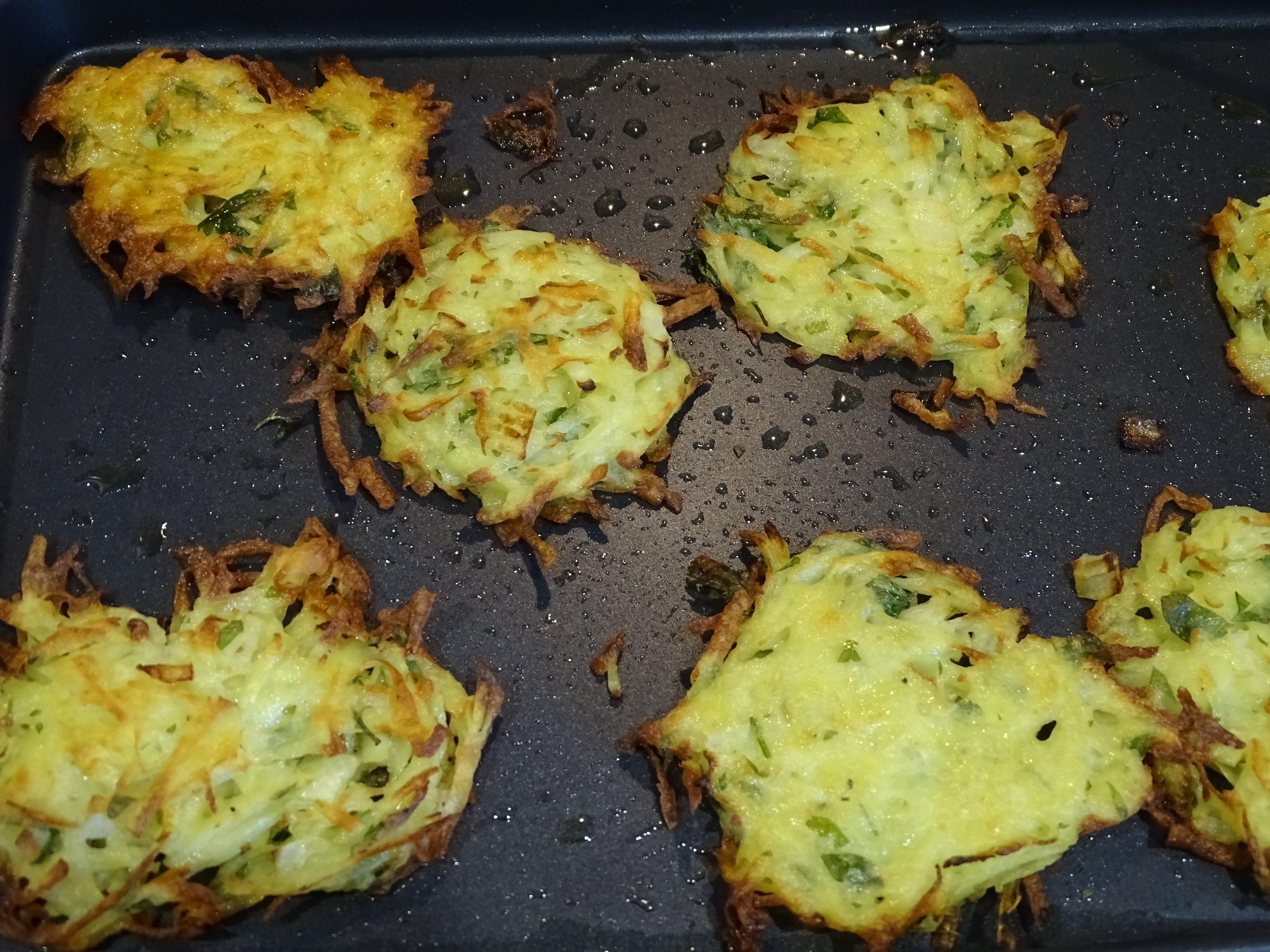
Miscellaneous Rösti

Your Allies:

Potatoes (about 1 kg)

Maize flour

2 eggs

1 small onion

Fresh flat parsley

Salt, pepper

Olive oil

❧ Wash and peel the potatoes, then grate them using the side with the large slots and put them in a large bowl where you have already beaten two eggs.

❧ Either grate (if your eyes can stand it) or chop the onion very finely and stir it into the mixture.

❧  Add salt, pepper and some finely (or not so finely) chopped or torn up parsley (previously washed, naturally), as well as a dash of olive oil.

❧ Stir everything.  You will notice the moisture from the raw potatoes form a pinkish liquid at the bottom of the bowl.  This is when you need to start adding a few tablespoons of maize flour.  Add as little or as much as you need for some of that liquid to be absorbed.  Many people suggest pouring it out, but I like keeping as much of it as I can.

❧  Pre-heat the oven to about 200 – 220ºC, and spread a generous amount of olive oil on the bottom of a baking sheet/ oven tray (or two, depending on how much potato mixture you have).

❧ Spoon dollops of potato mixture onto the tray and flatten them with the back of the spoon to form a kind of patty, leaving a little space between them.

❧ Put the tray(s) into the oven and bake until golden on one side, then turn over each patty.  The time your rösti take to brown depends on your oven, on how many patties you’re baking at once, and on how thick they are.

I tend to serve our rösti with a side of greens.  Last week, we had steamed curly kale with a knob of butter.

Kartoffelpuffer, latke and rösti are traditionally fried.  I choose to bake them for the simple reason that I am a keen but lazy cook with a full-time job as a translator.  Frying on the hob involves my standing over the cooker for over half an hour, with splatterings of  hot oil aiming at me, and I still need to keep the ready rösti warm in the oven until I’ve finished frying the last one.  Baking them in the oven all at once allows me to put my laptop on the kitchen table and do a little more work while the rösti are browning. 

Plain flour can be used instead of maize, and you can replace fresh parsley with oregano or basil or herbes de Provence.  I frequently do.

Posted in Feasts & Fancies | Tagged , , , , , , | 4 Comments

Link missing from previous post

My apologies to e-mail subscribers: there is a link missing in the previous post, FEASTS & FANCIES: THE MAGIC OF BREAD.

In the section:

Three-Seed Brown Bread

Your allies:

(all measurements are approximate, see here )

Here is the link:

 https://scribedoll.com/2023/01/15/new-blog-feasts-fancies/)

Posted in Uncategorized | Comments Off on Link missing from previous post

Feasts & Fancies: The Magic of Bread

If anything makes me believe in magic in the kitchen it is making bread.  The verb make is, of course, somewhat inappropriate in the context of magic, since you are not, alone, in control of the process.  As in any magic spell intended to come to fruition, you pick the right ingredients, set up the right circumstances, focus (focus softly: hard focus is too dense, impenetrable to imagination and, consequently, a magic-repellent) and let… the rest ensure it all turns out right. 

In the Chinese practice of QiGong, you achieve your greatest result by using 70% of your energy.  Push yourself to 100% and you have no reserves left for your next endeavour.  70% leaves room for elegance, which is a sibling of effortlessness and of grace, in every sense of the word.  70% allows you to focus softly, allowing inspiration to flow in.

Magic.  Mixing just some yeast, water and flour with a pinch of sugar, letting it rest for a couple of hours and returning to find the mixture swollen two- or threefold.  If that doesn’t give you a sense of magic, I don’t know what will.

Like so many other people, I learnt to bake bread during the first Lockdown.  I joined the scores of amateur bakers with enough time on their hands to post photos of their loaves on Facebook, then count the number of Likes.

Sourdough is still a spell beyond this apprentice’s skills.  My numerous starters have yet to start.  Perhaps, by the time this blog, Feasts & Fancies, is completed, a year from now, I will have graduated with a Pass grade in the art of sourdough baking.  In the meantime, I love working with fresh yeast (dried or fast-action never responds to me).

I bake our bread in what the British call, in deference to our French neighbours, a casserole, and North Americans a Dutch oven– a name I prefer.  A Dutch oven brings to mind tall, narrow houses mirrored in straight, narrow canals, and the crow-stepped gables of my beloved West Flanders.  I imagine a hearty stew made up of glossy, colourful vegetables being spooned out of a casserole, and the lid of a Dutch oven being lifted to release the bear-hug-like aroma of freshly baked bread.

Possibly because I always bake very small loaves, enough for one or two meals, in our large Dutch oven, or maybe because of a fault in my modus operandi, my bread tends to sprawl during baking, and often looks more like a focaccia than a loaf.  Still, Howard, my husband, says it tastes good.  And I like it, too.

Three-Seed Brown Bread

Your allies:

(all measurements are approximate, see https://scribedoll.com/2023/01/15/new-blog-feasts-fancies/)

● 300g wholemeal flour

● 250-300 ml tepid/lukewarm water

● a piece of brewer’s yeast

● one tablespoon date syrup

● a small handful of sunflower seeds

● a small handful of pumpkin seeds

● a third of a handful of caraway seeds

● salt

● extra-virgin olive oil 

In a large bowl, dissolve the yeast in the lukewarm water, with the date syrup.

Add the flour, a couple of tablespoonfuls at a time, whisking gently with a fork until you have a dough of the right consistency.  You’ll know when that is, and if you need to tweak the amount of flour or water.

Using a spatula, lift the dough from the sides of the bowl and flip it over a few times, creating a homogeous mass.  Leave it for 10-15 minutes, then do it again. Scrape it off the sides of the bowl, turn it, flip it, toy with it, tease it.  And once more.

Once the third game is over, it’s time for your dough to enjoy a good night’s rest: it has a feat to accomplish the next day.  I cover the bowl with a silicone lid and, if it’s winter, place it in the bedroom, where the heating is on and it’s nice and warm, overnight.  If it’s a very hot summer, the dough sleeps in the fridge.

With a little luck, by morning, the dough will be awake before you are, grown threefold, pushing against the lid, bubbling to burst out of the bowl, demanding your attention.

Prepare your work surface (I use a large wooden board), a small amount of flour so the dough doesn’t cling to your fingers too much, and the remaining ingredients.

Scoop the bread dough onto your work surface and start kneading it gently, incorporating the salt, seeds and olive oil, making sure these are distributed throughout the mixture as evenly as possible.  Stretch, fold, turn, massage, then form a ball and place it in the Dutch oven, lined with baking parchment.

Just like the human body after exercise, the dough must now be kept warm and not catch a chill.  I usually put the Dutch oven on the bed, wrapped in a woollen jumper or blanket, on top of a not-very-hot hot water bottle.  I live in England.  In warmer climes, this is not necessary.  In the summer, I stand the Dutch oven in a sunny part of the room.

After a couple of hours, the dough will usually have risen enough (twice its original bulk) for you to put it into a preheated oven at about 200ºC (180ºC if, like me, you have a fan oven) for about 20-30 minutes.  After that, remove the Dutch oven lid, turn up the heat by 20 or so degrees and let the bread become brown and crusty.  If, like me, you have used date syrup, don’t be surprised if the brown of your bread has a reddish glow about it.

Take the Dutch oven out of the oven, scoop the bread out with a long-handled spatula or wooden spoon and let it cool on a wire rack before you cut the first slice and perform the how-does-it-taste-with-butter test.  Inhale the reassuring aroma of your freshly baked bread.  Fill your lungs with its goodness. 

I like to give thanks after the first bite, reminding myself that this alchemical process was a team effort between me and all the ingredients.  I just find that it makes the bread taste even better.

Enjoy!  

Posted in Feasts & Fancies | Tagged , , , , , | 10 Comments

New Blog: Feasts & Fancies

No Scales or Measuring Jugs – Just Imagination and Senses

Welcome to my new blog, Feasts & Fancies and the first recipe. 

When I moved away from my family, to another country, I asked my grandmother to write down the recipes of my favourite dishes and cakes.  She bought an exercise book — grey with a cluster of multicoloured stripes running across it – for that very purpose, only I waited and waited, but the recipes weren’t coming.  “Wait, it’s not ready yet,” she kept saying.  On one of my visits, I saw her writing in the exercise book, then tearing out the page almost immediately.  “No, that’s not quite right,” she muttered to herself.  The loose cover led me to suspect this wasn’t the first page she had torn out.  

“If you carry on like that, I’ll never get my recipe book,” I said.  She gave me a look of barely perceptible frustration.

When, at long last, my grandmother gave me the exercise book, the cover was a little frayed and only half the remaining pages had been filled with her neat handwriting.  I thanked her, took a look, and didn’t open the exercise book again for three decades.  Her recipes were no use to me: they contained hardly any measures of weight or volume.

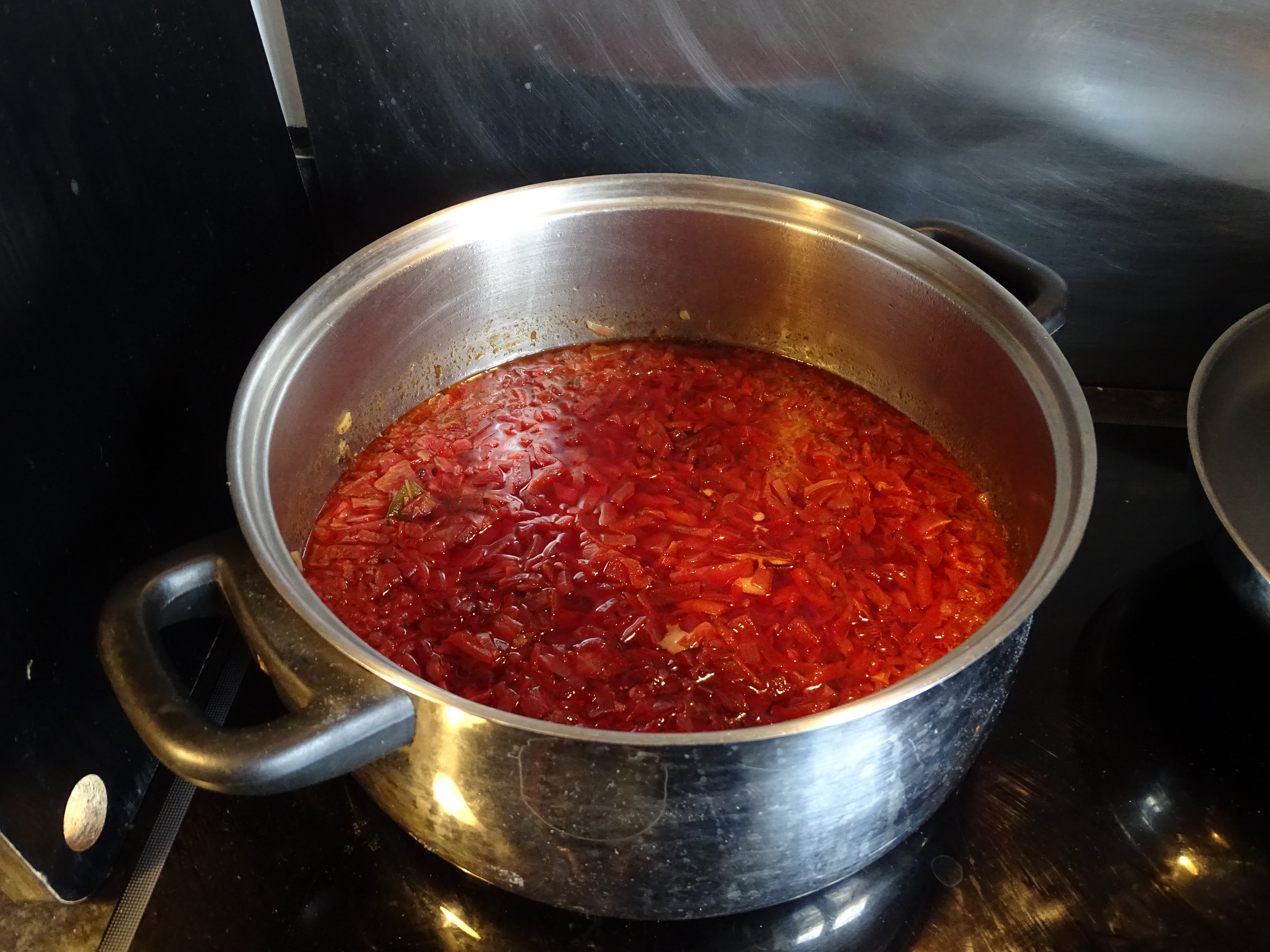
Cooking had always been a bone of contention between us.  Her voice would call from the kitchen. “Katia, I’m making borscht [or kalach or Salade Olivier].  Come and watch, so you can learn.”

“I can’t.  I’m doing my homework.” 

Sometimes, when unable to provide the unarguable excuse of homework, I would drag myself to the kitchen and stand fidgeting, forcing myself to watch my grandmother slicing, chopping or stirring and listen to her explanations.  But then some beautiful piece of music would catch my attention and I would turn up the radio dial, or our dog would stroll in for some company and I would start playing with him, or else I’d be rescued by a ringing phone.

Yekaterina Gregorián (1911-2012)

My maternal grandmother, a Russian-bred Armenian from Rostov-on-the-Don, was a superlative cook, and any friend who came for a meal would eagerly accept a second and third helping of her food.  My mother, on the other hand, was an enemy of all household chores, cooking first and foremost.  When I was growing up, she could produce all of four dishes: lettuce salad, tomato salad (she did not believe in mixing the two), artichokes a la romana and steak, my absolute bête noire

I will never forget my mother’s daily steak during the fortnight my grandmother spent in hospital because of a ruptured hernia, when I was about six years old. 

“Katia, eat your steak.  It’s getting cold.”

“I can’t swallow it – it comes back up.”

“Nonsense.  You’re not leaving the table until you’ve eaten everything on your plate.  You’ll sit here all day, if need be.”

After a couple of days, Snoopy, our gentle English Setter cross, came to my aid.  He learnt to sit very still under the table and quietly wolf down the chunks of meat I would spit, unchewed, into my napkin before placing the said napkin back on my lap.

In her later years, my mother became a vegetarian, and so added pasta sauce, roast potatoes and two or three other dishes to her repertoire, although raw salad (which included uncooked grated potato) was always one of her favourites.  

I prided myself on being my mother’s daughter.  In my first week away from home as a self-catering student, I dined on grilled apple halves filled with Cheddar cheese.  In my late twenties and married to my future ex-husband, I produced some very respectable dishes from recipes copied to the letter without the slightest deviation.  

In my forties, I learnt to cook.  Using imagination and instinct in preference to scales and measuring jugs.  Trusting my senses.  Trusting the vegetables, the fruits, the grains, the herbs.

A few months ago, when I opened my grandmother’s grey exercise book with the cluster of multicoloured stripes running across the cover, I suddenly understood her frustration at having to squeeze her intuitive cooking into exact grammes and centilitres, her inability to explain her creativity in cups and centigrades.  She tore out the pages because the recipes she recorded were not true to the reality of her cuisine.

With age, I have become more and more my grandmother’s granddaughter in the kitchen.  When friends ask me for the recipe of something they’ve enjoyed eating at my table, I, too, hum and haw, struggling to provide exact instructions.  “It’s a handful of this,” I say apologetically, “and a small fistful of that – but if you prefer you could use that as a substitute for this and add another thing instead.”

All that is a roundabout way of saying that most measurements in Feasts & Fancies will be approximate.  These posts and the recipes included in them are intended for spontaneous, intuitive, fun-loving cooks.  If you cannot trust your intuition in the kitchen, where can you trust it? I will provide no oven temperature settings because I wouldn’t dream of assuming that your oven and my oven have the same personality.  Only you know your oven and its quirks.  I will not tell you how many apples to use in a cake or how many spoonfuls of cinnamon powder to add to the mixture.  No two apples are exactly the same size, or have exactly the same degree of sweetness.  It is up to you to consult your palate and decide how much sugar it craves on that particular day.  Or how much salt it fancies.  No two snowflakes are the same, and neither are two vegetables, two pieces of fruit, or two eggs.  No two dishes will turn out identical, even if you use the same recipe twice.  And that’s part of the fun.

I hope you enjoy Feasts & Fancies, and that it inspires you to take joy in cooking if you don’t already.

I dedicate this blog to the memory of my grandmother, Yekaterina Gregorián.  Wherever she is, I hope she watches me cook – and smiles.

Unpasteurised Brie* Tartiflette

Your assistants:

Potatoes

Unpasteurised Brie*

A bunch of fresh basil (washed in cold water)

Extra-virgin olive oil

Salt & pepper

When my potatoes are organic, from a trusted greengrocer, and the skins are smooth and glossy, I scrub them thoroughly under the tap, but don’t peel them.  

Place a large pan of salted water to boil, while you cut the potatoes into slightly thick, even slices.  Once the water starts bubbling, remove it from the heat and carefully ease the sliced potatoes into the hot water with a long-handled spoon.  Once they’re all in, place the pan back on the ring and turn down the heat.  The bubbling must be gentle, playful, like a giggle, not a volcanic eruption.  How long should the potatoes cook for? Well, as long as it takes for you to stick a fork in easily but without the flesh crumbling.  Once that’s achieved, drain the potatoes, taking care not to break them – so don’t go shaking the pan.  This may be a good time to preheat your oven and set it to a moderately high heat.

With a perforated spoon (to make sure the excess water drains), place each potato slice in an oven-proof dish previously drizzled with olive oil.  How you arrange the potatoes is entirely a matter of personal preference.  You can line them in rows, wind them in a spiral, form them into a flower, or however you please, depending on the size and shape of your oven-proof dish.  A generous drizzle of olive oil on top, then slide the potatoes into the oven and wait for the edges to brown.

Meanwhile, cut the Brie into thick slices, not forgetting to put one piece into your mouth – a cook’s efforts deserve a downpayment.

 Then, tear up the basil leaves into large strips.  Some people cut herbs with a knife.  I find metal too hard and cold against the delicate leaves, so I use my hands, and the bright, joyous aroma of basil rubs off on my fingers.  

Once the potatoes have got a golden crust on them, take them out of the oven and scatter the shredded basil over them, then distribute the slices of Brie, making sure most of the potato and basil surface is covered.  Uncovered basil is likely to turn black in the heat.    On some days, I add a very, very light dusting of freshly-ground black pepper.   

And now everything goes into the oven… for as long as it takes for the Brie to melt and perhaps turn golden.

This is the stage when H., my husband, starts loitering in the kitchen, asking when the food will be ready.  And it soon is.

I usually serve my tartiflettes with a side of stewed spinach, or some steamed green kale, or cooked red cabbage.

* I prefer unpasteurised Brie, but please check if you can tolerate unpasteurised dairy produce and note that it is generally not advised during pregnancy.

Posted in Feasts & Fancies | Tagged , , , , , | 25 Comments