An Apology for the Grey Squirrel

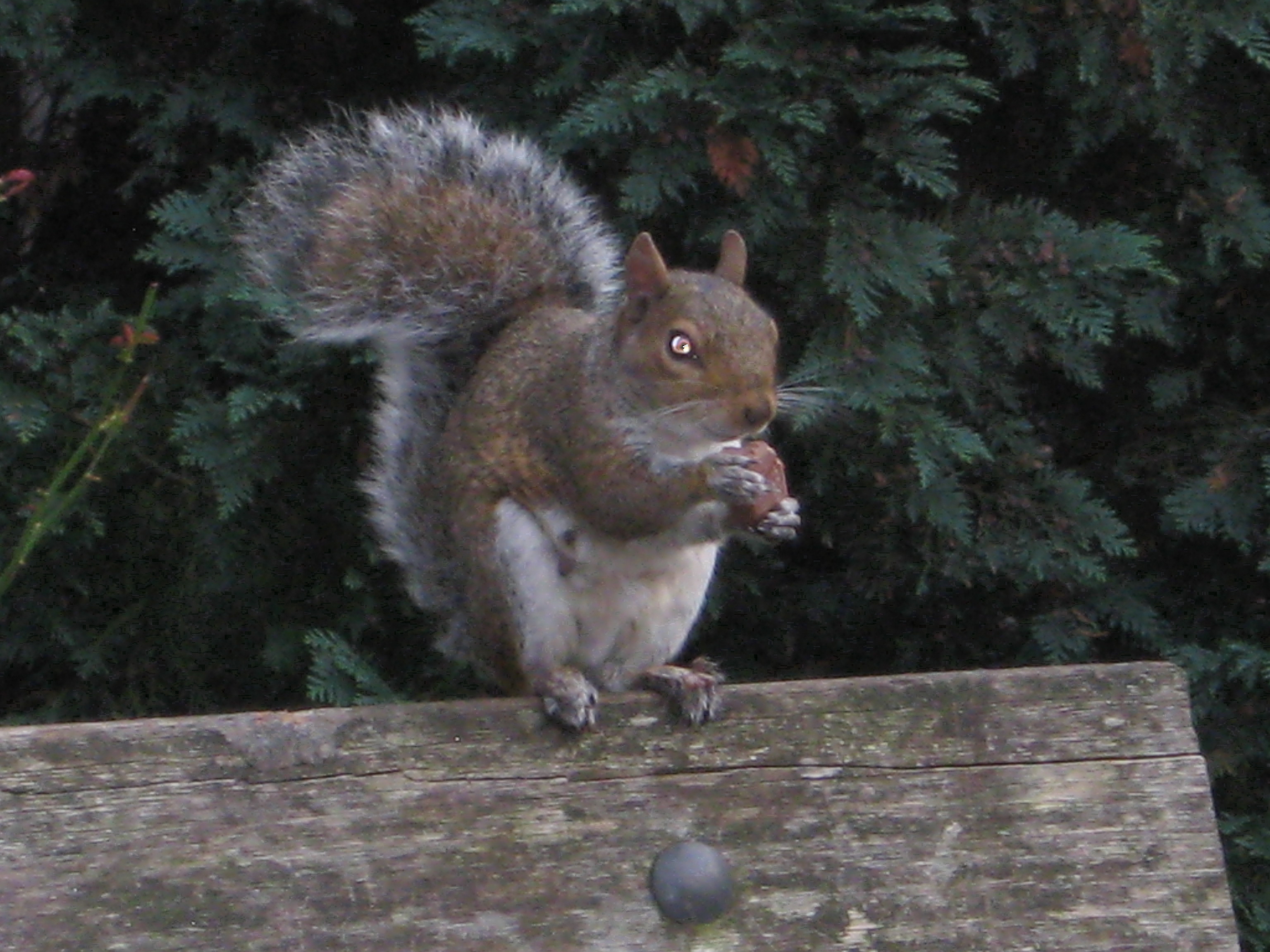
Cobnuts – Yum! Yum!

“Tree rats”, “rats with bushy tails”, “pests’, “vermin”.


First of all, what is wrong with rats? I can feel my question sending ripples of disgust among you.  “Eek!”, “Yuck!” Your lips are twisted in revulsion.  Rats are dirty – you say – the live in sewers and run along polluted river banks, and spread disease.  I reply – rats could not thrive without human dirt and disease.  And who is responsible for those? Humans, who generate more detritus than any other creature on the planet.  As for being “pests”, I have come across several many humans whom I could accurately describe as such, but no animals.


In England, the grey squirrel is viewed as Public Enemy No. 1.  Express affection for grey squirrels, and you are answered with a contemptuous narrowing of the eyes and rebuked for loving the criminals responsible for the demise of the native red squirrels.  One vital fact is omitted.  North American squirrels did not fly nor swim en masse across the Atlantic.  They were purposefully introduced here in the 19th Century… By humans (and once again, the tune from Dukas’s Sorcerer’s Apprentice rings in my ears).


Hello!

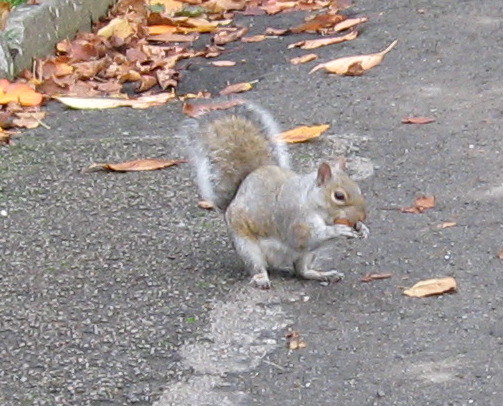
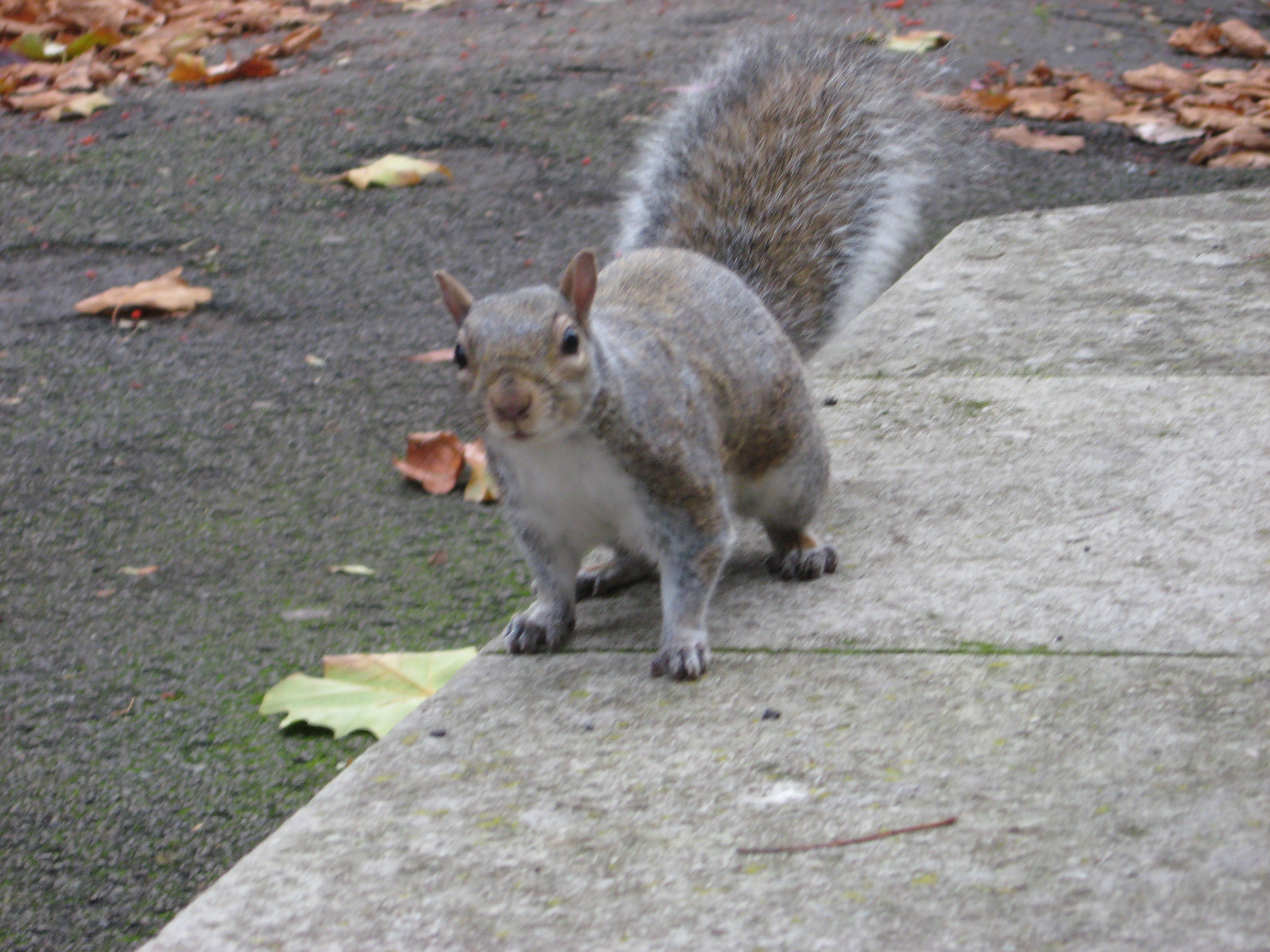
I love grey squirrels.  Moreover, I admire them.  Granted – they can be spiteful but carry out their revenge on you with a great deal of charm.  They knock down your bird feeder or pee on your windowsill (generally as a reprisal for your failing in your duty to provide food), and always linger to watch your reaction with an invariable expression of irresistible cuteness.  The grey squirrel does not take no for an answer.  Once it is fiercely determined to appropriate your box of corn flakes, then you might as well stand aside and watch the creature drag the cardboard box along the kitchen table, and heave it onto the windowsill (I speak from personal experience).  Now that‘s focus.


I first became acquainted with squirrels when I lived in Cambridge, about twenty years ago.  They were regular visitors at our sloped-ceilinged attic flat in Cranmer Road, which they reached by climbing up the drain pipe before running up onto the roof.  If the windows were locked, they tapped on the glass pane to request admittance, and waited with intermittent – somewhat impatient – flicks of the tail.  After a few weeks, I learnt to tell them apart by their markings, size and battle scars, and gave them names.  Ariel, Lysander, Desdemona (she had weepy eyes), Tybalt (he always got into scrapes), and Ginger (a pale carrot albino).  Occasionally, they would chase each-other up and down the living room curtains, at which point I would chase them out.


How can you fail to have affection and admiration for a creature so agile, so manipulative (that takes intelligence), so wilful, so tenacious, and so resourceful?  The grey squirrel is the Scapin, the Figaro, the Truffaldino and the Gianni Schicchi of the animal world – and we are conquered by the latter ones’ charm and audacity.


At the end of Puccini’s only comic opera, Gianni Schicchi addresses the audience.  He tells us that his cheating made Dante consign him to Hell.  If, however, we have enjoyed the performance, he asks us to provide him with mitigating circumstances… By giving him a round of applause.


And so the grey squirrel stands up on its hind legs and lifts a paw to its chest.  Me – a criminal? It seems to say, and stares at us with black, liquid eyes that glisten with innocent intensity.  Let us find mitigating circumstances for its cheekiness, and reward it with a nut or two.

Actually, who wants nuts when you can have Swiss chocolate!


© Scribe Doll

Posted in Animals | Tagged , , , , , , , , | 4 Comments

Words and Civilisation: English – the Fast Food Burger of the Language World

English is a democratic language.  Vox populi, vox linguae.  As soon as 51% of people say something in a particular way, then it becomes correct.

Incorrect English usage.  Now there is a minefield.  Do not even venture there.  “Incorrect” implies that there is such a thing as “correct”, and what is “correct”? Who are you to decide what is and is not correct? On whose authority? And here you find yourself in the firing line.

French has the famous Académie Française.  Italy, the renowned Accademia della Crusca.  Other languages, including Spanish, Portuguese, Japanese, Hungarian, Polish, German, Arabic, Greek, Russian, Korean and Turkish, have equivalent academic bodies who act as custodians of language as a regulated, monitored and supervised form of expression.  They have someone who takes on the responsibility of separating the right from the wrong in grammar, spelling and usage.  It is even a position that invites respect.

In England, imposing rules on the language would be instantly considered as undemocratic and an attempt to restrict personal freedom and human rights.  You may have been taught that the singular possessive form takes apostrophe, s (as in Tom’s car) but it would be dictatorial and intolerant of you to impose that view on others, who may choose to use apostrophe, s, to illustrate the plural of a noun (as in fish and chip’s, frequently seen listed on the menu blackboards of our beloved pubs).

English is a living, ever-evolving language, and the general belief is, that constricting it within rules would stifle its progress.  English is not a carefully pruned rose; it is the free and unruly, miscellaneous plant that takes over the garden.

English is currently the most useful and the most functional language in the world.  It is readily available and easy to grab – like a fast food burger.  You can have it with any combination of prepositions.  So what, if you get them mixed up? Nobody will look down on you, or even correct you – that would go against your human rights, apparently.  English is freedom.

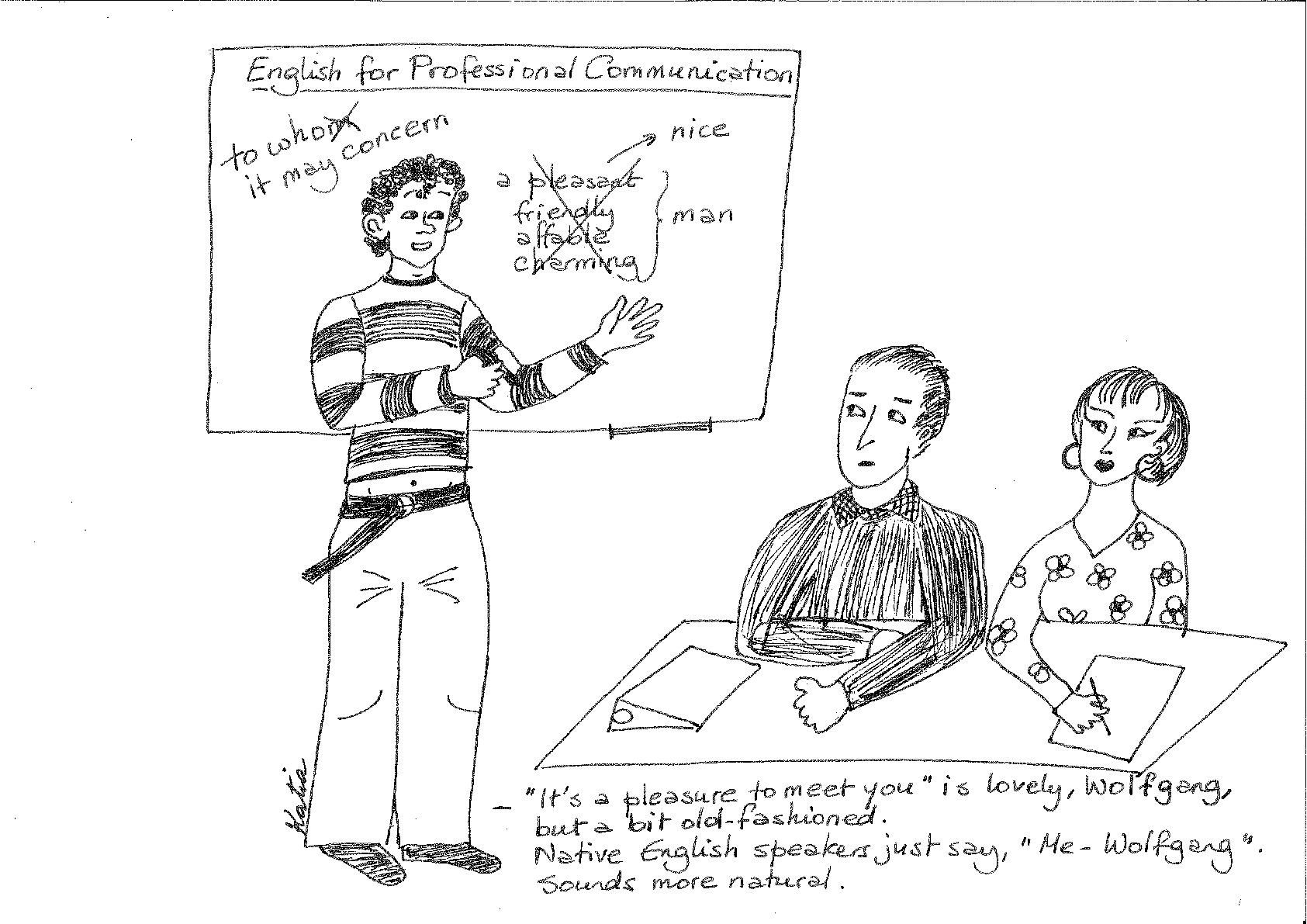
English is communication.  Why strain your brain learning half a dozen synonyms, when a single word does the trick? The adjective ‘nice’ is a wondrous, multi-purpose, one-size-fits-all, adjective.  Nice person, nice food, nice weather, nice house, nice music, nice clothes.  Thanks to the supersonic evolution of English, ‘nice’ has outgrown its original 14th Century meaning – stupid.  Why burden yourself with vermillion, crimson, scarlet, burgundy and terracotta, when plain old red will do.  Why bother with an elaborate dish  when you can just fill the hole in your tummy with a cheeseburger? You do not need to spin words like a filigree pattern of silver to get your message across.  Let us go back to basics, and adopt a grass roots approach to communication.  The Ape-Man coined it perfectly.  “Me – Tarzan.  You – Jane.”  And communication was established.

Sakru Haluk Akalin – Head of the Turkish Language Institute – said, “The limits of your language are the limits of your world.”

I would add, that our language tells the world who we are.  So let’s show them.

© Scribe Doll

Posted in Words and Civilisation | Tagged , , , , , , , | 11 Comments

Odds & Ends: Autumn


It is one of my favourite days of the year.  The day the clocks finally go back to a user-friendly time, as far as I am concerned.  My reward for the annual body shock I am submitted to by the Enlightened Authorities whenever Summer Time kicks in.  The welcome opportunity of having an extra hour’s sleep and yet waking up not regretting that one has already wasted precious free time in bed.  The official acknowledgement that autumn is in full swing.  Keep your baby pastel spring blossoms, and your strident summer sun.  Give me the deep, warm colours of autumn.  The paths of my local park are a carpet of burnt sienna, ochre and crimson.  Conkers smooth and shiny as swirls of chestnut marble are carried off by grey squirrels bounding among tufts of dark green grass.  Holly bushes carry scarlet berries that will be gone before Christmas.  As you stroll, leaves of soft gold drift down towards you, swaying on invisible wings.  The light has warm gold in it.  It does not attack with demands.  It caresses your brow with the understanding of experience.  It is mature enough to know how to temper summer passion.  Autumn feelings run as deep as its hues.  Spring is in your face.  Summer bullies all who are not its gang.  Autumn requires a fine ear, a keen eye and finely tuned senses to be enjoyed.  For as long as I can remember, autumn has been for me the mark of new beginnings.  New academic years, new hopes, new projects.  There would be no spring rebirth, if autumn did not sing its soft lullaby before the winter nap.


Wear bright colours and short sleeves, and everyone will remark, “You look so summery!”  The compliment is implied.  I am going to a friend’s show.  I will wear doeskin brown, with a shawl of fir green, terracotta, crimson, Titian and gold.  I do not anticipate anyone commenting on my elegant “autumnal” dress.


*   *   *


Our Government is, once again, airing the suggestion that we should not bring the clocks back at the end of October, but keep them on Summer Time then, come late March, add an extra hour for the Daylight Saving scheme.  They are proposing a three-year trial.  Trial.  That is what they call an imposed change that is brought on softly, softly, till the monkey is caught.  Like the act of generosity that brought down our VAT from 17.5% to 15%.  Once the period of indulgence was over, VAT did not return to its original 17.5% but rose up to the current 20%.  Give with one hand.  Remove with the other.  The Government is explaining that the United Kingdom’s clocks should align with Europe’s.  How touching that the British Government should suddenly wish to turn its back on the casual, convenience-based relationship with the European Union, by proposing to join it in holy matrimony.


As usual, we are told that changing to permanent Summer Time is for own good; like everything else our recent governments have brought in.  Apparently, having longer dark winter mornings but then longer light evenings would cut the number of road accidents, boost tourism, and reduce energy use.  Do they assume that sleepy people getting up two or three hours before dawn (and that is in the South of the island alone) will brush their teeth and have breakfast without turning on the lights, then have quick reflexes while driving to work?  I know it is somewhat depressing to walk out of your workplace when it is already night time but how does that compare to the overwhelming feeling of wrongness and physical self-violence when getting up in the dark, and arriving at work when it is still dark? As for saving energy, could we start by turning off the lights, outside working hours, in the City offices, shops and department stores? Could we ban overhead heaters outside cafés and restaurants?


If any health issues arise from this change, will university medical departments begin to spend millions on researching the culprit and finally blame a previously undiscovered virus? Will there be a naming ceremony for a new syndrome? Will pharmaceutical companies concoct a new drug?


I am still trying to follow the argument which states that bringing the clocks forward will boost tourism.


Nights have never put anyone off socialising or partying.  Getting up to go to work in the pitch black – now that is inhuman.


In the meantime, a happy All Hallows’ Eve to you all.

© Scribe Doll

Posted in Odds & Ends | Tagged , , , , , , , , | 1 Comment

Odds & Ends: Rabbit Rights

New York, January 2001.

‘I am looking for ear muffs,’ I told the sales assistant at Macy’s.

The girl lead me down the cluttered aisles of the department store, past the jewellery and the glove section, to a stand covered in small plastic boxes.  ‘Here they are, Ma’am’, she said helpfully.

I was getting quite excited by the prospect of my imminent purchase.  When I had first arrived in the city, a month earlier, everyone was wearing ear muffs – men, women, children and policemen.  They came in all colours and fabrics.  Pink fluffy ones, white plush ones, brown furry ones and a plain black style for men.  All designed to protect New Yorkers’ ears from the icy  wind.  At first, true to my European dress sense, I had turned my nose up at them.  A month later, ‘flu-ridden and feverish, I embarked on a search for ear muffs to comfort my sore ears.


I began opening the boxes, one after the other, handling the soft furry pads.  I tried a pair on.  An unpleasant sensation suddenly came over me.  I took off the ear muffs and smelt them.  There was a definite, animal scent.  I looked at the label, to discover they were made of real fur.  I replaced them on the stand and fought my way through the January sale crowds, out onto Fifth Avenue.


I decided to try Saks.  I marched down the glittering aisles that were still decorated in festive tinsel, up to the display of ear muffs but – alas – no muffs there.  I went in search of a sales assistant.  She tried to look interested.  ‘We don’t have any left, Ma’am.  It’s the end of the season.  We’re selling  off all our winter stock because we’re bringing in our spring collection next week.’

‘Spring?!’ I gasped, ‘It’s January!’


The sales assistant looked at me tolerantly.  ‘Try Macy’s’, she suggested.

‘I’ve just been there’, I replied.

‘Then perhaps try Bergdorf and Goodman’, she continued, obviously humouring me.


Once again, out into Fifth Avenue, at -7 Celsius.  I watched with envy all those cosy muffs on the ears of warmly wrapped New Yorkers.  I rubbed my own reddened earlobes with my woollen gloves.  How was it possible that in the world capital of designer ear muffs, I couldn’t find a pair for myself?


I caught sight of the imposing front entrance to Tiffany & Co. and crossed over to the other side of the street.  Bergdorf and Goodman was untainted by the sales crowds.  There were subtle indications that many of their prices were discounted but no large, bright signs hanging overhead like in the other stores.  I stood up straight and put on a vaguely bored expression  that suggested I had seen all that luxury before – that in fact, I had been born to it.  With that casual manner, I approached a sales assistant, ‘Good morning.  I don’t suppose you have any ear muffs left, do you?’


She responded accordingly.  ‘Certainly, Ma’am.  This way, please’.

Success! My ears were already feeling warmer.  I followed the girl down the glittering aisles, past well-to-do ladies in fur coats and diamonds.  The air was filled with a blend of expensive perfume and leather.  She stepped behind a counter, pulled out a drawer and handed me – lo, and behold – a pair of rich brown ear muffs.  Light as a feather.  Voluptuously soft.  I tried them on.  I felt my ears wriggle with pleasure.  My hand could not stop stroking the muffs.  I decided there and then, that on warm winter days, I would carry them in my pocket where I could fondle them any time I needed comforting –


‘Original mink, down to $85’, said the sales assistant.

I handed the offending item back to her.

‘I’m sorry’, I said, ‘do you have any wool… or synthetic ones?’

All right, I should not have said synthetic.

‘No, Ma’am’, replied the sales assistant, a glint of contempt in her eye.

‘Do you know where I can buy some?’ I persevered.

‘No, Ma’am’, the sales assistant’s eyes were beginning to glaze over.  ‘Perhaps try Macy’s or Saks’.

‘I’ve already been there’, I insisted and began explaining that it was not the $85 that were an issue – after all you expected to pay $85 for a pair of ear muffs (!) – the problem was the mink.  It was a matter of principle.  I came from London, and in London, it was considered a small crime against fashion to own ear muffs but  a capital offence against political correctness to be seen wearing real fur ones.  I expressed a hope that the sales assistant understood my predicament.  She blatantly did not.  ‘Try Bloomingdale’s’, she said.  I strolled out of Bergdorf and Goodman’s wearing my best disdainful face.


Out on Fifth Avenue again, I felt cold and disappointed.  I had to resign myself to my ears freezing.  I was hungry and my feet were sore from all the walking.  I did not see much point in trekking over to Bloomingdale’s.  The staff there was bound to be animal-unfriendly, like the rest of New York.  I ventured there, nevertheless.


Once again, I was being walked down crowded aisles with too many glaring lights glaring in too many mirrors, to a polished wooden counter covered with round, plastic boxes.  All were inscribed with ‘Bloomingdale’s’ in Art Deco style gold lettering and contained dark coloured muffs.  Green, purple, grey.  Irritable from hunger, I opened a box and pulled a pair of brown ones, held together by a black velvet Alice band.  They were soft and cosy on the ears.  I examined the label and saw the word ‘rabbit’.  I was going to cast them aside when I noticed another word – ‘sheared’.  The ear muffs were made of sheared rabbit.  I felt a sudden hope rise.  I attracted the attention of the sales assistant.  She looked up helpfully.  ‘Excuse me’, I said, ‘these ear muffs are made from sheared rabbit, right?’  She replied affirmatively.  I continued, ‘Is that the same system as shearing a sheep?’

‘Yes, that’s right’.

I needed one more piece of information to convince me.  ‘So they don’t kill the rabbit?’

‘No, he’s just a bit cold, afterwards’.

I could have hugged the sales assistant.  ‘I’ll buy these.  How much are they?’

‘$20, please’.

I pulled out the banknote with a sense of deep satisfaction.  I asked the girl to cut off the label and wore the ear muffs there and then.  I walked out of the store, forgetting that I was hungry, and decided to take a triumphant stroll down Fifth Avenue to celebrate.  My ears were deeply content.  And the bunny – albeit naked – lived on.

©Scribe Doll
Posted in Animals, Odds & Ends | Tagged , , , , , , , , , | Comments Off on Odds & Ends: Rabbit Rights

Pet Hates: The Menace of Contagion

I am meeting two female friends for an after work drink at the Windsor Castle Pub.  I give one the socially compulsory kiss on the cheek.  I turn to the other but she takes a step back.  “I have a cold,” she says.

Lady A promptly sidesteps away from her.  Lady B notices.  “Yes, do keep your distance.  I don’t want you to catch it.”

“Rubbish,” I say, and kiss her, anyway.  “Besides,” I add, “I don’t go pinching other people’s colds.  Mine are all bespoke.”

I am blasé about the contagiousness of colds and ‘flu.  I am comfortable with my unscientific belief that it’s all a barrowful of nonsense.  To this belief, I add the philosophy that, should I be wrong, and these viruses are eager to pounce on me at the first opportunity, then precautions are a waste of effort.  They could just as easily leap on me on the Tube, in a restaurant, or at the newsagent.


Lady A and Lady B, far from appreciating my mark of steadfast friendship, eye me with suspicion.  They would clearly label me as mad, if doing so would not make them a little mad by association.  Perhaps they harbour the fear of catching my madness, if they come too close.


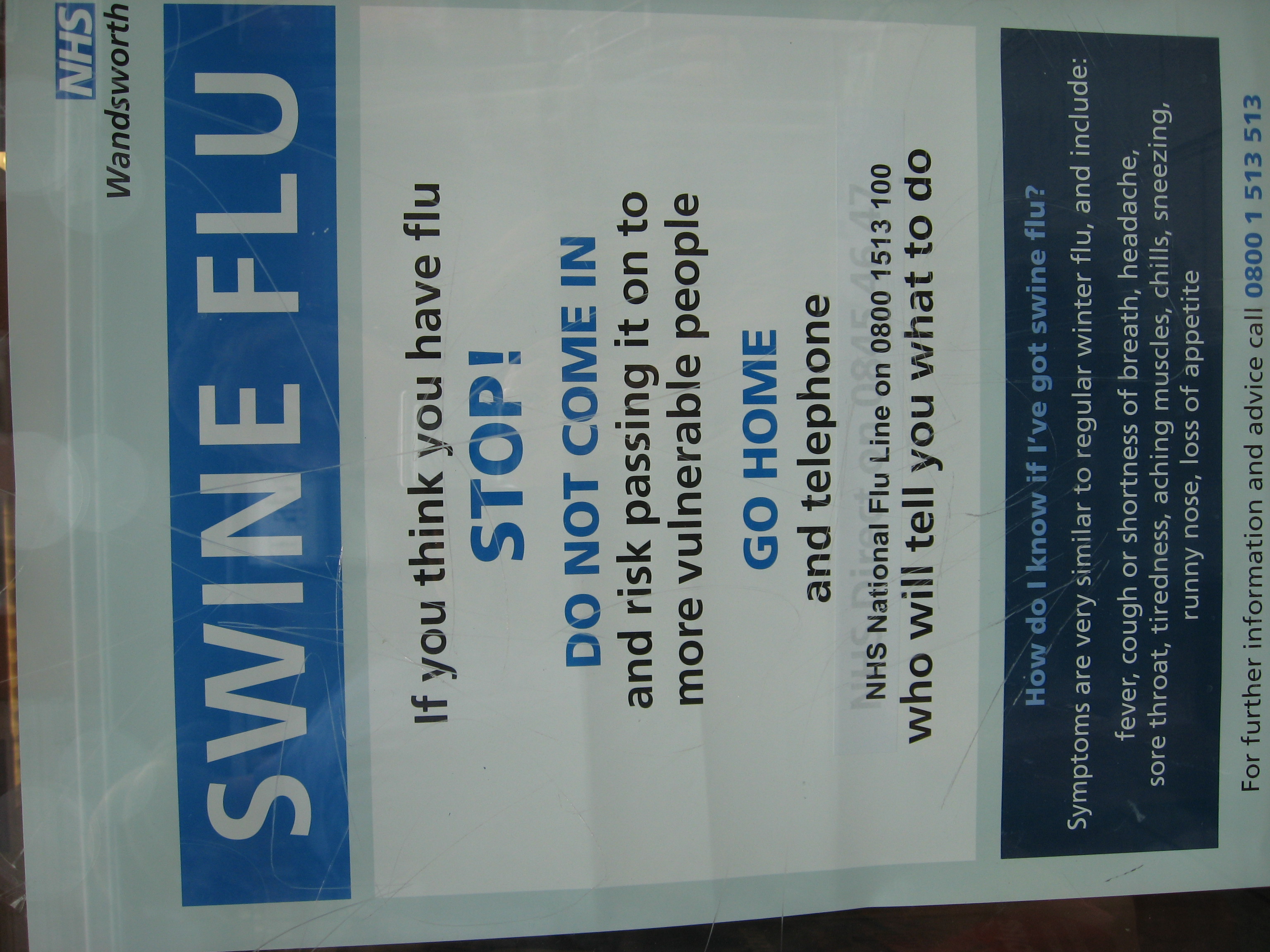
A couple of years ago, when swine ‘flu turned out to be yet another failed threat that half the world’s population would be wiped out (now wouldn’t that have been handy for those who pull the strings of the world economy), there was a large poster displayed in the window of my local Boots the Chemist:


The doctors surgery down the road carried a similar sign.  In other terms, if you are ill, do not go to a doctor or a pharmacy.


With the Government’s cuts to the National Health Service, perhaps small bells should be issued to British residents.  This way, anyone suffering from a cold or ‘flu, would be required by law to ring the bell when circulating in public places, so that non affected people can keep away.  Like lepers did, in the Middle Ages.


A few years ago, a friend of mine was hospitalised with pneumonia.  She was kept in isolation, apparently highly contagious.  Before allowing me in, the nurse made sure I smeared antibacterial gel on my hands.  Then she instructed me to wear a curious outfit of cellophane, composed of an apron, cap, gloves and a beak shaped mask (not unlike the one worn by the Plague Doctor in the Commedia dell’Arte).  This level of precaution made me wonder what care they must take at the School of Tropical Medicine.  Thus accoutred, I entered my friend’s room.  She lifted her head from the pillow and peered.  “Who’s that?” she asked.

I pulled the elasticated mask away from my face for a moment, to reveal my identity.


A few minutes later, the doctor arrived, wearing no protective gear whatsoever.  When I voiced my surprise in my Dalek voice behind my mask, she said.  “I’m not worried,” she said, sitting down on my friend’s bed.  “She’d have to cough into your mouth for you to catch anything.”

I promptly removed the cellophane off me, and rammed it into the nearest bin.


It seems to my medically uneducated mind, that the more antibiotics, antibacterial and antiseptic substances we use to fight germs and viruses, the stronger and more invincible the critters are likely to become.  Like the New York cockroaches that grew large to spite DDT.  Whatever happened to building up our immune system? Would it not be more beneficial, long term, to strengthen our antibodies rather than waste energy on devising various plots against bugs? Perhaps a shift in focus should be considered here.


Again, it seems obvious to my limited intellect, that if everything was as infectious as our health illuminati want us to believe, there would be a lot more dead doctors and nurses lying on hospital corridor floors.  In fact, who would want to study medicine at all?


It’s mid October, and the posters are warning us against the impending arrival of  the ‘flu.


I wonder if they have the flight arrival details.


©Scribe Doll

Posted in Pet Hates | Tagged , , , , , , , | 6 Comments

Pet Hates: Sticking Things Out

When you’re struggling with a situation, do your friends tell you to “stick it out”?


Stick it out.  You’ll be glad you did.


How do they know that? Do they have 20/20 vision into the future?


Stick it out.  Friends tell you that when you hate your home, when you detest your job, when you are in an unhappy relationship, when you are going out of your mind studying on a course you simply do not understand.  They said it to me when I was homesick, feverish, jobless and broke in South East Asia, a few years ago, and wanted to come back home.  Quitting is always frowned upon as an irredeemable sign of weakness.  If you quit, then you are spineless.  Stick things out, and you will rise in everyone’s estimation – never mind your standing there all bandaged up and bruised while they give you a congratulatory tap on the back… Before turning their attention to something totally unrelated.


At this point, let me establish the usual caveat.  Of course, the importance of sticking things out cannot be questioned if our actions have a direct bearing on others who may be dependent on us.  I am not, here, supporting the  right to pursue one’s own happiness to the detriment of others.  However, neither is it my right to judge those who do.  I do not know what is in their hearts and minds, nor what private demons might make them unable to cope with their circumstances, and drive them to escape, breaking things and people on their way out.  Moreover, there are undoubtedly cases where sticking things out is important to an individual for his or her own personal reasons, which I respect.


What I am querying here, is the necessity to stick things out for the sake of it – for no reason other than the unquestioned conviction that you simply do not quit.  Instead, let us question that conviction – and drag it off its plinth.


That is right.  You have guessed it.  I am a Quitter.  My CV resembles the multicoloured diamond pattern on Arlecchino’s costume. Would be employers stare at my CV during interviews and ask if I have itchy feet.  I quote Dolly Levi, and tell them if you have to live hand to mouth, you might as well be ambidextrous.  Depending on whether you like me or not, you could describe me  as one with the ability to reinvent myself, or as flaky.  The difference lies merely in the spin.  I am a Jack at many trades – but master at none.  Just call me Figaro.


Joking aside, most of my career fluctuations were thrust upon me, rather than actively chosen by me.  Circumstances change because of politics, economics or geography and, sometimes, you just have to acquire a new skill to keep body and soul together.  However, I admit, I have walked out of a few situations – professional, personal and geographical when I have felt that neither they nor I were ever going to change and live in harmony.  That was my choice.


You have got yourself into a mess.  You realise you have made a mistake.  That in itself is a blessing – a gift.  If you cannot find, or there simply is no way out, then you grin and bear it.  You stick it out.  However, if you do have that rare luxury of choice, then why not just honour that freedom of choice and walk away? Do you not owe it to all those people who do not share your luck? People who, for various reasons either are not aware of being in the wrong place or – worse – are aware of it but are unable to quit and start anew? Stick it out? Why? To prove to people around you that you are constant? Strong? Reliable? Or to show solidarity for their own fear of change? Rolling stone gathers no moss, that is true.  But it certainly becomes polished and smooth in the process of rolling.


You start reading a novel you do not enjoy.  Do you read it till the end, on principle, or do you abandon it after a few pages, thus avoiding wasting more time on it? (Only in the past couple of years have I learnt to permit myself not to finish a book.)  If you go to the theatre or the cinema and do not like the play or film, do you leave during the interval (or during a scene change, if you are sitting near the exit), or do you feel you might as well see the end? If you order a dish in a restaurant and realise you hate the taste after a couple of mouthfuls, do you leave the rest, or do you say to yourself, “I’ve paid for it, so I might as well eat it”? The money is already spent.  Why add insult to injury by eating the stuff?


Errare humanum est.  Everyone knows the first part of the adage.  However, how many people remember the full version?

Errare humanum est, perseverare diabolicum.  To err is human, but to continue erring is devilish.


©Scribe Doll

Posted in Pet Hates | Tagged , , , , , , | 4 Comments

Words and Civilisation: Really. Really! Really?

Really is a word we  really use really a lot.  Really.  In fact, every few sentences, really.  I am not really sure why.   Now, really! There is no need to get uppity about this.  It’s really just a case of trying to understand the reason for the popularity of this really annoying word.  Because, actually, in most cases, you should really use ‘very’, instead.  Is it really necessary constantly to assure our listeners that we are really truthful about everything we say? Has there really ever been any suggestion that we are lying? Similarly, when we are told something extraordinary, we automatically retort, “Really?” Do we really expect the other person to reply, “No.  Not really”? One of my ex-bosses – a headmaster of Eton meets retired colonel, type – used to voice his disapproval (and lack of ability to provide a quick enough response to the situation) by uttering, in a thunderous tone, “Really!” in the hope that the staff would shudder and quake.

We also use this word as an opinion softener.  For example:

“Do you like marzipan?”

“Not really.”  Why not just say “No”? In this case really provides a form of apology for giving a negative response.

Other examples of really uses:

As a moderator of advice:

“You really  shouldn’t do this.”

As emphasis:

“I really don’t know.”

“She is really nice.” (As opposed to ‘un-really’ nice?)

There is a myth going around that there are more words in English than in any other European language.  We really ought to dispel it.

Or live up to it, really.

Or perhaps the Coalition could tax it.  Really!


©Scribe Doll


Posted in Words and Civilisation | Tagged , , , , | 1 Comment

Double Standards: Smoking

As those of you who are UK based will have heard, there has been a discussion in the media, over the past week, on whether films showing scenes of people smoking should be given a Certificate 18.  On one particular report I watched, on the BBC, a film critic was saying that it was not the film industry’s job to educate teenagers.  The doctor on the other end of the couch was vehement that films with cigarette smoking scenes were influential in teenagers taking up smoking.  So, once again, Matthew Hopkins is off on a witch hunting spree.


Interestingly, only about sixty years ago, the medical profession, with trust-inspiring consistency, not only took part in cigarette commercials, but was known to recommend smoking for weight loss, and as being beneficial for your throat and voice.  Some of you may have seen the superb film, The King’s Speech, in which the future George VI is told by doctors that smoking will ease his stammer.


No.  I am not, nor have I ever been a smoker.  No.  I am not advocating smoking.  Personally, I find it unpleasant to inhale the acrid, clawing smell of ready packaged cigarettes – especially when I am eating.  It makes sense even to my medically untrained mind, that breathing in smoke laced with ammonia, cadmium, mercury and arsenic must, surely, be harmful to one’s health.  I just feel that, for the sake of fairness and a sense of proportion, smokers should not be alone in being submitted to public persecution.


I understand that pollution levels in London frequently reach higher levels than those permitted by the EU legislation.  I am sure we would welcome a campaign by the powers that speak out on behalf our health, to reduce these levels.  Just blow your nose after a ride on the Tube, and you will see.


When I was nineteen, a doctor examined an x-ray of my lungs, frowned, and told me to stop smoking.  I did not smoke.  I just lived in a city.


You will argue that we cannot do without cars or the Tube.  Fair enough.  But, on a polluted Earth where the price of fuel is constantly rising, and fossil fuel reserves shrinking, what exactly is the value of car and motorbike racing? I have never heard anyone pose the question.


We are told that teenagers are encouraged to smoke if they see actors on the screen light up a cigarette.  I will not argue with that because, in all honesty, I do not know if that is true or not.  Let us assume it is so.  In that case, why is nobody concerned about teenagers watching people drink numerous pints of beer, have a casual sex without a single thought, and inflict extreme violence on one another? Why is no one outraged by the misogynist attitudes in James Bond films? Why is no one concerned about exploring the possible influence of superficial, brainless, shoe-obsessed female characters i TV series on our teenage girls?


Could we get a sense of proportion over here, please? And, while we are at it, a helping of common sense?


See BBC report on http://www.bbc.co.uk/news/health-14971560


See doctors advertising Camels on http://www.youtube.com/watch?v=gCMzjJjuxQI

© Scribe Doll

Posted in Double Standards | Tagged , , , , , , | 4 Comments

Odds & Ends: The Dumb Innocent and the Wise Enchantress

My grandmother brought me up on fairy tales.  Every evening, as daylight faded and silhouettes grew blurred, my mind’s eye would open up to the world of magic.  Talking animals would trot into our living room, princesses with stars on their foreheads and moon crescents in their hair would sit beside me, and the firebird would light up the room while trying to steal a golden apple from our fruit bowl.


I learnt to use fairy tales as a bartering tool at dinner time.  I would eat on condition that I was told a story.  Soon enough, the power balance shifted in my grandmother’s favour.  I would hear the end of the story only after I had wiped the plate clean.


Like most five year-old girls, I longed to be a fairy tale heroine – but not Sleeping Beauty, Cinderella or Snow White.  Their fates made me nervous.  After all, who would want to be so entirely dependent on a prince? What if he forgot to kiss you? What if he did not have the nous to match your foot with the ermine slipper? You could be stuck waiting for ever.  At least, as a Russian or Arabic heroine, rescuing the prince was your prerogative, so you could make sure you did the job of finding yourself a husband properly.  So there it was, the comfort zone of the control freak.


The contrast between Eastern and Western fairy tale heroines is particularly noteworthy where the relationship with magic is concerned.  Who casts spells in Western tales? Old, asexual fairies and young, evil witches.  In the East, the young heroines are alluring and spellbinding.


A recurring character in Russian fairy tales is Vassilissa the Wise.  We are told that her beauty is such, that no fairy story can narrate it nor pen describe it.  She is the daughter of the most powerful wizard of them all, and he teaches her everything he knows.  However, when she surpasses him, he casts her out with a curse upon her head.  It is Vassilissa who rescues, counsels and ultimately seduces the Prince.  As he sits with his face in his hands, hopeless in the face of impending trials, Vassilissa urges him to go to bed and sleep, because “the morning is wiser than the evening”.  Once he falls asleep, she summons all the fairy folk at her service, and goes to work on the problem.  When the Prince wakes up, she presents him with the solution.


The Tales of a Thousand and One Nights are also full of  stunning, resourceful women.


The role of the Western heroine is to be beautiful, kind and, above all, innocent… Sometimes to the point of blatant stupidity.  How can Rapunzel fail to feel the difference between a frail crone and a strapping young man climbing up her hair? Little Red Riding Hood is obtuse to the point of risibility.  Cinderella is a rag doll pushed around by a wicked stepmother, prodded forth by a fairy godmother, and finally picked up by a prince.  At no point in the story does she take a decision.  As for Sleeping Beauty, she cannot even wake herself up without a man’s help.


What kind of message is being given here to little girls? There is nothing you can do except be pretty and wait…


This is a complex subject worth exploring in a PhD thesis.  I cannot do it justice in a blog.  However, I would like to end with a perfect example which illustrates the contrast between Eastern and Western femininity.  Blue Beard  and Sheherazade.


Both stories share the selfsame premise.  A young woman marries a serial killer, and fights for her survival.  In Blue Beard the (nameless) heroine unlocks a closet she has expressly been forbidden to open, and stumbles on the bodies of dead wives.  When Blue Beard discovers her, he decides to kill her on the spot.  Whilst pretending to say her final prayers, the young woman shrieks for help and calls for her brothers.  They finally arrive and slay Blue Beard.  End of story.


In Tales of a Thousand and One Nights, Sheherazade marries a king who kills a new bride every morning.  To save herself – and put an end to the senseless murders – Sheherazade devises a ruse.  On the morning of her execution, she begs the King to grant her permission to tell one last tale to her sister.  He agrees, and stays to listen.  Hence, she starts weaving a story within a story, unravelling tales of travel, love and magic, night after night after night.  On the morning of the thousand and second day, she kneels before the King, ready to die.  However, after all this time, the King has learnt to love his wife, and value her wisdom.  Not only is Sheherazade spared but her love, her patience and her intelligence turn a brutal murderer into a just and much loved king.


I know which heroine is the best role model for me.  How about you?

© Scribe Doll

Posted in Odds & Ends | Tagged , , , , , , , , , | 8 Comments

Double Standards: The Ravens in the Tower

I took one of my students to the Tower of London, last Friday.  I confess that, in the seventeen years I have lived in London, I had never been there.  Well, at least not in daytime.  I was not looking forward to seeing any of the historical evidence of human cruelty.  The sight of the Crown jewels’ sparkle left me cold.  It is no match to the opulence of the Vatican Museum, and the finery of the higher echelons of poverty-vowing churchmen.  I was amused by the sign, at the entrance, that we were about the enter the most secure room in England.  I would have assumed that to be somewhere in the MI5 building.  However, I was very excited by the prospect of seeing the famous ravens.  A friend of my local corvine neighbourhood, I could not wait to catch a glimpse of their famed cousins.  I had heard something about their wings being clipped to stop them from flying away but nothing had prepared me for the overwhelming feeling of sadness I was to experience.


These magnificent birds, glossy black, with knowing eyes, walk with a sideways gait, as though their body weight is unevenly distributed.  When they try to fly, they are thrown off balance, and practically topple back down.  It reminded me of a poem by Charles Baudelaire, where the sailors on a ship entertain themselves by catching an albatross* and putting him down on the deck.  The bird’s wings are too large, and his legs too short.  Once on the ground, this symbol of the high-flying poet cannot soar back into the sky but dawdles ungracefully, mocked by the vulgar, ignorant creatures who have imprisoned him.  If the albatross represents the free-spirited poet, then the highly intelligent raven – with its Arthurian associations with magic – must stand for wisdom, and the knowledge of truths ancient and mostly forgotten.   I guess with the general wilful dumbing down of this country by a string of fear-mongering and increasingly brainwashing governments, there is something disturbing in the symbolism here.  The ravens in the Tower carry the distinct mark of the cut in their wings.  Like a surgery scar denting their backs.  Their movements are consequently awkward, ridiculous, heartbreaking.  Birds decreed not to fly, by humans.  Like a handicap to keep too much intelligence and free thought in check.


A jovial Beefeater told me that two ravens managed to escape.  (“Good on them!” was my reaction.)  When one of them was found, he was emaciated.  Bred in captivity, these birds cannot fend for themselves in the wild.  I hated the implication that, consequently, it was jolly kind of humans to care for the ravens, feed them meat and eggs, and even cod liver oil and vitamins.  There was not even the shadow of a sense of guilt for having actively and purposefully rendered these creatures so helpless in the first place.  I do not want to hear that they are bred especially for the Tower,  that they are treated like royalty, that they are well cared for, that they feel special, that they are happy.  That they are well fed and looked after, I have no doubt.  That they are happy? Happy animals do not try to escape.  If they were happy, they would come in hoards.  Their wings would not have to be clipped.


And for what? According to a legend no one can actually source, if the ravens were to desert the Tower, then the Crown would fall.  It should warm the heart of all the loyal subjects in the Land, that ours is a monarchy so strong, its future depends on seven resident black birds.  Does keeping them by force not go against the philosophy of fair play the English are so proud to endorse? Does it not constitute – tut-tut, dare I say the word – cheating? And, in the 21st Century, is it just not plainly absurd?


I am not about to launch into a pro-Republican argument.  I have nothing against the Royal Family.  Their pastel figures do not trigger strong emotions of any kind in me (though their fashion sense does make me cringe, and wish some of our taxes could go towards the fees of a Parisian or Milanese couturier).  As for the Monarchy, I am not naive enough to believe that its demise would bring liberty, equality, fraternity – or an equal distribution of wealth among the people.  History has shown that revolutions often go from “two legs good, four legs better” to the inevitable “four legs good, two legs better”, and crowned tyrants are often replaced by uniformed oppressors or manipulators in suits.


I would just feel prouder to belong to a country that treats animals with kindness and respect.  That includes foxes, bear cubs, badgers and ravens.  Producing vegetarian cheese and vegetarian beef-flavoured crisps is not enough.


Gandhi phrases it perfectly: “The greatness of a nation and its moral progress can be judged by the way its animals are treated.”

© Scribe Doll

* Read the poem in the original French or in English translations on http://fleursdumal.org/poem/200

Posted in Animals, Half-English Observations | Tagged , , , , , , | 11 Comments