Theatre Review: While the Sun Shines

It is a crying shame that this production is on for only a week, or I would go and see it again.

Terence Rattigan’s 1943 comedy is a farce involving the usual premise of mistaken identity and romantic complications, but there is nothing usual about the plot twists and ‘coups de theâtre’. Just when you think you know where the story is taking you, a surprise awaits you. This is not a run-of-the-mill…

Please continue reading this review on Remote Goat.

Posted in Reviews | Tagged , , , , , | 2 Comments

Odds & Ends: My Adventures in Twitter

Beginnings:

I signed up to Twitter a few days before Christmas.  It seemed like a low-maintenance way of promoting my writing electronically.

As usual, I needed someone to show me.  Not that the instructions were complicated – on the contrary.  I am just the sort of person whose mental learning pattern responds better to a physically present human being.  That, surprisingly, turned into a friendship test.  Just about everyone I turned to eluded me with, “Oh, yes, I’m on Twitter but I really don’t know what I’m doing”, even though they clearly were a few steps ahead of me.  Until I asked my young friend Mark.  He started his response to me with, “I’m really not an expert” but ended it with the magic words “but I’m happy to show you what I know.”  Hurray for Mark, my first Twitter follower.  So, after a crash course in a West End Starbucks, I flung myself onto the Twitter scene, which felt like walking into a moonless night filled with anonymous barks.  I began contributing my own.  Woof! Woof! Woof! Listen to me! Read me! Me! Me! Me!

My initial impression (altered since) was that part of the deal was to keep up a rhythmic, peremptory bark, whilst doggedly ignoring the others.  So, after a few days, I got bored with the incessant din and logged off.  About a month later, BBC Radio 4 aired a piece about crows, which I had recorded just before Christmas.  Within seconds of the broadcast, my friend Sue rang me.  “They’re tweeting about your crows!” she said.  “What do you mean you’re bored with Twitter?! Get on it now!”

So I logged on again and, a few hours later, collected a respectable number of followers.  Now that people were barking back, this was becoming fun.  Eventually, I worked it out.  Like any other social microcosm, the Twitter “community” has its pecking order, its unspoken rules, its club code, and its players.  It was simply a question of building my own little structure within the overall edifice.

Etiquette

Retweets

I thank for retweets and I like being thanked for retweeting someone.  Every thank you induces me to retweet more.  It is like a nod or wave to the driver who slows down to let you cross the road.  Small courtesy, but it oils the social interaction machinery.

Plugs/Positive Mentions

I think it is kind and polite to mention/plug someone who regularly mentions/plugs you.

Returning the Compliment

A learned friend of mine, who entered the world of Twitter at around the same time as I did, but quickly became an expert on the subject, tends to follow back his followers.  He says it is simple courtesy.  I quickly discovered that not everyone shares his two-way street gentlemanly attitude.  That is where the pecking order element comes in.  Generally, famous people follow other famous people.  We are welcome to follow them but that must be satisfaction enough, for they will seldom follow us.  They are not aware that we, their admirers, low beneath their feet, are what supports them above the icky mud and makes up the blocks of the pyramid atop which they stand.

Having said that, I – in my relatively inconsequential state – find that I do not follow all my followers, either (all right, I never said I never indulge in the odd double-standards episode.)   However, my case is different (yeah, right) – no, but honestly – hear me out.  The truth, is that I actually read all the tweets on my timeline.  Therefore, I need to limit my number of “followees”, to keep the number of tweets manageable.   For what it is worth, if you are reading this and know that I am one of your followers, then you can be sure I read your tweets (and I might well be reading them, even though I do not officially follow you!)

The People I Choose to Follow

So how do I decide whom to follow?

– People I know personally (but that one must work on a strictly mutual following basis.)

– People who tweet information that interests me (links to articles, blogs I enjoy reading, etc.)

– People whose tweets I find entertaining, funny, instructive (tweets that tell me only that the sender is off to walk his/her dog, that he/she is stuck in a traffic jam, or what he/she is  having for supper fail to engage me, unless phrased with wit.)

Because I am a cautious kind of gal, whenever someone starts following me, I check out their last twenty or so tweets, to see if they appeal to me.  Sometimes, I monitor them for a few days.  Then, once I decide to follow, I try not un-follow… Though I do not promise everlasting loyalty, either.  I also see the average of daily tweets they emit.  However interesting someone’s tweets may be, you can have too much of a good thing, and when I scroll down and see a string of tweets from the same person, I am afraid my heart sinks and my attention drifts.

Twitter Vocabulary

Let us agree on this:

Tweeter (not Twit nor Tweeterer nor Twitterer): person who uses Twitter

To tweet (not twitter)to send tweets

Myths

I learnt this the hard way.  Just because someone follows you does not, sadly, mean that they click on all the links you tweet.

Twitter and I – Now

Contrary to advice, I do not chase after hoards of people to follow in the hope that half that number might follow me back.  I am far too lazy.  I am content with the number of people I follow and whose tweets I read.  And I am equally content with having a relatively small number of followers (by Twitter standards).  I live in hope that they, too, read my tweets.  I particularly enjoy the odd Twitter dialogue or exchange I get with individual Tweeters.  Who said you cannot have human contact electronically? Who said you cannot be supportive of people you have never physically met?

Scribe Doll

Posted in Odds & Ends | Tagged , , , , , | 6 Comments

Odds & Ends: Showbiz Party*

The Scene: a bar

Props: nibbles and alcoholic drinks (white wine with a soupçon of ammonia, red wine with a bouquet of vinaigre, or champagne à la bicarbonate) .

Sound Effects: Near hysterical laughter and raised, sometimes high-pitched voices with very pronounced inflection, expressing the following:

– Surprise: “I didn’t know you were coming!” (they really did invite everyone)

– Exaggerated compliments: “You look positively Chekovian in that dress!” (i.e. “like an unfashionable peasant”)

– Off the scale, extreme emotions: “I adore your script!” or “That show was absolutely awful.  I simply lost the will to live.”

– Disproportionate joy outbursts: “I was over the moon when I found a seat on the Northern Line.”

– Over the top terms of endearment: “You’re an angel!” or “I could just eat him up, he’s such a poppet.”

– Begging: “I told my agent, you’re the best director I’ve ever worked with.”

– Lying: “Dah’ling, I’m absolutely thrilled you got that part.”

– Practising actor’s sport: “My agent is totally useless!”

Special Effects:

– Regular 360º head rotations to scan the room for useful people.

– Blank, dummy stares if you are nobody.

– The submarine viewfinder: impressive upwards stretching of the neck to twice its natural length, to raise the head just above everyone else’s, aimed at scanning the room for important people.

– The air kiss: a form of thespian greeting, consisting of pressing your cheek against another person’s, and pursing your lips forward, to kiss the air (“Mwah!” sound optional).

The bar is crowded with actors, directors, agents, casting directors and writers performing the above.

Enter a reasonably well-known female actor (TV credits) with a flourish, slight pause (just in case the room wants to applaud).  Eyes sweep the room in semi-circular movement just above other people’s head level (Hello, Dah’lings! It’s me!) using submarine viewfinder technique.  Panic  freezes face at not seeing anyone she knows.  Recognises someone in the crowd, immediately darts towards them like to a life-saving anchor, expressing unadulterated rapture and giving an air kiss.

Writer in search of agent walks up to Agent.  Smiles.

Writer: “Hello, how nice to see you! How are you?”

Agent: “Very busy. (submarine viewfinder effect) I’m just looking for someone.” (Propels himself through the crowd, away from Writer.)

Struggling Actor sees Successful Actor.

Struggling Actor: “I absolutely loved you at the National, last week.”

Successful Actor: “Oh, thank you very much.  That’s very kind.” (Assesses usefulness of stranger.)

Struggling Actor: “I’m an actor.”

Successful Actor: “Oh, right.” (360º head rotation).

Struggling Actor: “I was in that new adaptation of  The Illiad, in a great little space above a pub – a great show with energy and grit.”

Successful Actor (dummy stare): “Mmm… (Swallows the rest of the wine in the glass) Great.” (Floats away at full speed).

Up-and-Coming-Actor (character role in West End), represented since drama school by Caring & Nurturing Associates, in conversation with Agent-With-Carpeted-West-End-Office.

Agent-With-Carpeted-West-End-Office (taking a gulp of wine, wincing): “I saw you in the show, last Thursday.  I thought you really stood out.”

Up-and-Coming Actor: “Really?”

Agent-With-Carpeted-West-End-Office: “You’ve definitely got something there.  You know – that special quality.”

Up-and-Coming Actor: “You really think so?”

Agent-With-Carpeted-West-End-Office (looking vague): “Who are you with?”

Up-and-Coming Actor: “Caring & Nurturing Associates.”

Agent-With-Carpeted-West-End-Office: “Who? Never heard of them.” (frowns)

Up-and-Coming Actor (face crumples): “Well, I’ve been with them since I left drama school…”

Agent-With-Carpeted-West-End-Office: “Have you been seen for The Hottest Ticket in Town? You’d be perfect for it.”

Up-and-Coming Actor: “No.  When are they casting?”

Agent-With-Carpeted-West-End-Office: “Very soon.  I’m surprised you haven’t been seen.” (hands business card and walks away)

Starting out Playwright walks up to Flavour of the Month Playwright.

Starting out Playwright: “Congratulations on the Award.”

Flavour of the Month Playwright: “Thank you.”

Starting out Playwright: “I also write plays.”

Flavour of the Month Playwright (blank)

Starting out Playwright: “I also write a blog.”

Flavour of the Month Playwright (blank)

Starting out Playwright: “Well, it’s lovely to meet you.”

Flavour of the Month Playwright (blank)

Starting out Playwright: “Bye.”

Flavour of the Month Playwright (nods).

Casting Director and Agent standing together.

Agent: “How many actors does it take to change a lightbulb?”

Casting Director: “Depends on the motivation and character development of the lightbulb.”

(Actor overhears and approaches)

Actor: “Wait a minute – does Equity have an agreement for changing lightbulbs?”

* All characters appearing in this work are fictitious. Any resemblance to real persons, living or dead, is purely coincidental.

©Scribe Doll

Posted in Odds & Ends | Tagged , , , , , , , , | 8 Comments

Odds & Ends: Diamond Jubilee

All right, so I’m a spoilsport.

I had planned to spend today hiding in my flat, and catching the River Pageant on the television news.  I just have never been a fan of crowded, public celebrations of anything.  I still carry the trauma of a New Year’s Eve spent on Waterloo Bridge, a few years ago.

I successfully parried most of my friends’ attempts to lure me to Pageant-watching-picnics by the river, or Pageant-on-TV-screen with a pint, in a pub.  The last friend, however, ambushed me with a weapon against which I had no defence.  It was her birthday, and she wanted to be a part of the national celebrations.  She told me there had not been such an event since Queen Elizabeth I.  That there would be 1,000 boats on the river.  So she dragged me, mentally kicking and screaming, to the bank of the Thames, just by Blackfriars Bridge.  Knowing I was on the brink of bolting any minute, she had come armed with a rucksack full of ammunition in the form of cheddar biscuits – in case I complained I was hungry, a soft cashmere scarf – in case  I complained (as I did) that I was cold, a bottle of water – in case I complained I was thirsty, and so forth.  True to my spirit of un-cooperation, I showed up in a short-sleeved T-shirt under a tweed jacket and a cotton scarf with flowers and peacocks on it, which was more for decoration than warmth.  Still, as a token of self-preservation, I did take along a golf umbrella.

In for a penny, in for a pound.  I tried to look forward to the event.  A flotilla of 1,000 boats.  I pictured a colourful painting by Canaletto, and thought of grandiose music by the Gabrielis.  Perhaps there would be ancient ships, with gilt decks and candid sails tied to timber masts.  I imagined the Queen wearing the crown Imperial, clad in scarlet velvet and ermine.  I imagined, bugles, bagpipes, Handel’s Music for the Royal Fireworks, Elgar and Walton played with gusto, flowers tossed from the boats, floating on the Thames like a waving carpet, drum rolls, church bells peeling.  I imagined pomp, circumstance, magnificence, solemnity, majesty.  I imagined something awesome.

We could not see the river at all, all the prime viewing spots being occupied by people who had got out of bed at the crack of dawn.  There were large television screens lined up at regular intervals.  As we approached one, the volume was so high, I rammed my fingers into my ears, and contemplated escape on hearing health grounds, but my friend merely led me further away from it with patience and unwavering determination.  The sky was grey and the air chilly and humid.  At least, I told myself, it was not raining.  There was a friendly, jovial atmosphere in the crowd.  Union Jack flags on plastic sticks were waving from people’s hands, were stuck in people’s hats, and emerged from people’s rucksacks.  Union Jack hearts were painted on people’s cheeks.  Union Jack bags, towels, mats, T-shirts.  In front of us, a dog wore a Union Jack coat and tried to chew his mistress’s Union Jack flag.

The Queen wore a white outfit.  No regalia.  There were boats carrying musicians but I could not hear them against the noise of police helicopters and TV screens.  I was surprised by the relatively low-key style of the event.  I kept waiting to feel the thrill of a sense of occasion, but it never quite came to me.  Perhaps watching the event on a screen removed you from the emotion of the action.  And then, the heavens opened, and it started to pour.  Still, it is always lovely to see a crowd of people enjoying themselves, bonding and taking pride and joy in a happy event.  I do not know why I had expected something sumptuous and lavish – almost magical.

When I came home, sneezing and shivering, the television newsreaders were comparing the event to a Canaletto.  What a coincidence, I thought.  I thought again.  No.  It did not look like a Canaletto.  I guess that is the problem with imagination – reality seldom lives up to it.

Still, in these hard times, a happy day.  At least I can say I was there.

© Scribe Doll

Posted in Half-English Observations | Tagged , , , , | 3 Comments

What Made Me Start Writing

“I think you’ll be a writer and a teacher, when you grow up,” said my grandmother, when I was about eleven.  To this day, I do not know what made her see that in me.  Still, when I got divorced, it made perfect sense – as a teacher and weekend scribbler – to scrap my husband’s surname and, not reprise my maiden name but adopt my grandmother’s.  It was my way of thanking her for all the stories with which she nurtured me.

Most of them were fairy tales.  Russian fairy tales from the country of her birth, and Armenian tales from the land of her forefathers.  They were woven with firebirds, loyal grey wolves, Caucasus beauties bearing a star on their foreheads and a moon crescent in their hair, and enchantresses as knowing as the mountains of Central Asia.  I was a lazy reader but a voice telling a story could bewitch me into obeying any order, including eating up my dinner.  Eventually, I became my grandmother’s apprentice, making up spells and feats of my own, to tell after dinner.

I had to write down my first story because I could find nobody to listen to it.  So my school fountain pen became my voice and the notepad, my audience.  I was twelve, and the dream I had been nurturing all my life lay shattered on the winding staircase of a 19th Century building in Southern France.

More than anything else, I wanted to be a dancer.  As soon as I could draw, I covered sheets of white paper in figures of ballet dancers.  I leaned on the kitchen sink, trying to stand on my toes.  I pushed drawing pins into the soles of my shoes, to try and tap like Gene Kelly, on the tiled floor.  Dancing made me feel alive.  Our frequent house moves and difficult financial situation prevented me from attending ballet school until, at the age of twelve, I was accepted by the Conservatoire in Nice.  I could have danced all over the walls and ceiling, like Fred Astaire.  I planned to take the title role in Prokofiev’s  Cinderella when I grew up.  Every Wednesday, I skipped up the wide staircase of the 19th Cetury building to my class.  Every Wednesday, I practised turning out my feet.  Until the bone in my arch became swollen and painful.  Something was out of sync.  My back did not arch as far back as the other girls’, my legs could not kick as high, and my hips refused to remain level.  My body could not keep up with my longing to dance.  Wednesdays became the days when I was told off by the teacher, whose feet were so distorted by years of ballet, she had trouble walking.  Until the Wednesday when she told me not to bother coming back.  I walked down the winding staircase expecting, hoping to be swallowed up by it, since I could see nothing ahead.  There could be not future without dance.  There could be no me.

Next, I sat sobbing my heart out at our kitchen table.  A twelve year-old who had lost her life’s purpose.  “Never mind,” said my mother – or words to that effect.  I felt as though I had been slashed across the chest.  I might as well have lost my voice, for all impact I made on other people’s ears.  So I took out my ink pen, and wrote it all down – my grief, my anger, my despair – and the notepad listened with empathy.  I wrote a story about the ghost of a dancer who haunts the Nice Conservatoire every night, the sound of her weeping echoing throughout its corridors.

That is how, whenever my voice failed me, my pen took over as my spokesman, and when I could find no friend, the notebook became my confidant.  In time, I discovered that by writing I could create a world where I felt happier than in the so-called real world.  In my written world, I could become myself – free of the constricting boundaries of my physical life.  I had always been miserable at school but now I had something to look forward to every afternoon.  I would rush back home, put on some music, and start scribbling until I entered a world where anything was possible, and where I could have anything I wanted.

Even three decades later, my writing world feels much more real to me, than the so-called real world.  It is the world where all the normally scattered pieces of me come together to form a whole Self, and I feel real.

And the dancing ghost of the Nice Conservatoire still pirouettes up and down the winding staircase, her joyous laughter bouncing off the 19th Century walls.

© Scribe Doll

Posted in Odds & Ends | Tagged , , , | 8 Comments

Odds & Ends: English Houses

English houses are an infuriating combination of the cosy and the absurd.

There are few pleasures comparable to walking home down a street lined with traditional-looking English houses.  Diminutive in height, sloped roofs as observation decks for modulating blackbirds and rasping crows.  Cats loitering by the front door.  Bay windows that invite you to peek into the warmth inside.  The houses may have been designed as identical, but each one has a touch of individuality.  The stained glass window above the front door may have a different pattern, or the wooden door painted a different colour, with a unique knocker, and every hedge blooms with different flowers.  Compare that with the impersonal high-rise blocks of flats in Italy, France, Germany and Spain.  Here you can see the sunset splashing the rooftops.  Here, there are no blinds on the windows – even on the ground floor, and many front doors have glass panels.  We are not – yet – so worried about break-ins here, as people are on the Continent, and for that I am thankful.

English houses look adorable.  On the outside.

Once you open the front door, you generally find yourself at the bottom of a steep, narrow staircase, each step not deep enough to support the full length of an adult shoe sole.  You tackle the stairs with – more often than not – a part of your foot hanging in the air: your heel on the way up, and your toes on the way down.

The inside of English houses tends to be cosy – if cluttered – with a fine powdering of dust on the surfaces, perhaps to give the place a sense of the “lived in”.  Here, there is no danger of slipping and breaking a limb on the over-polished parquet common in Italian homes.  The carpets are warm, soft – and seldom washed.  We live in the comfortable belief, that vacuuming once a week actually makes the carpet clean.  What is wrong with easily washable rugs? Beneath the carpets, the floor boards are rough and with spider-friendly gaps. In fact, most English houses include accommodation for eight-legged creatures which, local belief has it, bring luck to the home and – another native superstition – do not sting.

English houses, because they are made with much wood, creak with the variation of temperature, season, time of day and moon phase.  And so, alone in the house, you hear a number of suspect creaks, groans, squeaks and pops which, if you give your imagination free rein, become goblins, fairies and ghosts.  The house sounds as though it has a personality of its own, and that is part of its charm.

A visitor from some Continental countries – especially ones that were influenced by the Greco-Roman love of cleanliness – will be shocked by the shortage of bathrooms in an English house.  Unlike Italy, for instance, our architects consider it a waste of space putting an extra bathroom as soon as a third bedroom has been built (naturally, I am not referring to expensive modern constructions).  It is not unusual for a two-storey, six-bedroom house, to have just one bathroom and, if you are lucky, a Lilliputian loo under the stairs, the use of which requires remarkable physical agility to avoid banging yourself against the toilet, the sink, the towel hook and the door knob.  On the subject of bathrooms, the vast majority of homes still have separate taps for hot and cold water, forcing you to swing your hands from freezing to scalding.  The reasons for this sadistic plumbing escape me.  No doubt it stems from some deep psychological need to shun the pleasure of warm water on your hands.  These taps are fitted so close to the back of the invariably minuscule sink, that it is impossible to keep your back straight while washing your hands.  Again, the plumbing makes sure that you do not wallow in obviously immoral comfort.

There is something of the fairy magic in the atmosphere of a traditional English house and, as such, it is built to fit the stature of fairies, pixies and little people.  The ceilings are low, the rooms tiny, the built-in wardrobes (a rare feature), sometimes not deep enough to accommodate wide coat hangers.

One of the most charming features of an English house, are the now slightly old-fashioned sash windows.  Impossible to wash from the outside, without the help of a professional, these have the convenience of opening from the bottom or the top.  Moreover, let us admit it, they are so pretty.  More modern houses have – somewhat illogically – windows opening outwards.  On the Continent, windows open inwards, hence allowing for fresh air even when it rains.  Here, open your windows in nothing less than perfect weather, and you get your window panes rained on, and pooed on by birds.  Again, impossible to wash on the outside, unless you hire a window cleaner.

England is a country of actors, of writers, of diplomats, of economists.  Perhaps we should hire architects from abroad.

Scribe Doll

Posted in Half-English Observations | Tagged , , , , | 2 Comments

Odds & Ends: Tristan and Iseut

It was a book with a dark blue cover, with a ghostly picture of a Mediaeval ship, in a paler blue and grey, on the front.  My mother had brought it for me from the local library, in Nice, as I sat up in bed, age twelve, my neck all swollen with mumps.

“Seigneurs, vous plaît-il d’entendre un beau conte d’amour et de mort? C’est de Tristan et d’Iseut la reine.  Ecoutez comment à grand’ joie, à grand deuil ils s’aimèrent, puis en moururent un même jour, lui par elle, elle par lui.” *

Thus Joseph Bédier starts his lay.

“My Lords, would it please ye to hear a beautiful tale of love and death? ‘Tis of Tristan and of Queen Iseut.  Listen how, to their great joy and great sorrow, they loved each-other then died of their love upon the same day, he because of her, and she because of him.”

I did not want dinner, that evening, nor sleep.  I could not bear to part with the book.  The more I drank its bewitching prose, the more I thirsted after it.  The words were light as air, fragrant as honeysuckle, vivid as a fire, soothing as the strings of a lute and haunting as moonlight.  They wove a tale of such incomparable beauty, I felt I had been given the key to a realm of wonders.  Some episodes were already familiar to me.  I had heard their echoes in the Russian fairy tales my grandmother had told me.  For instance, King Mark announces to his plotting barons that he will marry the woman whose golden hair two squabbling swallows have dropped on his windowsill that day.  In the Russian story, it is two sparrows that fight over the golden hair.  Other things were strange to me.  Learning that Iseut has ordered to have her slain, faithful servant Brangien cannot recall ever causing her mistress any offence except, she says, by lending her her own nightgown for the Queen’s wedding night, since hers was torn on the sea voyage to Cornwall.  I was shocked, and wondered at the extreme poverty of Celtic people.  That the daughter of the King of Ireland should have only one nightgown, and have to borrow her servant’s for her wedding night, seemed odd to me.  Had she been the heroine of a Russian or Middle Eastern fairy tale, she would have had caravans of nightgowns follow her train.  All would have been richly embroidered in silver, gold and pearls, and stored in trunks of gold and gemstones.

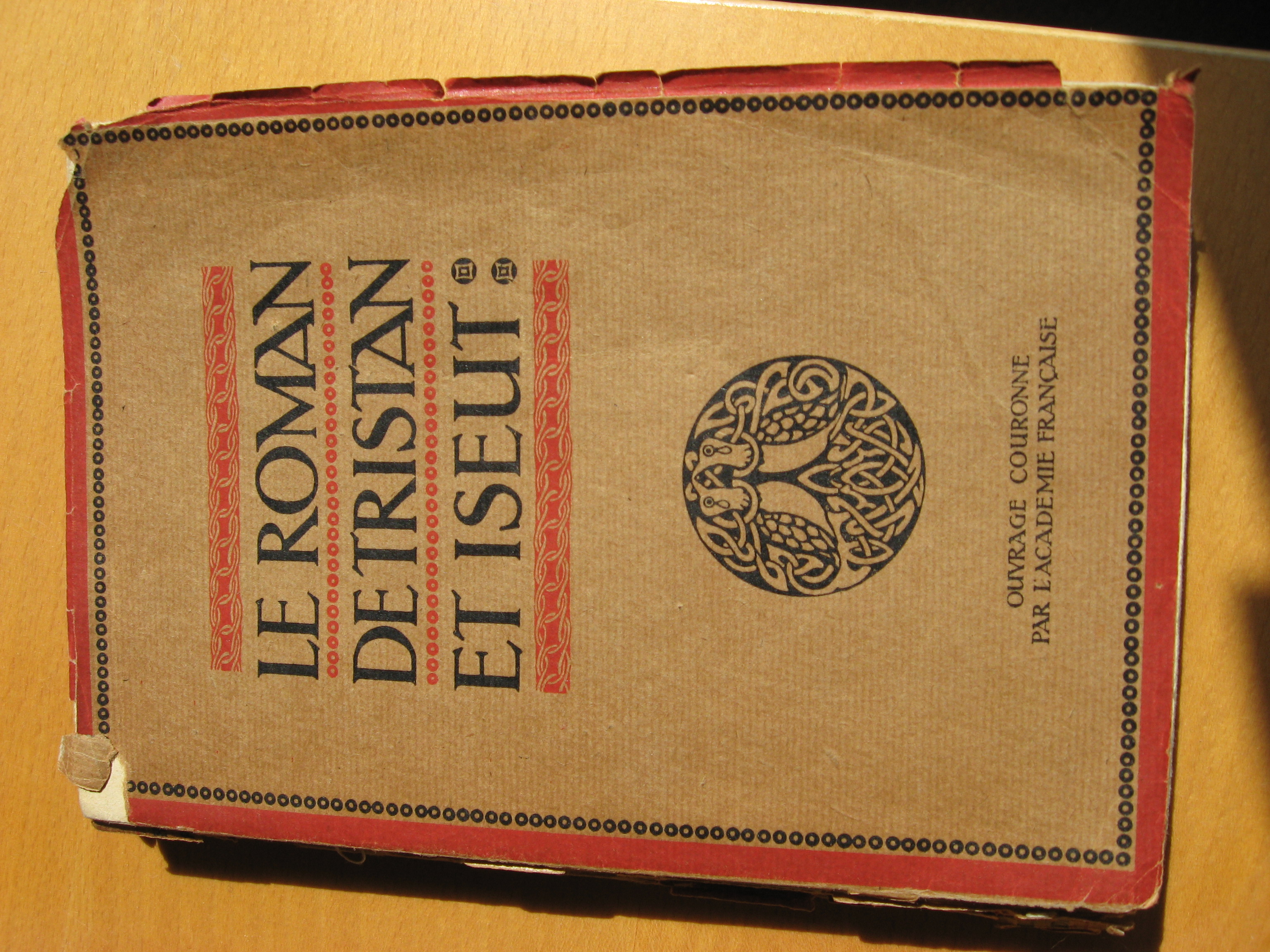
I read and reread the book, renewing my library loan as many times as I was allowed, then went to a bookshop.  Imagine my disappointment when I was told that it was out of print.  Then, imagine my joy when, a few years later, I came across a battered 1920 paperback edition of the book amidst various pieces of junk in a bric-à-brac shop.  The manilla brown cover has a Celtic lovebird pattern beneath the title.  The pages are thick and their edges frayed, obviously cut with a blunt paper knife by its original reader.  I must find a caring craftsman, a true lover of books, to bind the precious tome in the style it deserves.

First published in 1900, Le Roman de Tristan et Iseut is a poem in prose written by Mediaeval expert Joseph Bédier, in which he brings together several fragments by poets such as Béroul, Thomas, Marie de France and Gottfried of Strasbourg, and weaves them into a complete story.  His work, which received an award from the Académie Française, is more than a translation.  It is a pure work of art in its own right.  Although written in prose, the book reads like a poem, so rich and evocative is Joseph Bédier’s style.  The late 19th Century French captures – like a scent in a bottle or a colourful Flemish tapestry – the sensibilities and atmosphere of the 12th Century Celtic legend.

The spell cast upon me by Le Roman de Tristan et Iseut led me to explore Mediaeval literature, music and art.  From there, I read La Chanson de Roland, Le Roman de Renart and the poetry of Chrétien de Troyes.  I became fascinated with Arthurian legends.  I read avidly anything I could find on the subject.

Years later, when, as part of a trial, the University of Durham French Department elected that all fourth years should choose to specialise in a specific period, I shrieked away in horror at 19th Century depression and 20th Century angst and, instead, chose Mediaeval and Renaissance French Literature.  One of the set texts was the French poetry of the Tristan and Isolde legends.  This time, of course, I required the help of a Mediaeval French dictionary.  It was such delight to revisit the enchanted land I had first stumbled upon as a mumps-ridden twelve year-old.

Of all the tragic love stories, the legend of Tristan and his Isolt/Yseult/Isolde is the most poignant and the most romantic.  It defies all the rules of State and Church, and yet carries a message of loyalty, courage, faith, integrity and hope.  Its protagonists are flawed, but that is perhaps what makes them both so true to life.  It is, after all, a story of true love.  The magic love potion brewed by Iseut’s mother, I believe, is a narrative device to make the story more credible.  How else could most people believe that such steadfast passion exists, if not triggered by sorcery? Unless, of course, they have known such love themselves.  And that is how Joseph Bédier concludes his tale.  He tells us that his story is meant for those who love – not for the others.

© Scribe Doll

* Joseph Bédier, Le Roman de Tristan et Iseut (Editions Piazza)

Please note that Joseph Bédier’s Le Roman de Tristan et Iseut is now back in print, and readily available – both in book and electronic reader forms.

Posted in Odds & Ends | Tagged , , , , , , , , , , | 2 Comments

Pet Hates: Ethnic Monitoring Forms

Join a library, apply for a job or submit a play for a competition.  More often than not, you will have to fill one in.  Apparently, their purpose is to guarantee an equal distribution of opportunities among ethnic backgrounds.  Does it really work? I am fully aware that this policy is aimed at eradicating racism and comes with genuinely honourable intentions.  However, when you are in the vulnerable position of a petitioner, it is easy to think, “Does that mean, then, that the focus is on people’s ethnicity more than on their talent or suitability for a position? Will I tick the right box or the wrong one?”

I refuse to fill in ethnic monitoring forms at application stage, as a matter of principle.  I do not consider them relevant.  I am applying for a job or submitting a play – not volunteering for a study in anthropology.  For statistics’ sake, I would be happy to supply information about my ethnicity after my application has been processed, and I informed of the outcome.  Not before.  I feel that would be a far more considerate and sensitive approach on the part of employers.

Another objection I have to ethnic monitoring forms, is the inaccurate language they use.  White British or White Other? The last time I saw that question, it was printed on a form issued by a highly reputable Arts organisation.  I drew a line across the form and wrote, “British is a nationality, not an ethnic group.  Are you trying to ask whether I am originally Anglo-Saxon, Norse or Celtic?” Other forms make a difference between White British, White Irish and White Other.  What happened to the other Celtic tribes which populated the British Isles?

Why not adopt a worldwide policy that would allow us to apply for jobs and submit our work with a CV bearing only initials, instead of a full name?  Then, you would know – at least up to the interview stage – that it is strictly your qualifications and experience that have led you to the interview, since the other party knows nothing of your nationality or even sex.  At that point, the company could keep track of the percentage of various ethnicities that make it to the final cut, and draw the relevant conclusions about itself.

Surely, it is focusing on our differences too much that leads to intolerance, suspicion and ignorance? Why do we not just forget about ethnicities, and focus on and appreciate people as individuals?

The term background is a pet hate of mine.  It is given too much importance.  There is a good reason why the word back is contained in it.  Our background is behind us.  It is there to propel us forward, not for us and other people to dwell on it.  Nobody ever advanced by walking backwards.  Another concept I feel we are encouraged to focus on too much, is that of our roots.  Roots are very well for trees.  We are humans, shaped with legs intended for us to walk ahead.

It is my experience of the British  – or should I say English – mentality, that much importance is attached to our nationality and ethnic origin, sometimes to a point, in my view, of impolite and almost judgemental prying.  It is my curse, as someone brought up speaking four languages, to have a hint of an accent in all of them.  I was lunching at the home of a Cambridge Fellow and his wife.  I was discussing opera with one of the guests, also an academic.  I begged to differ with him on a point of music.  His immediate response was, “You weren’t born in this country, were you?” I was taken aback by the abrupt change of subject, and asked what had so suddenly triggered his question, since it was clearly so irrelevant to our existing conversation.  “It’s just interesting,” he said.  “Well, it’s not all that interesting to me,” I replied, forcing a smile.  Far from taking the hint, he insisted, until I had to ask if it was my “foreign” accent that was clearly making him doubt my opinion in music.  To give him credit, he apologised.

An old copy of Debrett’s I had as a teenager advised against asking strangers at parties “So what do you do?” since the last thing a person may want to do at the end of a hard day, is discuss his or her work.  It may sound fascinating to some that I am a half-English, half Middle Eastern polyglot but for me – having grown up with it – it is as commonplace as discussing my height, weight or eye colour.  My heart sinks when I hear the question “where do you come from?”  My family background is such a mixture, and because I cannot give a simple, concise answer and remain truthful, I give outrageous replies, such as coming from a long line of East Anglian pixies or having ancestors from the side of the Moon which is invisible to modern technology.  I hope, against hope, that it will deter further questions, and that, if the other person craves a “fascinating” story, that he or she might pick up a novel.  Far from it.  They just do not take the hint.  They push, persist, insist.  Having said that, I do not object giving a three-hour talk on my full background to someone I have grown to know a little better over time.  However, being interrogated within the first few minutes, makes me feel like an exotic animal in a zoo.

A while back, I found myself at a drinks reception, where a gentleman asked me the dreaded question.  “I’m English,” I replied.

“Pure English?” he insisted.

“Is anyone pure English?” I retorted, somewhat irked.

“I am,” he said.  “100%.”

It was too tempting to resist.  “Really?” I said, pussycat smile in place.  “100% pure English? There can’t be many of you about.”

“That’s right.”

I checked my nails were sharp enough.  “How far back?”

He smiled, contentedness spreading over his face.  “William the Conqueror.”

I unsheathed a couple of claws, in preparation.  “Oh, how fascinating! Are you of Norman descent?”

“That’s right,” he said, ever so proud.

The scratch was as effortless as a paper cut.  “So you have French and Scandinavian blood!”

His face froze.

“Excuse me,” I said, moving away from him.

© Scribe Doll

Posted in Half-English Observations, Pet Hates | Tagged , , , , , , | 6 Comments

BBC Radio 4

My Sound Sculpture feature on crows on the BBC Radio 4 programme Saturday Live, broadcast on 14 January 2012.

Posted in Audio | Tagged , , | 2 Comments

Odds & Ends: The Silence Experiment

I am recovering from a drawn out case of laryngitis.  During this time, there was one particular day when I could not speak.  My throat hurt too much.  Because I am currently between jobs, I was able to indulge the laryngitis, and allow it to take its time over its tantrum.  After all, I did not want it to become truly nasty by feeling unvalidated.  At the same time, I spoilt myself.  I permitted myself something I now know to be a delectable luxury – I did not speak for twenty-four hours.  I simply decided to declare it a vocal holiday.  Moreover, I did something I had never ever done before – I let the ‘phone ring without picking it up.  Glad of my new rebellion, the transition was easy to a state of mind where I could ignore all but the most urgent text messages and e-mails.  When I went to the shops, I used smiles instead of words, to thank the till staff for the receipt and change.  They appeared perfectly content with that.

Many ancient philosophers praise silence over speech.  Even nowadays, in many Eastern cultures, a person who says little is often considered wise and worthy of respect.  In the West, however, wit is valued above sagacity, and people frantically talk over each-other in an aggressive attempt to secure intellectual territory (Mea culpa.  Mea maxima culpa.)  My beloved BBC Radio 4 news programmes are a frequent arena of such tenacious and unnecessarily rude interruptions, that it is sometimes impossible to make out what either party is actually saying.

I am a natural chatterbox and this new experience of not speaking for a full day was a true revelation.  I cannot express just how refreshing, soothing, grounding and surprisingly empowering it was.  Giving myself permission not to speak made me feel powerfully centred and anchored.  It was as though by keeping my mouth shut I prevented my strength from leaking out, and I could feel that strength rise and expand within me.

My sense of taste, smell and hearing were naturally impaired because of the cold symptoms.  However, my deliberate silence seemed to sharpen my vision.  I started noticing new details around me.  Strange, but true.  Equally strange, but true, is that I felt slightly sorry when my ability – and hence obligation – to speak returned.  I would have liked to remain quiet for another day or so.

Many religions advocate regular fasting.  My mother is a fervent supporter of fasting for medical reasons, and swears by its health benefits (her latest success was curing her painful disc hernia that way).  Fasting does not agree with my body.  After all, we all different.  However, a “silence fast” might well bring me great benefits.

I wonder if I could get into a one silent day a month pattern.  I have friends who renounce chocolate and/or alcohol for Lent.  I have never done that.  Once, as an undergraduate in the last Century, I tried to abstain from sarcasm but my resolution did not last past the end of Ash Wednesday.  Perhaps next Lent, I might experiment with keeping silent.  Not for the whole forty days, of course, but maybe just forty evenings? Of course, there could be no cheating with text messaging or tweeting.

Now there’s an exciting thought.

 © Scribe Doll

Posted in Odds & Ends | Tagged , , , , , , , , | 1 Comment