Odds & Ends: English Houses

English houses are an infuriating combination of the cosy and the absurd.

There are few pleasures comparable to walking home down a street lined with traditional-looking English houses.  Diminutive in height, sloped roofs as observation decks for modulating blackbirds and rasping crows.  Cats loitering by the front door.  Bay windows that invite you to peek into the warmth inside.  The houses may have been designed as identical, but each one has a touch of individuality.  The stained glass window above the front door may have a different pattern, or the wooden door painted a different colour, with a unique knocker, and every hedge blooms with different flowers.  Compare that with the impersonal high-rise blocks of flats in Italy, France, Germany and Spain.  Here you can see the sunset splashing the rooftops.  Here, there are no blinds on the windows – even on the ground floor, and many front doors have glass panels.  We are not – yet – so worried about break-ins here, as people are on the Continent, and for that I am thankful.

English houses look adorable.  On the outside.

Once you open the front door, you generally find yourself at the bottom of a steep, narrow staircase, each step not deep enough to support the full length of an adult shoe sole.  You tackle the stairs with – more often than not – a part of your foot hanging in the air: your heel on the way up, and your toes on the way down.

The inside of English houses tends to be cosy – if cluttered – with a fine powdering of dust on the surfaces, perhaps to give the place a sense of the “lived in”.  Here, there is no danger of slipping and breaking a limb on the over-polished parquet common in Italian homes.  The carpets are warm, soft – and seldom washed.  We live in the comfortable belief, that vacuuming once a week actually makes the carpet clean.  What is wrong with easily washable rugs? Beneath the carpets, the floor boards are rough and with spider-friendly gaps. In fact, most English houses include accommodation for eight-legged creatures which, local belief has it, bring luck to the home and – another native superstition – do not sting.

English houses, because they are made with much wood, creak with the variation of temperature, season, time of day and moon phase.  And so, alone in the house, you hear a number of suspect creaks, groans, squeaks and pops which, if you give your imagination free rein, become goblins, fairies and ghosts.  The house sounds as though it has a personality of its own, and that is part of its charm.

A visitor from some Continental countries – especially ones that were influenced by the Greco-Roman love of cleanliness – will be shocked by the shortage of bathrooms in an English house.  Unlike Italy, for instance, our architects consider it a waste of space putting an extra bathroom as soon as a third bedroom has been built (naturally, I am not referring to expensive modern constructions).  It is not unusual for a two-storey, six-bedroom house, to have just one bathroom and, if you are lucky, a Lilliputian loo under the stairs, the use of which requires remarkable physical agility to avoid banging yourself against the toilet, the sink, the towel hook and the door knob.  On the subject of bathrooms, the vast majority of homes still have separate taps for hot and cold water, forcing you to swing your hands from freezing to scalding.  The reasons for this sadistic plumbing escape me.  No doubt it stems from some deep psychological need to shun the pleasure of warm water on your hands.  These taps are fitted so close to the back of the invariably minuscule sink, that it is impossible to keep your back straight while washing your hands.  Again, the plumbing makes sure that you do not wallow in obviously immoral comfort.

There is something of the fairy magic in the atmosphere of a traditional English house and, as such, it is built to fit the stature of fairies, pixies and little people.  The ceilings are low, the rooms tiny, the built-in wardrobes (a rare feature), sometimes not deep enough to accommodate wide coat hangers.

One of the most charming features of an English house, are the now slightly old-fashioned sash windows.  Impossible to wash from the outside, without the help of a professional, these have the convenience of opening from the bottom or the top.  Moreover, let us admit it, they are so pretty.  More modern houses have – somewhat illogically – windows opening outwards.  On the Continent, windows open inwards, hence allowing for fresh air even when it rains.  Here, open your windows in nothing less than perfect weather, and you get your window panes rained on, and pooed on by birds.  Again, impossible to wash on the outside, unless you hire a window cleaner.

England is a country of actors, of writers, of diplomats, of economists.  Perhaps we should hire architects from abroad.

Scribe Doll

Posted in Half-English Observations | Tagged , , , , | 2 Comments

Odds & Ends: Tristan and Iseut

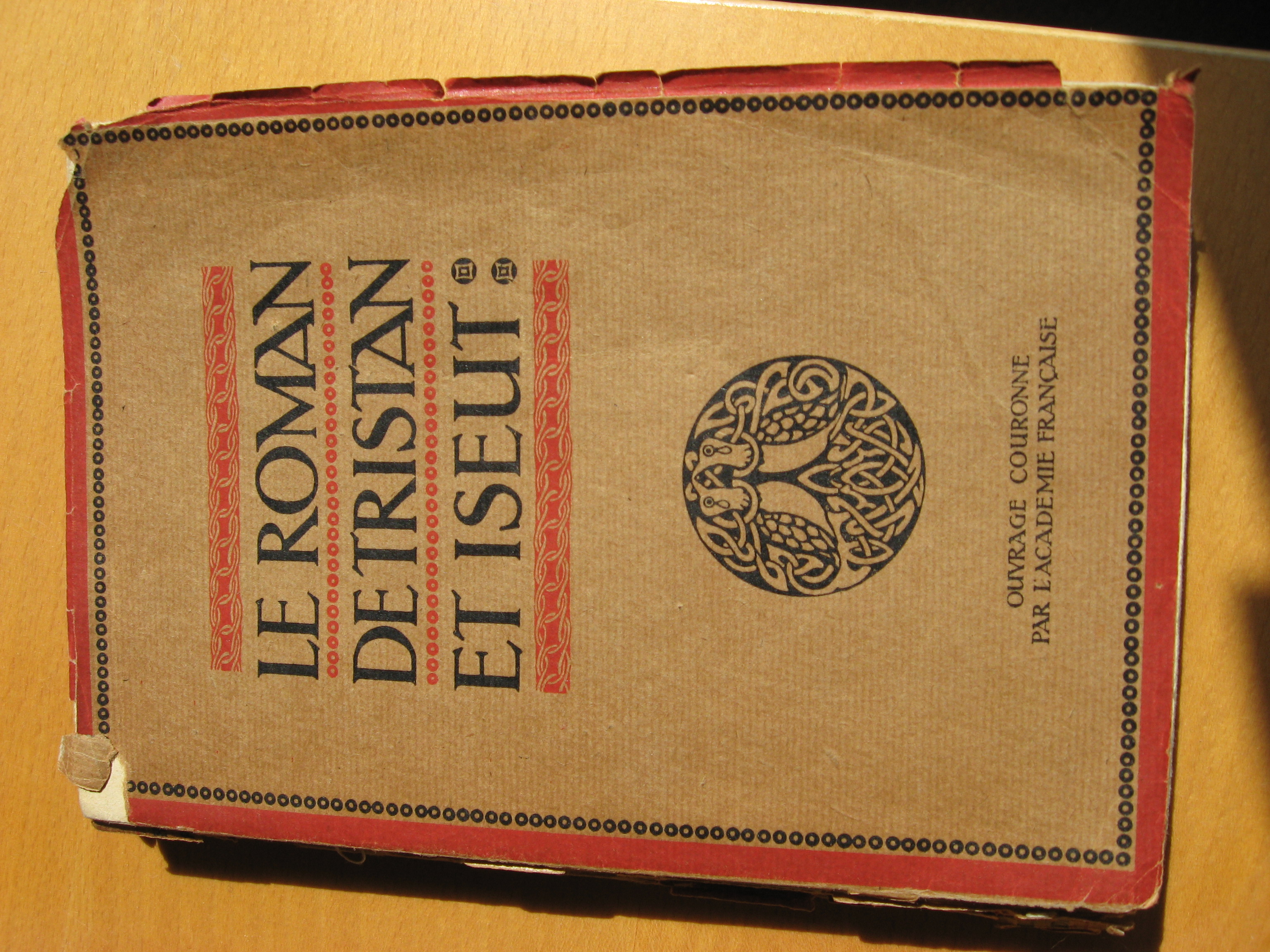
It was a book with a dark blue cover, with a ghostly picture of a Mediaeval ship, in a paler blue and grey, on the front.  My mother had brought it for me from the local library, in Nice, as I sat up in bed, age twelve, my neck all swollen with mumps.

“Seigneurs, vous plaît-il d’entendre un beau conte d’amour et de mort? C’est de Tristan et d’Iseut la reine.  Ecoutez comment à grand’ joie, à grand deuil ils s’aimèrent, puis en moururent un même jour, lui par elle, elle par lui.” *

Thus Joseph Bédier starts his lay.

“My Lords, would it please ye to hear a beautiful tale of love and death? ‘Tis of Tristan and of Queen Iseut.  Listen how, to their great joy and great sorrow, they loved each-other then died of their love upon the same day, he because of her, and she because of him.”

I did not want dinner, that evening, nor sleep.  I could not bear to part with the book.  The more I drank its bewitching prose, the more I thirsted after it.  The words were light as air, fragrant as honeysuckle, vivid as a fire, soothing as the strings of a lute and haunting as moonlight.  They wove a tale of such incomparable beauty, I felt I had been given the key to a realm of wonders.  Some episodes were already familiar to me.  I had heard their echoes in the Russian fairy tales my grandmother had told me.  For instance, King Mark announces to his plotting barons that he will marry the woman whose golden hair two squabbling swallows have dropped on his windowsill that day.  In the Russian story, it is two sparrows that fight over the golden hair.  Other things were strange to me.  Learning that Iseut has ordered to have her slain, faithful servant Brangien cannot recall ever causing her mistress any offence except, she says, by lending her her own nightgown for the Queen’s wedding night, since hers was torn on the sea voyage to Cornwall.  I was shocked, and wondered at the extreme poverty of Celtic people.  That the daughter of the King of Ireland should have only one nightgown, and have to borrow her servant’s for her wedding night, seemed odd to me.  Had she been the heroine of a Russian or Middle Eastern fairy tale, she would have had caravans of nightgowns follow her train.  All would have been richly embroidered in silver, gold and pearls, and stored in trunks of gold and gemstones.

I read and reread the book, renewing my library loan as many times as I was allowed, then went to a bookshop.  Imagine my disappointment when I was told that it was out of print.  Then, imagine my joy when, a few years later, I came across a battered 1920 paperback edition of the book amidst various pieces of junk in a bric-à-brac shop.  The manilla brown cover has a Celtic lovebird pattern beneath the title.  The pages are thick and their edges frayed, obviously cut with a blunt paper knife by its original reader.  I must find a caring craftsman, a true lover of books, to bind the precious tome in the style it deserves.

First published in 1900, Le Roman de Tristan et Iseut is a poem in prose written by Mediaeval expert Joseph Bédier, in which he brings together several fragments by poets such as Béroul, Thomas, Marie de France and Gottfried of Strasbourg, and weaves them into a complete story.  His work, which received an award from the Académie Française, is more than a translation.  It is a pure work of art in its own right.  Although written in prose, the book reads like a poem, so rich and evocative is Joseph Bédier’s style.  The late 19th Century French captures – like a scent in a bottle or a colourful Flemish tapestry – the sensibilities and atmosphere of the 12th Century Celtic legend.

The spell cast upon me by Le Roman de Tristan et Iseut led me to explore Mediaeval literature, music and art.  From there, I read La Chanson de Roland, Le Roman de Renart and the poetry of Chrétien de Troyes.  I became fascinated with Arthurian legends.  I read avidly anything I could find on the subject.

Years later, when, as part of a trial, the University of Durham French Department elected that all fourth years should choose to specialise in a specific period, I shrieked away in horror at 19th Century depression and 20th Century angst and, instead, chose Mediaeval and Renaissance French Literature.  One of the set texts was the French poetry of the Tristan and Isolde legends.  This time, of course, I required the help of a Mediaeval French dictionary.  It was such delight to revisit the enchanted land I had first stumbled upon as a mumps-ridden twelve year-old.

Of all the tragic love stories, the legend of Tristan and his Isolt/Yseult/Isolde is the most poignant and the most romantic.  It defies all the rules of State and Church, and yet carries a message of loyalty, courage, faith, integrity and hope.  Its protagonists are flawed, but that is perhaps what makes them both so true to life.  It is, after all, a story of true love.  The magic love potion brewed by Iseut’s mother, I believe, is a narrative device to make the story more credible.  How else could most people believe that such steadfast passion exists, if not triggered by sorcery? Unless, of course, they have known such love themselves.  And that is how Joseph Bédier concludes his tale.  He tells us that his story is meant for those who love – not for the others.

© Scribe Doll

* Joseph Bédier, Le Roman de Tristan et Iseut (Editions Piazza)

Please note that Joseph Bédier’s Le Roman de Tristan et Iseut is now back in print, and readily available – both in book and electronic reader forms.

Posted in Odds & Ends | Tagged , , , , , , , , , , | 2 Comments

Pet Hates: Ethnic Monitoring Forms

Join a library, apply for a job or submit a play for a competition.  More often than not, you will have to fill one in.  Apparently, their purpose is to guarantee an equal distribution of opportunities among ethnic backgrounds.  Does it really work? I am fully aware that this policy is aimed at eradicating racism and comes with genuinely honourable intentions.  However, when you are in the vulnerable position of a petitioner, it is easy to think, “Does that mean, then, that the focus is on people’s ethnicity more than on their talent or suitability for a position? Will I tick the right box or the wrong one?”

I refuse to fill in ethnic monitoring forms at application stage, as a matter of principle.  I do not consider them relevant.  I am applying for a job or submitting a play – not volunteering for a study in anthropology.  For statistics’ sake, I would be happy to supply information about my ethnicity after my application has been processed, and I informed of the outcome.  Not before.  I feel that would be a far more considerate and sensitive approach on the part of employers.

Another objection I have to ethnic monitoring forms, is the inaccurate language they use.  White British or White Other? The last time I saw that question, it was printed on a form issued by a highly reputable Arts organisation.  I drew a line across the form and wrote, “British is a nationality, not an ethnic group.  Are you trying to ask whether I am originally Anglo-Saxon, Norse or Celtic?” Other forms make a difference between White British, White Irish and White Other.  What happened to the other Celtic tribes which populated the British Isles?

Why not adopt a worldwide policy that would allow us to apply for jobs and submit our work with a CV bearing only initials, instead of a full name?  Then, you would know – at least up to the interview stage – that it is strictly your qualifications and experience that have led you to the interview, since the other party knows nothing of your nationality or even sex.  At that point, the company could keep track of the percentage of various ethnicities that make it to the final cut, and draw the relevant conclusions about itself.

Surely, it is focusing on our differences too much that leads to intolerance, suspicion and ignorance? Why do we not just forget about ethnicities, and focus on and appreciate people as individuals?

The term background is a pet hate of mine.  It is given too much importance.  There is a good reason why the word back is contained in it.  Our background is behind us.  It is there to propel us forward, not for us and other people to dwell on it.  Nobody ever advanced by walking backwards.  Another concept I feel we are encouraged to focus on too much, is that of our roots.  Roots are very well for trees.  We are humans, shaped with legs intended for us to walk ahead.

It is my experience of the British  – or should I say English – mentality, that much importance is attached to our nationality and ethnic origin, sometimes to a point, in my view, of impolite and almost judgemental prying.  It is my curse, as someone brought up speaking four languages, to have a hint of an accent in all of them.  I was lunching at the home of a Cambridge Fellow and his wife.  I was discussing opera with one of the guests, also an academic.  I begged to differ with him on a point of music.  His immediate response was, “You weren’t born in this country, were you?” I was taken aback by the abrupt change of subject, and asked what had so suddenly triggered his question, since it was clearly so irrelevant to our existing conversation.  “It’s just interesting,” he said.  “Well, it’s not all that interesting to me,” I replied, forcing a smile.  Far from taking the hint, he insisted, until I had to ask if it was my “foreign” accent that was clearly making him doubt my opinion in music.  To give him credit, he apologised.

An old copy of Debrett’s I had as a teenager advised against asking strangers at parties “So what do you do?” since the last thing a person may want to do at the end of a hard day, is discuss his or her work.  It may sound fascinating to some that I am a half-English, half Middle Eastern polyglot but for me – having grown up with it – it is as commonplace as discussing my height, weight or eye colour.  My heart sinks when I hear the question “where do you come from?”  My family background is such a mixture, and because I cannot give a simple, concise answer and remain truthful, I give outrageous replies, such as coming from a long line of East Anglian pixies or having ancestors from the side of the Moon which is invisible to modern technology.  I hope, against hope, that it will deter further questions, and that, if the other person craves a “fascinating” story, that he or she might pick up a novel.  Far from it.  They just do not take the hint.  They push, persist, insist.  Having said that, I do not object giving a three-hour talk on my full background to someone I have grown to know a little better over time.  However, being interrogated within the first few minutes, makes me feel like an exotic animal in a zoo.

A while back, I found myself at a drinks reception, where a gentleman asked me the dreaded question.  “I’m English,” I replied.

“Pure English?” he insisted.

“Is anyone pure English?” I retorted, somewhat irked.

“I am,” he said.  “100%.”

It was too tempting to resist.  “Really?” I said, pussycat smile in place.  “100% pure English? There can’t be many of you about.”

“That’s right.”

I checked my nails were sharp enough.  “How far back?”

He smiled, contentedness spreading over his face.  “William the Conqueror.”

I unsheathed a couple of claws, in preparation.  “Oh, how fascinating! Are you of Norman descent?”

“That’s right,” he said, ever so proud.

The scratch was as effortless as a paper cut.  “So you have French and Scandinavian blood!”

His face froze.

“Excuse me,” I said, moving away from him.

© Scribe Doll

Posted in Half-English Observations, Pet Hates | Tagged , , , , , , | 6 Comments

BBC Radio 4

My Sound Sculpture feature on crows on the BBC Radio 4 programme Saturday Live, broadcast on 14 January 2012.

Posted in Audio | Tagged , , | 2 Comments

Odds & Ends: The Silence Experiment

I am recovering from a drawn out case of laryngitis.  During this time, there was one particular day when I could not speak.  My throat hurt too much.  Because I am currently between jobs, I was able to indulge the laryngitis, and allow it to take its time over its tantrum.  After all, I did not want it to become truly nasty by feeling unvalidated.  At the same time, I spoilt myself.  I permitted myself something I now know to be a delectable luxury – I did not speak for twenty-four hours.  I simply decided to declare it a vocal holiday.  Moreover, I did something I had never ever done before – I let the ‘phone ring without picking it up.  Glad of my new rebellion, the transition was easy to a state of mind where I could ignore all but the most urgent text messages and e-mails.  When I went to the shops, I used smiles instead of words, to thank the till staff for the receipt and change.  They appeared perfectly content with that.

Many ancient philosophers praise silence over speech.  Even nowadays, in many Eastern cultures, a person who says little is often considered wise and worthy of respect.  In the West, however, wit is valued above sagacity, and people frantically talk over each-other in an aggressive attempt to secure intellectual territory (Mea culpa.  Mea maxima culpa.)  My beloved BBC Radio 4 news programmes are a frequent arena of such tenacious and unnecessarily rude interruptions, that it is sometimes impossible to make out what either party is actually saying.

I am a natural chatterbox and this new experience of not speaking for a full day was a true revelation.  I cannot express just how refreshing, soothing, grounding and surprisingly empowering it was.  Giving myself permission not to speak made me feel powerfully centred and anchored.  It was as though by keeping my mouth shut I prevented my strength from leaking out, and I could feel that strength rise and expand within me.

My sense of taste, smell and hearing were naturally impaired because of the cold symptoms.  However, my deliberate silence seemed to sharpen my vision.  I started noticing new details around me.  Strange, but true.  Equally strange, but true, is that I felt slightly sorry when my ability – and hence obligation – to speak returned.  I would have liked to remain quiet for another day or so.

Many religions advocate regular fasting.  My mother is a fervent supporter of fasting for medical reasons, and swears by its health benefits (her latest success was curing her painful disc hernia that way).  Fasting does not agree with my body.  After all, we all different.  However, a “silence fast” might well bring me great benefits.

I wonder if I could get into a one silent day a month pattern.  I have friends who renounce chocolate and/or alcohol for Lent.  I have never done that.  Once, as an undergraduate in the last Century, I tried to abstain from sarcasm but my resolution did not last past the end of Ash Wednesday.  Perhaps next Lent, I might experiment with keeping silent.  Not for the whole forty days, of course, but maybe just forty evenings? Of course, there could be no cheating with text messaging or tweeting.

Now there’s an exciting thought.

 © Scribe Doll

Posted in Odds & Ends | Tagged , , , , , , , , | 1 Comment

Odds & Ends: Rain

I love the rain.  We had a few thunderstorms, last week.  One afternoon, just as I lighting sparked into my room and I heard the thunder drumroll, I grabbed my mac, and rushed out into the street, towards the Thames.  The drops were getting fatter and heavier, and I turned up my collar to stop them sneaking their cold fingers into the back of my neck.  They were drumming little ripples in the grey river water, and I could hear their light tapping sounding increasingly urgent on the tree leaves.  I turned my face up towards the leaden sky, welcoming the cold, hard drops on my face.  The icy wind chilled my wet cheeks.  A flash of lightning grinned at me from behind the trees across the river.  Thunder cracked a threat.  I laughed.  There is something wildly exhilarating about thunderstorms.  The more violent they are, the more I feel as though they have come to boot out the old, to make way for the new.  I had a cat who would sit on the windowsill during thunderstorms and, each time lightning flashed, she lifted her paw in an attempt to catch it.

I also love steady, all-day rain.  The kind that sets a gentle, introspective rhythm.  Ideal for listening to Herbert Howells, a Bach Cantata, or music for Anglican evensong.  You know that once this rain has stopped, the air will be fresh, and everything will have a clear, revitalised scent.  The lawns will be a more vivid green, the sky an uncompromising blue.

Then there is the light, powdery drizzle that is now seldom seen in England.  The kind of rain that does not require an umbrella.  It curls your hair and makes your skin smooth and soft.

It is raining now.  A slow, gentle rain, tapping regular beats on my window panes.  Occasionally, it pauses, and sunlight peers through the gap in a cloud.  It lights up the droplets on my window panes, like burning diamonds, almost blinding me.

© Scribe Doll

Posted in Odds & Ends | Tagged , , , | 2 Comments

Odds & Ends: Illness as a Friend

I am unwell, and beginning to enjoy it.  For one thing, it is giving me time to think.  No, I am not mad.  It is like observing a student being taught a difficult but valuable lesson.  The student throws a tantrum, sulks, tries distraction techniques but then returns to her desk, because she knows she cannot leave the classroom until she completes her assignment.  She figures, at that point, she might as well aim for good marks.  That student is I.

I have been unwell for the past few weeks.  Nothing serious or permanent but enough to keep me from some of my normal activities.  It is the first time in years I am lucky enough to be in a position where I am able to watch my body act freely, and do not have to gag its voice with tablets, just so my daily work routine will not be disrupted.  I can say to it, “All right, you just do whatever it is you have to do.  Just give me a shout if you need anything.  I trust you.” And when it shouts for a hand, I try and listen to its precise request.

Once again, the usual caveat is in order here.  What I am about to say does not apply to seriously debilitating, let alone life-threatening illnesses, but to those dis-eased states which call for our attention but are manageable, at least if addressed early enough.

I speak for myself only when I say that I have been responsible for 99% of my health problems.  My severe spine curvature is a physical manifestation of the courtier-like subservience I had to exercise in many of my jobs.  So many years of stooping to please, you forget how to stand up straight.  My throat problems have arisen when circumstances have forbidden me from speaking out, let alone scream, my anger and frustration.  I got tinnitus when I simply could not bear to listen to what people around me were saying, anymore.  I developed adrenal exhaustion after years of my body begging for rest and calm, its pleas falling on my deaf ears.

I think, in our Western world, we are brought up to view our bodies as dumb machines.  The slightest ailment, and we dispatch them to complete strangers to fix, like cars to a mechanic.  We do not even try to listen out for our body’s voice, and hear its request.  Of course, we cannot treat everything ourselves, without outside help.  I have a couple of wonderful practitioners who listen and suggest but never try and take over.  After all, they may be trained in supplying options but, naturally, nobody knows my mind and body better than I.  So getting me well is always a team effort.  I still remember how horrified I was, a few years ago, when a doctor was advocating a particular course of treatment.  I was not convinced.  He insisted.  I said, “I need to feel confident about this.  Surely, the treatment will work better if the patient cooperates.”

He replied, “We don’t need your cooperation.  This drug is so strong, it will act with our without your collaboration.”

I few days ago, I had the opposite experience.  I went to a herb shop to buy something for a specific respiratory symptom.  I had woken up with an unexplained craving for licorice, and was not afraid to be frank about it (just imagine saying that to a GP).  As she weighed out the licorice, the herbalist also suggested I might benefit from plantain.  I had no opinion, since I had never tried this.  She brought over the jar and unscrewed the lid.  “Have a smell,” she said.  “What do you think?” (Ha! The thought of a GP doing anything like that!

The scent appealed to me, so I got some to mix with the licorice.  Four cups of infusion later, my respiratory symptom had disappeared.

One of my ex-bosses (well, most of them, actually) used to quiz me about what I took to bring down the temperature when I had the ‘flu.  They looked at me with an expression of disconcerted contempt when I said that – as long as the fever did not exceed 38.5º – I would just let it take its course with some minimal homoeopathic and vitamin assistance.  If it had ever got worse, of course, I would have taken the day off and gone home.  A raised temperature is a sign that my body is fighting for me.  Why would I hammer my champion on the head with something that would weaken his strength and initiative? Similarly, friends cannot seem to understand why I do not take pain killers (again, I am not talking about debilitating pain, here).  Pain is like a fire alarm.  Why would you want to disactivate your fire alarm?

My latest state of dis-ease (I love the insight provided by that word), is a fantastic opportunity for me to discover myself, and to learn to trust.  That does not mean I have to  learn with a smile on my face.  I am human and grumpiness comes naturally.  Above all, it is a wonderful opportunity to discover my body’s voice and its requirements.  If I crave a food or herb or particular taste, I try and trust it.

Are you laughing at me?And yet you are the same people who watch nature programmes and marvel at animals’ ability to eat the right food or herb for their illnesses.  Would should we humans not reacquire this wonderful, dormant skill?

© Scribe Doll

Posted in Odds & Ends | Tagged , , , , , , | 2 Comments

Words and Civilisation: “I don’t want to get involved”

A friend and I were walking down the street and saw a woman sitting on a doorstep, crying her eyes out.  “Don’t get involved,” said my friend, picking up the pace.  A few steps further, I let my friend go on without me.  I felt I had to turn back, or I could not have lived with myself.

The woman on the doorstep was drunk.  She said she was a recovering alcoholic, and had been sober for fifteen years – until today.  Today, however, her sister (and only relative) had died trying to give birth to a baby.  The woman sobbed, and I saw three or four empty beer cans on the pavement, next to her.  Nothing I could say or do would ever make a difference or alleviate her truly harrowing sense of loss.  She had spent everything she had on alcohol and, since she declined my offer of money, I bought a couple of ready-to-microwave meals from the corner shop, and started walking her home.  On the next street, we bumped into a neighbour of hers who gently took her by the arm, and led her the rest of the way.

I did not try and help that woman for any noble reasons.  I just realised that if I did not, then I could not have looked at myself in the mirror again.  Selfish, really, if you think of it.  As for getting involved, it was not about getting involved.  I was involved by the very fact that I saw that woman sitting there, crying her heart out.

Time and again, I hear people say, “I don’t want to get involved” or “I’m not taking sides”.  Why this state of non-committed neutrality? Are they not a part of this world? Are they extra-terrestrials?

I can sense the usual hoard of devil’s advocates falling over one-another with objections and spouting “things aren’t always black and white” platitudes.  Yes.  There are times when it is not wise or safe to get involved in a situation.  The list of examples is too long to write out.  However, it is also true that, in many cases, this “not getting involved” is not so much a sign of dignity but of fear.  Actually, “fear” is too politically correct, nowadays.  Let us just call it what it really is – cowardice.

We live in a society in which, we are striving to be so tolerant of differences, in which we are so terrified of uttering any opinion that might come across as judgemental, that I sometimes wonder if we have lost track of what is Right and Wrong.

My favourite Shakespearean quotation is by Hamlet, “There is nothing either good or bad but thinking makes it so.”  I believe that to be true to a great extent.  Even so, there are areas, off-limits, where the absolutes of Right and Wrong do apply.  I feel that it is wrong willfully to harm another human being, or an animal, or nature.  That does not mean that the perpetrator should not be understood or forgiven, but that the act per se is unquestionably wrong.

I also believe that you should be true to yourself, and that that involves standing up for what you believe is right.  Every time you look away, pretending something does not concern you, you lose a piece of your humanity.  If circumstances are such that all you can do is look away then, at least, be truthful to yourself by admitting that that is what you are doing.

If your colleague is being bullied by the boss, or one of your friends has wronged another, and you take the attitude that you “don’t want to get involved”, then I can only hope that you may, someday, come to understand how it feels to be vulnerable, isolated and with nobody to back you.

Once again, I need to clarify this.  We are all humans, flawed, insecure, etc.  I am not advocating throwing yourself headlong into a destructive situation, at genuine peril to yourself.  Nor am I suggesting that you put your job on the line for the sake of a colleague.  However, there are ways of giving support without placing yourself at risk.  If you cannot or will not jeopardise your position publicly then, at least, you can do so privately.  “I’m sorry, I can’t support you openly but I am on your side” will often be like a drop of water on parched land to a person who feels wronged.  A small act of kindness that will tell him or her that he or she is not completely alone.

Hundreds of idealistic undergraduates will quote John Donne’s lines, “No man is an island…”

Of course you’re involved.  Or are you a day tripper in this life? I guess what it comes down to, is how you want to feel about yourself when you look in the mirror.

© Scribe Doll

Posted in Words and Civilisation | Tagged , , , , , , , , | 12 Comments

The Temple Church

As a rule, I feel uncomfortable at church services.  It is not that I have an issue with God, or with churches per se.  I believe in God, and like most churches built at least 500 years ago.  It is the congregation.  Everybody looks so sorted.  The serene smiles, the aura of security, the confident friendliness.  All stir up my natural sense of not belonging.  It is not that I do not want to belong.  I do.  It is just that  – like Arlecchino’s dress – I am made up of too many different lozenges to be added to an existing pattern, without one of my lozenges sticking out like a sore thumb.  And if I try and ignore the clashing lozenge, then someone will always come along and point it out.  Being surrounded by so many sorted-looking people make me feel irremediably un-sorted.

What I love, is to sit in an empty church, gather my thoughts and watch the sun rays play hide and seek with the colours of the stained glass windows.  That, however, is a thing of the past.  Most churches are now locked outside service times.  Or else they charge admittance but then tend to be full of tourists, so robbed of the intimate silence I long for.

My relationship with the Church is ambivalent.  After all, I graduated from St John’s College, Durham.  That would be St John the Evangelist.  Moreover, that was under David Jenkins as Bishop of Durham.  It is important to understand that, back in the late Eighties, religion had such a strong presence in College life, that it was difficult not to form a strong opinion about it.  Undergraduates experienced different reactions.  Mostly – at least among my peers – you either embraced the overwhelmingly evangelical College style, or went flying towards the formality of High Church.  I fell in with the “spike” clique.  I feel inspired by the poetry of the King James Bible, and the soothing mist of frankincense.  A professional standard choir is a non-negotiable requirement for me – trebles, please, rather than girls.  Again, because of my love of language, I am partial to the Book of Common Prayer.  If, in addition, the reader completes the Old or New Testament reading with “Here endeth the (first or second) lesson”, then I am in Seventh Heaven.

For as long as I lived in Cambridge, King’s College Chapel embodied my church ideal.  Of course, there was no question of my ever belonging there.  I could sit and gaze with longing at the raised, wide seats in the back rows of the choir stalls – complete with their 17th Century editions of the Book of Common Prayer – till Doomesday.  I would never be permitted to sit there.  They are reserved for members of the College.  Perhaps that is why, with some perversity, I felt I did belong there on some level or other.  After all, if the Chapel Administrator guarded the hierarchical order, the music, on the other hand, shared its sublime perfection with anyone willing to listen.  And listen I did.  Almost every evening.

Since coming to London, in 1994, I have not been a regular church goer.  I could not seem to find a place I “clicked” with.

For some time, I had been aware of the Temple Church but, each time I walked past, I found it locked.  Moreover, I got it into my head that, after its noteworthy mention in Dan Brown’s Da Vinci Code, it would be swarming with tourists, and one would have to queue for Sunday service.

No such thing.

The Temple Church is a jewel tucked away in the labyrinth of barrister chambers off Fleet Street.  Built in 1185, it was the focal point of the Knights Templar.  On the floor of the Round, lie effigies of Knights, in full armour, swords at their sides.  Soldiers? Conspirators? Personally, I lack the necessary faith in the human ability to be so well-organised as to sustain a thousand year-old conspiracy.  Mystics? Scapegoats? Who knows? I like to think of them as seekers of knowledge.  The armoured figures appear to state that this is a place to inspire action, and not merely contemplation.  The latter is there to serve as a key to the feats you elect to undertake.

The sober beauty of the Norman architecture seems designed to open the way to magnificent thoughts, not dazzle you away from them.  The church itself is small enough for your focus not to be scattered, and for the atmosphere to be intimate.  The minimally decorated grey pillars, the sand-coloured stone arches and the somewhat deviant layout of the wooden pews evokes a sense of mathematical precision.  Of order.

The same order permeates the glorious singing by the choir.  Every breath, every voice, every note is woven into a sublime musical tapestry that sounds tailor-made for the size, the light and the material of the building itself.  The sound of King’s Choir equals in my mind the uncompromising whiteness of a moonbeam.  The Temple Church Choir, on the other hand, has something of the glow of gold in its tone, which complements the austerity of the building, seamlessly.  It is an understated kind of perfection, which supports your imagination without ever imposing on it.  Here again, you witness the comforting sense of order.  My friends gently tease me for my search for order, but it is just another word for harmony.  Without order, there can be no harmony, as we have daily proof in nature.

The first time I went the Temple Church, I was encouraged by the fact that the service follows the Book of Common Prayer, and cheered up by the sight of a King James on every pew.  Then, my heart leapt for joyous disbelief when I heard the reader close his Old Testament reading with the words “Here endeth the first lesson”.  It was like coming home.

Another important quality of the place, is the unobtrusive friendliness of the clergy.  There is no smothering inclusiveness, nor looking over your shoulder – your head a clear nuisance to the view – while talking to you.  The Master and the Reader make a point of greeting and saying goodbye to you when you enter and leave the church, and there is obvious sincerity in their handshake.

Belonging, of course,  is something I never could in what is known, for good reason, as a barristers’ church.  That is one job I have never done.  Writing a barrister as a character in a play does not count.  However, that matters little.  Every so often, for as long as the glorious music, ancient stones and inspiring atmosphere issue me with a generous invitation, I shall accept – gratefully.

© Scribe Doll

Posted in Half-English Observations | Tagged , , , , , | 8 Comments

Yekaterina Gregoryán – My Grandmother

NiniMy grandmother had nerves of steel.  My mother and I used to joke that if anyone were ever to tell her there was an imminent nuclear attack, she would purse her lips in that way she did when considering various options.  Then she would say,  “In that case, we needn’t lock the door when we leave the house.” There would be no panicking.  Very little ever disrupted the perfectly controlled neutrality of her smooth, ivory face.  Someone once asked to use that face to advertise cosmetic creams, but my grandmother declined.

Yekaterina Gregoryán was born in a small mining town just outside Rostov-on-Don, in Russia, in 1911.    She said the coal dust turned the snow grey.  An Armenian family, from a region that was technically part of Iran.  From what I heard, she had a very happy childhood.  I remember snippets from what she recalled about it.  There was the bear cub her much older brother had once brought home after a hunting trip, who used to break into the cellar drink wine, then become drunk and aggressive.  The dying cat the little girl put into the dolls’ bed by the fireplace, applied regular cold compresses to, and nursed back to health.  Christmases with fir-trees so tall, their tips brushed against the high ceilings.  During the First World War, Yekaterina narrowly survived typhoid fever.   She said she had hallucinations about a Chinese man throwing a large spider on her.  She sleepwalked in nothing but her nightgown, bare feet on the snow, to the outdoor lavatory, anxiously watched by her mother who was afraid of giving her a shock by waking her up.  The war turned into the Revolution.  One snowy winter’s night, the family woke up to noise outside the house.  It was the fleeing White Guard, breaking into the stables to steal the horses.  Yekaterina’s father forbade everyone to go out, saying it was better to lose the horses than risk their lives, since the White Guard was almost certainly armed.  Some time later, it was the turn of the Red Guard to raid the house.  My great-grandmother Gayaneh was baking bread when she saw them through the kitchen window, arriving on horseback.  In a fraction of a second decision, she ran to fetch the two diamond rings in her jewellery box and slipped them on her fingers, plunged her hands back into the moist, sticky bread dough.  The Red Guard took away everything of value.  My grandmother remembers one of the soldiers crouching before her and her sister and removing their earrings.  Lapis set in gold, like an Indian turban, she said.  Nobody checked my great-grandmother dough-covered fingers hands.

One story I particularly like, is that of the family maid, who had an attack of malaria every other day, like clockwork, and so came to work at the house only on odd days.  When the Communists forbade the practice of religion, all the churches were locked up.  One day, the priests rebelled and opened the church doors and rang all the bells.  Yekaterina was out with the maid.  They were caught up in the disturbance.  Bells peeling, crowds running, police charging on horseback.  In the general panic, Yekaterina let go of the maid’s hand and ran across the street, right in front of a policeman.  His horse reared up.  The maid’s heart stopped. The child is about to be trampled, she thought. But, luckily, she managed to get her out of harm’s way just in time.  The next day, the maid came to the house even though it was supposed to be her malaria attack day.  “Why are you here?” my great-grandmother Gayaneh asked. “And you’re not shivering.”

The maid was just as puzzled.  “I woke up expecting the usual shivers,” she replied, “but they didn’t come, so I thought I might as well come into work.”

There is an old belief that malaria can be cured with a violent emotional shock.  Unscientific as that may be, after the  panic of seeing my grandmother nearly trampled by a horse, the maid never had another attack of malaria.

Under the new Soviet order, the Gregoryáns – who owned a delicatessen shop – began to be viewed with suspicion as “bourgeois oppressors”.  The school began charging the family fees that were three times as high as the “proletariat” had to pay.  This was more than they could afford.  As a teenager, Yekaterina moved to her grandmother’s house in Rostov, to continue her schooling there.  The house was considered by the Communist committee to be too large for just one household, so most of it was requisitioned to shelter other families.  Rooms were divided up into portions, partitioned by curtains.  You were afraid to whisper anything potentially subversive even to your own kin, in case the stranger in the bed on the other side of the curtain overheard you and reported you to the authorities.

Although she was not academically brilliant, my grandmother more than made up for it with extreme hard work and dedication, and was highly respected by her teachers.  She wanted to go to university and study to become a technical draftswoman.  I think it must have appealed to her strong sense of precision.  Still, the fees were way beyond the means of her family.  Besides, further education was almost impossible unless you were a member of the Party.  She didn’t want to join.  With no money and no career prospects, there was little for my grandmother to look forward to.  In 1933, she married a young foreign diplomat and left the Soviet Union.  Prior to her departure, her mother took the two diamonds off the rings she had saved from the Bolshevik raid and Yekaterina swallowed them.  When she arrived abroad, she sold the diamonds and got enough to buy table and bed linen.  I guess they cannot have been large stones.

For the first few years, she corresponded regularly with her family, even though most letters arrived with much of the writing blacked out or cut up by censorship.  Then, the letters stopped coming.  She could get no news from the Soviet Consulate.  She never found out what happened to her family.

I wonder if the stillness of her face was a way of keeping in check the pain of so much turmoil and of so much loss.

Yekaterina moved to Rome shortly after I was born, and helped raise me while my mother, a single parent, had to go to work.  She was very strict.  “Come away from the window,” she would say to me as I stood commenting on the neighbours‘ comings and goings.  “Mind your own business.  Do your homework or read a book.”   When we lived in France, she used to collect shiny candy wrapper foil and we would spend an afternoon make Christmas decorations.  She had extraordinarily skillful hands.  Her knitting and embroidery were of professional standard; her cooking was famous among neighbours and friends.  She had a talent for making everything look neat and beautiful – and cosy.

From an early age, I loved listening to her telling and reading Russian and Armenian fairy tales.  However, when it came to teaching me to read and write Russian, she had quite a battle on her hands.  I was lazy and, as a child and teenager, had a yet to be explained resistance to the Russian language.  We had a volume of Pushkin’s complete works and she used his fluid poetry and entertaining novels to seduce me into deciphering the Cyrillic alphabet.  I loved every minute and every word.  Moving onto Dostoyevsky was quite another matter, though.  I remember a summer, when I was about sixteen, when we spent a couple of hours a day on the terrace, taking it in turns to knit a blanket.  One knitted, the other one read Crime and Punishment aloud.  My knitting was no better than my reading.  As I read, my grandmother undid my three inches of twisted, irregular loops and had to knit it all over again.  Reading, and being corrected every few words, was pure torture for me.  To this day, I don’t remember the crime, but the memory of the punishment is most vivid.  Fairy tales, Pushkin and Lermontov were one thing, but Dostoyevsky almost sent me off screaming.  Rebelling or complaining was no use because, sooner or later, I would end up doing as I was told.  “Education is the one thing nobody can take away from you,” my grandmother always said.  “Times change, wars break out, you can lose everything you own – but what’s inside your head is always yours.”

My grandmother was an impeccable judge of character.  She could see through a person within seconds of meeting him or her, noticing imperceptible details of eye movement or body language.  I still don’t know what made her say, when I was about eleven, that she thought I would grow up to be a teacher and a writer.  At the time, I think I might have been planning to become a secret agent or a reporter.  I promised her that, if she turned out to be right, I would take her maiden name as a pseudonym.  Three decades later I did and not just as a pen name but my legal surname.  Gregoryán was too long for the back of a credit card, and my heart sank at the prospect of English speakers prounouncing it with the stress on the second syllable, “Gregorian”, like the calendar or the chant.  So I shortened it.  Gregor.

Yekaterina Gregoryán, my grandmother, passed away in 2012, aged one hundred.

Scribe Doll

Posted in Odds & Ends | Tagged , , , , , , | 7 Comments