Easter in Brussels

M., the neighbour upstairs, asks if I am going to plant flowers in the large pots overgrown with weeds and dusty, pollution-corroded rosemary.  She looks disappointed when I say that I’m not going to bother planting anything, since we’re staying in this flat only six months.  As I look at our mini-deck cum terrace, with its floor made of thick, wave-patterned, blueish glass, I think of red geraniums on the kitchen windowsill, trailing their curly, strongly-scented leaves down the wooden planks that make up the wall beneath it.  I imagine the fragrance of lavender, rosemary, sage, mint, tarragon and basil, growing in shiny terracotta pots on the edge of the terrace.  I picture drilling holes in the tired white wall opposite the living room French window, and hanging baskets of honeysuckle, jasmin and any trailing flowers that are bright yellow.  Then I estimate the cost of all the pots and plants, and know I cannot justify the expense for just six months.

What this flat needs to make it into a home, is colour.  It is a flat with scarce daylight, and which the landlord has furnished in cream, camel and grey.

A flat where the light bulbs are those energy-saving ones.  You know – the ones which need so long to light up that by the time they’ve drummed up a furtive light, you’re leaving the room again (not they ever have the honest, strong glow of a traditional 100W or even 60W bulb).  I want to buy a bright-coloured throw and cushions for the sepia sofa.  Once again, not only do I tell myself that it’s an expense we can’t justify for just six months, but my now permanently injured back and neck – acquired after lifting a few boxes too many, a couple of moves ago – remind me that, no, we cannot just carry it all with us to our next home, wherever that might be.

It’s Holy Week, and I want at least to make an Easter meal full of colour.  I have not cooked a traditional Easter meal in years.  I am not even sure what a traditional Easter dish is.  I remember my grandmother’s scrumptious cooking.  I know I cannot reproduce her touch but I start thinking about the flavours and smells in her kitchen.  Of the colours.  Red.  Especially red.

I wrap eggs in onion skins and foil and hard-boil them.  They look like rusty-gold marble, as I stack them in a bowl.  I decide to make my grandmother’s borscht.  I chop onions, carrots, cabbage and potatoes.  I fill a stockpot with glistening white, orange, ivory and light gold.  Then, last but not least, my eyes feast on the dark red of the beetroot I dice before it permeates the other ingredients with its colour so full of life.  After a few minutes, the rich aroma triumphs over the ever-present Brussels smell of dust.

As I cook, the measured voice of the presenter on Radio Klara – which I have on much of the time – announces Pergolesi’s Stabat Mater.  After a couple of weeks here, I am starting to make out some of the Flemish words and every time I do, I feel a sense of glee.  I would like to learn some Dutch while I am here.  A couple of days ago, while buying drawing felt-tip pens from the Flemish stationer, to whom I always speak French, I ask, “Comment on dit ‘Joyeuses Pâques’ en flamand?

She gives me a long look, then enunciates clearly.

Zalig Pasen,” I say, hoping I heard correctly, and that what I am saying is true to my intention.

She smiles, thanks me, and wishes me the same.

Easter would not be complete without an appropriate cake.  When I was a child, my grandmother would make kalach, a cake shaped like a braid closing in on itself.  I remember that Greeks have a very similar sweet, so I go to the Greek café in the square up the road, and ask where I can buy one.  The owner tells me there is a Greek delicatessen shop in Rue Birmingham but that sounds too far away.  I decide that an Italian Colomba will be a very decent substitute, so take a long walk to my favourite Italian alimentari on the Rue Haute but they tell me they’re not stocking any this year.

It’s a sunny day, and I decide to ease my disappointment at the prospect of a cakeless Easter by exploring the quirky Rue Blaes, full of antique dealers and second-hand clothes shops.  Suddenly, across the street, I catch sight of a Polish food shop.   I cheer up.  All is not lost.  Indeed, as I walk in, I see my favourite Polish poppy seed cake, makowiec, by the counter.

Our Easter feast is full of colours and different nations.  Russian rusty-gold coloured eggs, and crimson borscht, Polish gold and black poppy seed cake and a bottle of Italian red wine.

Oh, and, of course, a slab of rich brown Belgian chocolate.  The authentic stuff.

Scribe Doll

Posted in Travel | Tagged , , , , | 10 Comments

London Book Fair 2014

After a warm spell, there’s an icy wind blowing through my jacket as hundreds of us are queuing to get into Earl’s Court exhibition centre.  Plastic badge cases are handed out at the entrance.  We’ve been instructed to download our ID badges and print them in colour but I notice that most people, like myself, thought it a waste of cartridge and are sporting logos in various shades of grey.  I pin mine to the lapel of my jacket.  Ms Katherine Gregor, Literary Translator/Writer.

I walk into what makes Dante’s Inferno sound positively simple to navigate.  The huge, sprawling conference centre with alphabetical aisles is like a city criss-crossed by streets lined with the stalls of hundreds of publishers from what feels like every country on the planet.  Academic, technology, fiction, history, religion, self-help, cookery, children’s, archeology, history, science – my eyes dart in every direction but my mind cannot focus.  Too much to see, too much to take in.  Then there’s the overwhelming, constant, dull buzz of hundreds of voices trapped under the metal dome.  It’s like a bubble that shuts out the outside world and where the artificial lights give all faces an unhealthy yellow tint.  It’s a book city that stretches a mile or so, which I will have to walk up and down and across several times a day for the three days to come.  By the end of the first day, my feet hurt.  The following day, they feel like they’ve been mangled.  By the end of day three, they’re burning, throbbing wrecks at the end of my ankles, and every step I take reverberates through my body.

Shaking hands, smiling, expressing enthusiasm, exchanging business cards.  It’s a huge market place where everyone is touting for work, negotiating deals or trying to make a sale.  I drop every card into the London Book Fair canvas bag we were all handed at the entrance – and which is growing increasingly heavy with brochures – hoping that three months from now, I will remember the face that corresponds to the name on the business card.  Someone should invent an app enabling you to send through the ether – preferably telepathically – all your data straight to the other person’s IT device or mobile ‘phone.  Data that would include name, profession, contact details, photograph, voice sample and scent.  At the same time, the other person could add his/her impression of you to the information received.

I decide to use as my base and reference point for all three days the Literary Translation Centre.  It has the advantage of being situated at the back of Earl’s Court, so close to one of the glass exits, therefore within view of natural daylight.  There, I see many familiar faces.  Translators I have seen either at British Centre for Literary Translation events, or at the London Review Bookshop, or at publishers’ parties.  Time and again I ask – and am asked – “Have we met before?” and “Which languages do you work with?”

Translators compare notes on the difficulty of conveying a given idiom from Turkish, Russian, Mandarin or Italian.  And how do you translate body language?

Thousands of people, hundreds of nationalities, countless different languages.  Whether they are drawn here by love of money, love of fame, or love of books, one thing binds them together – the word, printed on paper or displayed on a screen.

Scribe Doll

Posted in Odds & Ends | Tagged , , , , | 4 Comments

Trying Out a New City (Again!)*

Eclectic, dirty, quirky and – for a European capital – surprisingly scruffy.  This city reminds me of a bric-à-brac shop, where a precious artefact, a piece of useless junk,  an item of modern tat and a neglected masterpiece lie side to side on a moth-ravaged, dusty piece of felt.  Dust being the one substance that binds rubbish and treasures together.  Dust seems to cover every street with a yellowish powder that stings the back of my throat.

The cobbled streets are strewn with food wrapping, plastic bags, the occasional sack of rubbish, and a myriad of cigarette buts that makes you wonder if news of the widespread European smoking ban ever reached these shores.

For a Nanny-State accustomed Brit, the nonchalant attitude towards health and safety measures is also initially shocking.  I have walked along stretches of street that are totally unlit – because of works or some other reason – and there are no security lights or warning signs to stop you tripping over.  I guess this is a city that assumes its inhabitants have enough common sense to find their own way in the dark, just as it takes it for granted that train passengers can see for themselves the wide gorge between the carriage and the platform, and feels no urge to warn anyone to “mind the gap”.

When you first walk across the city, you feel as though you’re entering a junk shop where, at first glance, there is nothing but the smell of damp, dust, and the colour of all the merchandise a kind of uniform, weary sepia-grey.  It’s up to you whether you turn on your heels and walk straight out again, or if you sneeze, wince, venture in, and start picking up one object after another, rubbing some of the dust off with your hands, and examining it carefully.  Someone once told me that this city was “Europe’s best-kept secret” so, like all secrets, you need to dig through cobwebs in order to uncover it.

Look up from the grimy, uneven pavements towards the hazy sky and you will notice that every single building has an architectural detail that distinguishes it from its neighbours.  You’ll see a row of Art Nouveau apartment blocks that look identical from a distance but, if you walk up closer, you’ll see that every balcony has slightly different ironwork, that every window has a slightly different frame, and every rooftop a quirk of its own.  Every building is crafted to tell a story – and a unique one at that.  Suddenly, a stone Virgin and Child smiles down at you from an alcove on a street corner, or above a doorway.  The gothic spires that rise above the skyline seem amused rather than arrogant about their status.

Every street is a distinct individual here.  There are hardly any anonymous chains.  Every brasserie, restaurant and bookshop is a character in its own right, and quietly proud of it.

There is quiet pride and obvious care in the way food and drink are served.  Every hot drink comes with a biscuit or a sliver of cake.  Hot chocolate generally arrives at your table in two parts – a glass of hot milk, and a cupful of chocolate chips next to it, with a long spoon for you to mix to your taste.  Or else, you’re given a kind of solid chocolate lollipop on a wooden stick, for you to immerse into the milk and stir until melted.  Every glass of ice-cold beer (and, after sampling the Trappist monks’ nectar you’re unlikely ever agree to drink another pint in England) comes with a small bowl of pretzels.  Moreover, every beer is served in its own specially appointed crystal-clear, gleaming glass.

We have six months to try out this city.  My hands may get filthy from digging but I have the feeling there’ll be a treasure chest at the bottom.

* Please also see last year’s posts.

Scribe Doll

Posted in Travel | Tagged , , , , | 18 Comments

Watch this space…

Scribe Doll apologises for the long silence.  She is in the middle of a major relocation.

Please watch this space…

Posted in Uncategorized | 4 Comments

A Translator’s Point of View…*

* Please see Part One of this story, last week,  A Bookshop for Free Thinkers

…. Last Thursday, 27th February 2014.

“Eat.  You need sustenance,” says Barbara, my publisher, as the tray with canapés comes towards us.  But I can’t eat a thing.  My stomach feels tight.  In fact, every part of me, including my lungs, feels constricted.

Frau Schwepcke, Barbara’s mother, offers me wine but I know it will go straight to my head, so I ask for a glass of tap water, and sip it whilst circulating around the bookshop, greeting people, thanking them for coming.  Most shelves and surfaces at bookHaus carry the small, cloth-bound, cherry-red book – the star of the evening, the reason for the party.  The launch of the translation into English of Italian writer Pino Cacucci’s Le balene lo sanno or, now, The Whales Know.  Inside, right beneath the author’s name, is my name.  Translated by Katherine Gregor.  The writer cannot be here tonight, so I have to present the book.

Two years almost to the day of the first book launch I attended at bookHaus, a launch for my book.

I feel someone take me by the hand.  I turn around.  Barbara smiles.  “You look like I’m taking you to your execution.”  I follow her through the crowd of people, up to the desk at the back of the room, my mind a blank except for the absolute certainty that I have nothing to say.  I suddenly hear my friend B.’s words in my head.  If all else fails, just burst into song and start tap dancing.  In a surreal moment, I try to think of a song.

Just over a year ago, I signed the contract with Haus Publishing to translate this book.  I spent several months trying to give Pino Cacucci an English voice.  Trying to be a servant of two masters – faithful to the writer’s intentions, faithful to the reader’s expectations.  Building a bridge from one language to another.  For several months, I lived and breathed the magic of Baja California, accompanying the author on his journey along this Mexican peninsula in the footsteps of John Steinbeck.  Months of visualising a land I have never seen, meeting its inhabitants so full of warmth and wisdom, listening to their stories of buried treasures and infamous privateers.  Months of discovering new horizons.  Getting to know the whales that come up close to the shore and allow humans to stroke them.  Whales who show off their calves, unafraid of humans, because they know that, in Baja California, they have nothing to fear, because they know more than we give them credit for.  Indeed, the whales know

I am too short to be seen from the back of the bookshop.  Barbara points to a wide, leather-padded stool and tells me to stand on it.  She calls for everyone’s attention, and introduces me.  I smile but am not listening to her.  I just keep glancing from the soft padded stool to my feet.  I am wearing high heels.  I have visions of sinking through the leather and crashing down on the desk, or onto the audience in the front.  I don’t know what to do.  Barbara hands over to me and I have to make a split-second decision.  So I slip off my shoes and stand up on the stool in my stockinged feet.  “When I was little, a paediatrician told my mother I’d grow up to be average height for a Nordic woman and tall for a Mediterranean.  Instead, I’ve turned out short.  If I ever get my hands on that paediatrician…”

I have said this too loud and a giggle spreads through the room.

I start speaking about Pino Cacucci – I could not have wished for a better, more accommodating author to translate.  Friendly, eager to help, willing to answer all the questions I had about the text and highly appreciative.

Then I read out three passages from the book, narrowed down from the twenty or so favourite passages I’d picked out in the morning.  I think I must look like a total idiot, standing barefoot in full view of members of the Mexican Embassy.

I stand down to take questions.  Words just shoot out of my mouth, bypassing my brain.  People laugh.  I guess that must be good.

After the questions, I turn to Barbara.  “Was that OK?”

She beams.  I imagine she must be pleased.

People ask me to sign copies of the book.  I feel a tiny bit of a fraud.  After all, I did not create the book but merely built a bridge to it.  As a highly-respected translator and former teacher of mine says, “I am only as good as the book I translate.  The better the book, the better my translation.”  And The Whales Know is a jewel of a book.  I feel immensely privileged to have facilitated access to it for English-language readers.  Still, I’ve never been asked to sign books before, so I produce my pearwood and chrome Faber-Castell fountain pen – might as well rise to the occasion with swirls of jet-black, glossy ink.

Two years, almost to the day, after the first party I ever attended at bookHaus, another party.  Another book launch.  If not my book, then one I have the honour of bringing to an English-language readership.  A book that has become a part of me, and I a part of it.

Scribe Doll


Posted in Odds & Ends | Tagged , , , , , , , , | 10 Comments

A Bookshop for Free Thinkers

It was advertised through Twitter as a book launch cum Charles Dickens’ birthday party, two years ago.  I decided it was the only way to spend a snowy February evening.  Trying to keep my balance on the icy Chelsea street, I reached the corner bookshop.  bookHaus, with a prominent red ‘H’ sign.  The windows were all steamed up.  I opened the door and a wave of body warmth, wine and conversation poured out.  The tiny bookshop was bursting at the seams with an eclectic crowd of people trying to balance their glasses and not spill wine on their neighbours’ coats.  The good humour was palpable.  That was the first of many bookHaus parties for me

photo 42I am not really a party person.  I am shy and find small talk exhausting.  The thing is, it’s never small talk at bookHaus.  History, geography, philosophy, literature and films are discussed in assorted languages by individuals from different countries and backgrounds, while the wine flows and exquisite nibbles are passed around.  Making conversation is never difficult at a bookHaus book launch party, where those present seem fascinated by what you have to say.

Barbara Schwepcke – the owner of Haus Publishing – towers over the guests, hugging and smiling, dimples in her cheeks, genuinely excited to see so many people.  Her voice is deep, with a trace of German.  There’s no mistaking it:  Barbara is passionate about books, languages, words and ideas, and positively glows when surrounded by them.

Her mother, whom I always address as Frau Schwepcke, floats among the guests, making photo 43sure glasses are kept filled and everyone is content.  A tall, distinguished lady with a self-possessed, quiet manner and blue eyes that see through you.  You can easily imagine her, a few decades ago, giving the other undergraduates at Heidelberg an intellectual run for their money.

Harry, Barbara’s associate publisher, stands in a corner, peering through his glasses, holding his wine with both hands.  As I walk up to say hello, his courteous expression is a blend of “lovely to see you” and “oh, no, what is she going to spring on me now?”

Ellie, the editor, edges her way through the crowd, carrying a tray of canapés, describing the composition of every morsel.  Her eye is keen, her speech precise and her words accurate.

By the window, Edoardo, the sales executive, holds court.  His tone is earnest.  His face reminds you of the Florentine paintings of the 1500s and when he speaks his native Italian, he turns his ‘c’s into ‘h’s, in authentic Tuscan fashion.

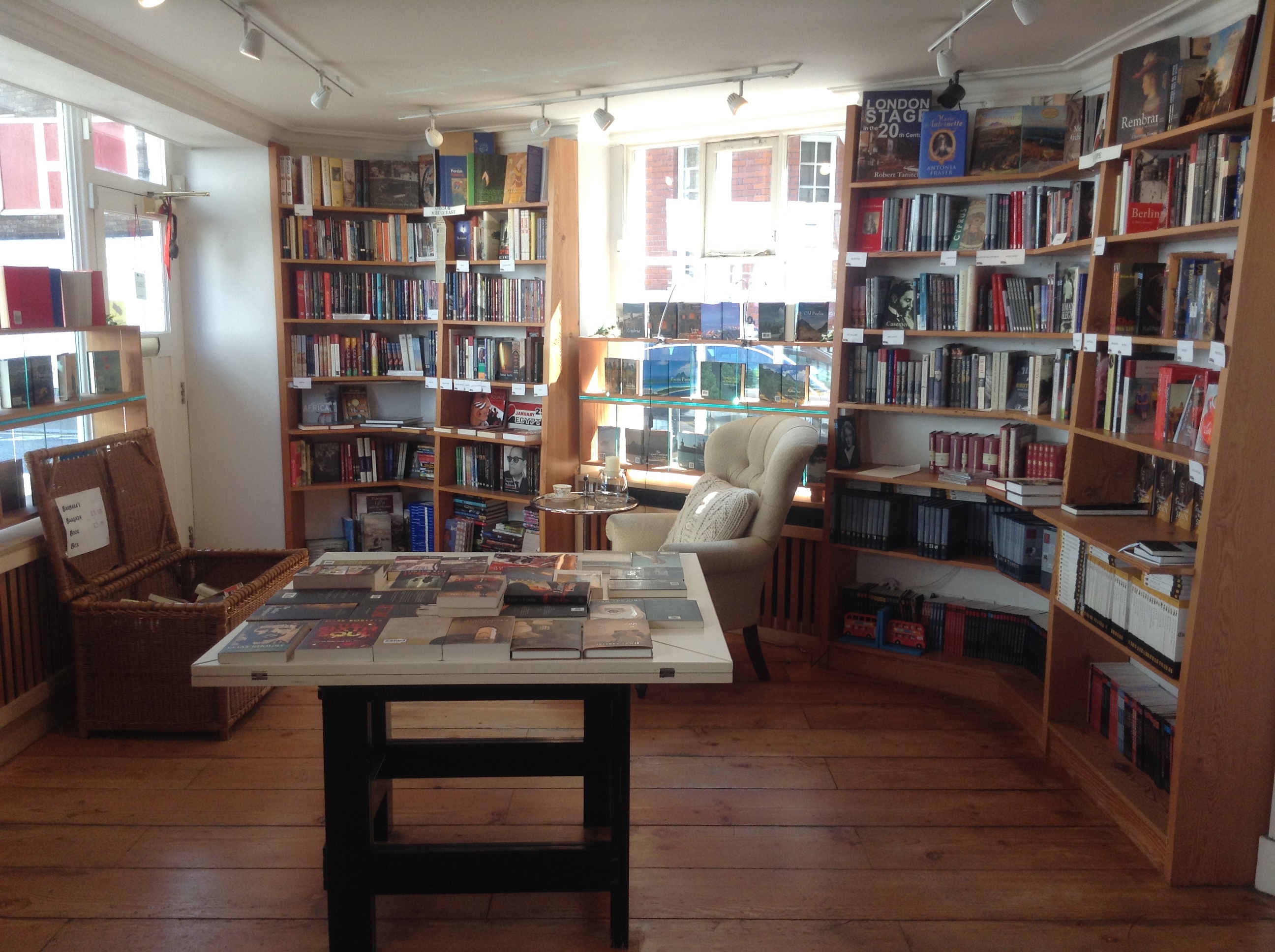
When Dr Barbara Schwepcke acquired this Belgravia corner building for the offices of Haus Publishing, she had not thought of opening a bookshop.  However, the leasehold stipulated that the ground floor should contain premises open to the public.  And so, in 2008, bookHaus was born.  At first, it was an outlet for books published by Haus but, in time, volumes by other publishing houses found their way onto the shelves that line the walls.  Many are translations from other languages.  Although the range of Haus-published works remains as varied as ever, bookHaus has recently become a travel bookshop.

photo 21

Eighteen months ago, Barbara gave me my first “proper” break as a literary translator.  Over an espresso from the stylish coffee machine in the corner, by the large, soft armchair, she provided advice, e-mail addresses and encouragement.  Then she took a punt on me, and gave me a book to translate.  Le balene lo sanno, by Italian writer Pino Cacucci.  A jewel of a book by a man who truly sees and lives the lands he visits.  A travel log about Baja California, where the author travelled in the footsteps of John Steinbeck.  My first real translation, published by a real publisher, as a real book.  Eighteen months on, under the title The Whales Know, it’s a real, cherry-red, cloth-bound book, with my name printed beneath that of the author.  “Translated by Katherine Gregor”.

I still can’t quite believe it.

Wow.

photo 11

Scribe Doll

Posted in Odds & Ends | Tagged , , , , , , , , , , | 16 Comments

Picking Up The Pen Again

Just start.  Take that first – hard – step.

“I haven’t written since before Christmas,” I say to H.  “If we stay at home, I’ll just keep working.  I really want to write something – anything – today.  Besides, we both need fresh air and some good coffee.”

So we stroll up the hill to the Village, past daffodil and crocus buds, to the little French pâtisserie where I spent so many Sundays over the summer and autumn, scribbling away while people-watching.

I open the A4 spiral notebook at a white page full of possibilities and take a deep breath.  That’s not enough.  I take a gulp of cappuccino.  The coffee glides down my throat and injects some clarity into my fogged-up brain.  Across the table from me, H. is engrossed in a large, hard-bound volume about Gabriele D’Annunzio.  Without taking his eyes off the book, he reaches for his latte and takes a sip.  I know I’ve dragged him away from his work, so we can’t go home until I have written something – anything.

One… Two… I pick up my Faber Castell and slowly unscrew the chrome cap.  The pearwood barrel feels smooth in my fingers.  I haven’t used my fountain pen for nearly two months.  Well, I haven’t used it for anything important, that is – for anything creative.

I get a pang of anxiety as I hold the pen suspended above the page.  I don’t know what to write.  I suddenly think I can’t write.  Was there ever a time when I could? I make a conscious effort to lower my hand, and the nib lands on the paper.  An instant of thrill and anticipation.  Like the moment when a sapphire needle lands on a spinning glossy black record and you wait for the music to begin.  Two months of not writing.  Weeks of trying to breathe whilst caught up in a whirlwind of work deadlines, teaching, translating, home-hunting, life changes, etc.

Swirls of shiny black ink start waving along the faint lines, slowly gaining momentum.  I am suddenly a cauldron bubbling with emotions.  Excitement, fear, longing, passion, joy and the overwhelming realisation of just how much I have missed writing.

My thoughts are shapeless forms floating, whizzing and sagging inside my head.  They need a pen to sort them and give them a clear identity and purpose.  My feelings are like a garden overgrown with weeds.  They, too, need a pen to groom them into a sharper definition.  I am an overworked bundle of uncontrolled emotions.  I need to be written down, so that I can read myself and so see myself clearly.  I can’t see because everything is inside me.  So I slowly let it all pour out of me through the tip of the nib, and watch myself take shape in the glossy ink loops and curls that run across the white page where I begin to see myself.

I look up and meet H.’s eyes, full of gently amused kindness.  He’s been watching me for a while.  “Your face…” He looks for the right words, although I already know what he’s going to say.

“Is my face giving a theatrical performance?” I ask.

“Yes,” he says, smiling.  “All those contrasting expressions.”

 Scribe Doll

Posted in Odds & Ends | Tagged , , , | 19 Comments

No Post Today (Again!)

Not being lazy – I promise.

Posted in Uncategorized | 2 Comments

No Post Today

Scribe Dolls begs your patience.

Posted in Uncategorized | 4 Comments

No Post Today

Apologies.

Posted in Uncategorized | 2 Comments