Odds& Ends: Alone, but not Lonely.

When I was at university, my best female friend said she preferred sharing a house with other friends.  I said I preferred living alone, if I could.  Then she said something that has always stayed with me, “I like to be with people, but have the option of being on my own.”  I guess I like being on my own, but have the option of being with people.

The older I get, the more solitary I seem to be turning.  I am increasingly craving my own company.  Perhaps this is because all my jobs, so far, have involved days full of intense listening and talking to people.

If I spend too long with my fellow humans, I feel as though I am floating in the air, disassembled, not quite sure where the various bits of me are.  The sense of fragmentation makes me bad tempered, anxious and exhausted.  When I am alone, all the scattered parts of me come together.  I feel the ground supporting my feet.  I am whole, again.  At that point, some people might even say that I am good company.

Do not get me wrong.  I like people.  I love my friends, very much.  I feel privileged to have them in my life.  However, for friendships to work, the times I spend with them need to be followed by intervals.  I like to think of my precious friends like luxuriant oases you come across after a relatively long walk across a stretch of golden sand, with no other company but the twirling djinns of the wind.  I am not one for sipping water from a bottle every few minutes.  I need to wait until I can drink a large glassful in few gulps, and feel the cool water fill me with strength.

Having dinner alone whilst on holiday is a miserable experience for me.  I hate the looks – part disapproval, part pity – I get when eating at my table for one, in a restaurant.  I also miss not having a companion to share my report of the day’s events.  However, I do not necessarily want to share all the events with my companion, as they unfold.  I like to wander the streets of a new city, stopping to rest or drifting into a winding street because it intrigues me, without having to take into account anyone else’s preferences.  I like to listen to the murmur of ancient buildings without another voice in my ear, and establish intimacy with a new place, without interference.

To this day, one of the most perfect holidays I have had, is a trip to Venice with my dear friend B.  We would meet and have breakfast at one of the tables the pensione had set by the canal, then he would go his way and, I, mine.  We would meet again in the late afternoon.  “I want to show you this beautiful church” or “shall we go and see this painting together?” one of us would say, and we would set off together.  Later, we would have our picnic supper under the arches of the Palazzo del Doge, then stroll down the narrow calli for the rest of the evening.  After a large part of the day alone, it was wonderful to have the company of a like-minded person.

When you travel alone, you meet many people on your way.  Your read their faces and hear their tales.  You can even make new friends.  When you travel in company, the same people are no more than anonymous passers-by.

I enjoy going to the theatre with my friends.  There is great fun in laughing or being struck by a new idea, whilst in state of togetherness.   Still, often, I like to go on my own.  I like immersing myself into the text and the performance, without the distraction of worrying if the person next to me is enjoying the evening, or is comfortable in that seat.  I am ridiculously long-sighted, so going to the cinema alone is sometimes more relaxing, unless I am with an obliging friend who does not mind sitting in the back row.  Also, I like staying put and reading the final credits to the very last, and not feel I have to get up as soon as the film is over.  Afterwards, I sometimes like to spend a little time analysing the play or film, absorbing it, deciding what I think, before starting the vocal post-mortem which inevitably follows when you are with friends.

I enjoy very much going to a park with a friend.  I like sitting on the grass with a picnic (as long as my friend has prepared it – I never seem to get the hang of a good hamper), discussing books or politics.  However, often, I love spending time in the park on my own.  In truth, I am never alone in the park.  A red-breast robin will hop over to my bench, inquisitive.  I think he is the park’s secret agent, on a mission to investigate all human visitors.  He cocks his head.  Friend or foe? Friend, I reply.  Somebody’s dog runs up to me and, after a good cuddle, we look into each-other’s eyes, and acknowledge a perfect understanding.  A grey squirrel does a somersault in the grass, then runs up a tree, like a circus acrobat, spreading the news of my arrival and, hence, the possibility of nuts.  In the distance, a grey heron takes slow, balletic steps in the shallow water, then stops and stands still, like a statue, before lunging with his beak into the water, with lightning speed.  I admire and envy his unwavering focus.  A breath of wind rustles the leaves of the tree, and the swishing sound gives me a kind of thrill.  Above me, a crow caws an ancient, arcane spell.  A leaf sways down and lands in my lap.  It is a message for me from the tree.  “Listen,” it says, “I’ll tell you a story.  Something I witnessed three hundred and twenty-five years ago.”

I close my eyes, set my imagination free, and listen.

I am alone, so there is nobody to tell me that I am… well… perhaps a little mad.

Scribe Doll

Posted in Odds & Ends | Tagged , , , , , , | 14 Comments

Words and Civilisation: “Freedom” and “Rights”

All the news headlines in the country, in the past few days, have mentioned what I understand to be the recent publication, by a French magazine – and now, apparently, also an Irish newspaper – of the Duchess of Cambridge seemingly sunbathing topless in a French château.  It now appears that an Italian magazine is also following suit.

Mostly, these headlines mention “topless photos” or “topless pictures”.  I am astounded by the poor grammar.  Are the actual photos, or pictures, topless? Have their tops been snipped off with scissors? Or is the person in them topless? After all, if you said “the black and white photo of so-an-so”, the black and white would refer to the photograph print – and not to the colour of the so-and-so in it.

Still, that is a small, possibly pedantic point.  There is a more serious issue here.

Newspapers and magazines need to sell copies of their publications.  That is a fact.  However, they rely on the public buying them.  What I find nauseating, is that there are so many people who will rush to buy newspapers or magazines because they contain photos of a semi-naked Duchess of Cambridge.  What does that say about these humans? Do they think Catherine Middleton’s breasts will be somehow differently shaped because she is a Duchess and the wife of the second in line to the throne? They are just breasts.  Nature distributes them evenly among all women.  Or is this curiosity driven by a desire somehow to own an intimate part of an individual whose status and fame places her outside the reach of their social circles? Or is it a deep-seated satisfaction to see her embarrassed and humiliated? An urge to see a crack in an even veneer? Whatever the motivation behind this voyeuristic tendency, I find its expression repulsive and disturbing.  I also find it profoundly sad.  I feel deeply uncomfortable that such a large part of humanity, of which I am an indivisible part, should have it in it to act this way.  If, as John Donne put it, “No man is an island” then I, in part, also bear the responsibility and the shame of this.  We all do – even those of us who exercise their freedom not to look at such photos.

Once again, this makes me think of the concept of freedom and right, and of the overuse and abuse these words suffer every day.  The term freedom lost its power to inspire me some time ago.  When I hear it, I am sorry to say, I often equal it in my mind to the word bullying.  As for the term right, all too often, it makes me think of tyranny.

I was on the bus, going to work.  A young woman opposite me was listening to her iPod.  I could hear quite clearly the songs she was listening to, in spite of the rattle of the bus, it was that loud.  I could sense the man sitting next to me growing increasingly irritated.    I, on the other hand, kept trying to distract myself from a Salvador Dali-style mental image, inspired by the dream sequence in the film Spellbound, of a pair of gold manicure scissors floating in through the bus windows, by magic, and snipping through the white cords of her earphones, in two clean cuts.  Finally, the man snapped, “Turn that down, will you!”

Immediately, the young woman told him, in a rather superior tone, that he should ask politely, then – so predictably – said it was her right to listen to her music.  An argument ensued.  I controlled my impulse to butt in.  On London public transport, asserting your rights against the sprawling rights of others has been known to lead to unpleasantness and even violence.  Still, this looked like a potentially reasonable young woman.  Even so, I needed to dispel my frustration, before speaking.  It is true, the man could – and perhaps should – have said, “I’m so sorry but would you mind turning it down just a little?” However, I find it interesting how people push and push your boundaries with their actions but then judge you as the bad guy for reacting to them.  Somehow, it did not cross the young woman’s mind that she could have been responsible for causing the man’s abruptness.  It annoyed me profoundly that she was taking the moral high ground just because she was managing to keep a calm and polite – albeit patronising – tone of voice.  I took a deep breath, and smiled at her (was I proud of myself!) and said, “You’re absolutely right.  It’s within your right to listen to your music.  The problem is, that I don’t actually like your music very much but I have to listen to it because it’s loud.  Do I have a right not to listen to it? You see our problem, here…  That’s the thing about crowded buses.  We’re all thrown on top of one another, so everybody has to compromise a little… What do you think?”

I could not believe it.  The young woman gave me a long, intense look.  “Yes, I guess that’s true,” she said.  She turned down the volume on her iPod; I thanked her and we travelled in the silence.  When I got off, I thanked her again, and I wished her a good day.  She responded with a beaming smile, and wished me the same.  This episode restored my faith in humanity, and cheered me up for the rest of the day.

There is a reason the word right as an adjective – meaning morally good and correct, is the same as the noun.  The OE Dictionary defines it firstly as “that which is morally right”.  Never mind the fact that, legally, we are entitled to do something.  Is it actually right that we do it.  In Terence Rattigan’s play The Winslow Boy, barrister Sir Robert Morton expresses the desire that right, as opposed to justice be done.  Justice provides guidelines on what is acceptable by law but it is up to our conscience to do right.  It may be legal for embarrassing photos of celebrities during their moments of privacy to be printed in the press.  Is it right, though?

It is legal to make noise in your flat until 10 p.m.  You are free to do so.  Does that mean you cannot exercise your freedom to be considerate towards others, and spare a thought for them, by keeping the volume contained within the walls of your flat?

US American lawyer Clarence Darrow said, “You can only protect your liberties in this world by protecting the other man’s freedom.  You can only be free if I am free.”

If we do allow our personal freedom to sprawl and invade a part of another individual’s personal space, then our freedom become tyranny.  If the pursuit of our rights infringes on another person’s rights, then we bully that person.  Your freedom must be limited by the boundary marking the start of my freedom.

Personally, I do not believe we come into this world with rights, but with privileges; and, as such, we should exercise our freedom of personal responsibility to treasure and safeguard them.

Scribe Doll

Posted in Words and Civilisation | Tagged , , , , , , | 24 Comments

A Poesy Ringful of Stories

I used to be a theatrical agent.

A young actor from RADA, whilst deliberating whether or not to accept my offer of representation, asked, “What, would you say, sets you apart from other agents?”

I struggled to come up with an original answer.  Then I caught sight of the engraved gold ring on the little finger of my right hand.  I showed it to him and said, “I’m probably the only agent in town who’s received a present from all her clients together.”

The young actor in question – whose original and extraordinary talent, in my opinion, made him stand out among his peers – went on to become my client.  I doubt it was my answer which swayed him, though.

As I said, I used to be a theatrical agent.  I had a small office in Southwark, around the corner from Blackfriars Bridge.  At six o’clock – official but rarely observed closing time – the chimes of Big Ben would float over the Thames and come tapping on the window panes I faced as I worked.  On the wall on my right were arranged black and white portrait photographs of all my actors.    The wall on my left, by which the kettle and biscuit tin stood, hung a British Library print of a Mediaeval music score.  The frosted glass wall behind me was covered in Commedia dell’Arte pictures and Al Hirschfeld cartoons.  Within these walls were sheltered many people’s dreams.

When I first joined the agency, I inherited a ready-made list of clients, none of whom I had actually seen act, so plugging them to casting directors was an exercise in histrionic ad-libbing, at first.  What I needed, to do my job properly, was to see them all perform; ideally, as soon as possible;  in a dream scenario, all at once, to save time.  Soon enough, the perfect opportunity presented itself in a location I had loved for some years: the archeological site of the Rose Theatre, on Bankside, around the corner from the Globe.  I had been bewitched by the place a few years earlier, when attending a party there.  It helped that I happened to strike up a conversation with Peter O’Toole.  A charming gentleman with extensive knowledge, he showed me a part of the archeological dig and told me some of its history.  We talked about the symbolism of the rose throughout the centuries.  Who could ask for anything more?

And so a fundraising event in aid of the Rose Theatre was planned for a cold February night, on the very site where Christopher Marlowe premiered some his tragedies and a few Shakespeare plays first saw the light.  We called the show A Pastime with Good Company –  a series of scenes from plays spanning several centuries, all starring my clients.  Directors generously willing to give their time for nothing were roped in from outside the agency for the occasion.  Casting directors and other showbiz people were invited.  The rest of the tickets were sold to the public.  The show sold out and there was a waiting list.  It was a magical evening.  Standing at the back, watching the show, with its fairy lights and flaming torches, smelling the damp rising from the excavations, I imagined Kit Marlowe looking down on us all, and hoped he was smiling.

After the show, as befits a company of thespians, we adjourned to the pub.  That is where a surprise awaited me.  All my clients had clubbed together to buy me a gift.  A most perfect gift.  A replica of a poesy ring found during the archeological excavations of the Rose Theatre.   A gold ring, engraved with a heart pierced diagonally by two arrows crossing in the middle, and carrying an inscription in Old French: PENCES POVR MOYE DV [Deo Volente].  Think of me, God willing.

Please God, may you think of me.

I have worn that ring every day since that cold February night.

In time, I took over the agency.  Many of the original black and white portraits on my walls gave way to new faces, and each and everyone of them also became a part of my gold ring – even though they had not taken part in the performance at the Rose.  Then the Credit Crunch sank its fangs into my agency.  On Christmas Eve 2009, all the office walls were bare as I locked the door for the last time.  Like everyone who has ever worked in showbusiness, I have my share of scars on my back.  However,  they have not tarnished the gold of my ring.  There are a sufficient number of loyal and generous people, be it actors, casting directors, directors, theatre managers and others, who will always ensure that my ring is bright and shiny.  Every good thespian who crosses my path gives me my ring anew.

*   *   *

For years now, I have wondered about the history of the posy ring of which mine is a copy.  A few days ago, I finally rang the Museum of London, where the original Rose Theatre ring is displayed (although it is currently on loan to the British Museum for their Shakespeare exhibition) and asked if someone could tell me about it.  That is when a whole new story unfolded before me.  I had always assumed that the French inscription was nothing more than Tudor aristocratic pretentiousness.  However, it transpires that the ring is, in fact, authentic French, 16th Century.  The lettering on it is not engraved but stamped, which makes it a poor quality piece of jewellery, likely to have belonged to a low-status man or woman.  It could have been a lover’s token or a wedding ring.  It also seems that Philip Henslowe, owner of the Rose Theatre, ran a pawn shop, on the side.  Although many other poesy rings are listed in his inventory, “mine” is not mentioned.  Could he have forgotten to note it down? I think it unlikely.

How did this ring come to be buried in the dust of a playhouse for over four centuries? And what was a French ring doing in England? Did a Frenchman give it to his English sweetheart? A low quality ring, hence not the gift from a nobleman.  Was he a clerk? A lawyer? A poet? Or a weaver?

PENCES POVR MOYE DV

Think of me, God willing.

Did circumstances keep these lovers apart, separated by the grey waters of the English Channel? If so, why?

Did a woman lose that ring, while watching Dr Faustus? Was it loose on her finger, and slip off while she applauded the actors? Did she frantically search for it on the ground, after the performance, among the broken hazelnut shells and the dirt? Did she weep when she could not find it? Did she keep running her thumb on the base of her finger, feeling a shock when the ring was not there? Was she young or elderly?

Please God, may you think of me.

Were the lovers reunited? Did he – or she – cross the grey waters of the English Channel? Did she leave the White Cliffs of Dover behind her, or did he rejoice at the approaching sight of them, knowing his beloved awaited him there?

I imagine all of us, who own a copy of that ring, have woven our own stories and memories into what could have been that of its anonymous original owner.

As for me, the faces and voices of the theatre folk who have enriched my life are reflected in the sunny gold of my ring.  I see those who have graduated from clients to friends, and with whom I am still in touch.   The mischievous smile of the talented Shakespearean actress who presented me with the gift ring.  The quirky sense of humour and unwavering support of the Australian actor who was my first-ever signed up client.  The actor-director with the warmest hug in the world – and a taste for cake.  The actor-musician who never complained on an arduous tour, who has become a brunch buddy.  The young actress-musician who offered to double her commission to me, when the agency ran into financial difficulties.  I see the musical theatre  actor I was trying to place with another agent, who said, “I’ll be fine – I’m worried about you! Who is going to look after you?”.  The Irish actor who offered to come and help move boxes and furniture.  The clients who volunteered to come and work in the office, so that I could take a part-time job to keep the agency afloat.  The people with whom it was an honour to do business and especially those I was privileged to represent, as an agent.  And, of course, all the extraordinary people I have yet to meet.

God willing, they may think of me, every so often.

*   *   *

With thanks to the Museum of London – most especially Ruth Rolfe and Julian Bowsher, for so kindly answering my queries.

An image of the original ring will be published on the Museum of London website in November. 

Scribe Doll

Posted in Odds & Ends | Tagged , , , , , , , | 27 Comments

Church Bells

Sometimes, the wind carries in through my windows the faint sound of bells from a Tudor church that stands right by the river.  On a Sunday morning, it is a joyous pealing.  In the evening, the sound is more measured, more akin to the Anglican chant of the evensong it precedes.


A few months ago, I heard about a couple, newly relocated to an English village, who had begun a campaign to hush the church bells, because they stopped the couple from sleeping at night.  I was saddened.  In time, you get used to sleeping through any amount of noise, be it road traffic, airplanes, the neighbours’ television, and even gunshots.  How could this couple not grow accustomed to sleeping to the bells? After all, just how loud could village church bells be?


For as long as I can remember, I have loved the sound of church bells.  There is something reassuring in the regularity of their chimes, something cosy in the way they watch over the  passing of time, gently punctuating it, like a metronome.


My grandmother used to take me to hear the joyful ding-a-ling of Russian Orthodox bells, and the jingle of the soprano solo bell, teasing the others to respond.  On Sunday mornings, we sometimes followed its their peremptory call to the colourful Russian Cathedral off the Avenue Tzarevitch, in Nice.  A call associated in my memory with air heavy with incense and the basso profundo of the stern Batyushka priest.


I remember a not dissimilar pealing at midnight on Easter Saturday in Athens, when I was nine years old.  Competing with the crack of fireworks, it resounded among a congregation spilled out into the church yard, all exchanging Easter blessings.  Children, red-dyed hard-boiled eggs in hand, tapped them together.  If your egg remained unscathed but managed to crack the other child’s egg shell, then you won.


I am partial to English church bells.  I love the slightly disorganised clanging, as though the bells were tripping over one-another in their eagerness to be heard, like a group of neighbours competing to be the first to impart a piece of juicy gossip or good news.  When I was at university, my College was a few paces along from Durham Cathedral.  I remember with great fondness the merry bell-ringing on a Sunday afternoon, bouncing off the stone cobbles of the Bailey, running downhill past Windy Gap, to the River Wear, and echoing as far as Prebends Bridge, almost in answer to Sir Walter Scott’s poem engraved on the parapet.  When I sat up all night writing last-minute essays, the quarter-hourly chimes kept me company, perhaps with a tone of reproach for my having left the essay so late.  In the early evening, a quick, regular dong called to choral evensong.  It gave me just enough time to grab my gown, wrap its black folds over my jeans, and sprint through the Norman arches.


The solemn, baritone bell of San Marco roused me from my sleep at every hour on my first night in Venice.  A solemn toll, proclaiming the indisputable supremacy of La Serenissima, reminding you that you are but a mere traveller, ascertaining that you feel the full privilege of being in presence of such magnificence.  I listened and mentally bowed to the bell, my senior by a few centuries.  On my second night, the same bell drowned out the swearing in veneziano of the gondoliers drifting below my window, and lulled me to sleep.  Now that I honoured the status of the City of Venus, San Marco’s bells would watch over my slumber.


Scribe Doll

Posted in Odds & Ends | Tagged , , , , , , | 16 Comments

Female Solidarity?*

A couple of years ago, my colleagues and I were watching BBC News 24 during our lunch break.  There was a report about the Chilean miners trapped underground for several weeks.  Finally rescued, the men were telling the interviewer about the bond of solidarity that had developed among them.  A bond as strong as brotherhood.

One of my female colleagues sniggered.  “If it had been women trapped together like that,” she said, “they’d have scratched one-another’s eyes out.”

All the women at the table laughed and nodded.  The men stared, eyes wide.  “Why?” one of them finally asked.

We did not bother explaining it to them.

Speak up, Ladies.  I would be very interested in hearing your comments about this, to see if a pattern emerges, and if experiences vary from country to country.

What kind of female boss have you had? One who views you as a competitor? One who demands to be kept informed of every detail of every stage of your progress with your task – or one who is simply interested in the result, but how you get there is up to you?   One to whom you are nervous submitting too good a piece of work? One who will clearly take offence if your dodge questions about your personal life? One who will correct you in front of a roomful of people? One you look up to as a mentor? Who is supportive, laid back and eager for you to get ahead in the profession? One who feels genuine pride and joy when she tells you that you have surpassed her?

Right.


If you are single, how often do you see those female friends who are married/paired up? Is that during normal socialising hours (i.e. evenings and weekends) or during off-peak times (i.e. Monday to Friday before 7 p.m.)?

Those of you who see your attached friend evenings or weekends, is her husband/partner generally present, or does he happen to be out/away? Does your friend call to invite you over for dinner, saying, “[Man] is working late/away.  Why don’t you come ‘round for a girly night in?”

Do you find that your married/attached female friend reserves evenings and weekends for socialising with other married/attached friends (complete with respective husbands/partners)? If you drop a hint that you would quite like to join in, does she quickly say, “I’d invite you but you’d be bored – we’ll all be couples.”

Or does she make a point of inviting you and adding an extra man to her guest list?

Do you feel an unspoken rule that you are expected to confine your ‘phone calls to your married/attached friends either to office hours or that narrow post-work – pre-dinner gap?

Right.

You are at a party, engaged in enjoyable conversation with a man.  Does a female figure slink over, out of nowhere, insinuate her hand into the crook of the man’s arm (or slide it around his waist) and dart you a “just so you’re clear whose territory this is” look?

Right.

You are sitting in a restaurant, in company of men and women, chatting.  An alluring woman, charged with sexuality and self-confidence, walks in.  Everyone falls silent and stares.  Once she has disappeared from view, what comments do the men make? And how do the women respond? Do they say “Go, girl!” or draw parallels between her and females of the canine species?

Right.


You have just embarked on a passionate affair with a gorgeous-looking, intelligent, impeccably-mannered, generous, entertaining, wealthy man who is madly in love with you.  How do your female friends react?

Right.

I just wondered.

This piece is dedicated to all the generous, supportive women who enrich my life.  In the manner of Gianni Schicchi’s apology at the end of the opera, I hope they will forgive me – and giggle.

* Don’t get too smug and comfortable, Gentlemen.

Scribe Doll

Posted in Odds & Ends | Tagged , , , , , , , , | 18 Comments

Dress Circle: Another Pearl, Crushed.

It was Michael who first taught me the difference between soundtrack and cast recording.  “Soundtracks are from films, darling,” he said, pushing up his glasses, his mellow Irish accent softening a vague distaste for my ignorance, “and cast recordings are from stage shows.”

I used to call them all soundtracks.  But that was before Michael and Chris – before my education at Dress Circle.


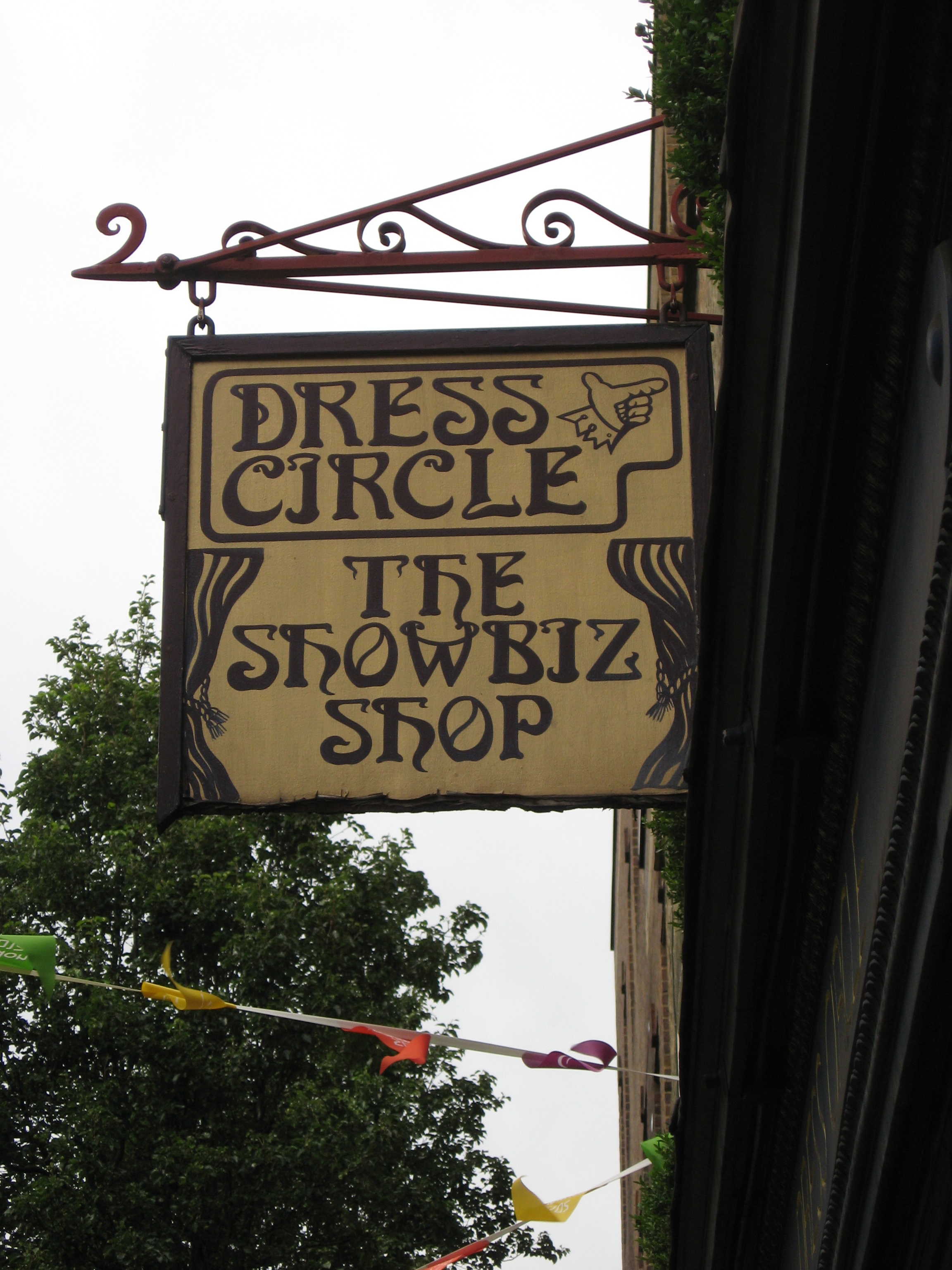
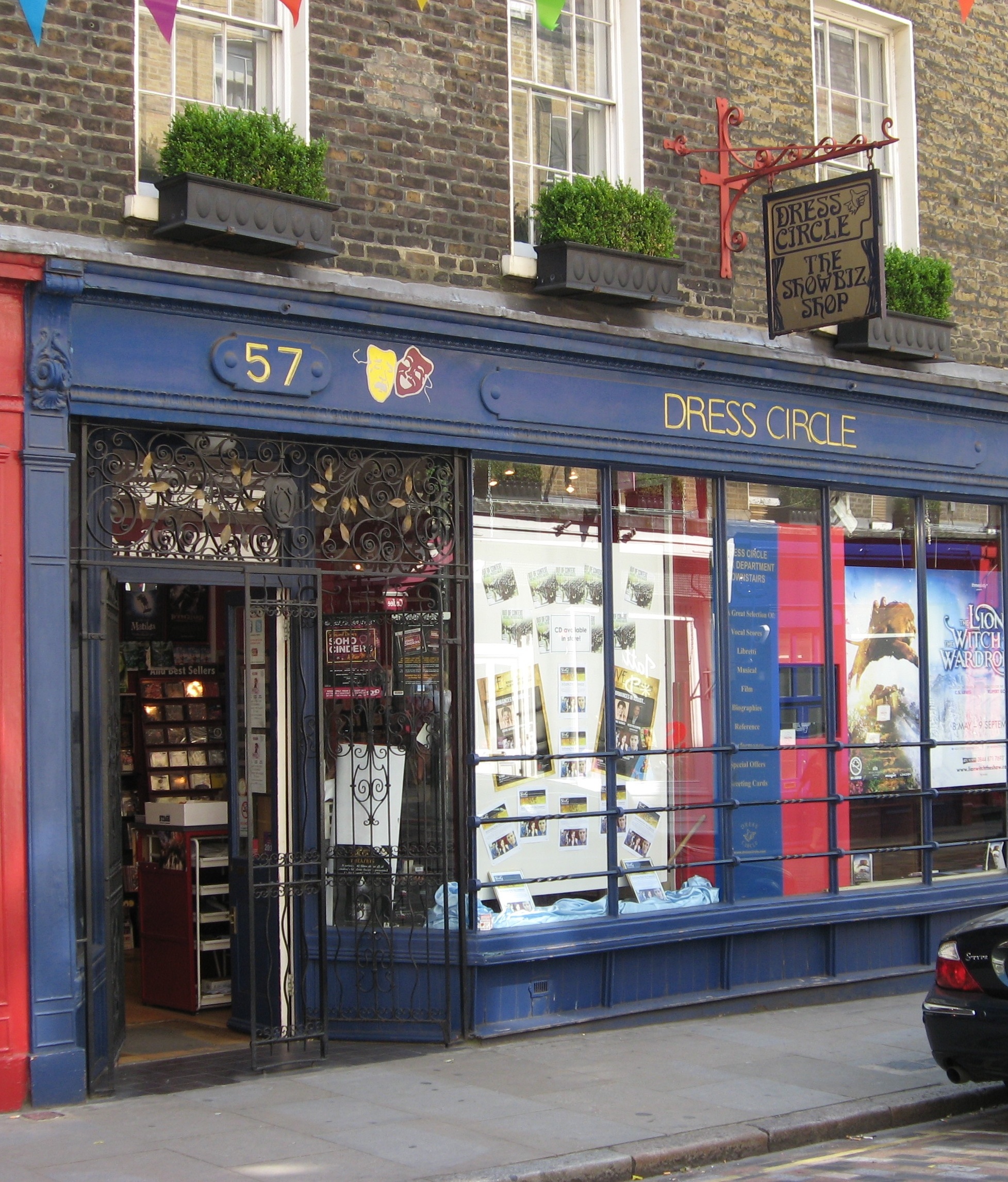
Dress Circle is a famous musical theatre shop located in London’s Covent Garden and, for many of us, the centre of the musical theatre universe.  A small shop with a dark blue front and wrought iron gates, at the top of Monmouth Street, it attracts customers from all over the world.  Time and time again, I have seen Dutch, German, Japanese, American and Italian customers walk in with a map indicating the shop, and leave with a basketful of CDs, DVDs and memorabilia.  Drama school students sit on the floor against the bright red walls, perusing books of music scores, looking for audition pieces.  They walk up to the counter.  Chris tells them they can get 10% off with a student Equity card.  Did their tutor not tell them?  Sometimes, they hum a tune and he comes up with the title, composer and lyricist.   Tourists ask to buy a wind up model of the monkey playing the cymbals from The Phantom of the Opera.  Hoards of giggly teenage girls raid the shop for anything relating to Wicked.  They try on Elphaba’s green sunglasses, buy the silver witch hat pendant, and ask if the West End show poster can be rolled up.  Thrilled customers put DVDs on the counter, ready to pay.  They have been looking for this film for years.  “Have you got a multi-region player?” asks Michael.  “This is Region 1.”  Many musicals on DVD are imported from the US.  Dress Circle trained me well –  I now buy only multi-region DVD players.  I also learnt how to open a new CD by running a biro point along the side, slashing the film wrapping easily.


Stephen Sondheim, I am told, has been in to buy CDs.  So have other famous artists from the world of musical theatre.  Before curtain time, West End performers rush in – their stage make up already on – to buy CDs and get an update on showbiz gossip.  When asked how the opening night of a major show had gone, a minor role actress is said to have replied, “Honey, I was wonderful!” A Broadway star reportedly had to be taken down a peg by the musical director of the show, for acting like a prima donna.  As an agent, I often relied on Dress Circle for advance information on which musicals were casting, not waiting for the official breakdown, which Broadway musicals were transferring and, of course, which shows were worth seeing.

“It’s two and half hours long, darling, but it feels like five.”

“Marvellous.”

“It made me lose the will to live.”

“Oh, darling, I wish I could see it twice.”

Anything you want to know about past, present or future musical theatre, the Witches of Monmouth Street hold the answer.  They live and breathe musicals, they know every recording, every version, every artist, every date – whether it is still being sold or deleted, and no matter how obscure.    Whatever it is that you want, they will try and get it for you, and if they cannot, then you can rest assured it does not exist.  The banter with the customers and among the staff is included in the price of the goods.  You can even get a cast recording of The Producers in Hungarian.


I may have drunk my love for musicals with my mother’s milk, but it is Chris and Michael who are my musical theatre godparents, and Dress Circle, the academy where I was trained.  As I walk into the shop, Michael turns his candid white head towards me.  “Katherine, my dear, how are you?” He purses his lips beneath his snow-white moustache  as he kisses the air about four inches away from both my cheeks with a loud, “Mwa!”


Regular customers walk in to say hello, and stand around chatting.  Some have frequented the shop for two or three decades, and know each-other’s tales.  All have stories to tell me about great stars they have seen in the West End or on Broadway.  One tells me of how he stood waiting for Gertrude Lawrence at stage door on a cold, rainy night.  When the great lady came out, she graciously apologised for keeping her fan waiting, and thanked him for his patience.  Another tells me that I cannot possibly not have heard ‘Cornet Man’ on the Broadway cast recording of Funny Girl.  I reply that I’ve only ever seen the film version.  He nearly faints from shock, pulls out the CD from his bag, and demands that the shop play it for me on the spot.  Barbra Streisand’s youthful voice rings through the shop, plucking at every musical string in your body.  I am transported, and ask to buy a copy of the CD.


Early on a Saturday morning, I sometimes bump into another regular, who bows before me.  “And how is Katherine the Great, today?”

I curtsey on cue.

Someone standing and smoking by the door says,  “His Majesty  – three o’clock.”

We all scramble to the door, and stare as a well-known showbiz personality walks by, and  gives us a puzzled glance.


Chris’s sense of humour is caustic, deeply irreverent and always right on the nose.  After a girl with a particularly oversized bust leaves the shop, he looks at me.  “What can I say, darling?” he comments with a slight London twang, “The children of England will never go hungry.” I can barely breathe for laughing.  A pearly grin spreads across his tanned face, and his eyes sparkle with mischief behind his glasses.  I feel like giving his jet black cowlick a tug.  It is Chris who introduced me to the cartoons of Al Hirschfeld.  I bought the collection of English cartoons, British Aisles as my Christmas present.


Richard, downstairs, is the one whose job is to find the unfindable CD or DVD.  He  watches the humour histrionics of the shop floor with an air of acceptance and imperturbable calm.  Andrew will listen to your comments about the latest show – or anything else, for that matter – with a twinkle in his eye.  Few people know that he possesses a superlative singing voice.  His rendition of Lerner and Loewe’s ‘If ever I would leave you’ is a rare treat.  John’s tone and expression are long suffering to the novice’s eye, but conceal a wicked sense of humour.  Even when he does not utter it, you can see the joke dance in his eyes.


As I write this, I glance at the top shelf of my CD case, dedicated to musicals, most of which are original cast recordings, most of which I bought from Dress Circle; and most of which represent episodes of my theatrical career.  City of Angels and Grand Hotel – both shows I saw at the Royal Academy of Music end of year shows, and which featured young performers who caught my eye and whom I signed up when I was a theatrical agent.  Both have become friends.  The London cast recording of The Sound of Music – another show with another young client – and now, friend.  Do I Hear a Waltz? – The first show I went to see in my role as a theatrical agent.  On the Twentieth Century – a show I once reviewed after I was told, “What do you mean you don’t know it?!”


It is a symptom of the current absurd decline of many things charming, unique and with a heart, that Dress Circle closed down* last Wednesday, 15th August, after thirty-three years.  So many independent shops are being crushed by the obscene rise in London rents or  the growth of internet shopping, or because they are unable to compete against the wave of faceless chain coffee shops, chain restaurants, chain clothes shops and other chains.  Another pearl, crushed.  London, so famous for its quirkiness and inclusiveness, is now increasingly suffocating the individuality of small, independent shops.  They are often unable to remain afloat in an ocean stirred by the power of the Pound Sterling.


I have no idea who or what will eventually open behind the listed wrought iron gates.  I just know that I will not be walking down Monmouth Street for a while.


Last Wednesday, many loyal customers paid a final visit to the shop that was a cradle of musical theatre knowledge.  I went, too.  Everybody was trying to be cheerful.  The  cast recording of the London production of Singing in the Rain bounced off the red walls, carefree and upbeat, strangely at odds with the depleted shelves.  You could hear “Change is good”, “I’m sure you’ll be fine” and other platitudes to stop yourself from bursting into tears.  There were many cards displayed on the glass cabinets.  People expressed their sorrow, and wished everyone the best of luck.  Some brought wine.  Others, chocolates.


This piece is my gift to Dress Circle.


* Dress Circle will continue to trade online.  For more information, please visit their website

Scribe Doll

Posted in Odds & Ends | Tagged , , , , , , , | 19 Comments

I am Overwhelmed…

Dear All,

I am not sure how to phrase this elegantly, and without gushing.

On Sunday evening, I received an e-mail from one of the editors at WordPress, informing me that my latest post The Delight of Hand Writing had been selected for the Freshly Pressed Homepage, and that it would go live within a day or two.  Naturally, I was delighted.  I have been writing a weekly column since February 2011, and this is a first for me.  Last night, just before going to bed, I checked the Freshly Pressed page, but my piece was not on it, yet.

This morning, like every morning, the first thing I did was switch on my BlackBerry.  The e-mail notification alert started beeping continuously.  It would not stop.  I panicked.  Last time I had received so many e-mails was when I had been hacked.  I looked on the display screen.  253 e-mails.  I rushed to my laptop, my BlackBerry still beeping every few seconds, demanding my attention.

While I was asleep, my blog piece had gone live on WordPress.  While I was asleep, in England, other parts of the world were awake – and 1,853 people had read my blog, some of whom had clicked the “Like” stars, commented, reblogged me and/or subscribed.  Hence, all the e-mail notifications.  There were 85 comments pending.

In a state of overcharged joy, anxiety and disbelief, I went to work.  I desperately wanted to tell someone about what was happening, and how my head was reeling but there was nobody I could ring at 7.45 a.m.  Many of my friends are showbiz people – and so would not be awake then; and those with daytime jobs would be busy.  I took myself to my morning class on automatic pilot, utterly stunned, trying hard to focus on what I was going to teach.  Vocabulary.  Animal idioms.  Infinitive and gerund verb forms.

After class, when I switched on my BlackBerry again, more e-mails started flooding in.  As I write this, the view count has reached 2,984, and there are 130 comments pending.  Europe is awake.

I want to thank you all, from the bottom of my heart.  Thank you to all those who subscribe to my blog and have supported and encouraged me for the past year and a half.  I would most especially want to thank those of you who leave comments – be it on the WordPress blog or privately by e-mail.  Your comments mean a great deal to me.  They are an acknowledgement, an encouragement and an act of true generosity.  It is you (I would like to name you but you all, I hope, know who you are) who have kept me writing in the knowledge that there are people out there worth writing for – even when I feel lazy or unmotivated.

I also want to thank all the people who have read my blog since last night – and all those who are about to read it (3,011 views and 133 comments pending now).  I hope that you may continue to read my Sunday posts, and enjoy them.

Heartfelt thanks and apologies to the 134 people, so far, who have left such incredibly kind comments, and reblogged my piece.  I will now read and tick “approve”, though it may take a little while to get through them all.  I would like to respond to everyone’s comment so, again, please bear with me for the next few days.

I wish there were more special words of expressing gratitude.

THANK YOU!

(Now 3,139 views and 136 comments pending)

Scribe  Doll


Posted in Odds & Ends | 32 Comments

The Delight of Hand Writing

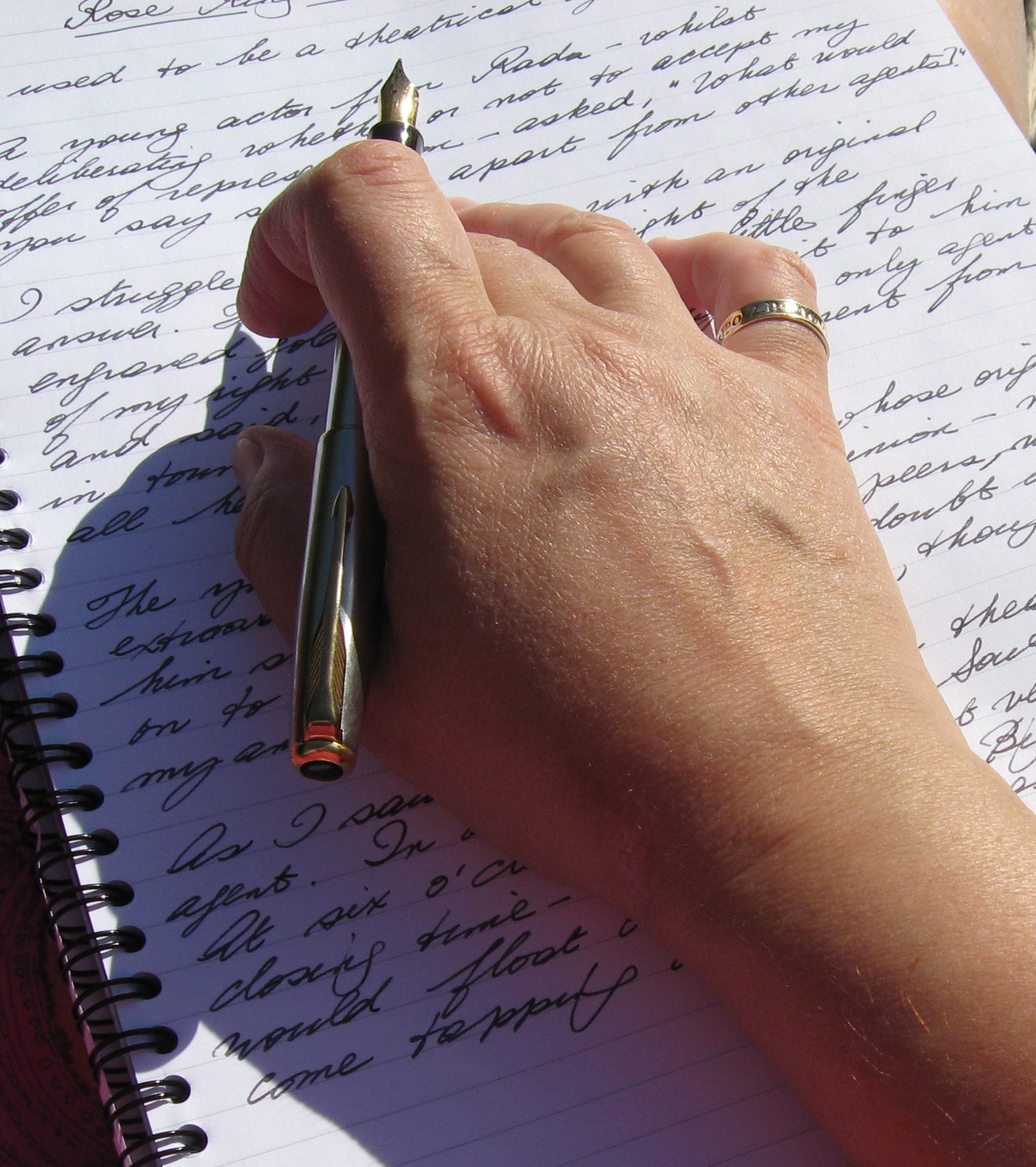
I am sitting on a wooden bench, by the red-brick wall of a small Elizabethan palace.  My back against the arm-rest,  my legs stretched out before me, bare toes  wriggling with the pleasure of sunshine.  Behind the bench, a few sprigs of lavender nod to the breeze, giving off a delicate fragrance.  The self-satisfied gurgle of the Tudor courtyard fountain is caressing my soul.  Somewhere in the vicinity, a crow is cawing.  I sense mockery in its tone.  On my lap, my usual A4 spiral notebook; in my hand, my usual fountain pen.

A gentleman and his wife stop to ask me directions for the café in the park.  Before I have a chance to point, he exclaims, “Oh, my goodness – you’re writing! And with a proper pen! It’s ages since I’ve seen anyone do that.  I’m impressed!”

I am not used to strangers expressing quite so much astonishment, true, but I am used to getting looks; looks that combine puzzlement with wariness or a hint of admiration.  Sometimes, when I look up, I meet a supportive smile from the person opposite me on the Tube or across the coffee shop.  In my mid-forties, what used to be viewed as youthful quirkiness is now labelled as middle-age eccentricity, but the truth is I have written with a fountain since I was nine years old – ever since I was sent to a a French school.  The teachers there demanded that we use nibs.  Allegedly, it helped improve our handwriting.  I have just never grown out of it.

I derive great pleasure from writing with a fountain pen.  I love the soft murmur of a well worn-in nib as it glides on the paper, tracing glistening black swirls which turn into an elegant matt as they dry.  I own four fountain pens.  The latest addition (and the only non Parker-made), was crafted from a piece of 13th Century oak, recovered from the timber ceiling of York Minster.  The handsome nib is engraved with a pattern of swirls.  I have had it only a few months and it has not yet got used to the caprices of my hand.  It has not yet learnt to pace its ink flow.  It stumbles, rebels, catches on the paper, and scratches it with a harsh rasp.  I try and be patient and exercise it regularly, to train it to my fingers.  The eldest of the four saw me through my final school exams.  The stainless steel barrel is just the right thickness and weight for my hand.  The burgundy red plastic of the grip section has changed shape over the years, moulded by the knuckle of my right middle finger.  The small hooded nib skates across the paper with seamless dexterity, and in almost total silence.  It is an old friend who knows all my thoughts and whims, and is at one with my hand.

I like the fact that you can hold a fountain pen in your hand lightly, and not have to force it down onto the paper as you have to do with a biro.  I like the boldness of the black ink that stands out against the white paper, like an uncompromising statement, ready to be counted.

Do not get me wrong.  I can type on a computer.  I have an excellent working relationship with my 13’’ MacBook Pro.  It always knows what I want, and executes it to perfection but I cannot open my heart to it.  I must hand-write it first, then convey it to Mac.  I can, when faced with time restrictions, create a text straight onto computer.  However, I always feel as though I have missed a stage of the process; like leaping from A to C without going through B; like eating a sandwich on the hoof instead of a sit-down meal; or jumping over a river without walking over the bridge.

Paradoxically, it can take me longer to come up with a sentence on a computer screen than on a  sheet of paper.  I stare at the screen and become aware of its almost imperceptible tremor.  It does not inspire me, yet I cannot look away, even though my eyes start feeling tired.  I get distracted by the low but monotonous whirr.  Thoughts and words start chasing one another at increasingly vertiginous speed, in a  chaotic game and I struggle to keep up.

The moment I pick up my fountain pen, thoughts and words get into pairs and stand in an orderly queue, waiting their turn to slide down the ink piston and flow out smoothly through the nib onto the paper.

Because my thoughts have to obey the speed of my wrist, they become more focused, more anchored.  Words written on paper feel more tangible, more physical, more firmly rooted in soil – even more real.  Also, my handwriting reflects back to me my own feelings about what I am writing.  It is not as professionally neutral as the perfect Palatino font programmed on my Mac.  It becomes irregular, crooked and even illegible when I am writing out of duty or necessity.  However, the letters increase in size, the curves grow smoother, the loops acquire panache, and my penmanship becomes clearer when I mean the words I write.  One could say that my handwriting is quick at calling my bluff.

Any creative writing I do – be it a theatre review, a short story, or my weekly blog – I prefer to hand-write first, then copy/edit onto computer.  My novel, I am typing directly onto my laptop because I cannot bear the thought of having to copy 100,000 words.  I sometimes wonder if that is the reason I am finding it difficult to connect with my novel, and why it is taking me so long to write.

In his marvellous, inspiring book, The Places in Between, Scottish historian and politician Rory Stewart narrates his journey on foot across Afghanistan in 2002.  He talks about the serenity of mind he achieves while walking.  He refers to travel writer Bruce Chatwin, who

“concluded (…) that we would think and live better and be closer to our purposes as humans if we moved continually on foot across the surface of the earth.  I was not certain that I was living or thinking any better.”

I agree with him.

What Rory Stewart feels about the physicality of travelling on foot is akin to how I feel about writing by hand.  It gives me a sense of achievement and continuity.  It is grounding and brings me peace of mind.  It is profoundly healing.  By translating my imagination into words, hand writing manifests the ethereal into the physical – with a solid, stone bridge.  I would not miss out on the walk over that bridge for anything in the world – there is a wonderful view from it.

Scribe Doll

Posted in Odds & Ends | Tagged , , , , , | 440 Comments

Odds & Ends: In Praise of Food

I was seven years old and auditioning to be the voice of the Russian commercial for an Italian chocolate spread.  The director was desperately trying to drag more enthusiasm out of me.  “Do you really, really like this chocolate spread?”

Blood out of a stone.  I repeated, in the same, vaguely detached tone, “Yes, it’s quite nice.”

Actually, I loved the said chocolate spread but, a product of my mother’s and grandmother’s drilling, I was trying to behave like a lady; and ladies never expressed strong emotions, but maintained dignified serenity.  “Yuck!” and “Eek!” were banned for being rude, but so were overly vociferous “Yummy!” and “Del-i-cious!”.  My mother and grandmother would curb such enthusiasms at the dinner table.  “What’s this, Katia? Have you never seen food before? Have been starving for over a year? ‘Very nice, thank you’ will do.”


The director turned to my mother for support.  She, too, encouraged me to be more effusive on this occasion, but I was too well trained, not to mention confused.  So the job went to another – no doubt more expressive – little girl.


My grandmother was an outstanding cook who could easily coax guests into third and fourth helpings.  Between mouthfuls, they would plead for the recipe.  On the other hand, my mother’s appearance in the kitchen was the equivalent of a Vandal raid.  On that front, she has not improved with age.  Only the other day, now in her late seventies, she asked why I needed butter to bake a cake.  As a girl, I had no interest in cooking.  I planned to grow up to become rich and eat only in restaurants.  When I first left home, at nineteen, I spent the first few days eating grilled apple slices with cheese on top, until my housemate taught me to scramble eggs.  I would also boil pasta, then drown it in ketchup, since I could not make a sauce.  Believe it or not, I enjoyed that.


In spite of my grandmother’s talent for cooking, and our living both in Italy and France, where food preparation is an art form, I managed to grow up with almost totally insensitive taste buds.  Somehow, I followed into my mother’s footsteps in the quiet assumption that food was for sustenance and health, health being paramount to the development of the mind.  Hence, a healthy diet was a means to an end – to make your brain healthier and better able to cram more “worthy” information, such as languages, philosophy, history, literature, art, sciences, music, geography – and have I already mentioned languages?


And so, for the first three or so decades of my life, my response to food was, “Yes, it’s quite nice” and I did not give it any more thought.


I greatly owe the precious discovery of the pleasure of food to two friends, L. and B., who entered my life about fifteen years ago.  They showed me that food is not just a means to an end but a jolly companion in one’s intellectual pursuits.


L.’s hospitality is truly magnificent.  No one I know can pack a more delectable picnic hamper, and you will always be fed when you visit her flat – no matter what time of day, or night.  You can sit at her table, discuss poetry by Pushkin or Lamartine, whilst biting into whole cloves of garlic, dipping sperlonga bread in olive oil, popping juicy cherry tomatoes into your mouth, and reaching out with your knife towards a plateful of seasoned Manchego or goat’s cheese with tarragon.  The poetry infuses the food with subtlety, while the food anchors the poetry into something earthy.  Of course, there is always a glass of red wine to team up with the imagination.  Sharing food with L. is a celebration of life as a whole, where head, heart and stomach team up in perfect harmony.


My friend B. is another gourmet.  He is always game to try out a new food, a new ingredient, a new taste.  On a trip to Venice, we admired unknown produce in alimentari shops with as much curiosity and excitement as the Moorish arches that lined the narrow calli.  On our first day, I asked the shopkeeper for “a typical Venetian cheese” only to be told, in Veneziano sing-song, “Well, Signora, Venice is an island – don’t know if you’ve noticed – we don’t have any cows here…”  Our evening picnic dinners – complete with a bottle of Valpolicella – on the bench beneath the Doge’s Palace, to the lapping sound of the Canal Grande, are as powerful a memory for me as the splendour of the city.  Even now, I mix a tea brew at home, which I first tasted in a Venetian bar.  A fragrant blend of Earl Grey and rose petals.  Refreshing, with a dash of milk; subtly teasing, with a slice of lemon.  Like Proust’s madeleine, its taste brings back the experience of Venice for me.  I often make what I call “Venice tea” when B. comes ‘round.


In Brugge, you wake up to the scent of chocolate and, as you take an early morning stroll, the sweet fragrance permeates the cobbles under your feet, the Flemish base-reliefs of the church walls, and rises to the tops of the crow-stepped gables which flank the narrow streets.  It gives the town a fairy-tale atmosphere.


When I was in San Sebastiàn, my friend O. (himself a superlative cook) introduced me to Basque cuisine.  Rich, fragrant and full of flavour, it wraps you up and takes you for a spin to the myth-filled heights of the Pyrenees.  Every bite of a pincho has a story to tell.


Going out for a drink in a bar or pub is convenient when time is of the essence, but you form a special bond with people when you share food and, especially, enjoy food.  Sharing food can be binding, grounding and comforting.  Perhaps because it reaches that part of us which comes from and is connected to our common mother, the earth, and so reminds us that we are – in many ways – siblings.  It is also deeply satisfying to give people food you have cooked yourself.  And what joy it can be to cook with someone you get on well with.


When my young friend M. and I meet for tea, we study the cake display at the Pâtisserie Valérie and pick out two varieties we both like.  Once served, we split the cakes and each gives the other half of his/hers, so we end up having two different flavours on our plates.  A simple enough practice, but it adds a further sense of fun to the – already scintillating – conversation.


I suddenly find that food is playing an important role in many of my friendships, in that it adds a special kind of warmth to them.  There are good reasons why most social celebrations have meals as their centrepiece.  One of them is, undoubtedly, that if you enjoy your food, you are happy within yourself and so, consequently, become good company to others who have also shared food with you.


And now I am off to bake a loaf of wholemeal soda bread.  Not just any soda bread, though.  Into the dough, I will sprinkle rosemary, pitted black and green olives, shreds of sundried tomatoes, chop some garlic and fold in some grated hard goat’s cheese.  While the bread is still warm, I will slice it and spread rich, creamy butter on it, which will melt in contact with it.  I plan to accompany it with a glass of tempranillo.


Anyone care to join me?


As you may have gathered, I can cook now.

Scribe Doll

Posted in Odds & Ends | Tagged , , , , , , , | 6 Comments

Review: Scandal, Lyres and Audiotape

Take a lyre.  Take a harp.  Both string instruments, right? Well, not just string instruments.  The lyre and the harp have been heroines of the music stage since the dawn of times.  Since Orpheus first charmed his way in and out of hell.  The lyre and the harp were also rivals for the affections of minstrels and courtiers.


In her one-woman show, Scandal, Lyres and Audiotapes, directed by Rafe Beckley, storyteller Clare Goodall imbues her musical instruments with a soul and an almost human personality.  Moreover, she becomes at one with the numerous instruments laid out on the stage, which she lovingly picks up and plays during this forty-five minute performance.


From the moment you take your seat in the theatre, and see Clare Goodall already on stage, playing a 14th Century song on a dulcimer (a dulcimer – yes – when was the last time you saw one of those?) you sense that you are in for an unusual, priceless evening.  Once the house lights are dimmed, she stands up and begins her tale of musical instruments and their role in Society, from Ancient Egypt through the Middle Ages and the Renaissance.  The Lyre, mother of all string instruments reigns in supreme glory until she is usurped by her daughter, the seductive harp.  She never forgives her.  Many other troubadours witness the rivalry.  Among them, the angelic dulcimer, the earthy shawn and the devilish bagpipes – each of them also trying to sing for his and her supper.  Each has to be conscious of social conventions and positions, and of the roles prescribed to men and women.


Clare Goodall is clearly knowledgeable about the field, and her passion for the instruments – she handles each with the tenderness of a mother towards a cherished baby – latches onto everyone in the audience.  She makes eye contact and tells you a story, and you cannot help but hang onto her every word.


Clare Goodall playing the bray harp

Like a troubadour of yesteryear, she ends her tale with a thanks and a bow.  At that point, aficionados of Mediaeval music and new converts alike start firing questions at her.  They want more, and she answers every question, showing off her instruments with obvious pride.  A few people step onto the stage and gingerly touch the instruments with their fingertips.  “Go on, try playing it,” she encourages.  And so we stroke the polished wood and pluck at the strings of these wonderful objects.


Rafe Beckley’s direction makes this monologue with music and audience involvement flow like a smooth melody.


I am certain that Scandal, Lyres and Audiotape will be like a pinch of magic powder during the Edinburgh season.

Scribe Doll

Scandal, Lyres and Audiotape is on at the Space on the Mile (venue 39)

Preview 13th August £5(£3.50 concessions)
14th-18th August £7(£5 concessions)

8:35pm

http://www.edfringe.com/whats-on/theatre/sex-lyres-and-audiotape


Posted in Reviews | Tagged , , , , , , , | Comments Off on Review: Scandal, Lyres and Audiotape