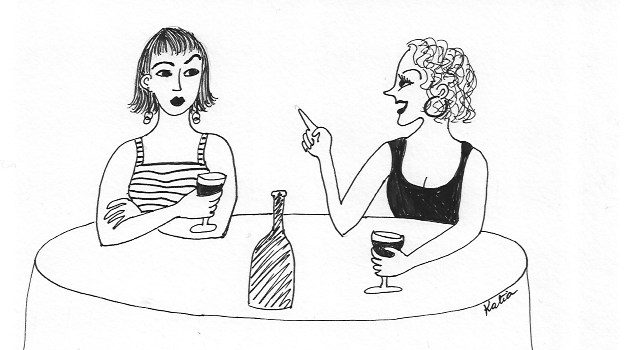
Within half an hour of arriving, I hear that Paul* is bipolar, Helena* left her husband for another man and Emily* has fallen out with all her children. Good thing I declined tea and cake or there’s no knowing how many more mutual acquaintances would have been stripped naked, so to speak.
This is a business meeting with a woman – let’s call her Anne – I barely know, so I wonder why she feels it necessary to volunteer this information that’s entirely irrelevant to the purpose of my visit. As politely as I can, I swerve the conversation back to the pre-arranged topic. Anne’s expression quickly changes from triumphant to ruffled. She clearly feels unappreciated and every time adds, “Don’t get me wrong, I’m very fond of [Paul/Helena/Emily]!”
Then why don’t you respect their privacy? I want to ask.
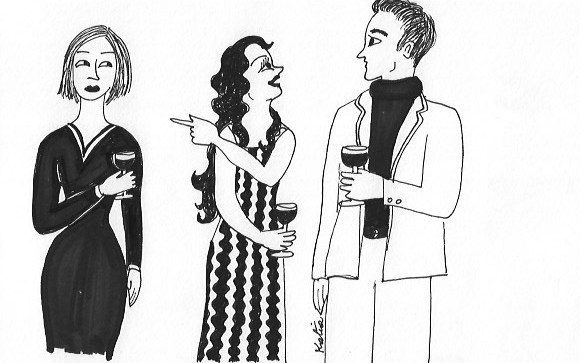
As it happens, not two months earlier, at a drinks party where Anne was also present, a man I’d never met before glanced in her direction and said to me, “Anne’s beginning to lose it. Honestly, I think she’s going gaga.”
I wasn’t in one of my more compassionate moods that day, so I said, “I’m sorry, I don’t think this is any of my business. Besides, she may not like your saying this to me,” at which point the man gulped his wine the wrong way, coughed and said angrily (as though I was the one out of order), “I mean it affectionately! Anne and I have been friends for years!”
With such friends, who needs enemies?
In my days as a theatrical agent, many, many moons ago, I was an avid listener and, when required, sharer of gossip. Gossip is the lifeblood of show business; a currency vital for survival in the profession. Which musicals casting director tends to pack the audition room with entirely unsuitable candidates, so that the director may immediately spot the two or three actors who stand out merely because they’re the best of a bad bunch, because they are the ones the casting director wants in the show. Which BBC casting director casually announced that he’d forgotten his wallet at home, expected the agent to buy him wine before the performance, during the interval and after the show had come down, left without so much as a thank you, let alone inviting any of this agent’s clients for a casting call. Which actor, all smiles and adoration when auditioning for a minor role, sat bitching about the director in the green room as soon as there was one bad review. Which producer of a long-running West End show threatened to withdraw the offer of a part from an actor as soon as the agent queried a clause in the contract. You owe it to your fellow thespians to share information that will help them watch their backs. This will come across as naive, but while working in the theatre, I never heard the kind of gossip that made me feel unclean, as though I had peeped through somebody’s keyhole.
Moreover, even outside the rarefied air of show business, London is a big, sprawling place, where the likelihood of two individuals meeting at a party knowing the same person could almost be called remote, unlike in a smaller city like, say, Norwich, where if you don’t know everybody, then you know somebody who definitely knows somebody who does. I am exaggerating to make my point.
In my early days in Norwich, I quickly learnt to be careful about what I said and to whom, because chances were the information would run up the grapevine like a ladder up a tight as soon as you snag it. Joking aside, many a time have I heard somebody proudly announce that they had heard about such an event occurring in my life, only the embroidery took up more space than the fact and I found myself wishing my humdrum existence really was filled with such colourful adventures and enviable achievements.
Seriously, why do people relish telling you they’ve heard something about you? Is it a display of power? Or a misplaced attempt at bonding? Surely, it’s much more flattering when a person chooses to confide in you.
When it comes to asking personal questions, I’d make Parsifal look nosey. My grandmother’s motto was Wait for people to tell you themselves. If they want you to know, they’ll tell you. And if you already know, then act as though you don’t. I don’t mean to suggest that I’m not interested in people. I am to a certain extent, but just as I hate other people prying into my business, I would feel somehow cheap if I questioned them about theirs. My friends and acquaintances would blush or laugh at the backstories and futures I embroider for them in my imagination. The crux is keeping schtum about it. I hate it when people show off their knowledge about my business. Not only does it feel intrusive, but it potentially deprives me of the pleasure of telling them myself.
There is gossip and gossip. A close friend telling me personal information about someone I may or may not know, because it’s relevant to his or her having had a tough day, is not something I would necessarily call gossip. People sometimes need to vent. For one thing, my friend knows that it will go no further. I guess the crucial difference is whether you’re sharing what you know or think you know about somebody else because you need to pour your heart out or because you’re hoping to entertain or, worse, appear clever or somehow important or powerful.
Seriously, with all the well-written books, fascinating television programmes, harrowing political news, satisfying cooking, thought-provoking art, etc., etc. – the list is endless – why on earth would you want to gloat about snippets of information about somebody else’s life?
One of my favourite scenes in John Patrick Shanley’s play Doubt is where Father Flynn give a sermon about gossip. He tells the story of a woman who confesses to her parish priest that she has gossiped and asks him to absolve her. The priest tells her to go home, take a pillow, slash it with a knife and shake it out of the window. She does as told then goes back to see the priest and this time he demands that she collect every single feather she has scattered. “It can’t be done,” she protests. “I don’t know where they went. The wind took them all over.” “And that,” the priest replies, “is gossip!”
* The names have been invented.