
(When You Really Don’t Feel Like It)
Introduction
“Norwich named as best place to live in the UK” (BBC, 20 March 2026)
“The historic city with a ‘small-town feel’ named the best place to live in the UK” (The Independent, 20 March 2026)
“Norwich named as the best place to live by The Sunday Times” (Norwich Evening News, 20 March 2026)
And the source, hiding behind a paywall, that started this: “Norwich, Norfolk, named best place to live in the UK 2026” (The Times, 20 March 2026)
For about two weeks, friends – even those living abroad – sent me links to similar articles. “Yes, I know, I know,” I replied. That is, I knew somebody had proclaimed the city where I live the most desirable residence in the United Kingdom. I did not know what had inspired this opinion – or whether or not it truly was the best place to live.
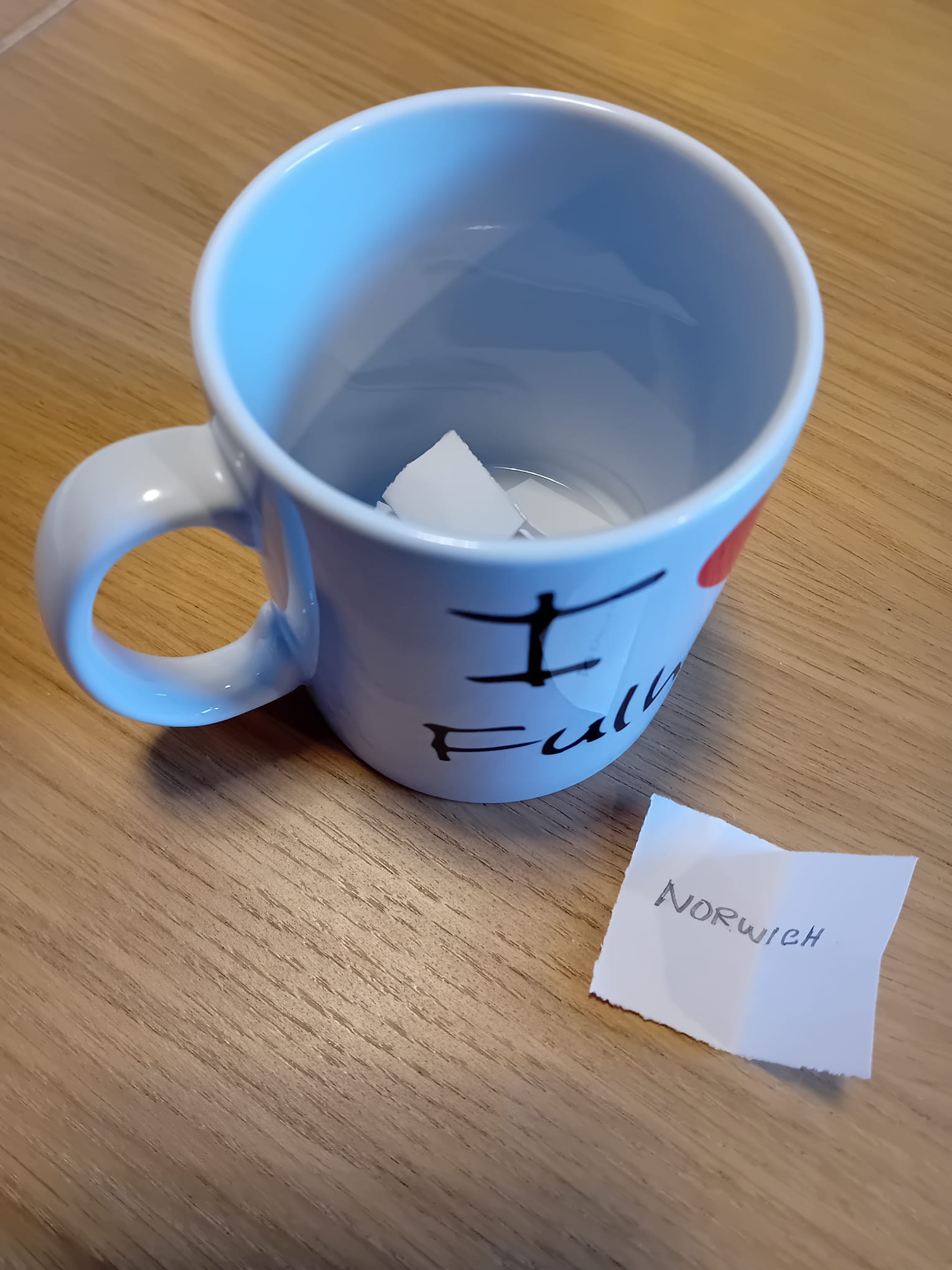
For me, it all started when I was still living in London, with writing Norwich on a piece of paper – a small rectangle, one of six identical ones, carefully folded into four. On the others, I scribbled Cambridge, Oxford, York, Norwich, London, Other. I dropped them all into a large mug, which I covered with the palm of my hand and shook. Then I closed my eyes, picked one and unfolded it. Norwich. And so I came here. On Shrove Tuesday 2013.
I had hit rock bottom in London, where I had lived since 1994 and assumed I would live for the rest of my life. My beloved London, my adoptive home. I had recently walked out of a teaching job where I was subtly bullied by my boss. I was still grieving the death of my cat, Genie, killed by an incompetent vet. My friends started to avoid my company. Nobody wants to be with someone who is unhappy, weighed down by too many problems. People are afraid the load will spread to them, drag them down and drain them, too. Despondency can be contagious. No one ever tells you that. Or else your friends hate feeling helpless and seeing you reminds them that they are failing to help you, and that’s an uncomfortable feeling.
“Don’t leave London,” the few friends to whom I voiced my plan told me. “If you run away from your problems, they’ll only come after you.”
There’s no copyright on platitudes.
Actually, running away can save your life. It can give you a new lease of life. Running is movement and movement dispels stagnation. Getting away to a new place can clear your head and give you a new perspective, a panoramic view of your journey thus far, a clearer understanding of the crossroads where you took a wrong turn. You cannot retrace your steps to that fork in the road and take a different path, but, from your new vantage point, you can head somewhere new. You can change your course. It’s a moment for finding your bearings after years of trudging in the same direction, hunched over, eyes on your feet. Taking stock of your life makes you stand up straight and look around, look ahead. Moreover, whatever therapists and self-help books may advocate about change coming from within you, it’s much easier – or at least less hard – to undertake this change when what is outside you changes first. It’s difficult to change – be it your attitude, your belief system or your thought patterns – if, day by day, it’s the same routine, the same job, the same colleagues, the same bus or Tube or train ride to work. Then, in your leisure time, the same friends and acquaintances who’ve known you for years and expect you to act in a particular way. You could say that once people have pigeon-holed you, they won’t allow you to break out of the mould, that they don’t like the image they have formed of you to be disturbed in any way. We all are creatures of habit. You also say that you are reluctant to alter your behaviour because you are anxious about potentially disappointing the people around you, and so losing their affection, their interest, their company. Their love. Isolation can be a frightening place.
When you move to a new place, everything and everyone is new, often unfamiliar. So you’re practically ejected from your old habits and forced to adjust to your new surroundings. You may try and act physically the way you recently did, but, before any changes even begin in your mind, your body – your best and closest friend, who never lies to you if you care to listen to it – takes the lead.
Change, whether you go looking for it or at least allow it to find you, begins on your first morning in the new place, when you get up and look out of the window. You have some – if not all – new reactions and, consequently, thoughts, because what you see through the window is new. In fact, even before you look out of the window, when you wake up on that first morning in your new place, your eyes open to the sight of different walls, different furniture, a different light and sounds. This unfamiliarity may be disconcerting at first, but it will put your senses on alert. You’re suddenly paying attention to the world around you instead of drifting through it mechanically. Maybe you eat a different breakfast, drink a tea that tastes different. Then you step out into the street and walk past different buildings, architecture, colours. You stroll past different shop windows. All this newness inevitably affects your physical senses, consequently your body, your body goes on to affect your mood and your mood affects your thoughts.
Eventually, you meet new people who don’t know you, so don’t assume or expect you to speak or act or think in any particular way. You’re not obliged to play the part you’ve been playing on cue for years. This is your chance to choose how you react and respond to external stimuli. Your chance to reinvent yourself. By “running away” you have gifted yourself this precious, golden opportunity. For many, it can be the opportunity of a lifetime. A new leaf on which, instead of doing the same old lines, over and over, and over and over again, you can create new writing, you can create yourself a new story.
To be continued…
Discover more from Scribe Doll
Subscribe to get the latest posts sent to your email.


Thank you!
Here’s to change (which is so much more difficult than it should be)! I’m looking forward to the next installment….
Thank you for commenting. I’m glad my piece spoke to you!
Yes, yes, yes! While changing locations mainly in order to leave your problems behind is less likely to succeed (as the adage notes), changing locations to get a new angle on things is almost a slam dunk, as your observations attest. Sometimes a good vacation shakes things loose enough to do the trick, but there are times when nothing short of complete reorientation is necessary. 🙂
Thank you, Sue. More to come…
Thank you, Annette!
Ah, starting over is bittersweet! Looking forward to part two!
Loved this. It takes courage to make such dramatic changes.
Thank you so much – for liking it, for taking the time to comment and for encouraging me!
“There’s no copyright on platitudes”
Brilliant! Neither is there an expiration date.
I can agree with you about the positive impact of physically changing your space because I did the same thing, changing coasts after an entire life time spent in one limited geographical area. Truly one of the best decisions I ever made. I can’t wait to see how your story unfolds and I am so sorry about Genie.
Thank you, Pierre! Such a wonderful compliment, give how talented you are.
I do so enjoy receiving these Katherine 🙂
http://www.authorpierredurand.com