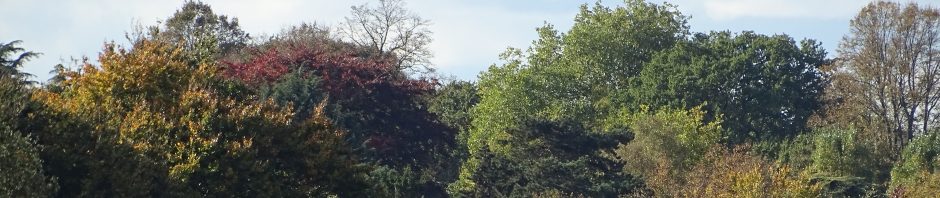
“I need a new tree friend,” I say to S. “A tree like my oak Merlin, outside my window in Wimbledon.”
My new friend S. is a children’s and young adult fiction writer. She doesn’t find anything odd or unusual about a middle-aged adult being friends with a tree, or, for that matter, that the tree should be called Merlin. She takes a sip of coffee. “Have you tried Lion Wood?”
“It’s too far to walk and up that steep hill,” I reply. “I need a tree nearby. Somewhere I can get to easily and say hello whenever I feel like it, without it becoming an expedition.”
Through her rimless glasses, S.’s blue eyes look sideways, to that corner of her mind where she probably stores her list of suitable trees. I know she’s making a mental note to find me the perfect rooted confidant.
I’ve been within easy reach of one specific, special tree, for most of my adult life. In Cambridge, it was the copper beech watching over Leckhampton Gardens, and the canopy – practically a tent – offered by the trailing branches of a weeping willow. In London, there was the wise cedar of Lebanon in Bishops’ Park, and, later, in Wimbledon, my room looked onto a large, powerful oak. It was a tree with stories and insight. Merlin. I don’t know why Merlin. The name just kept popping into my head whenever I looked it him. Him. Because, for some reason, to me he was unmistakably a he. On the night of St Jude’s Storm, I went to bed with the certainty in my heart that he would not crash against my windows, that he would keep me safe. And he stood sturdy all night.
*
H. and I were strolling in the Cathedral precinct, a few weeks ago, when I suddenly stopped in my tracks. “There it is!” I said.
H. also stopped and looked around. “There what is?”
“My tree!”
“Your tree…”
“Look! There! Straight ahead.”
H. accepts, with infinite patience and warm indulgence, that I was born with a certain amount of madness, so did not query my use of the possessive pronoun but followed my pointing finger with his eyes. “Wow. That is impressive,” he admitted.
 Before us, at the back of the Cathedral, beneath the flying buttresses, the most majestic of trees. A cedar of Lebanon. Tall, dark green, sprawling, some of its branches trailing on the grass, with round cones bobbing gently in the wind. Alive. Very much alive. I slowly approached, took off my glove, and stroked its needles. His needles. Immediately, I felt many eyes turn towards me, watching me, studying me. Quizzical, wary, judging, alert. A chubby, pale green chiffchaff. A couple of blackbirds. A sparrow. Wood pigeons. And all the eyes I felt upon me but did not see, could never see with my eyes. Chirping, whistling, tweeting, cooing. Who is she? Friend or foe? What are her intentions? Shall we allow her into our world? And then there were all the voices I could never hear with my ears. Among them, a deep, booming voice. A bass baritone full of warning but also promise. A warning against contempt, a promise of reward for honour. I couldn’t hear it, and yet I knew it was there. The voice of the tree. I leaned against the trunk and ran my fingers on the bark. His bark. A name suddenly resounded through my chest. An ancient name. S –. What was that name? Yes, it definitely starts with an S, I sensed again, the healing power of the tree penetrating my hands and my back. Tremendous power. The kind of power whose respect you long to earn, whose friendship you want to deserve. And a storyteller tree, custodian of mysteries, of knowledge. A keeper of secrets.
I wonder how old it – I mean he – is.
*
I text our friend J., who is a tree surgeon. “Are you acquainted with the cedar of Lebanon at the back of the Cathedral? Do you know old it is?”
He replies, “Measure its girth. One inch for every year.”
I take the tape measure from my sewing basket, and recruit H.’s help. 184 inches. One hundred and eight-four years? It looks older, given its size and sprawl. I try asking the Cathedral staff. They don’t know. “Ask one of the guides,” they say. “If it’s a historical tree, one of the guides is bound to know about it.”
I suppress a snort. A “historical” tree? Aren’t all trees historians, record-keepers of man’s fleeting visits?
*
“Let’s go and visit S –,” I say to H. after breakfast this morning.
“That’s an excellent idea,” he replies enthusiastically.
As we approach the cedar of Lebanon, as always, I find myself slowing down, stepping with caution, with deference to his awe-inspiring majesty and gravitas.
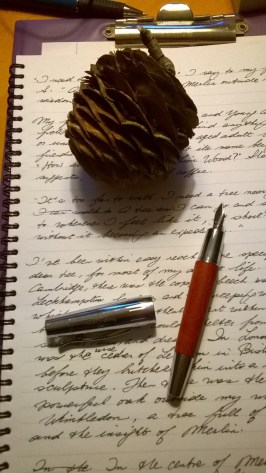 I get it into my head that I would like a cone. In all the times I’ve come, I’ve never seen one lying around. I ask politely. Suddenly, I am convinced that I will be given one today. I start walking slowly on the soft carpet of needles beneath the sprawling branches. Nothing. I am surprised, given the recent gales. Perhaps after the next gust of wind.
There it is.
I pick it up.
Thank you, S –.
I hold it gently as I take it home and place in on my work table. It has a wonderful smell of resin. It’s beautiful.
It’s perfect.
Thank you.
Scribe Doll
 Scribe Doll